
Recording paper notes by @chongzzzhang who is interested in robot learning
busy with paperwork recently
Joined March 2024
- Tweets519
- Following1
- Followers3.4K
- Likes14
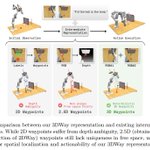




C's Robotics Paper Notes retweeted

arxiv.org/pdf/2609.08511v1
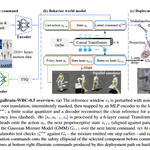
PGMT is probably the best tracking paper I've seen. It can walk on stairs or a 40cm box while tracking ref, without modifying the flat ground reference.
No reference-terrain adaptation, cheap training. The model arch design is the key and is very smart.

C's Robotics Paper Notes retweeted
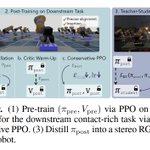
New paper release: Learning Agile Perceptive Traversal of Sparse 3D Structures for Humanoids
Paper arxiv.org/pdf/2608.29769
Videos nemantor.github.io/sparse-3d…
We study how to do learning and sim2real for 3d traversal, such as monkey bars and overhanging obstacles.
C's Robotics Paper Notes retweeted
There is another interesting parallel work from Stanford:
arxiv.org/abs/2412.09989
also learns disturbances, and uses learned RA values for shielding. The diff is they use reduced-order model to generate GT reachability values for supervision, while we bootstrap with full model.

C's Robotics Paper Notes retweeted
It might be a bit late but here's our work in L4DC 2025 on bridging agility, safety, and adaptivity.
Compared to prior work (ABS) that safeguards agile locomotion, this one further explicitly estimates the change in dynamics and does adaptive shielding.
adaptive-safe-locomotion.git…

C's Robotics Paper Notes retweeted
Refactored my collection repo of papers on biped locomotion learning (github.com/zita-ch/bipedal-r…).
I separate the papers into the different categories: Balance (named after Legged Robots That Balance), Adaptation (POMDP), Skillful, Human2Humanoid

C's Robotics Paper Notes retweeted

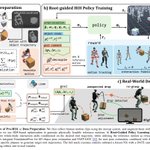
🚨 Without Any Motion Priors, how to make humanoids do versatile parkour jumping🦘, clapping dance🤸, cliff traversal🧗, and box pick-and-move📦 with a unified RL framework?
Introduce WoCoCo:
🧗 Whole-body humanoid Control with sequential Contacts
🎯Unified designs for minimal tuning across tasks
🤖Generalize to various high-DoF robots
Website: lecar-lab.github.io/wococo/
C's Robotics Paper Notes retweeted

Introduce OmniH2O, a learning-based system for whole-body humanoid teleop and autonomy:
🦾Robust loco-mani policy
🦸Universal teleop interface: VR, verbal, RGB
🧠Autonomy via @chatgpt4o or imitation
🔗Release the first whole-body humanoid dataset
omni.human2humanoid.com
C's Robotics Paper Notes retweeted
youtu.be/egQq9bRwqW4?feature…
you can manually add spring to your robot even when the company doesn't provide that
C's Robotics Paper Notes retweeted
mbrl + first order for legged locomotion learning: how contact reduces gradient accuracy and how to fix it.
sim only though


C's Robotics Paper Notes retweeted

RL controllers for quadruped locomotion are great but black-box. Are they safe enough? Our work in #RSS2024 reveals the risk of small noises and low-frequency velocity commands falling SOTA controller, which helped win DARPA SubT Challenge, even on the simplest flat terrain.
C's Robotics Paper Notes retweeted

one of the most important things I know about deep learning I learned from this paper: "Pretraining Without Attention"
this what I found so surprising:
these people developed an architecture very different from Transformers called BiGS, spent months and months optimizing it and training different configurations, only to discover that at the same parameter count, a wildly different architecture produces identical performance to transformers
this may imply that as long as there are enough parameters, and things are reasonably well-conditioned (i.e. a decent number of nonlinearities and and connections between the pieces) then it really doesn't matter how you arrange them, i.e. any sufficiently good architecture works just fine
i feel there's something really deep here, and we may be already very close to the upper bound of how well we can approximate a given function given a certain amount of compute. so we should spend more time thinking about other questions, such as what that function should actually look like (what data? which objective function?) and how to make it more efficient

C's Robotics Paper Notes retweeted
Our works (Human to Humanoid and Agile But Safe) are featured by IEEE Spectrum Video Friday! @TairanHe99 @_wenlixiao
Twice within a month as the cover videos -- thanks for sharing!
spectrum.ieee.org/video-frid…
spectrum.ieee.org/video-frid…