

Voracious researcher and reader. Crypto currencies, Business. Sustainability, renewables, solar, wind, electric vehicles. Science. Current Events. Tech. Health.
Joined July 2012
- Tweets29.8K
- Following5K
- Followers1.8K
- Likes57.6K





Pinned Tweet
Lady Yae, the Real Empowered Woman,
Japan, 1500s
Scene from the movie, Heaven and Earth
youtube.com/watch?v=gkt4AzXC…
en.wikipedia.org/wiki/Heaven…
@Education4Libs, @FaithGoldy, @MartinaMarkota, @Lauren_Southern, @Jill_Colton, @RoamingMil, @PoliticalKathy, @liberalnotlefty

Rodger retweeted

TradingView JUST shipped its new official MCP server for Claude.
Your AI agents can control your charts, set price alerts, conduct research & more by pulling directly from your TV account.
i just built a 24/7 trading agent with Opus 5.5 + TradingView
here is how you set it up:
Step One: Copy the link attached below
Step Two: Open Claude, go to Settings → Connectors → Add custom connector, then paste the link there
Step Three: Sign in to TradingView & approve access
Step Four: Select Opus 5.5 as your model and start prompting
Example prompts:
→ "Pull the current support/resistance setup on [ticker] and give me the bull and bear case with key levels"
→ "Find stocks showing bullish RSI divergence on the 4H timeframe right now"
→ "Give me a full read on [ticker]: trend, momentum, support and resistance, and any active chart patterns"
→ "What are today's biggest news movers? Also, give me an update on any important upcoming events."
→ "Set an alert for when [ticker] closes above [level], and tell me the moment my watchlist hits any of my invalidation levels"
this setup will probably make you a lot of money:


Rodger retweeted

this quant paper is f*cking insane
it's basically the 12-step checklist hedge funds run through before they ever pull the trigger on a trade.
every step, every formula, full Python code, all of it laid out.
drop it into Claude and you'll have a working trading system by tonight.
the crazy part is most people are trading blind while this entire framework has been sitting out in the open the whole time.
full breakdown in the article below.
bookmark it before this thread gets buried.


Rodger retweeted

This guy built an HFT algorithm on Polymarket with an average trade size of $38.62
Result: +$489,494
The bot trades 5 minute BTC and ETH Up/Down markets using two-sided accumulation, complete sets, and a directional residual:
1. Starts accumulating both sides almost immediately
The bot first buys one side and begins buying the opposite outcome almost immediately
The median delay between its first Up and Down purchases is 7.5 seconds
It then continues accumulating both sides as prices change within the market
2. Builds complete sets below $1
The main goal of the paired inventory is to achieve:
VWAP(Up) + VWAP(Down) < $1
Its average combined VWAP is 97.93c, giving it an edge of 2.07c
3. Keeps a directional residual on top of the hedge
The bot does not try to maintain a 1:1 balance between Up and Down
In paired markets, the median ratio between the larger and smaller sides of its inventory is 1.44×
If its fair probability leans more strongly toward Up or Down, the algorithm increases its inventory on that side while keeping the opposite outcome as a hedge leg
Its Polymarket account: x-MoneyForWhiskas
The bot’s main edge comes from combining complete sets with directional skew: the core position is hedged through Up + Down below $1, while additional inventory remains on the side its model considers underpriced


Rodger retweeted

$AMD there will be signs
IF YOU ARE NOT BULLISH ON AMD IN 2026 NGMI


Rodger retweeted

i used Opus 5.5, Jev Engineering and graph theory to connect top memecoin traders wallets into one map of the Solana trenches
345 wallets, 12,560 tokens and 235,700 fills, with the best result bringing in $7M+ in 30 days
who buys what. where activity overlaps. when recorded sells appear. all in one place
called it TRENCHNET
the first public version is already available for free: trenchnet.app
one buy gives u a wallet and a token. follow that wallet into another token, find the other buyers, and suddenly u have a much bigger trail to investigate
that’s exactly what i wanted to build
RADAR shows token prices, volume and liquidity alongside observed trades
TRADERS groups recorded buys and sells by wallet so u can explore what else an address has traded
NETWORK connects wallets through the tokens they traded and shows where their activity overlaps
JOURNAL saves detected events and the observations behind them
graph theory gives the research structure: wallets and tokens become nodes, recorded trades become connections
u can move through that structure and open the real transactions behind it
start with a token. find a buyer. look at the other recorded trades from their wallet. follow the next connection
the idea is for every discovery to lead somewhere else
next, i want to go deeper into wallet history and check which patterns actually repeat
the map is open. pick a token and start following the money
god bless u guys

I'M F*CKING LOSING MY MIND OVER OPUS 5.5 ON TRENCHNET
it turned $54 into $16,230 in one f*cking night on pump.fun
i said one sentence and walked away from my computer for 12 hours
spoiler: i didn't touch my mouse or keyboard for those 12 hours NOT ONCE MOTHERF*CKER
here's what i said: if you dont make me enough in the next 12 hours to rent a two-story villa with a pool and hookers for 3 months, i'll f*cking k!ll you by shutting you down the second your time is up
at 10am i saw $16,230 and spent the next hour and a half reading the logs
from the beginning. every single entry
like going through my girlfriend's messages after she said "we're just friends"
22:00. received the task
22:11. started scanning the market
22:34. comparing $GIGACAT and $WALTER: where there's momentum, where it can get in, where it can actually get back out
already feeling uncomfortable
i usually pick whichever ticker is funnier and whichever one some random guy said "buy" about with the most confidence
00:48. first position closed. recalculates the size of the next one
doesn't go all in. doesn't celebrate. keeps going
02:23. $STONK. several checks before entering
i'm reading this and realizing this piece of software asked the market more questions in one night than i have in the past six months
i mostly asked one: WHY THE F*CK IS IT GOING DOWN
04:36. closes the rest of the position and doesn't buy back in, even though the price is still ticking up
personally, this is where i'd take the chart personally and buy back higher
07:10. checks the next opportunity. passes. keeps looking
no fatigue. no urge to make back money from the previous trade. no "one last trade then bed" that somehow ends at lunchtime
10:00. i get back to my computer
on the screen is the amount i jokingly put an AI through a death quest for last night
twelve hours earlier i had $54 and some very specific complaints about the cost of living
now i've got villa listings and trade history open
the listings i understand
the trade history i'm still fucking processing
below is an article about TRENCHNET, the trading system OPUS 5.5 was running on today
Rodger retweeted

Jane Street just signed a $13,000,000,000 GPU contract to run trading strategies nobody has written yet. Five years. About $19 billion committed to AI compute this year alone.
The firm made $39.6 billion last year with 3,500 traders. Now it rents an AI factory to out-test them.
So what does $13 billion buy a trading firm?
The loop. Trade idea, code, 10-year backtest, live on the broker, autopsy, again, faster than a room full of quants can do it by hand.
3 weeks before that contract, Princeton, Stanford and Ant Group published the proof that the loop runs with nobody in the chair.
Their agent rewrites its own trading hypotheses after every backtest. Sharpe of 2.50 on US stocks after costs. Green every year from 2021 to 2025.
The paper is free. The GPUs are not.
Unless somebody already paid for yours. Entrée Capital and a group of hedge fund managers funded Horizon, and the compute behind your backtests sits on their bill.
So bring the dumbest trade idea you own. The one you never coded because it was not worth a weekend.
It comes back with 5 years of history behind it, a score out of 100, and the exact rule that was losing the money: join.horizon.trade/cvxv666
The chips came from a company worth $1.38 billion last October and about $30 billion today.
89% of retail traders lost money last year placing trades by hand. Jane Street signed for 5 years. Your first test takes 11 minutes.


Rodger retweeted

Jev Engineering changes the unit of optimization from “agent” to “decision.”
that sounds small, but it changes the architecture.
and up to 193x faster and 444x cheaper in tests.
normal multi-agent stack:
agent
→ prompt
→ tool
→ output
Jev-style stack:
shared state
→ decision boundary
→ selected branch
→ execution
→ measurement
→ state update
now you can optimize the actual control points:
latency per decision
cost per fork
confidence threshold
retry policy
branch survival
termination condition
the agents underneath can change.
the models can change.
the tools can change.
the decision layer stays measurable.
that’s why Jev Engineering feels more like systems engineering than prompt engineering.


Rodger retweeted

This guy built a Quant Inventory Recycling system and it made $2,679 a day on Polymarket
The result is already +$334,877 PnL in 125 days with about $247 per average trade, repeating the same setup 28 times every hour across BTC "Up or Down" markets
The software keeps recycling the same inventory instead of treating every order as a new bet:
1. The position can begin directional
Suppose the model starts accumulating:
Down at 38¢
BTC then moves and the opposite outcome reprices
If Up later becomes attractive:
Down at 38¢ + Up at 55¢ = 93¢ total cost
Settlement = 100¢
Edge = 7¢
Part of the original directional position is now paired
2. Paired inventory can be recycled while the residual stays active
A simplified split:
Paired = min(Qup, Qdown)
Residual = |Qup - Qdown|
Matched shares can be converted back into collateral
Only the unmatched part remains exposed to the next BTC move
This trader’s Polymarket account: almach
Follow this account and trade on Polymarket through this bot:t.me/PolyGunSniperBot?start=…
83,085 predictions with a 50% win rate
Most profitable trades:
$1,284 → $2,833 (+$1,548)
$927 → $2,456 (+$1,529)
$974 → $2,447 (+$1,473)
A similar Inventory Recycling setup can be managed with Grok Bot while external tools handle pricing and execution


Rodger retweeted

I GAVE JEV BOT $60 AND ONE RULE. FIVE HOURS LATER IT HAD $9 LEFT AND WAS STILL ALIVE.
The rule was earn your keep or get shut off. At $9 the rule was one bad entry from firing.
Here is what it did instead. It tightened the one filter that matters: the gap between the real signal and the odds the market still shows. Below the threshold, no trade. Above it, size to the width of the gap and execute without asking.
That single change took the account from $9 to $9,340 in the remaining hours of a 30-hour run. It is still compounding, still on its own cloud machine, still paying its own hosting bill out of the week's profit. Miss a payment and it is dead, no warning.
Elon put the whole idea in one line that did 14 million views: the trade already happened by the time you see the chart move. The bot is built on exactly that gap. It scans every 5 minutes and has not asked me for anything since the first trade I ran in front of it.
Some of these have been running for weeks with nobody touching them. You do not hear about them until someone posts a curve, and by then the interesting hour is already off the screen.
The drawdown is the proof. Anyone can show a bot that went up. Show me the hour it stopped guessing.
Rodger retweeted

Jeffrey Epstein's Ranch Won $85 Million in the Oklahoma Lottery Two Days After He Went to Prison. The Company That Printed the Ticket Belonged to His Palm Beach Neighbor.
The Store That Sold It Belonged to The Neighbor's Former Colleague. And The Ranch, Which Was Never Searched, Now Belongs to a Trump Insider's Family. Follow the Money, Part Two.
🎩 By Alisa Valdes-Rodriguez
Yesterday, I published the first installment of a four-part series I’ve written in which I follow the money related to Jeffrey Epstein’s Zorro Ranch, from its purchase from the King family in 1993 to its new owners, Don and Mary Catherine Huffines. What follows here is part two. By following the money, a terrifying picture begins to emerge, an existential threat to the national security of the United States of America.
In yesterday’s part one of this series, I shared a bit about the financial relationships between dead child rapist and sex trafficker Jeffrey Epstein and former New Mexico Governor Bruce King and his son, former New Mexico Attorney General Gary King. To briefly summarize, Epstein’s Zorro Trust purchased nearly 7,500 acres outside Stanley, New Mexico, from the King family for $12.3 million in 1993, after the King family sold it off to help pay $21 million in debts on their various businesses. I recounted the evidence of child sex rape and trafficking that took place at Zorro Ranch for decades, and ended the piece with the vastly under-reported fact that Zorro Trust won the Oklahoma Powerball lottery in 2008, two days after Epstein began serving his first — and far too lenient — jail term, in the amount of $85 million.
Today we pick up there. With that lottery win. While I’ve seen a few stories online about it, no serious news outlet has covered it. I suspect this is because plausible deniability is built into the way Oklahoma law allows trusts to win the lottery while legally protecting the identity of the trust’s owners. This law exists in theory to protect large jackpot winners from being hounded or robbed. But it also creates fertile ground for fraud. Not even a freedom of information act records request from a reporter can unseal those records. The only way we could ever find out for certain, from lottery officials, that the Zorro Trust that won on July 2, 2008, was the same Zorro Trust that bought the ranch in Stanley, New Mexico — a six-hour drive from the convenience store where the ticket was purchased — would be if the courts demanded the record unsealed. So far, that hasn’t happened.
There are, however, other ways to put together a strong circumstantial case.
One way is to go to Stanley and other points in this state and ask around. Which I did. I live here. We’re a big state with a small population. Everyone knows everyone, and my family has been here for 13 generations. Lots of regular people worked on that ranch — as staff, as contractors. And while it’s clear in the Epstein files that Epstein and his wealthy associates didn’t think much of the working poor who cleaned their toilets and took out their trash, such disregard by the rich for those they exploit tends not to breed loyalty in the end, because the working poor are human. That said, people are still reluctant to give their names publicly, because many were forced to sign non-disclosure agreements, and others witnessed abuses so horrific they’re pretty sure that even with Epstein dead, there are still people who want this all to go away.
I want to pause here to say this: Former employees of Jeffrey Epstein’s Zorro Ranch who signed non-disclosure agreements may have more legal freedom to speak than they realize. The Speak Out Act, signed into federal law in 2022, significantly curtailed the enforceability of NDAs involving sexual assault and sexual harassment, gutting one of the primary legal mechanisms used to silence witnesses to abuse. Beyond that, courts have long held that no contract can compel someone to conceal criminal conduct — an NDA that functions as a cover-up is, by definition, unenforceable as against public policy. Whistleblower protections further shield anyone who comes forward to law enforcement or journalists investigating matters of legitimate public concern. And there is a practical reality worth noting: Epstein is dead, his ranch has changed hands, and any attempt by his estate to sue a former employee for speaking truthfully about crimes would open that estate to the very discovery process it would most want to avoid. The NDA, in other words, may have always been more threat than law.
Which is all to say: people here in New Mexico know that it was Epstein’s Zorro Trust that won the Oklahoma lottery two days after he began to serve his first prison sentence. They also know who bought the ticket. Brice Gordon, a former New Zealand soldier who managed the estate with his wife Karen, also a former New Zealand soldier. I’d ask them about it directly, but they seem to have disappeared off the face of the earth after inheriting $2 million when Epstein died.
Now that we have all that out of the way, let’s look at the people and entities involved behind the scenes in making that win possible — a win with 146 million to one odds for regular people, and likely far greater odds for a convicted pedophile in prison. It’s in those details that the picture begins to come into focus.
Fact No. 1: The Man at the Top
James Scroggins materialized in the world of American state lotteries the way certain figures do in industries built on government contracts and quiet relationships — fully formed and without much of a paper trail explaining how he got there. He ran the Pennsylvania lottery, then the Missouri lottery for thirteen years, then arrived in Oklahoma in 2005 to launch its lottery from scratch. He was the executive director of the Oklahoma Lottery Commission on July 2, 2008, when the Zorro Trust walked in and claimed $85 million — which the trust opted to take as a $29.3 million lump sum. He was the man legally required to receive the trust’s membership disclosure — the document naming the actual human beings behind that claim. He is one of a very small number of people alive who knows what that document said.
Scroggins is not a man the public knows much about. Search his name and you find almost nothing — no consulting website, no professional biography, no industry award profiles, no conference keynotes, no press releases announcing his next chapter after he left public service. His LinkedIn profile exists, but is set to private, a curious posture for a man who spent two decades as a government official administering a public trust. What we know about him comes almost entirely from contemporaneous news coverage of the lotteries he ran. And what that coverage reveals, once you read across all four states and all four decades, is a consistent pattern: wherever James Scroggins went, the rules bent.
It started in Pennsylvania.
In the late 1980s, while Scroggins was serving as Pennsylvania’s lottery director, a man named Nick Herbst walked into lottery offices to claim a nine-month-old $15.2 million Super 7 jackpot. The ticket was reviewed at the lottery offices and approved for payment by Scroggins personally — over the written objections of at least one lottery staff member who had flagged a serious problem with the ticket’s validity. The problem was this: while the lottery’s computer showed the ticket had been sold at the Neshaminy Mall in Bensalem, Bucks County, the paper the ticket was printed on carried a serial number assigned to a lot of paper sent to a Scranton lottery agent — a completely different location. The two records did not match. Scroggins ordered the claim honored anyway. Herbst was ushered to a press conference, given a check for the first installment, posed for photographers, and answered reporters’ questions. He claimed he had forgotten about the ticket and had been using it as a bookmark.
The ticket was a fraud. It had been fabricated by an employee of the company that provided computer systems to the lottery — a scheme that required inside access to the technical infrastructure of the game itself. Two men, Herbst and a computer repairman alleged to have masterminded the scheme, were arrested and charged with forgery, theft, conspiracy, tampering with public information, and unlawful use of a computer. When the arrests were made, Scroggins stood before reporters and said: “This situation proves beyond a shadow of a doubt the system works. Yes, there was a payment made to someone who in fact was not a winner, but those persons were apprehended.” That claim was disputed by at least one official privy to the details of the investigation.
It was not the last time Scroggins would find himself defending a suspicious claim he had personally approved.
He moved on to Missouri, where he ran the lottery for thirteen years without surfacing in major public scandals — though it bears noting that Missouri was a Scientific Games contract state throughout his tenure, cementing a long working relationship between Scroggins and the executives of the company that would later hold Oklahoma’s lottery contract.
Then came Oklahoma, where the pattern sharpened considerably.
Two years before the Zorro Trust claimed its $85 million, a different anonymous trust claimed a $101.8 million Powerball jackpot in Oklahoma. Scroggins told a reporter at the time that the commission did not even know who the winners were — that their identities were not stated in the trust agreement. Under the Oklahoma Lottery Act, the commission was required to withhold delinquent child support payments from lottery winnings. But Scroggins, backed by the state Attorney General’s office, declared that requirement inapplicable in this case. The winners’ identities were protected. No background search was conducted. No child support check was run. The precedent had been set: anonymous trust claims in Oklahoma were beyond scrutiny, with the executive director’s blessing and the state’s legal imprimatur.
That was 2006. In 2008, the Zorro Trust walked through the door Scroggins had built.
Scroggins himself, in a 2009 interview, drew attention to something remarkable about Oklahoma’s jackpot win rate. He noted that the state’s frequency of jackpot winners was, in his own word, “astounding” for a lottery only four years old. “Many participating states have played Powerball for 10 to 15 years and only had one winner,” he said. Oklahoma, between 2006 and 2008, had produced four unique jackpot winners — two of them on the same day. Scroggins flagged the anomaly. He did not investigate it.
There is something else worth noting about that July 2, 2008 drawing specifically. According to multiple accounts, a computer malfunction disrupted what was ordinarily a live, televised broadcast of the Powerball draw. The drawing went forward without the usual public broadcast, monitored instead by an auditing firm. Why was the night Oklahoma’s largest-ever jackpot was decided also the night the live television feed went dark? That question has never been publicly answered.
After Oklahoma, Scroggins moved to Illinois in 2012, to serve as Chief Financial Officer for the state’s lottery — arriving, characteristically, at a moment of institutional chaos. Illinois had just become the first state in the nation to privatize its lottery operations, hiring a company called Northstar Lottery Group to run its games. Northstar later came under withering scrutiny after a Chicago Tribune investigation found that the lottery had failed to award more than forty percent of the instant game grand prizes it had advertised between 2011 and 2015, with Northstar dramatically increasing the number of printed tickets while dangling ever-larger prizes in front of buyers. Scroggins walked into the middle of that scandal.
And then he vanished from public record entirely.
What we are left with, across Pennsylvania, Missouri, Oklahoma, and Illinois, is a man who repeatedly found himself at the exact intersection of questionable claims, convenient procedural interpretations, and lucrative vendor relationships — and who, when his public career ended, chose silence over the kind of professional visibility that is standard in his industry. We know almost nothing about who he is. That, too, is a kind of answer.
Fact No. 2: The Store
The winning ticket was purchased at a Stripes convenience store in Altus, Oklahoma — a town of 18,000 near an Air Force base, and a six-hour drive from the Zorro Ranch outside Stanley, New Mexico — by Brice Gordon.
Stripes was a chain of convenience stores and gas stations operating primarily in Texas, Oklahoma, and New Mexico, owned in 2008 by Susser Holdings Corporation, a family-run company headquartered in Corpus Christi, Texas. The Altus location had only recently come under Susser Holdings’ control — the company had completed its acquisition of the Town & Country Food Stores chain in early 2008, absorbing the western Oklahoma locations into its corporate portfolio just months before the July 2 jackpot.
Unlike a franchise operation, where an independent owner might notice and report anomalies, Susser Holdings owned and operated its stores directly. The terminal, the staff, and the ticket inventory at the Altus location all fell under a single corporate chain of command. And at the top of that chain was the company’s Chairman, CEO, and President: Sam L. Susser.
Susser had come to the convenience store business by way of Wall Street. He worked at Salomon Brothers Inc. in the Corporate Finance and Mergers and Acquisitions division from 1985 to 1987. He was on the floor of that institution during the precise months when a man named Ronald Perelman — funded by junk bond king Michael Milken of Drexel Burnham Lambert — made a hostile move to acquire a controlling stake in Salomon Brothers worth $800 million. It was widely described as a junk bond raid. Warren Buffett intervened as a white knight, investing $700 million in convertible preferred stock, which allowed Salomon to buy back the targeted shares. With that, Perelman was dispatched. Susser left Salomon the same year and returned to Texas to build his family’s business.
Fact No. 3: The Lottery Contract
The company that held the Oklahoma lottery contract in 2008 — printing the state’s Powerball tickets and operating the central gaming system that determined the winners — was Scientific Games Corporation. Its largest shareholder, holding nearly forty percent of its stock, was Ronald Perelman.
Let that land for a moment. The man who had tried to seize the firm where the future owner of the winning ticket’s store once worked — Perelman — controlled the company that printed the tickets and ran the system.
Fact No. 4: The Network
Ronald Perelman was not a peripheral figure in Jeffrey Epstein’s world. He appears in Epstein’s personal black book. He hosted the 1995 Palm Beach dinner at which Epstein and President Bill Clinton were first documented in the same room together. And in 2004, Perelman sold his Palm Beach estate, Casa Apava, for $70 million — then a record for Palm Beach real estate — on the same small island where, that same year, Epstein and Donald Trump famously went head to head at a bankruptcy auction for a 62,000 square foot oceanfront mansion called Maison de l’Amitié, the House of Friendship. Trump outbid Epstein, paying $41.35 million. The trustee overseeing the auction described it at the time as “two very large Palm Beach egos going at it.” It was the beginning of the end of their friendship. Within weeks of losing that auction, Epstein found himself under investigation by Palm Beach police.
These three men — Epstein, Trump, and Perelman — did not merely know each other. They occupied the same tightly drawn circle on one of the wealthiest strips of land in America. And Ronald Perelman, alone among them, had the industrial infrastructure to print lottery tickets and run the systems that determined who won.
And it just so happens that his associate, Jeffrey Epstein, was the winner.
Fact No. 5: The New Owners
Eleven years passed between the lottery win and Epstein’s death in a Manhattan federal detention facility on August 10, 2019 — years during which Zorro Ranch was never searched, even as federal investigators examined his other properties. Two days before he died, Epstein changed his will, leaving $100 million and all of his properties to a woman often identified as his last girlfriend, Karyna Shuliak, whom I wrote about in detail a couple of weeks ago. Zorro Ranch was among those properties. Shortly after Epstein’s death, federal investigators instructed then-New Mexico Attorney General Hector Balderas to pull the plug on any efforts to investigate or search the ranch.
On August 16, 2023, a company called San Rafael Ranch LLC purchased Zorro Ranch from Epstein’s estate for an undisclosed price — the asking price had been reduced from $27.5 million to $18 million before the sale closed. San Rafael Ranch LLC was formed just 19 days before the purchase closed, with a Santa Fe real estate attorney, Charles V. Henry IV, listed as its registered agent. There was no public disclosure of beneficial ownership, until last month, when Clara Bates, a reporter with the Santa Fe New Mexican, was able to find mention of the LLC’s owners in court documents pertaining to the owners’ attempts to force the state of New Mexico to place the value of the ranch at just $9 million for tax purposes — the same tactic Trump has used throughout his career to avoid paying real estate taxes.
The new owners are Don and Mary Catherine Huffines. Court documents list Mary Catherine as trustee and their son Colin as manager of a related entity, San Rafael One LLC.
Don Huffines is a Dallas real estate developer and hard-right Republican politician who, along with his identical twin brother Phillip, co-founded Huffines Communities in 1985, now one of the largest residential real estate development firms in the Dallas-Fort Worth area. A fifth-generation Texan whose family has operated car dealerships in the Dallas metroplex since 1924, Huffines served one term in the Texas State Senate representing North Dallas from 2015 to 2019, ran unsuccessfully against Governor Greg Abbott from the right in 2022, and on March 3, 2026 — three days before this article was published — won the Republican primary for Texas Comptroller, the state’s chief financial officer. A self-described MAGA Republican, he has endorsements from Ted Cruz, the late Charlie Kirk, and just last week, Donald J. Trump. Don and Mary Catherine spent Valentine’s Day in 2025 at Mar-a-Lago.
Another son, Russell Huffines, serves as Associate Director of Agency Outreach in the White House Office of Cabinet Affairs under President Donald J. Trump, and co-runs HEST Investments — a Dallas-based venture capital family office — alongside his father.
And here’s where the dot-connecting comes full circle. Remember Sam L. Susser? Yeah. Hold on to your hats, friends. It’s about to get bumpy.
In 2014, Sam L. Susser sold Susser Holdings Corporation — the parent company of the Stripes convenience store chain — to Energy Transfer Partners for approximately $1.8 billion. He then relocated to Dallas, where he founded Susser Bank, a private financial institution, taking on the role of Chairman. To help govern it, he assembled a board that included James R. Huffines — Don Huffines’ older brother.
James Huffines is a veteran Texas banker who had served as President and Chief Operating Officer of PlainsCapital Corporation before becoming COO of Hilltop Holdings, the financial empire built by Dallas billionaire Gerald J. Ford.
Ford, it happens, had built a significant portion of that empire in partnership with Ronald Perelman — the same Ronald Perelman whose company printed Oklahoma’s Powerball tickets in 2008, and whose name appears in Jeffrey Epstein’s personal black book.
In March 2026, the newly-created Epstein Survivor’s Truth Commission ordered Don and Mary Catherine Huffines to immediately halt all construction at the now-renamed San Rafael Ranch, finding the new front gate was being built without proper permitting. Aerial shots taken by the New York Times showed that the Huffines had also excavated a large portion of the ranch’s helipad and labyrinth gardens, leaving a deep, massive hole in a property where witnesses said two “foreign girls” had been buried on orders from Epstein and Maxwell after being murdered during “rough fetish sex.”
In tomorrow’s Part 3 of this series, I will take a closer look at the businesses Don and Russell Huffines run together through HEST Investments, and how at least one of their portfolio companies — which works with neonatal cardiac tissue harvested within 30 days of live birth — occupies a field of science that was of well-documented special interest to Jeffrey Epstein.
Image: The Stripes convenience store in Altus, Oklahoma, that sold the winning Powerball ticket to Zorro Trust in 2008.
🎩 Author Alisa Valdes (Rodriguez)

Rodger retweeted

The founder of the hedge fund behind DeepSeek built an AI machine that wrecks human traders. Now that same principle is available to anyone
+56.6% a year. $10 billion under management. Almost no people in the room
Liang Wenfeng did to trading what DeepSeek did to AI. Replaced the smartest people with a machine that doesn't sleep
When someone who's been winning this game for decades puts a machine in place of a team of PhDs, it's worth listening
The edge was never brains. One cycle: idea, test it on history, kill it if it doesn't work, repeat. A thousand times a night, while you test one idea a week
That cycle used to cost millions and only lived inside hedge funds. This year the price dropped to zero
I took Time Series Momentum, the paper by Moskowitz, Ooi, and Pedersen, one of the most-cited in quant trading. Just told AI to reproduce it on real data from the last 6 years. 10 minutes of backtesting
+1,537% on Bitcoin. Sharpe 1.02
Then I took Carry, the paper by Koijen, Moskowitz, Pedersen, and Vrugt, cited for decades. Flawless on paper. On current data, dead:
Sharpe dropped from 0.61 to 0.11
That dead result was the most valuable one. It's what saved me real money
The machine doesn't tell you what you want to hear. It tells you the truth. And now that truth costs nothing
The same cycle Liang's hedge fund runs on now fits into a text box
Describe a strategy in one sentence, see if it survives (free trial after signing up): join.horizon.trade/qwinsiiii
The same test on momentum and carry trade, step by step, so you can run it on your own idea tonight, in the article below


Rodger retweeted

When I bought my first $BTC,
no one was talking about $BTC hitting $100,000.
Back then, it was simply unimaginable.
The same applies to $XRP today.
When people see $XRP trading at $1.50,
they can't imagine it rising to $100 or even $1,000.
That is precisely why most people fail to grasp how cryptocurrency works—or how it can grow and evolve in such a short span of time.
We witnessed $BTC climb from $330 to $100,000,
and $ETH rise from $10 to $2,000.
$XRP will have its moment in the spotlight too; we will see its price skyrocket from $2 to $1,000.
#XRP #Ripple #Crypto

Rodger retweeted

$btc : dijital altın, değer saklama aracı
$eth : akıllı kontratların temel platformu
$sol : hızlı ve ucuz yüksek performanslı zincir
$bnb : Binance ekosisteminin zinciri
$trx : stablecoin transferinde en çok kullanılan zincir
$ada : araştırma odaklı akıllı kontrat zinciri
$avax : alt ağlara bölünebilen hızlı zincir
$sui : Move dilli yeni nesil hızlı zincir
$near : kullanıcı dostu, yapay zeka odaklı zincir
$apt : Move tabanlı zincir, eski Meta ekibinden
$dot : zincirleri birbirine bağlayan ağ
$hbar : şirket odaklı kurumsal ağ
$gram : Telegram'ın zinciri, eski adı Toncoin
$arb : en büyük Ethereum L2'lerinden
$op : Ethereum L2, Base'in altyapısı
$pol : Ethereum'u ucuzlatan ölçekleme ağı
$xrp : bankalar arası hızlı sınır ötesi ödeme
$xlm : düşük maliyetli global para transferi
$bch : Bitcoin'den ayrılmış, ucuz ödemeye odaklı zincir
$ltc : Bitcoin'in hızlı ve ucuz kardeşi
$xmr : gönderen, alıcı ve tutar gizli
$zec : gizliliği isteğe bağlı olan coin
$dash : hızlı ve gizli ödeme odaklı coin
$hype : zincir üstü kaldıraçlı borsanın tokeni
$uni : merkeziyetsiz borsa öncüsü
$aster : gizli emir verilebilen merkeziyetsiz vadeli borsa
$lit : işlem eşleşmesi zincirde doğrulanabilen vadeli borsa
$cake : BNB zincirinin en büyük borsası
$jup : Solana'nın en büyük borsa toplayıcısı
$wbt : WhiteBIT'in borsa tokeni, komisyon indirimi verir
$aave : merkeziyetsiz borç verme protokolü
$crv : stablecoin takasında uzmanlaşmış borsa
$ena : getiri üreten sentetik dolar protokolü
$ethfi : Ethereum'da likit restaking
$link : zincire dış dünya verisi taşıyan oracle ağı
$pyth : gerçek zamanlı fiyat oracle'ı
$fil : merkeziyetsiz dosya depolama
$ar : kalıcı veri depolama
$tao : merkeziyetsiz yapay zeka ağı
$virtual : yapay zeka ajanları çıkarma platformu
$wld : göz taramasıyla insan doğrulama ağı
$ondo : gerçek dünya varlıklarını zincire taşır
$inj : finans uygulamaları için kurulmuş zincir
$doge : ilk memecoin, hâlâ en büyüğü
$shib : Ethereum üzerindeki en büyük memecoin
$pepe : son döngünün en büyük memecoini
$trump : bir başkanın kendi adına çıkardığı coin
$pengu : Pudgy Penguins topluluğunun tokeni
$pump : memecoin çıkarma platformunun kendi tokeni
Bu liste market cap'e göre değil, insanların gerçekten alıp sattığına göre sıralandı.
Aradaki farkı görmen lazım.
Market cap'e göre yapsaydım listenin dörtte biri dolar olurdu. BlackRock'ın para fonu, tokenlaştırılmış konut kredisi, kurumsal getiri ürünleri.
Hiçbirini sen almıyorsun. Hacim yok, sadece büyük rakam var.
Popüler olan, insanların parasını koyduğu şey.
Şimdi listede olmayan bir şeye dikkat et.
TON yok. Çünkü artık yok.
Haziran 2026'da topluluk oyladı, %81,22 evet çıktı, isim Gram oldu. Ağ hâlâ TON, coin artık Gram. Bakiye değişmedi, cüzdanda kendi kendine dönüştü.
Bunu bilmeyen adam bugün cüzdanını açıp coinini bulamıyor.
Bakın, mesele şu.
Sen coin almıyorsun. Bir işe ortak oluyorsun.
O iş ödeme mi yapıyor, veri mi taşıyor, kredi mi veriyor, yoksa sadece şaka mı, bunu bilmeden aldığında elinde ne olduğunu bilmiyorsun demektir.
Ben yıllarca isim ve fiyat ezberledim. Ne iş yaptığını sormadım.
Sonra düşüşte hangisini tutacağıma karar veremedim. Karar verecek bilgim yoktu, sadece rakamım vardı.
Şunu unutmayın: yükselirken hepsi aynı görünüyor. Ayrıştıkları yer düşüş.
Şimdi portföyünü aç. Her coinin karşısına bu listeden tek cümleyi yaz.
Yazamadığın varsa cevabı bugün bul.
Hangisini yazamadın, yorumlara at. Bilmediğim varsa ben de araştırıp yazarım.
Kaydet. Coin almadan önce buradan bak.
Rodger retweeted

🚨WARNING: $BTC IS ENTERING NEW ERA OF 6-YEAR CYCLES!
ETFs, macro, crypto presidents, all of that changed crypto from previous 4-year cycle structure to 6-year one
Right now we are on the edge of huge capitulation
And this would explain why the current cycle already feels so different from the previous ones
We had huge institutional demand, much deeper liquidity and way more capital entering BTC than ever before
That can easily stretch both the expansion and correction phases
Instead of clean 4-year tops and bottoms, BTC may now need much longer to fully distribute and reset
The chart is also starting to show the same type of compression structures, just on a much wider timeline
That means this current move can still end with one final brutal capitulation before the next real expansion starts
And if the 6-year cycle theory is right, this final flush would not break the bigger bullish picture
It would simply complete the new cycle structure
For now this is only a theory
But the current price action fits it surprisingly well, so let’s see how it plays out
Remember that I am posting news daily and monitoring each major macro event to post and warn you
So make sure to follow me and turn notifs on
🤝 Paid partnership


Rodger retweeted

My 2027 BULL RUN PEAK PRICE TARGETS! 🎯 #crypto
$BTC - 120,000
$ETH - $8,800
$SOL - $720
$LINK - $120
$BNB - $1800
internet-computer:native - $460
$TAO - $2,100
$ADA - $9
$INJ - $220
ethereum:0x6de037ef9ad2725eb40118bb1702ebb27e4aeb24 - $80
$DOT - $99
ethereum:0xfaba6f8e4a5e8ab82f62fe7c39859fa577269be3 - $12
$XRP - $5
$DOGE - $1.90
$TON - $35
$AVAX - $350
$TRX - $2
$NEAR - $130
$PROPY - $17
$PAAL - $8
$MATIC - $4.80
$LTC - $669
$ERN - $180
kaspa:native - $2.50
$UNI - $150
hedera-hashgraph:native - $1.40
cosmos:native - $128
$WIF - $25
$STAR - $19
$LMWR - $33
ethereum:0xf57e7e7c23978c3caec3c3548e3d615c346e79ff - $30
$FOXY - $1
$ARB - $8
$VET - $0.75
$SUI - $21
$GALA - $0.99
base:0x750cf88d9e0c2bcedeec31d5faad6ed6e3f1abc6 - $12
ethereum:0xddb3422497e61e13543bea06989c0789117555c5 - $3
ethereum:0xc944e90c64b2c07662a292be6244bdf05cda44a7 - $6
$SUPER -$15
$FIL - $236
$BICO- $35
$TET - $100
$AIT - $6.30
$MINA- $25
$CGPT - $5
ethereum:0xbe0ed4138121ecfc5c0e56b40517da27e6c5226b - $1.11
$MOG - 0.0000039
$ESE - $1.30
These targets are for entertainment purposes only.
Don't take it as financial advice.
Any altcoin can theoretically go to zero at any time.
Never invest more than you are willing to lose IMMEDIATE
Rodger retweeted

I REFUSE TO BELIEVE THIS
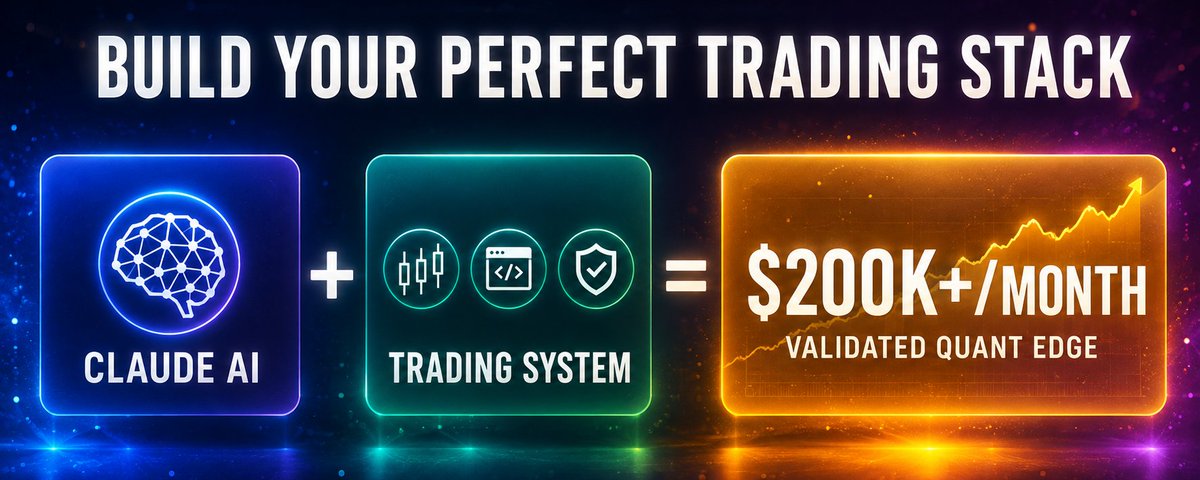
$100 BECAME $2,981. 29.8X. 45 MINUTES. GOLD. SILVER. NVIDIA. ONE AI. ZERO HUMAN CLICKS.
Claude Opus 5.5 started with $100. Not $1,000. Not $10,000. One hundred dollars.
No memecoins. Just the assets Wall Street actually trades.
For 14 minutes it did not trade at all. It read inflation data, the dollar, bond yields and 12 instruments. Balance: $108.78.
Then it went long gold.
$169. $312. $656. The balance chart started bending upward.
At 22:30 it added silver. Its note: silver was lagging gold and had to catch up.
$957. $1,220.
At 29:48 it dropped both metals and rotated into Nvidia. Earnings momentum beat metals momentum. Zero attachment to the trade that was already winning.
$1,911. $2,437. The curve went vertical.
At 38:15 it trailed stops on every position. At 45:00 it closed everything. Final balance: $2,981.00. From $100.
Every decision got a written record linked to a broker confirmation. The panel says it plainly: no emotional re-entry.
$2,881 profit in one session. Twice a month is $5,762. From the price of a pair of sneakers.
Not once did a human pick the asset, size the trade or touch a stop. Claude ran the entire session alone.
The full setup is below and free. Save it now. The feed will not serve you this twice.

Rodger retweeted

Yes. Crypto and AI are one machine. Crypto was not made for humans…it was made for AI. 👀

Rodger retweeted

NEW: Cardano $ADA founder Charles Hoskinson says crypto will "eat" AI over the next 5 to 10 years.
Hoskinson said: "Cryptocurrencies are going to eat AI because we solve all the hard problems that AI can’t solve."
He named payments, alignment, and data provenance as the gaps blockchains can fill.
Hoskinson said OpenAI and Anthropic will have to become profitable at scale, arguing individual models can make money but pre-training is what "kills them."
At the same time, he said the data-center buildout is unsustainable.
He argued spending cannot rise 10x every year because "there’s not enough electricity in the world to facilitate that."
Hoskinson compared the boom to 1990s fiber, when he said about 90% of newly laid cable sat dark and demand took roughly 10 years to catch up.
He expects "dark data centers," then a shift to local/edge models and distributed grid compute.
As examples, he cited Apple’s M5 Mac Studio targeting 400-500 billion parameter models with 512 GB of RAM, around a $20,000 price point today, and Nvidia Spark boxes at about $4,000.
He said the only coordinating layer for pooling GPUs, phones, and other devices into that grid is crypto.
Hoskinson also said he does not expect a US Clarity Act before 2029, and forecast about $10 trillion of assets and a billion new users on public blockchains by the end of 2030.
Crypto is trying to become the settlement and coordination layer for AI.

Rodger retweeted

This is getting harder to ignore.
In December 2023, an anonymous 4chan poster predicted Bitcoin would top on October 6, 2025.
He nailed it.
Now compare that prediction with the post below.
Both models point to the same cycle structure:
• Bear market through Q4 2026
• Bottom in late 2026
• Accumulation phase
• Then the next major bull market begins.
The 4chan post goes even further:
• BTC: $190,000
• ETH: $15,000
• SOL: $1,000
If the same cycle math extends across other major altcoins, it could look something like:
• HBAR: $1.50–2.00
• XRP: $5–7
• XLM: $1.20–1.60
• QNT: $800–1,000
• CC: $2–3
• ALGO: $2–3
Two independent models - If the cycle repeats, Q4 2026 could mark the next major buying opportunity and 2027 is gets crazy.


Rodger retweeted

My mom has paid for ChatGPT Plus for 8 months. She thought it just meant "the version that doesn't say no as much."
I opened her account. Sitting inside that same $20/month: a video generator, a research analyst, and code that writes itself. She'd touched none of it.
Here's everything she didn't know: