

Helping B2B founders turn their expertise into LinkedIn content, build relevant connections and start real conversations. https://teapawt.net/t.co/f3v6nW9S9U
Seattle, WA
Joined July 2023
- Tweets2K
- Following2K
- Followers388
- Likes2.2K




One reason I want founders to post regularly: people often check your profile after seeing your name in a comment or getting a connection request.
If they find a few posts about the questions you answer, the decisions you make, and what you’ve learned from your work, they can get a better sense of whether they’d like to know you.
Coming up with those posts can be the hard part when you’re busy running a business. So each week, we send EngageAlien clients questions by email and use their written answers to develop content.
A question a customer keeps asking might make a good post. So might a decision you had to make on a project, or an approach you changed your mind about.
You don’t have to come up with a grand new idea every day. There’s usually plenty to talk about in the work you’re already doing.
1
17
If someone posts about a problem they’re working through and I have something useful to add, I’d rather start there than send a cold message.
It might be a comment about a specific point they made, or a question that came up while reading. Other times, a like is enough.
For EngageAlien clients, we spend time engaging with a prospect’s content before sending a connection request. Our process includes at least three interactions, though there’s nothing magical about that number. The person may not see all of them.
What I like about the approach is that it makes us slow down and pay attention. When it’s time to connect, we’ve learned something about the person instead of relying on a job title and a company name.
16
Before I send someone a connection request, I like to know a little about what they do and what they post about.
A job title can tell you someone fits the audience you’re trying to reach. It won’t tell you much about what they care about or whether you have a useful reason to connect.
That’s why prospect research is part of the work we do for EngageAlien clients. We look at the person’s business, profile, and recent posts before adding them to the outreach workflow.
Sometimes there’s an obvious connection to the client’s work. Sometimes there isn’t. It’s fine to move on and spend that time getting to know someone else.
1
25
Most LinkedIn outreach starts with a pitch.
I’d rather start by getting to know the people you want to work with.
That’s the idea behind EngageAlien. We help B2B founders build a consistent presence and develop relationships with potential clients—without jumping straight into a sales message.
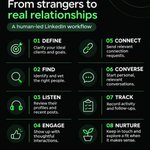
Here’s how the workflow looks:
1. We get to know your business.
We talk through who you help, what you offer, and what makes someone a good-fit client.
2. We turn your expertise into content.
Through a weekly written Q&A, we gather your ideas and experiences, then develop LinkedIn content around them. The goal is to help people understand how you think and what you do.
3. We find the right people.
We research and vet prospects who match your ideal client profile. We look at their roles, businesses, and activity to make sure they’re relevant.
4. We listen before we reach out.
We review their profiles and recent posts to understand what they’re working on and what they care about.
5. We show up and engage.
We interact thoughtfully with their content over multiple touchpoints. That might mean responding to an idea they shared or adding something useful to the conversation.
6. We connect and introduce you.
Once there’s some familiarity, we send a connection request and a personal introduction based on the person and their context.
7. We track and follow up.
We keep track of activity and conversations so good connections don’t get forgotten.
8. We bring you into the conversation.
When someone is interested, we hand the conversation over to you. You know your business best, and you should be the one having the deeper conversation about whether there’s a fit.
The reason I like this approach is that it gives people a chance to get familiar with you before there’s an offer on the table.
Not every conversation will turn into a client. Some might lead to a referral, a partnership, or simply a good connection. That’s still worth building.
If you’d like help doing this consistently for your business, send me a message. I’d be happy to walk you through it.
1
60
Most of us have received that LinkedIn message.
You accept a connection request, and about 30 seconds later there’s a pitch in your inbox.
It’s a little like walking into a networking event and asking someone to buy from you before you’ve learned their name.
There’s a better way to do this.
I’m offering a LinkedIn relationship-building service for people who want to connect with their ideal clients in a more thoughtful way.
Here’s what I’ll help with:
• Find people who fit your ideal client profile.
• Get to know what they’re talking about and what matters to them.
• Engage with their posts in a way that adds to the conversation.
• Connect and start relevant, personal conversations.
• Keep track of those relationships and follow up over time.
The idea is pretty simple: when you show up, pay attention, and have real conversations, people have a chance to get to know you. That creates a better foundation for trust—and for a business conversation when the timing makes sense.
Some conversations might lead to a client. Others might lead to a referral, a useful idea, or a relationship that pays off down the road.
If you’d like to build more of those relationships on LinkedIn but don’t have the time to do it consistently, send me a message. I’d be happy to talk about it.
🤖 Made with AI

1
42
Google’s AI Mode is now showing ads on follow-up questions in a search conversation.
That’s a different moment than the first search.
Someone might start by asking, “How do I improve my website?” A few questions later, they’re comparing specific tools or looking for someone to help.
For marketers, those follow-ups are worth paying attention to. They reveal what a buyer still needs to understand before they make a decision.
I’d spend less time guessing at clever keywords and more time reading sales notes, support questions, and the conversations happening in your industry.
The first question gets you into the room. The next few tell you what the person actually needs.
Source: seroundtable.com/recap-11-09…
1
42
Ogilvy just launched an AI platform called Echo that can generate additional campaign assets from a single shoot.
It also connects to CAA’s system for storing and licensing talent’s digital likenesses.
The obvious appeal for brands: more content without scheduling another production every time you need a new version.
The part I’m watching is how the rights work as that content gets reused. If an actor agrees to one campaign, what happens when the brand wants a new market, a new message, or another year of ads?
AI makes it easier to make more. The agreements need to keep up with what “more” actually means.
Source: marketingdive.com/news/how-o…

30
Anthropic just released Claude Fable 5.2, and the pricing tells an interesting story.
It’s 20% cheaper per token than Fable 5.1. But in one independent benchmark at maximum effort, the new model cost roughly twice as much per task because it used more output tokens.
That doesn’t make it a bad deal. It’s more capable, and the results will vary depending on the task and effort setting.
It does mean “cheaper model” and “cheaper work” aren’t always the same thing.
I’d use a less expensive model for routine drafting, sorting, and simple research. Save the heavy reasoning for the problems where a better answer is worth the extra cost.
Then check the bill against the finished work, not just the price on the model page.
Sources: anthropic.com/claude-fable-a…
toamig.com/radar/2026-11-10/

27
AI companies are spending billions on data centers. Communities are asking: what do we get out of it?
After voters backed restrictions, tech companies are talking more about local benefits.
Big promises go further when you can explain the local impact.
axios.com/2026/11/05/ai-data…

16
Big AI companies are backing a shared way for sites to opt out of AI training.
If you publish original content, it’s worth deciding how you want it used.
And training opt-outs and AI search visibility are separate questions.
webscraper.io/blog/robots-tx…

18
Reddit is testing search ads. Makes sense: people go there for honest opinions before they buy.
But Reddit users can smell a generic ad a mile away. Answer a real question and sound like a person.
It’s a limited test for now.
thekeyword.co/news/reddit-se…
23
Oracle announced new AI tools across its business software, including a service tool that can spot issues, suggest what to do and carry out approved changes.
That service example caught my eye because marketing doesn’t always get to see what happens after a campaign brings someone in.
Sales hears one part of the story. Support hears another. Meanwhile, marketing could still be running the same promotion without knowing customers are getting stuck.
Say the support team keeps getting the same complaint after a promotion. I’d want a simple way to collect those conversations, have AI summarise the pattern and send it to whoever owns the campaign.
That person can check what’s going on and decide whether the offer, the landing page or the follow-up needs a change.
It doesn’t need to be a huge project. Sometimes the useful thing is just making sure the people running the campaign hear what customers are saying afterwards.
oracle.com/tr/news/announcem…

25
Cloudflare showed off some AI visibility tools at its recent conference, including a preview of reporting on site access, mentions and citations.
I’d be happy to have a clearer picture of what AI systems are doing with a company’s website.
Can they access the pages? Are they finding the current information? Is the company showing up in answers?
But I’d be careful about putting all those numbers into a report and calling them leads.
A bot visiting your site doesn’t mean a customer read the page. A citation doesn’t mean someone picked up the phone. They’re clues, and I’d want to look at them alongside website visits, enquiries and what the sales team is hearing.
Over time, you might see a useful pattern. You might also find that a lot of activity isn’t leading anywhere yet.
Either way, I’d rather have a report that makes the difference clear.
searchengineland.com/cloudfl…

27
Publicis just gave its AI platform, Marcel, its own leadership team. They’ll be working on things like creator marketing, data and AI search.
That got me thinking about a question that applies to a much smaller team too: who’s looking after the AI stuff?
I don’t mean who has a ChatGPT login. I mean who checks whether the tools have the right information, whether anyone’s using what they produce and whether the work is actually getting easier.
If a campaign still sits around for three days waiting for approval, a draft that took 30 seconds isn’t going to speed things up much.
I’d pick one regular job and follow it through. Maybe it’s the weekly report, a campaign brief or lead follow-up. Where does it get stuck? Who’s waiting on what?
Then give someone the job of making that process work better.
You probably don’t need a new leadership team for it. You do need someone who can notice when the process is a pain and fix it.
marketingdive.com/news/publi…

1
34
Google Ads is expanding its tools for finding valuable new customers and bringing existing customers back.
Before changing the settings, I’d get sales, marketing and finance to agree on who they want more of.
The person with the biggest first order might never buy again. Someone spending less could stay for years.
And a customer who hasn’t ordered recently might be waiting for you to resolve a complaint. Sending them a cheerful “We miss you!” ad could be awkward.
This is the stuff I want sorted when setting up marketing automation. Check the customer records, agree on the groups and work out what each should receive.
The extra targeting options are useful once you know who belongs in them.
searchengineland.com/google-…

2
2
37
A recent study found that AI brand recommendations varied between platforms and changed across weekly tests. The researchers used specific models and settings, so there are limits to what we can take from it.
But it does make the “ChatGPT recommended us!” screenshot feel a bit less useful.
I’d want to check the questions customers actually ask, across a few tools, more than once.
Does an old price keep showing up? Is your service being described incorrectly? Are you missing from a comparison where you’d expect to appear?
That’s something I’d happily automate: run the checks, save the sources and flag changes for someone to look at.
You’d have a running record to work from when deciding what needs fixing.
searchengineland.com/ai-bran…

2
19
Semrush tracked 400 commercial keywords and found Google AI Overviews appearing for 88% of them, up from about 46% a year earlier.
Someone looking for your service could get a comparison of pricing, reviews and alternatives before opening your website.
So what information are you giving them?
Your sales team probably gets asked about cost, setup time and who the service suits every week. Those answers deserve a place on the site.
When I’m putting a marketing system together, I want a way to collect those questions and get the answers published. AI can help with the writing.
It’s a better starting point than asking it for another ten blog ideas.
semrush.com/blog/ai-overview…

1
1
34
Google Ads lets you mark certain form answers as qualifying, then automatically tag the people who select them.
Handy. But I’d be careful about what that label comes to mean inside the business.
Someone choosing “ready to buy” on a form tells you what they selected. You still need to speak to them and find out whether you can help.
I’d use the answer to make the follow-up more useful.
If someone needs help this week, get the enquiry to the right person quickly. If they’re researching for next year, give them something useful to read and a sensible way to stay in touch.
That’s where automation can help without making assumptions about everyone who fills out a form.
After a few weeks, compare the answers with what happened in the conversations.
Are the people marked qualified actually a good fit? Are we overlooking anyone else?
I’d trust that comparison more than a growing number of qualified tags.
1
26
Meta is rolling out Ads Super Burst, where brands can book a few hours of concentrated exposure around a launch or event.
I can see why that would appeal. You’ve got something coming out on Friday, and you want people to hear about it on Friday.
My first thought, though: what happens if it works?
Can the website handle the traffic? Is the offer easy to understand? Does the enquiry reach the right person? Is anyone available to reply?
That’s the stuff I want sorted before paying for a big launch window.
When I build marketing systems for companies, I pay a lot of attention to what happens after someone responds. A missed enquiry is expensive enough on an ordinary day. Having a whole bunch arrive at once makes that problem bigger.
Before booking the attention, I’d send a test enquiry through the entire process.
Right down to checking who gets the notification on Friday afternoon.
40
If AI suggests contacting someone, I want to know why.
ZoomInfo is bringing its company and contact data into Salesforce’s Hunter sales agent, which is expected to become generally available later this year.
I’d be interested in using that research to find a sensible reason to start a conversation.
Say a company hires a new marketing lead. I’d want to check whether the business is a fit, what’s changed and whether someone on our team has already spoken to them.
If there’s something relevant to say, draft a message and let a person review it.
That’s where I’d start when building this for a company. A small list of accounts, enough research to understand them and messages we’d feel comfortable sending ourselves.
Then look at the replies. Was the information right? Did the message make sense to the person receiving it? Did it start a useful conversation?
I’d want those answers before sending more.
1
56