

Helping B2B founders turn their expertise into LinkedIn content, build relevant connections and start real conversations. https://teapawt.net/t.co/f3v6nW9S9U
Seattle, WA
Joined July 2023
- Tweets2K
- Following2K
- Followers388
- Likes2.2K




One reason I want founders to post regularly: people often check your profile after seeing your name in a comment or getting a connection request.
If they find a few posts about the questions you answer, the decisions you make, and what you’ve learned from your work, they can get a better sense of whether they’d like to know you.
Coming up with those posts can be the hard part when you’re busy running a business. So each week, we send EngageAlien clients questions by email and use their written answers to develop content.
A question a customer keeps asking might make a good post. So might a decision you had to make on a project, or an approach you changed your mind about.
You don’t have to come up with a grand new idea every day. There’s usually plenty to talk about in the work you’re already doing.
1
17
If someone posts about a problem they’re working through and I have something useful to add, I’d rather start there than send a cold message.
It might be a comment about a specific point they made, or a question that came up while reading. Other times, a like is enough.
For EngageAlien clients, we spend time engaging with a prospect’s content before sending a connection request. Our process includes at least three interactions, though there’s nothing magical about that number. The person may not see all of them.
What I like about the approach is that it makes us slow down and pay attention. When it’s time to connect, we’ve learned something about the person instead of relying on a job title and a company name.
16
Before I send someone a connection request, I like to know a little about what they do and what they post about.
A job title can tell you someone fits the audience you’re trying to reach. It won’t tell you much about what they care about or whether you have a useful reason to connect.
That’s why prospect research is part of the work we do for EngageAlien clients. We look at the person’s business, profile, and recent posts before adding them to the outreach workflow.
Sometimes there’s an obvious connection to the client’s work. Sometimes there isn’t. It’s fine to move on and spend that time getting to know someone else.
1
25
Most LinkedIn outreach starts with a pitch.
I’d rather start by getting to know the people you want to work with.
That’s the idea behind EngageAlien. We help B2B founders build a consistent presence and develop relationships with potential clients—without jumping straight into a sales message.
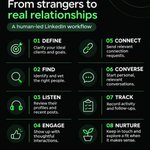
Here’s how the workflow looks:
1. We get to know your business.
We talk through who you help, what you offer, and what makes someone a good-fit client.
2. We turn your expertise into content.
Through a weekly written Q&A, we gather your ideas and experiences, then develop LinkedIn content around them. The goal is to help people understand how you think and what you do.
3. We find the right people.
We research and vet prospects who match your ideal client profile. We look at their roles, businesses, and activity to make sure they’re relevant.
4. We listen before we reach out.
We review their profiles and recent posts to understand what they’re working on and what they care about.
5. We show up and engage.
We interact thoughtfully with their content over multiple touchpoints. That might mean responding to an idea they shared or adding something useful to the conversation.
6. We connect and introduce you.
Once there’s some familiarity, we send a connection request and a personal introduction based on the person and their context.
7. We track and follow up.
We keep track of activity and conversations so good connections don’t get forgotten.
8. We bring you into the conversation.
When someone is interested, we hand the conversation over to you. You know your business best, and you should be the one having the deeper conversation about whether there’s a fit.
The reason I like this approach is that it gives people a chance to get familiar with you before there’s an offer on the table.
Not every conversation will turn into a client. Some might lead to a referral, a partnership, or simply a good connection. That’s still worth building.
If you’d like help doing this consistently for your business, send me a message. I’d be happy to walk you through it.
1
60
Most of us have received that LinkedIn message.
You accept a connection request, and about 30 seconds later there’s a pitch in your inbox.
It’s a little like walking into a networking event and asking someone to buy from you before you’ve learned their name.
There’s a better way to do this.
I’m offering a LinkedIn relationship-building service for people who want to connect with their ideal clients in a more thoughtful way.
Here’s what I’ll help with:
• Find people who fit your ideal client profile.
• Get to know what they’re talking about and what matters to them.
• Engage with their posts in a way that adds to the conversation.
• Connect and start relevant, personal conversations.
• Keep track of those relationships and follow up over time.
The idea is pretty simple: when you show up, pay attention, and have real conversations, people have a chance to get to know you. That creates a better foundation for trust—and for a business conversation when the timing makes sense.
Some conversations might lead to a client. Others might lead to a referral, a useful idea, or a relationship that pays off down the road.
If you’d like to build more of those relationships on LinkedIn but don’t have the time to do it consistently, send me a message. I’d be happy to talk about it.
🤖 Made with AI

1
42
Google’s AI Mode is now showing ads on follow-up questions in a search conversation.
That’s a different moment than the first search.
Someone might start by asking, “How do I improve my website?” A few questions later, they’re comparing specific tools or looking for someone to help.
For marketers, those follow-ups are worth paying attention to. They reveal what a buyer still needs to understand before they make a decision.
I’d spend less time guessing at clever keywords and more time reading sales notes, support questions, and the conversations happening in your industry.
The first question gets you into the room. The next few tell you what the person actually needs.
Source: seroundtable.com/recap-11-09…

1
42
Ogilvy just launched an AI platform called Echo that can generate additional campaign assets from a single shoot.
It also connects to CAA’s system for storing and licensing talent’s digital likenesses.
The obvious appeal for brands: more content without scheduling another production every time you need a new version.
The part I’m watching is how the rights work as that content gets reused. If an actor agrees to one campaign, what happens when the brand wants a new market, a new message, or another year of ads?
AI makes it easier to make more. The agreements need to keep up with what “more” actually means.
Source: marketingdive.com/news/how-o…

30
Anthropic just released Claude Fable 5.2, and the pricing tells an interesting story.
It’s 20% cheaper per token than Fable 5.1. But in one independent benchmark at maximum effort, the new model cost roughly twice as much per task because it used more output tokens.
That doesn’t make it a bad deal. It’s more capable, and the results will vary depending on the task and effort setting.
It does mean “cheaper model” and “cheaper work” aren’t always the same thing.
I’d use a less expensive model for routine drafting, sorting, and simple research. Save the heavy reasoning for the problems where a better answer is worth the extra cost.
Then check the bill against the finished work, not just the price on the model page.
Sources: anthropic.com/claude-fable-a…
toamig.com/radar/2026-11-10/

27
AI companies are spending billions on data centers. Communities are asking: what do we get out of it?
After voters backed restrictions, tech companies are talking more about local benefits.
Big promises go further when you can explain the local impact.
axios.com/2026/11/05/ai-data…

16
Big AI companies are backing a shared way for sites to opt out of AI training.
If you publish original content, it’s worth deciding how you want it used.
And training opt-outs and AI search visibility are separate questions.
webscraper.io/blog/robots-tx…

18
Reddit is testing search ads. Makes sense: people go there for honest opinions before they buy.
But Reddit users can smell a generic ad a mile away. Answer a real question and sound like a person.
It’s a limited test for now.
thekeyword.co/news/reddit-se…
23
The waterfall approach is useful. Only moving to the next provider when needed makes the cost much easier to manage.
8
Good question to ask. It makes the follow-up more useful instead of sending a generic deck and hoping.
16
Good point on creator fit. The right audience matters a lot more than picking the biggest account.
2
Love the curiosity-first approach. Sharing what you learn along the way gives people something real to connect with.
1
15