


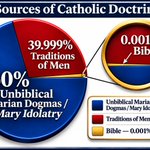



You're confusing Christ's unique role as Mediator with the authority of Scripture.
Protestants don't claim to mediate what anyone is allowed to believe. We contend that doctrine must be tested against God's revealed Word (Acts 17:11).
Christ alone mediates between God and man (1 Timothy 2:5). Scripture is the standard by which doctrine is tested (2 Timothy 3:16–17).
Neither makes a Protestant his own mediator.
Ironically, you're criticizing Protestants for claiming an authority they reject while defending a church that claims a uniquely authoritative Magisterium.
That's not a refutation. It's a category error.
Where does Christ or any apostle teach us to pray for the dead, much less establish a reciprocal relationship with them through prayer?
Scripture teaches that Christ is our one mediator (1 Timothy 2:5), that believers who die are with Christ (Philippians 1:23), and that judgment follows death (Hebrews 9:27).
The unity of Christ's body does not establish communication with the departed or the efficacy of prayers for them.
You cannot derive a doctrine from Scripture simply by appealing to the communion of saints.
That is eisegesis, not exegesis. Church tradition is not a substitute for apostolic teaching.
How Protestants read Scripture:
Scripture: “Mary was blessed among women.” (Luke 1:42)
Protestants: “Amen. Mary was blessed among women.”
How Roman Catholics read Scripture:
Scripture: “Mary was blessed among women.”
Catholics: “Therefore, she remained perpetually a virgin, was conceived without original sin, was bodily assumed into heaven, is Queen of Heaven, and should be invoked in prayer.”
Catholics are very talented at one thing:
EISEGESIS; reading their own beliefs and doctrines INTO Scripture rather than drawing their doctrines FROM Scripture.
Eisegesis: Reading INTO Scripture beliefs and doctrines that the text itself does not establish.
Exegesis: Drawing OUT OF Scripture the meaning the biblical authors actually intended.
The difference? One imposes doctrine on Scripture. The other derives doctrine from Scripture.

Comments like this are why it's difficult to take Catholic apologetics seriously. It's so blatantly contrary to Scripture that I genuinely can't tell whether this is rage bait, a troll account, or someone who simply hasn't read the Bible.
Christ is the hope of sinners, not Mary. (1 Timothy 1:1; Acts 4:12)

Because many have embraced a false version of Christianity that professes faith in Christ while rejecting the authority of His Word.
Jesus asked, “Why do you call me ‘Lord, Lord,’ and not do what I tell you?” (Luke 6:46).
You cannot claim Christ as Lord while treating His Word as optional. Genuine saving faith produces obedience to His truth, not rejection of it (John 14:15; James 2:17).
Jesus: “Come to me, all who labor and are heavy laden, and I will give you rest.”
Matthew 11:28
Jesus: “If you ask me anything in my name, I will do it.”
John 14:14
Scripture: “For there is one God, and there is one mediator between God and men, the man Christ Jesus.”
1 Timothy 2:5
Scripture: “In whom we have boldness and access with confidence through our faith in him.”
Ephesians 3:12
Catholics: 👇


So you agree Abraham was justified, declared righteous, BEFORE Genesis 22. Excellent. That's precisely my argument.
Genesis 15:6 establishes his justification by faith. Genesis 22 demonstrates that faith through obedience.
Now you're shifting to covenant promises becoming unconditional. But where does Scripture say Abraham's justification was provisional until Genesis 22?
Paul explicitly says God justifies the ungodly who do NOT work but believe (Romans 4:5).
You're arguing against a distinction I never denied while conceding the very point I've been making.
My goodness, indeed.
Abraham obeyed God before Genesis 15:6. Nobody disputes that. But where does Scripture say his obedience was the BASIS of his justification?
Genesis 15:6 explicitly credits righteousness to his FAITH, not his works.
Paul even uses Abraham to establish that righteousness is credited apart from works (Romans 4:2–5).
You're arguing from Abraham's chronology while ignoring Scripture's explicit explanation of his justification.
You're confusing God's acknowledgment of Abraham's obedience with the moment Abraham was justified.
Genesis 22:12 says, “Now I know that you fear God.” It does NOT say, “Now I declare you righteous.”
Genesis 15:6 had already established Abraham's righteousness through faith. James 2:23 explicitly connects the two events.
His obedience demonstrated the faith he already possessed. It didn't earn the righteousness God had already credited to him.
That’s right. Christ's finished work is the basis of our salvation, and good works are the fruit of that salvation, not the means of obtaining it. Ephesians 2:8–10 makes that distinction perfectly clear. We are not saved BY good works; we are saved FOR good works. Genuine faith produces obedience because God has transformed the heart.
James 2:24? Glad you brought it up. Now let's actually read it IN CONTEXT.
James 2:18 says, “I will show you my faith by my works.” The issue is the DEMONSTRATION of genuine faith, not how a sinner is declared righteous before God.
Abraham was justified by faith in Genesis 15:6, YEARS before he offered Isaac in Genesis 22. James 2:21–23 explicitly connects these events.
Paul says God justifies the one who DOES NOT WORK but believes (Romans 4:5).
James addresses dead faith. Paul addresses the basis of justification. They aren't contradicting each other.
You can't accuse Protestants of ignoring context while ignoring James's own argument.
That's a remarkable misunderstanding of sola fide.
Scripture teaches that we are justified by faith apart from works (Romans 3:28), not that saving faith produces no obedience.
Ephesians 2:8–9 excludes works as the BASIS of salvation, while verse 10 declares that we are CREATED in Christ Jesus FOR good works.
James 2:17 teaches that faith without works is dead.
Good works are the FRUIT of genuine saving faith, not the CAUSE of justification.
You're arguing against a caricature of Protestant theology, not the doctrine itself.
Amen! Presidents come and go, political parties rise and fall, but Christ reigns forever! His throne is never up for election, and His sovereign purposes cannot be overturned.
That doesn't mean we stop advocating for Christian values, righteousness, and godly leadership. God's sovereignty never negates our responsibility.
And sometimes, God's judgment upon a nation is to give its people the very leaders they desire (Romans 1; Judges 2).
Regardless of the outcome, our responsibility is faithfulness, and our confidence remains in Christ alone.

Regardless of the outcome of any election, one truth remains unchanged: GOD IS SOVEREIGN.
Daniel 2:21 reminds us that God removes kings and establishes kings. Romans 13:1 declares that no authority exists except by God's sovereign appointment.
Our leaders often reflect the moral and spiritual condition of the society that elects them.
But our greatest problem isn't political. It's spiritual.
A nation doesn't need merely better politicians. It needs repentance, righteousness, and the Gospel of Jesus Christ.
Kings rise and fall. Nations come and go. But God's throne remains forever.
Our hope was never in Washington. Our hope is in CHRIST.