

May 19(1)(a) triumph over all prejudice | Lawyer | NLSIU 2026
Bangalore
Joined March 2017
- Tweets3K
- Following1.2K
- Followers2.5K
- Likes7.6K







Shut Up Counsel retweeted
Finished reading Sonia Gandhi’s memoir, Belonging.
There are parts of the book I disagree with. But the chapter on Rajiv Gandhi’s death has stayed with me in a way I find difficult to put into words. Particularly @priyankagandhi words: “Papa is dead.”
Perhaps it is because I understand, in my own way, what it means not to have your parents beside you. But that one sentence carries a grief that is almost impossible to comprehend.
The pain that this family endured, the cost they paid for being in public life, two political assassinations within just five to six years, and the wounds they have had to live with since... I am honestly short of words.
I find myself looking at these chapters through a deeply personal lens, rather than a political one. At the end of the day, beyond their public lives and political identities, the Gandhis are a family too. Human beings who have had to live with unimaginable loss, trauma, and pain. And perhaps that is what makes these chapters so difficult for me to read without feeling overwhelmed.
Some books leave you with thoughts. Others leave you with a lump in your throat. But these particular chapters (those recounting Indira Gandhi’s assassination and Rajiv Gandhi’s death) are something I know I will carry with me for a long time.

Shut Up Counsel retweeted

Taking a brief doesn’t mean you actually agree/disagree with the cause. It’s your work that’s it
Anyone who appeared for an accused under terror charges isn’t supporting terrorism, right?
Cause is important but job is job, social media vigilante don’t get this I believe

The petitioner is represented by @KapilSibal’s son Amit Sibal.
The petition is drafted by one of the top legal firms, Shardul Amarchand Mangaldas & Co. that puts up pride flags in its offices during Pride month & makes social media posts on Inclusion, only to end up with a TERF.


Shut Up Counsel retweeted

“No need to drag CJI into politics.
CJI has shown a judicial way to file a petition and their issues will be addressed.”
- Senior Advocate and Congress MP Vivek Tankha


Shut Up Counsel retweeted
One must appreciate Justice Bagchi for holding the Court on a Sunday to hear the matter and, throughout, not being swayed by either side and carefully issuing a notice to the UoI.
Shut Up Counsel retweeted

Perhaps the most absurd attack doing the rounds today is the insinuation against Justice Satish Chandra Sharma for hearing DM Medha Roopam’s case because his son is standing counsel for the Election Commission before the Madhya Pradesh High Court.
What exactly is the conflict?
The Election Commission was not a party to Medha Roopam’s case. The case arose from an NSA detention. The supposed connection is that Medha Roopam is the daughter of the Chief Election Commissioner, whose institution Justice Sharma’s son represents in an entirely different High Court.
That is not a conflict of interest. That is guilt by familial association stretched to the point of total absurdity.
Taken to its logical conclusion, virtually no judge with a spouse, child or sibling practising law could hear large categories of cases. The administration of justice would become impossible.
Those who actually practised before Justice Sharma when he was Chief Justice of the Delhi High Court will also remember a brutally independent judge who was nobody’s pushover.
It is good to criticise judgments. By all means question a judge’s reasoning. Challenge their orders. That is entirely legitimate. But manufacturing imaginary insinuations against judges through increasingly remote personal connections is madness.
If every judicial order we dislike is answered by digging through the professional engagements of a judge’s family and constructing a theory of bias, we will eventually destroy the very institutional credibility we claim to be protecting.
This BS needs to stop and those doing it need to be challenged.
Shut Up Counsel retweeted
I think there is a difficult conversation to be had about the SC/ST (Prevention of Atrocities) Act, and I want to have it with care.
For me, one distinction is extremely important: a case being unproved does not make it a false case.
If there is no sufficient evidence, or the prosecution fails to establish the necessary ingredients of the offence, that does not by itself mean that the complainant lied. An acquittal is not automatically a finding of fabrication.
When I speak about misuse, I mean something much narrower: cases where there is evidence that the complaint was deliberately fabricated or filed with a malicious or improper intention.
That distinction matters.
Caste discrimination and caste based violence are real. I do not deny the failures that SC/ST victims can face from the police, administration and wider system. Genuine victims must be protected, and allegations must be investigated seriously.
But where a complaint is deliberately fabricated, it can also cause harm. It can undermine confidence in the law and, over time, make people more sceptical of genuine victims.
I therefore don't want to call every unsuccessful case a “fake case.” No evidence, insufficient evidence, or an acquittal is not the same as proving that someone made a false complaint.
My concern is only with deliberate, malicious misuse where that intention can actually be established.
The law should protect genuine victims, respect due process, and hold accountable those who are demonstrably abusing the legal process.
Protecting the credibility of the SC/ST Act is ultimately part of protecting the people who genuinely need it.
Shut Up Counsel retweeted
There is something almost fascinating about the political trajectory of sections of the UC vote bank. For years, some have continued to antagonise SC/ST communities while simultaneously expecting those communities to remain invested in the broader Hindutva coalition. And now, having turned their criticism towards the BJP itself, some appear willing to challenge the very political structure that has provided much of their ideological and institutional space.
That is where the contradiction becomes interesting.
The BJP has, in many respects, provided the political ecosystem within which this discourse has acquired influence. If the same rhetoric were directed at an opposition government, many of these statements might invite a very different political and institutional response. Yet the expectation seems to be that one can attack the BJP, weaken its political position and still retain the political influence derived from that ecosystem.
The more important question, however, is electoral arithmetic.
The UC vote may move away from the BJP for an election or two, but there is a reasonable political argument that much of it could eventually return to its traditional political alignment. SC/ST voters may not necessarily follow the same trajectory. Once a constituency develops a durable political identification around representation, reservation and social justice, electoral realignment can become considerably harder to reverse.
That is precisely why reservation could become an increasingly important component of opposition politics. Congress has already proposed removing the 50% ceiling on reservations for SCs, STs and OBCs. The larger possibility is the consolidation of a coalition involving minorities, SC/STs, OBCs, youth and women.
These are obviously not homogeneous constituencies, and keeping such a coalition together would be politically difficult. But if an opposition party can successfully convert these groups from temporary electoral constituencies into a durable political coalition, the consequences could extend across several election cycles.
And this is where the continuing hostility towards SC/ST voters could become strategically self-defeating. If you repeatedly tell a vote bank that its demands are excessive, its reservations illegitimate and its political influence inconvenient, you should not be particularly surprised when that vote bank begins examining alternative political arrangements.
The UC voter may eventually come back to the BJP.
The more interesting question is whether the SC/ST voter will.
Vote banks, after all, are not inherited property.
Everyone seems to be doing caste arithmetic now. The only mistake would be assuming that everyone else is using the same calculator.
Shut Up Counsel retweeted

Can we have Open textbook exams? The whole competition thing is useless in society. We don't actually need exams in real life. It's outdated. You don't solve real problems like this. You just create needless stress. You can be a doctor, engineer or architect without mugging up.
Shut Up Counsel retweeted
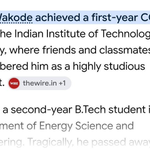
The IIT Bombay student’s death should not be reduced to a story about “cheating”. It raises a much larger question about how our educational institutions respond to academic misconduct, particularly when the student involved is barely 18 or 19.
I say this as someone who graduated from NLSIU, where we have very strict academic integrity and anti AI regulations. I understand why those rules exist, and I believe academic integrity has to be protected. But I also know what it is like to experience these rules as a student — and how intimidating the prospect of disciplinary action can feel when you are sitting on the other side of the process.
At NLS, even possession of a mobile phone in an examination can result in a student being removed from the examination hall and the paper not being considered. Our regulations also prescribe serious consequences for plagiarism and unauthorised use of generative AI, including zero marks and, in specified circumstances, having to re register for the course in the following academic year.
I understand the rationale behind these rules. But as students, we also experience their consequences very differently from how they may appear on paper.
The question is not whether students should face consequences. They should.
The question is whether those consequences are proportionate.
We are talking about 18 and 19 year olds who are still learning how to navigate university, responsibility and life itself. This is not a PhD thesis or professional misconduct where the stakes are fundamentally different.
If a first/second year student cheats, should the institutional response necessarily be severe enough to derail an entire academic year?
Could there not be proportionate alternatives: a fine, community service, mandatory academic integrity training, counselling, a supervised re examination, loss of marks or other penalties? [not involving the parents, cuz that'd make things way worse and "Out of fear of their parents, students may take the wrong steps."]
This is not an argument for allowing cheating. It is an argument for recognising that university discipline should also serve an educational purpose.
Students will make mistakes. Some will cheat. Some will use AI when they shouldn't. Some will carry a phone into an examination hall.
There must be consequences. But the response should also account for the student's age, whether it is a first offence, the nature of the violation and the circumstances in which it occurred.
For an 18 or 19 year old, failing a course and asked to carry forward it to ext year, losing an academic year or facing disciplinary proceedings can feel enormous. What may look like one line in a university regulation can feel like a life changing event to the student actually facing it.
And this is why the IIT Bombay incident deserves a larger conversation.
It's high time that the universities examine whether their disciplinary systems are not only strict enough to protect academic integrity, but also proportionate, humane and accompanied by adequate support.
A university should be capable of telling a student: you did something wrong, and there will be consequences, while also making clear that one academic mistake does not have to define the rest of their life.
Academic integrity matters. Accountability matters. But so does proportionality.
My thoughts and prayers are with the student’s family, friends, and other loved ones. I hope they find the strength to get through this unimaginable loss.
This quoted post is unavailable.
Shut Up Counsel retweeted
I fail to understand how merely handing over a transcript of the video amounts to contempt. Even if Adv @jai_a_dehadrai had said that I will rely only on the transcript I made and dispute the transcript in the FIR/Order it still would not be contempt by any stretch.

Ajeet Bharti bail plea: Delhi High Court sees intense exchange between Advocate Jai Dehadrai and judge
Read here: barandbench.com/news/ajeet-b…

Shut Up Counsel retweeted
NLSIU graduating students condemn the acts of BCI Chairman Manan Kumar Mishra & also echo the sentiments of NALSAR students and are not happy with the CJI Kant attending our convocation.
@abhijeet_dipke as you said the cockroaches in legal fraternity are coming together

Graduating students of National Law School of India University condemn BCI Chairman’s actions against NALSAR 2026 batch.
They demand unconditional apology from the Bar Council of India, and explanation of the protocol for the use of BCI letterhead by Manan Kumar Mishra. @MishraManan01 @NLSIUofficial @NALSAR_Official


Shut Up Counsel retweeted

What if all legal cockroaches come together?
#BREAKING BCI Chairperson Manan Kumar Mishra says that no student who graduated from NALSAR University of Law will be enrolled until further orders from Bar Council of India.
BCI Chairman seeks report from NALSAR on students who mobilised a campaign to not invite CJI Surya Kant for convocation.


Shut Up Counsel retweeted

Nothing is more important than the welfare and future of our youth!
We have decided to set up fast-track courts to ensure swift and stringent punishment for those involved in paper leaks. Have directed the concerned authorities and officials to take all necessary steps in this regard. This continues our series of steps for safeguarding the interests of students.
Those who try to harm the future of our youth will not be spared.
देश के युवाओं का हित और उनका भविष्य हमारी सर्वोच्च प्राथमिकता है।
पेपर लीक के सभी मामलों में दोषियों को जल्द से जल्द कठोर दंड देने के लिए, केस के त्वरित निस्तारण के लिए फास्ट ट्रैक कोर्ट्स का गठन किया जाएगा। इस संबंध में निर्देश दे दिए गए हैं कि संबंधित विभाग आवश्यक कार्रवाई सुनिश्चित करें।
विद्यार्थियों के हितों को सुरक्षित करने के लिए, सरकार द्वारा लिए जा रहे निर्णयों की श्रृंखला में ये एक महत्वपूर्ण कदम है।
युवाओं के भविष्य के साथ खिलवाड़ करने वाले किसी भी व्यक्ति को बख्शा नहीं जाएगा।
Shut Up Counsel retweeted

Hi guys!
I’m currently taking up freelance work in:
• Marketing Strategy
• Content Strategy
• Social Media Handling
• Brand Positioning
• Reels/Short-form Content
• Founder-led Personal Branding
Worked across SaaS, sports, legal ed-tech & creator ecosystems.
Pls share!
Shut Up Counsel retweeted
Share strange legal stories, behind the scenes of famous Supreme Court Cases and other theories & stories of the Courts and Judgments, that will make you go like this
(PS - Don't say anything that will put me on trial for contempt, I can't afford a Sr Adv to appear for me 😭)


Shut Up Counsel retweeted
So advocates cannot advertise.
Law firms cannot solicit work.
Rule 36 of the Bar Council of India Rules prohibits lawyers from publicising their practice, clients, achievements, or success stories.
Yet every single day legal media carries headlines such as:
“XYZ Law Firm advises on acquisition”
“XY Partners acts for investors”
“ZYX Law Offices counsel the transaction”
Interesting question:
Who is supplying these details?
Because in most cases, there is no official public announcement by the clients naming the law firm. There is often not even a company press release announcing legal advisors.
Yet somehow the names, deal structures, teams, and other details reach legal media platforms with remarkable precision.
Who is reporting this news?
Why shouldn't this be termed as an advertisement?
Now perhaps one may still give the benefit of doubt where a company independently and voluntarily announces its legal advisors through an official public statement.
I do understand that the information may sometimes originate from clients, market sources, public documents, or journalistic investigation or where a company itself voluntarily identifies its legal advisors, that may stand on a different footing altogether.
But still, in effect, this looks like an advertisement, and that is concerning.