

Tainan City, Taiwan
Joined January 2016
- Tweets656
- Following353
- Followers34
- Likes1.2K










slowdiverse_ignorance retweeted

台灣媒體沒有報導的新聞⋯幫忙轉post
美光台灣罷工現場
——-
沒理由你把其他國家做不到的事情丟到台灣
laid off 我們要承受
Cost down 員工over loading 我們要承受
93.9去年撐到賺錢了你餵香蕉 我們要承受
Maxout outperformance 台灣人做好做滿
CAPA 60-70% loading 營建一個高良率生產基地
然後還你告訴我!!! 與台灣人無關!!!
你當台灣人塑膠做的?


slowdiverse_ignorance retweeted
報告的通路查核,以及 IT 硬體與網路團隊同事的回饋顯示:在未來 18–24 個月內,完全原生的 800V 直流機房不太可能成為標準;更近端的最適路徑是混合方案(透過 sidecar 側櫃)。更長期看,800V 直流在很大程度上是一次內容結構切換,並實質抬升 TAM(即美元/機櫃/兆瓦)——驅動來自電氣側與熱管理側功率密度同時上升。
當前推動交直流資本支出的順風,對本報告覆蓋的低壓、中壓、高壓標的仍將持續;隨著架構成熟並具備可擴展性,800V 直流將是增量。
- 電氣: 交流(AC)/UPS(不斷電系統)利潤池並不會消失,而是遷移到直流耦合儲能+整流。單機櫃的淨功率與熱管理含量會明顯上升(GB200 約 50 萬美元,到原生 1MW 機櫃約 400 萬美元)。本報告認為主要受惠者是中高壓電氣供應商(正面:SU、ABB、SIE、GEV、ENR)。過渡對低壓直流內容偏負面(銅母排/導體、交流轉換級/中央 UPS)。
- 熱管理: 800V 直流會給機房加溫,冰水主機需求是重新規格化,而不是取消。更高密度機櫃使液冷成為剛需,同時也可能把液冷包絡延伸到其他設備,從而增加對 CDU/歧管的需求。中性偏正面:JCI、TT、CARR、NVT。
- SST(固態變壓器): 全面原生 800VDC 的關鍵使能技術。商用規模下成本約為傳統變壓器的 2 倍、使用壽命約為其 1/3,這指向 sidecar 方案目前最有效。營運流程、直流架構要求,以及推向市場的速度,都更有利於混合而非全架構;通路查核也顯示,混合方案已能拿到更高電壓能力/收益的 85% 以上,並可能平衡本報告對 ABB 於 9 月 24 日推出完整 800V 直流原生架構的預期。正面:SU。
- 低壓/銅材脫媒: 完整 800V 直流的成本約為 1,000–1,050 萬美元/兆瓦,對比今天約 1,200–1,300 萬美元/兆瓦,即去掉集中式交流佔地,並少用 40–60% 的銅。對 LR 有一定負面影響:管理層談到約 20% 的資料中心銷售在 2029 年後存在風險,集中在母排與 PDU;NVT 母排銷售佔比本報告估計為低個位數百分比,但其他電力設備加上 Maverick,從 800V 直流中料將淨正面。
slowdiverse_ignorance retweeted

I have made the following paid articles free.
I believe basic knowledge of optics, especially CPO, is something everyone should understand, so I decided to make all of my previously paid articles on this topic available for free.
I can confidently say that if you read all of these articles, you will be able to build your own conviction on CPO.
Please stop by my Substack, subscribe, and enjoy the articles below.
The War of Light Has Begun: damnang2.substack.com/p/the-…
The War of Light, Part2 - Who's at the Table, Who's Not, and Who's Hiding: damnang2.substack.com/p/the-…
Why CPO Is Becoming inevitable? [CPO Special Part1]: damnang2.substack.com/p/why-…
CPO, Fully Dissected [CPO Special Part2]: damnang2.substack.com/p/cpo-…
The Illusion of CPO [CPO Special Final]: damnang2.substack.com/p/the-…

slowdiverse_ignorance retweeted
Morgan Stanley research forecasts a “more severe shortage” of hard disk drives (HDDs) that will persist at least through 2028, with suppliers pricing significantly above current levels.
Accordingly, the firm substantially raised its target prices for major storage companies: Seagate Technology’s $STX target price was increased from $767 to $1,035, and Western Digital’s $WDC from $488 to $650. Under an extremely optimistic pricing scenario, both companies could see their EPS grow by approximately tenfold between CY25 and CY28.
The supply gap is larger than imagined—and continues to widen.
Research indicates that nearline HDD supply in 2026 will fall short of demand by approximately 300 exabytes (EB), equivalent to a 10%–15% shortfall. The gap is projected to widen further to around 400 EB in both 2027 and 2028.
Hyperscalers are currently deploying HDDs at a rate close to 100%, compared to a historical average of roughly 70%—indicating they are holding virtually no inventory and purchasing on a just-in-time basis. HDD inventory levels at ODMs have also dwindled to just one to two weeks, placing extreme strain on the supply chain.
Supply is being tightly controlled. HDD manufacturers are deliberately refraining from building new capacity (i.e., no greenfield expansions). Over the next two to three years, the annual EB growth of nearline HDDs will be entirely supply-constrained, with an estimated compound annual growth rate (CAGR) of 30%–35%. Meanwhile, demand is growing at 40%–50% annually.
Pricing: Suppliers’ target price of USD 25–30 is double the current level.
Currently, the blended average price of nearline HDDs from Seagate Technology and Western Digital stands at approximately $14.30–14.90 per terabyte (TB).
In April this year, the market was already aware that suppliers aimed to push prices to $20 per TB by 2027/2028. However, this latest research trip to Taiwan has revealed a more aggressive signal: suppliers’ internal target pricing now stands at $25–30 per TB.
A more direct signal is coming from the spot market—some distributors are already selling HDDs to customers without long-term agreements (LTAs) at $30–35 per TB, roughly 30% higher than previously reported figures.
For hyperscale cloud providers, pricing changes are typically communicated in advance and implemented gradually through quarterly price escalation clauses in contracts, offering greater control and predictability.
Cloud providers would prefer long-term agreements extending to 2032, but Seagate Technology and Western Digital are reluctant to lock in commercial terms beyond 12 months. The reason is straightforward—the application scope of HDDs is expanding, supply shortages are intensifying, the total cost of ownership (TCO) advantage over NAND flash memory is growing, and no alternative technology currently poses a threat to HDD dominance. Suppliers are willing to provide customers with five years of visibility into capacity and technology roadmaps but are unwilling to surrender pricing power prematurely, as doing so would be disadvantageous to them.
EPS Upside: Virtually all additional price increases will flow directly to profit.
Incremental pricing for HDDs translates almost 100% into after-tax profit.
This is because suppliers have been extremely disciplined in capacity expansion—there are no greenfield capacity plans, and EB shipment growth over the next two to three years is entirely supply-constrained, implying an annual compound growth rate of approximately 30–35%. Within this framework, every incremental dollar of price increase requires no additional cost and flows directly to the bottom line.
In an optimistic scenario: if nearline average selling prices reach $25/TB in CY27 and $30/TB in CY28 (consistent with channel checks in Taiwan), then:
> Seagate Technology’s CY27 EPS could exceed $70, and CY28 EPS could exceed $100.
> Western Digital’s CY27 EPS could exceed $40, and CY28 EPS could exceed $70.
By comparison, Seagate and Western Digital reported actual CY25 EPS of $10.24 and $6.95, respectively.
In the base-case forecast, the assumed nearline ASP in CY27 is approximately $19/TB, implying:
> Seagate Technology's FY27 EPS is $35.38, and FY28 EPS is $70.64.
> Western Digital's FY27 EPS is $22.40, and FY28 EPS is $43.47.
Even under this relatively conservative baseline scenario, the FY28 EPS forecasts are already approximately 70% above market consensus—Seagate Technology’s FY28 consensus EPS is around $40.60, while Morgan Stanley’s forecast is $70.64; Western Digital’s FY28 consensus is $26.20, versus Morgan Stanley’s forecast of $43.47.
How significant is the threat of new entrants?
The HDD industry is currently a highly concentrated oligopolistic market. The most frequently asked question from outsiders is whether new players could enter and disrupt this structure.
Western Digital CEO Irving Tan provided a direct answer. He explained that the barriers to becoming a competitive new entrant do not lie in capital availability, but rather in three key areas:
1. The technology certification cycle is extremely long. Certification for HAMR (Heat-Assisted Magnetic Recording) technology alone took more than 10 years.
2. It requires cross-disciplinary vertical integration capabilities. Internal integration across domains such as magnetics, materials science, photonics, and nanofabrication cannot be acquired simply by spending money.
3. The supply chain is highly concentrated with virtually no idle capacity. The HDD supply chain is extremely consolidated and currently operating at high utilization rates, making it difficult for new entrants to secure external resources they could leverage.


slowdiverse_ignorance retweeted

從 1.6T 到量子網路解密半導體巨頭的 PIC 光子晶片終極戰役
Call Memo
20260901
重點摘要
1. 1.6T進入量產,200G/lane成主流。
2. CPO加速導入,主動對位需求延續至2028年。
3. PIC放量,InP、PD與對位設備恐成瓶頸。
論壇重點
1. 1.6T光互連可透過8條200Gbps通道或增加100Gbps通道數達成,主流仍採PAM4。現階段可插拔光模組、LPO、NPO及CPO並行,差異主要在DSP配置、光引擎與ASIC距離、功耗、成本及可維修性。
2. Broadcom Tomahawk 6已出貨,單晶片交換容量102.4Tbps,支援100G/200G SerDes及CPO;其TH6-Davisson CPO方案由16個6.4T光引擎組成,每通道200Gbps,並已著手開發每通道400Gbps的第四代CPO。
3. NVIDIA Vera Rubin平台導入Spectrum-X Ethernet Photonics,將CPO直接整合於交換器ASIC封裝,200Gbps SerDes方案已進入量產,主要訴求為降低功耗、提升可靠度及支援百萬顆GPU規模的AI叢集。
4. 聯電與SILITH已由新加坡12吋廠交付首批量產矽光子晶圓,1.6T平台由開發至量產準備歷時18個月,累計出貨逾800萬顆100G/200G每通道PIC;後續將開發400G每通道純矽光子及TFLN方案。
5. 2026至2028年PIC與FAU整合仍以主動對位為主,需奈米級定位、點膠固化及光學測試;被動對位可簡化組裝與重複測試,但量產良率、標準化及產能仍待建立。
6. 1.6T供應鏈涵蓋CW Laser、EML、VCSEL、PIC、DSP、PD、TIA、FAU、光纖及光模組;Coherent、Lumentum與Broadcom位於光源及光晶片環節,康寧則擴充光纖、光纜與高密度光連接產能。
7. 預期可插拔光模組仍可延續至2028至2029年;隨交換器頻寬、熱密度與傳輸距離要求提高,CPO將先由交換器端擴大,後續再延伸至XPU及HPC互連。
8. 1.6T後續將朝3.2T及6.4T發展,單通道速率由200G提升至400G。當可插拔模組面臨功耗與散熱限制,光引擎將更靠近ASIC,並逐步由2.5D封裝走向3D整合。
9. LPO移除DSP可降低光模組功耗與成本,但對SerDes訊號品質、溫度補償、線路距離及模組一致性要求更高;短距離互連將呈現LPO、NPO及CPO多種架構並存。
10. PIC放量後,短期瓶頸將轉向主動對位及光測設備、InP磊晶品質與外延產能、PD良率、TIA供應,以及EIC/PIC之間的微凸塊與3D整合製程。
11. 被動對位若能透過Glass Bridge、微透鏡及高密度光纖連接降低組裝與測試成本,可能自2029年開始滲透;惟估計真正形成大規模產能或須至2030年前後,此為產業情境推估。
12. Micro LED與Micro-VCSEL可能用於更短距離、高密度光互連,但光源波段、耦合方式及通訊標準尚未定案,現有顯示用Micro LED產能不必然可直接轉為資料通訊用途。
13. 光量子運算須依量子位元類型區分;傳統LPO難以直接適用於極低溫量子系統,未來可能需整合單光子光源、PIC及超導奈米線單光子偵測器(SNSPD)的專用量子光互連架構。
※Q&A
14. PIC開始放量後,最可能先出現供不應求的環節為何?
2026至2028年仍以主動對位為主,FAU貼合前需精密對位、點膠固化及光測,PIC亦可能需要雙面晶圓測試,因此奈米級主動對位、光耦合及光測設備最可能先形成缺口。
15. PIC通道數增加後,接收端可能出現哪些瓶頸?
通道數由8條往16條以上增加,PD與TIA需求同步放大;瓶頸主要在InP材料及外延產能、磊晶品質、TIA供應,以及EIC與PIC對貼所需的微凸塊與3D整合能力。
16. PD短期限制主要是產能、良率或客戶認證?
材料與製程良率是主要限制。不同材料間約4%的晶格失配及熱膨脹差異會增加缺陷,PD製程良率難以穩定突破50%,因此擴產前仍須先改善磊晶與異質整合良率。
17. Glass Bridge與被動對位何時可能明顯取代主動對位?
2026至2028年仍由主動對位主導,被動對位可能自2029年開始滲透;考量美國新廠、FAU、光纖與特殊玻璃產能建置至少需兩年,真正明顯影響主動對位需求可能落在2030年前後。
18. Micro LED光互連與台灣面板廠有何關聯?
若採外置光源,具巨量轉移能力的面板廠可能參與供應;若由晶圓代工廠整合內置光源,價值將偏向半導體製程。關鍵仍是光通訊標準未定,既有顯示產線能否符合波長、可靠度及耦合要求尚待確認。
19. 聯電的矽光子與TFLN布局進度如何?
聯電與SILITH的1.6T矽光子平台已進入量產,並共同開發400G每通道純矽光子;TFLN則與生態系夥伴持續開發。預期2Q27可能出現新進展,但合作對象與時程未獲官方完整揭露。
slowdiverse_ignorance retweeted

我之前解释过不是功率越大的激光器越好,功率和带宽不是一个事情,带宽取决于解调器。
今天刚好小伙伴问我,说市场上有一种说法,认为 Sivers 的 CPO 路线存在内在缺陷,因为它采用 WDM,而不是单颗大功率外置激光器方案。
其实Lumentum 不仅有高功率激光器产品,同样也在推进面向 SiPh/CPO 的 CW-WDM 激光器,而 CW-WDM 本身还有完整的 MSA 规范支持,说明这并不是一条非主流路线。
更关键的是,系统比较落在调制器端,而不是只看激光器源头的总输出功率。假设一颗 400mW 的 UHP 激光器被平均分成 8 个通道,那么每通道理论上只有 50mW;如果一颗 8 波长 WDM 激光器每个波长同样提供 50mW,那么两者在调制器端的可用功率并没有本质差别。
进一步看损耗预算,单颗 UHP 激光器路线需要 1:8 分光,这本身会带来额外插损;WDM 路线则需要承担复用器/解复用器损耗。两边都有系统代价,因此不能简单把“更高总功率”理解为“更优方案”。真正重要的是最终到达每个调制器的有效光功率。
此外,WDM 路线还有带宽密度优势,因为它可以在单根光纤上传输多个波长;纯分光方案通常不具备这一点。CW-WDM MSA 已经在推动 8、16、32 波长标准,也反映出产业链对这一路线的明确支持。
因此,Sivers 的核心风险不一定是 WDM 架构本身,而更可能是竞争格局:如果 Lumentum 能凭借更成熟、更高可靠性的 CW-WDM 激光器切入同一赛道,那么 Sivers 面对的将是“被更强玩家替代”的风险,而不是“技术路线先天错误”的风险。
现在 Lumentum无暇顾及这一块,它自己的大功率激光器都供不应求。
现在可见的1-3年内,行业的瓶颈在于生产能力,不在技术路线和需求。基本上能造出多少就能卖出多少。

slowdiverse_ignorance retweeted
艦長 程正樺 論壇演講重點整理
(錄音檔經Grok STT處理,並由Claude整理總結)
一句話總結:
AI 基本面持續上修、算力依然短缺,真正的結構性大事是 NVIDIA 下一代架構讓光元件需求暴增六倍,CPO 量產時程比空方想的近(2027 小量、2028 放量),台灣供應鏈(測試設備、FAU、光纖)是主要受益者;最大瓶頸不是需求,是供應鏈做不出來。
演講重點
1. 總經與景氣
費半獲利預估持續上修:今年成長約 90%、明年 45–50%,基本面「一直都挺好」。
半導體庫存健康;下游(Cisco、Arista、Celestica、廣達等)庫存偏高但未失控,賭下半年賣得掉。
記憶體因漲價預期被迫備庫存。工業市場回溫(日本對中工具機出口金額創新高)。
風險在籌碼面與評價:費半 PE 回到 ~30 倍,部位擁擠、波動會放大。
2. AI 需求:算力仍然短缺
Token 使用量持續上行;四月一度下滑是因為漲價與算力不足限流,新增資料中心上線後又恢復成長。
Anthropic 已超越 OpenAI 成為第一大模型公司(以 ARR 計):一年半 ARR 成長約 40 倍,年底目標至少 $1,000 億、內部樂觀看 $1,500 億;兩大模型廠年底合計可能 $2,500 億。
模型廠商營收:去年全行業約 $500 億 → 今年約 $1,500 億 → 明年可能 $4,000–5,000 億。
CapEx 看法(核心論點):今年約 $7,000 億,市場估明年 $8,000–9,000 億,但講者認為上修到 $1–1.2 兆的機率很大——AI 營收上來後現金流支撐 CapEx 自動放大。
但漲不到失控:卡在資金(很多公司現金流轉負、要募資)和供應鏈產能(台積電、PCB、雷射都不夠)——「市場很熱但花不了那麼多錢」,反而是健康狀態,可維持一兩年。
3. 光通訊技術背景:448G 做不出來,逼出 CPO/XPO
448G SerDes 是死關:頻率太高,PCB 走線只剩約 5 公分;DSP 需要 N2 製程,產能輪到它最快 2028–29。在那之前 3.2T 傳統光模組做不出來。
過渡方案因此百花齊放:XPO(兩倍寬光模組、塞 64 lanes、LPO 概念去 DSP、水冷)、CPO(台積電 COUPE 路線)、micro-LED 平行光(多顆低速取代單顆高速)、TFLN 薄膜鈮酸鋰(讓 400G 雷射變可行)、VCSEL 陣列(短距、對應 PCIe scale-in/OIO)。
Computex 觀察:光的展示明顯變多=接近量產。值得注意的廠商:Ayar Labs(台積電/NVIDIA/Intel 都是股東):GPU 旁的 OE,偏 AMD 路線。 聯發科:PIC/EIC 分離路線,自做 EIC;長期可能連 PIC 都自己做。 大立光首次參展:FAU 光纖陣列號稱能堆四排(公差要求 0.3μm),實際看過的人「蠻驚豔」,第二代 CPO 有機會採用——值得期待的新進者。 安費諾的 XPO 連接器、Marvell 的 CPO switch demo。
4. NVIDIA:光需求 ×6 的來源
Roadmap:Blackwell → Rubin → Feynman。重點是 Rubin 世代多了 NVL576:8 個 NVL72 rack 用 CPO 跨櫃互連(cross-rack scale-up),每顆 GPU 對應 6 個 3.2T 光引擎——「對光的需求未來增加六倍」,之前傳的「一年 6,000 萬顆 OE」推算下來 2028 年是做得到的。這是講者對光通訊「整個 AI sector 裡最樂觀的行業」判斷的數學基礎。
VR200 機櫃取消線纜改 PDU 直插;switch tray 從 2 顆變 4 顆交換晶片。
正交背板是最大難關:材料(M9/M10、PTFE)全都還做不出來,明年量產無望,最快 2028——所以 Oberon 架構會沿用到 Rubin Ultra。
推論架構:prefill/decode 分離(disaggregated inference)。CPX 因 DRAM 暴漲變得「雷聲大雨點小」;SRAM 路線(疑指 Groq LPU)速度快但容量是 Rubin 288GB 的零頭,定位有限。
Token 經濟學(老黃論述,講者買單):差別定價時代來了——長上下文加倍收費、付費用快模型;Anthropic 和 Google 四月漲價後 token 量降但獲利反升。效能好的系統能讓客戶定更高價格,這是 NVIDIA 賣貴的正當性。
Vera CPU:CPU 全面缺貨下,ARM 陣營唯一能打的就是 Vera,賣點其實是「買 memory 送 CPU」(綁 500G/700G 記憶體配貨)。
5. Google TPU 與 ASIC 競局
448G 做不出來引發的連鎖效應:Google 為下一代搞了 336G 特規 SerDes,聯發科配合做了 → TPU v9 變成聯發科獨拿,Broadcom 押 448G 沒 ready 出局;v10 Broadcom 可能再回來。
Google OCS/3D Torus 優勢複習+新的 Dragonfly 式拓撲:內部頻寬加大、對外縮小,每 TPU 光模組需求 1.5 → 1.25 顆(微降但量級不變)。
6. 台積電(62:00–73:50)
先進製程藍圖再加一代;A12(疑為 A14 的背面供電版,類比 A16 之於 N2P)。
SoIC 3D 堆疊是明確趨勢:GPU 面積到頂,改往上堆 SRAM/IO。
COUPE 光引擎效能:3.2T OE 的每毫米頻寬 0.5Tbps,是傳統 1.6T 光模組的 2.5 倍;roadmap 是 200G→400G lane、單排→雙排 FAU、單波長→多波長。
成熟製程:28nm 產能在縮,往 12nm 移;高雄廠做 N2、台中新廠做 A14。
QA
Q:外資大師唱空 CPO(不會量產),怎麼看?
A:亞洲供應鏈「如火如荼」,比較踏實。時間差而已:業績貢獻 2027 年小量起步(NVL576 配 Rubin Ultra)、2028 年大量;空方講的 2029 指的是 GPU 旁 OE 的全光網路,那要等 Feynman+448G ready,兩者不矛盾。目前供應鏈最大問題是測試:時間久、規格未定。年底到明年初會先有 scale-out 的 CPO 交換器小量試水溫(幾萬台),跑順了 NVL576 就沒大問題。
Q:TPU v9 為何只剩聯發科?是 Google 刻意去 Broadcom 化嗎?
A:規格因素(336G SerDes)影響更大,不是單純扶持。Broadcom 沒有完全出局:Sunfish Ultra/Whalefish(雙晶片封裝)是給 Anthropic 的外賣 rack 用的——Google 的定位是自用 TPU 給聯發科、外賣機架給 Broadcom。另外聯發科在 Computex 期間已開始談自己包整機架(找台灣 ODM,省 Broadcom 的高額 fee),上週才開談、成不成未知。
Q:TPU v9 良率與封裝風險?
A:技術驗證良率 95%、量產會更低。絕對沒有台積電備案——台積電不幫人做備案(「我只做最好的 source」)。金句:「做半導體的對台積電都有信仰,Google 不是半導體公司、不是信徒,不是信徒的都要踢到鐵板之後才會增加自己的信仰。」若 v9 真的滑鐵盧,B8 多賣一點,最大受益者是 NVIDIA——NVIDIA 股價疲弱賭的就是 TPU 搶份額這件事。
Q:封裝翹曲問題?
A:藍寶石 carrier 解決不了翹曲;面板級封裝原預期 2030 才來,但台積電論壇突然提前討論,代表確實遇到挑戰、各種新思路都在試。
Q:AI 伺服器裡 CPU 比例提高(1:8 → 1:2 甚至 1:1)?
A:看使用情境,但方向確認。今年 CPU 卡在供應不足:Intel 受自家產能限制約 15–20%、AMD 三十幾percent。明年 CPU 成長要超過 30% 就供不出來了(還卡 ABF 載板)。順帶:現在 750GB 記憶體配置約一萬美金、比六千多的主晶片還貴——「memory 賺的錢比主晶片還多」。
Claude的觀察:
全場最有交易價值的數字是「×6」:NVL576 讓每 GPU 的光引擎需求從 1 個變 6 個,而且講者用供應鏈訪查(測試設備機台數、各環節廠商)交叉驗證過量產時程。這比「CPO 概念」空泛的多空之爭具體得多。
瓶頸思維貫穿全場:CapEx 上修卡供應鏈、CPU 卡產能、448G 卡製程、CPO 卡測試。講者的框架是「需求不是問題,誰能解掉瓶頸誰賺錢」——測試設備(愛德萬等)、FAU(大立光新進)、光纖是他點名產值較大的環節。
風險提示也誠實:籌碼擁擠、評價不便宜、模型廠現金流負值靠募資、Google 脫離台積電的執行風險。不是無腦多。

slowdiverse_ignorance retweeted

=>
Optical Networking: The Next Mega Trend in AI Infrastructure, May 21, 2026 (31 pp) goldmansachs.com/pdfs/insigh…
OCS, OCP Edu Webinar, Feb 26 teapawt.net/ogawa_tter/status/2027…
Si-Photonics Switching, OCP EMEA Summit, Apr 30 teapawt.net/ogawa_tter/status/2056…
CPO, Mar 26 teapawt.net/ogawa_tter/status/2039…
69 pp


=>
"Co-Packaged Optics: Heterogeneous Integration of Chiplets in Switches, Photonic ICs and Electronic ICs", John H Lau, Unimicron Tech, IEEE EPS Silicon Valley Area, Mar 26, 2026 (69 pp) r6.ieee.org/scv-eps/wp-conte…
teapawt.net/ogawa_tter/status/2032…
CPO: HI of Chiplets, J. Lau. Dec 15, 2025


slowdiverse_ignorance retweeted

Hej Sven synd att du inte fårr svar. Skall försöka summera några saker som jag ser som helt nytt.
1. Sivers is being integrated directly into GF's SCALE platform. GF only introduced SCALE publicly about a month ago. Until now, GF had announced the platform itself, but not a laser partner embedded into that ecosystem. The release states that Sivers' laser arrays will be available in GF's SCALE™ (Silicon Photonics Co-packaged Advanced Light Engine) platform and reference designs. Being picked as GF reference design vs Lumentum/SmartPhontics is strong statement and validation of Sivers as Laser supplier into the AI ecosystem. That means Sivers is no longer just supplying components into the market generally; it is becoming part of GF's preferred silicon photonics architecture.
2. Expansion beyond CPO into LPO and broader optical connectivity like Pluggables with a large TAM that is closer to ramp (1.6T. Pluggables). Earlier Sivers announcements focused heavily on External Light Sources (ELS) for CPO deployments. This release explicitly says the collaboration supports: a) Co-Packaged Optics (CPO) b) Linear Pluggable Optics (LPO), c) Other emerging datacenter interconnect architectures. This broadens the addressable market materially beyond the ELS/CPO discussed previously.
3. The first full foundry-level endorsement of Sivers' laser technology. All other communications with GF had been in group of companies or partnerships with Ayar Labs, or Wireless. Now adding foundry-level endorsement to previous announcements, with system and module partners such as O-Net, Enablence and Jabil. This is different because GF is one of the world's leading silicon photonics foundries. Having GF publicly state that it is pairing Sivers laser arrays with its silicon photonics and SCALE platforms is a stronger ecosystem validation than a group of partners on list or module-level partnership.
4. A big signal that Sivers is positioning for hyperscaler qualification for Pluggables via GF like they done for Jabil. If GF succeeds in becoming one of the major SiPh platforms for 1.6T or 3.2T Pluggables, then Sivers potentially gains visibility to: NVIDIA ecosystem suppliers, Broadcom ecosystem suppliers, AMD ecosystem suppliers, hyperscaler custom-AI programs.
slowdiverse_ignorance retweeted

I wasn’t planning to share this, but it’s such a high-quality explanation of CPO that I have to.
Just watch it. You’ll regret it if you don’t.
youtu.be/wiH6d4m9o4o?si=hwEO…
slowdiverse_ignorance retweeted

相信大家最近都越来越多看到“硅光子”和InP这些词,两者不是简单替代关系,而是各自擅长不同段位,最终光互连很多方案会走“硅光 + InP 异质整合”。
关于InP和代表公司 $AXTI 之前写过一条,欢迎考古teapawt.net/nft_hu/status/20494763…
本文主要来介绍一下硅光子技术与InP(磷化铟)路线的不同与各自的优缺点。
1️⃣什么是“硅光/ 硅光子”?
硅光(Silicon Photonics)本质上是“在硅晶圆上做光子集成电路(PIC)”,把光波导、调制器、探测器等光器件做成一个 IC 一样的“光芯片”。
2️⃣为什么要同时存在两条路线?
根源还是物理差异。
📌硅(Si)是“间接带隙”半导体,本身几乎不发光,电子复合时主要变成热而不是光,所以它不适合作为高效率激光材料,但非常适合做大规模 CMOS 电路与低损耗波导。
📌InP(磷化铟)是“直接带隙”半导体,电子复合很容易直接产生光,且波长刚好落在 1.3–1.55 μm 光纤损耗最低的窗口,是长距离/高速光通信里极高效率的发光和探测材料。
3️⃣硅光子技术的优势与短板
🌟优势
- 可复用 CMOS 生态,对大规模量产和成本下降极为友好;
- 高集成度、易和电路同片:硅光平台可以把光学功能与电子控制电路在同一片或同一封装内实现,有利于做高密度光 I/O、CPO(共封装光学)、coherent-lite 等新架构。
- 超大带宽密度,适合做高通道数、高带宽密度的光引擎,满足 800G / 1.6T / 3.2T / 6.4T 等数据中心互连需求。
❌短板
- 发光效率极差:,硅光平台通常需要外接 InP 或 GaAs 等 材料作为激光/放大增益介质,靠异质集成或光纤耦合把光引入硅波导;
- 高性能调制器材料不是最优;
- 在极长距离/超高功率下不一定最优:对于几十公里以上的长距传输、高功率光源等,传统 InP/硫化物等平台仍有明显优势。
4️⃣InP(磷化铟)路线的优势与短板
🌟优势
- 高效率激光与探测,适合中长距离与高速传输。
- 适合高速、高功率光源:InP 基 EML、DFB 激光器在 800G / 1.6T 这类高速场景下,仍是高功率、低噪声、高可靠性的主力方案,特别适合数据中心和电信级应用。
-可做完整光子集成电路(InP-PIC):在 InP 基板上可以 monolithic 集成激光器、调制器、探测器等功能,做成完整的光子集成电路,用于高速收发模块甚至 CPO 应用。
❌短板
- 成本与产能扩展难:InP 衬底贵、尺寸小(4 吋向 6 吋爬坡中)、外延工艺复杂,MOCVD/MBE 设备和良率都更具挑战,随 AI 光互连需求暴增容易进入“缺货+涨价+长约锁产能”的模式。
- 与 CMOS 集成难度大,设计与封装成本都较高。
- 大规模 SoC 型光 I/O 不占便宜:在需要海量端口、极高集成密度且对成本非常敏感的数据中心“光 I/O 砖头”场景,单纯 InP 平台很难像硅那样吃到 CMOS 规模效应。
5️⃣在 AI 光互连里的分工:不是“二选一”,而是“协同”
相信看完两者的优缺点,我们可以看到硅光和InP的互补性很强。因为在光互连中,两者都被需要。
📌在当前和可见的下一代(800G/1.6T → 3.2T/6.4T)中:
InP(EML / DFB / 有源器件)主要负责:
提供连续波激光(CW Laser)或 EML,把电信号转换成高质量的光信号;
特别适合中长距(比如几公里到几十公里的 DCI)、或者单通道速率高到 100G/200G/400G 时,对激光线宽、线性度、SNR 要求很高的场景。
硅光子(SiPh PIC)主要负责:
在一块小芯片上做很多通道的调制、合波/分波、路由(比如 8×100G → 800G,或者 16×200G → 3.2T),追求的是“单位面积带宽”和“功耗/通道数”。
更适合机架内、机架间短距互连,高密度互连、CPO/LPO 这类非常讲究功耗和集成度的AI集群场景。
📌典型 CPO / coherent-lite 架构中,常见方案是 “InP 激光 + 硅光 PIC + CMOS 驱动/DSP”,通过异质集成把三种材料各自的强项(发光效率、光学集成、电路与信号处理)拼在一起。
6️⃣目前的产业趋势:
$AXTI Sumitomo:上游 InP 衬底 & 外延 → 成为稀缺资源,动辄长约锁产能、4 吋→6 吋扩产,极易出现“抢货潮”。
$LITE/ $COHR 中游 InP 激光 / EML / PIC 平台 → 在 AI 数据中心与相干长距场景中,成为硅光与 CPO 方案的“光源 / 引擎”核心。
$TSEM / $GFS:硅光工艺平台→ 为 2.4T / 3.2T / 6.4T 级别光引擎与 CPO 方案提供 SiPh 流片基础,并通过与封装厂 / 模组厂协作,把高通道数光 I/O 推向贴近 GPU / 交换芯片的一线。

有了这一条抛砖引玉,就可以说清楚 $AXTI 的重要性了。
AXTI通过其北京通美设施,控制着全球60-70%的InP衬底产量。 这不是普通的市场份额优势,而是接近垄断的地位。全球做InP衬底的玩家极少,主要就是AXTI(北京通美)和日本住友电气,其他的产能零散且不成规模。
那这个中文名不知道有没有让大家心头升起一个疑问:这家公司和北京有什么关系?
问到点子上了。这家公司是很典型的“壳在美国,核在中国。” 北京通美晶体技术有限公司是 $AXTI 在北京的核心子公司,同样做InP、GaAs、锗等半导体衬底。
北京通美是AXTI整个商业模式的核心——AXTI不只是在中国制造晶圆,还持有中国十家原材料合资公司的股份,从原材料到成品晶圆全程垂直整合,这是它相比日本住友等竞争对手成本最低的根本原因。
通过前文咱们也知道,中国生产核心三大原材料,也是做InP的最最核心成分。
最近 $AXTI 所做的5.5亿美元增发,也是为了支持北京通美扩大InP衬底产能。(这笔交易每股64.25美元向机构投资者增发约856万股)
____________________________
$AXTI 印钞机一般的生产线
根据麦肯锡的分析,InP基EML的供不应求。2026年的短缺缺口可能达到17%,而短缺预计将持续到2027年下半年。 诸如英伟达等巨头都开始提前锁定关键EML供应商的产能,导致交货期延伸至2027年之后。
800G及以上光收发器的全球出货量将从2025年的2400万台跳升约2.6倍,到2026年接近6300万台。每台更高速的收发器需要更多、更高质量的InP衬底。
CPO(共封装光学)对InP的稳定性和低缺陷率提出了更高要求,同时也会显著提升每颗芯片所需的InP用量密度。在2026年,随着英伟达和博通实现CPO产品出货,InP需求将进入新台阶。
2025全年营收才$88.3M,但InP积压订单已达$60M创历史纪录,而且客户是在主动锁定长周期订单,因为AI数据中心建设需要的InP比以往任何时候都多。 瓶颈不是需求,而是能不能拿到出口许可证发货。
-------------------------------
最大的危机在北京——出口许可证
这就是整个故事里最微妙的地方。2025年2月,中国商务部宣布对铟相关材料实施出口管制。北京通美必须向中国商务部申请出口许可证,才能把InP衬底运给海外客户。
目前北京通美已经拿到了向欧洲、日本、英国和加拿大出口InP的许可证,但出口到美国的许可证仍在"最终审查阶段"。
我们其实看最近的财报也可以明显的发现,营收不取决于产能,取决于“许可证”🪪。


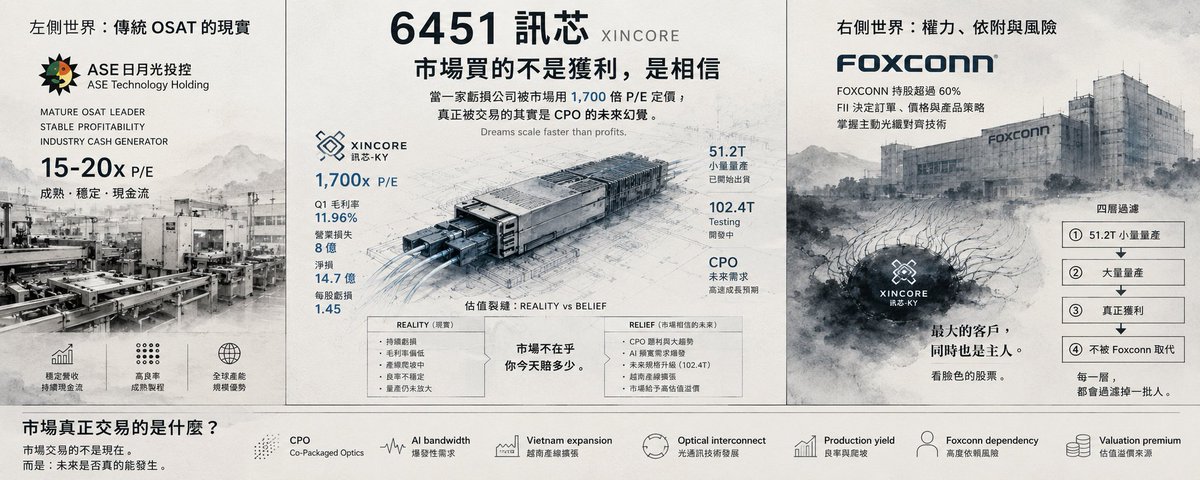
slowdiverse_ignorance retweeted

"But I’m very bullish on $SIVE since markets haven’t pieced together the connection to $POET and $MRVL yet."
$SIVE 100mW 파워 부족론은 아키텍처를 모르고 하는 말인 것 같습니다. SIVE 100mW가 부족하다는 비판을 종종 봅니다.
LITE, COHR, AAOI가 400mW ELSFP를 들고 나오는데 SIVE는 왜 100mW에 머무냐는 겁니다. 결론부터 말하면, 비교 자체가 틀렸습니다.
LITE/COHR/AAOI의 400mW는 고출력 레이저 1개를 스플리터로 나눠 여러 SiPh 엔진에 분배하는 ELSFP 구조입니다. 1:8 분기 시 9dB 손실에 커플링/변조 손실까지 더하면 출발 파워가 400mW 이상이어야 링크 버짓이 성립합니다.
LITE가 400mW UHP에서 800mW SHP, 나아가 1W로 bar를 올리는 것도 같은 논리입니다. (OFC 2026)
SIVE의 경로는 두 가지입니다.
첫 번째는 Ayar Labs SuperNova입니다. 16파장 DFB 어레이가 TeraPHY 광 I/O 칩셋의 각 레인에 스플리터 없이 1:1로 들어가는 구조입니다. 채널당 100mW면 충분합니다. ECOC 2024에서 이미 16 Tbps 양방향 라이브 데모가 완료됐습니다. 경쟁력은 파워가 아니라 파장 수(8→16λ)와 채널 균일성입니다.
두 번째는 POET Optical Interposer ELS입니다. SIVE DFB 레이저와 POET 인터포저를 결합한 칩스케일 통합 ELS 모듈로, H1 2026 프로토타입 고객 데모를 목표로 하고 있습니다.
POET는 단순한 부품 회사가 아닙니다. Marvell의 Celestial AI 인수 이후, Northland는 POET를 포함한 ELS 공급업체들의 장기 포텐셜이 구조적으로 개선됐다고 분석했습니다.
체인을 그리면 이렇습니다:
SIVE DFB 레이저 --> POET Optical Interposer ELS --> Marvell/Celestial AI scale-up 광 인터커넥트 생태계
시장은 SIVE를 소형 InP 레이저 회사로만 보고 있습니다만, Ayar Labs의 NVIDIA 전략적 협업을 통한 미래 노출, POET를 통해 Marvell CPO 생태계에 동시에 노출된 구조가 아닐까요?


Europe seems to be having a fun time from AI.
$LPK +20.69% - (glass core substrates) +20.69%
$IQE - 12.22% - (InP epiwafers)
$SOI +11.02% - (silicon photonics substrates)
$ALRIB +5.8% - (MBE / Quantum)
Then there’s $SIVE down -4.7% from a local Swedish hit piece, while $POET is up 40%+ after Marvell supplier confirmation.
But I’m very bullish on $SIVE since markets haven’t pieced together the connection to $POET and $MRVL yet.
Regardless, Europe has something to be happy about from being important to American hyperscalers.


slowdiverse_ignorance retweeted
I've been the first few to cover many supply chain photonic names.
Most are up 100-400%+ since I've posted.
Here's the TLDR overview of my thesis posts:
“Safest” Longs as of Today:
- $TSEM (Tower Semi)
- $SOI (Soitec)
- $COHR - Defensible compounders over time.
Soitec - Substrate monopoly over silicon photonics / CPO architectural ramp at dirt cheap valuation (after recent 40%+ rise maybe still 1.4x book)
Tower Semi - P/E in the 10's for 2028, 70%+ capacity booked already, $NVDA architectural partner, and basically the pure play $TSM of photonics.
Coherent - Basically does everything from materials/substrates to lasers to transceivers in photonics. As well as fundamental supplier to many other verticals.
Most High Beta/Extreme Growth Longs:
$AXTI - InP duopoly with Sumitomo (that getting export controlled), upstream feedstock duopoly with Vital.
Basically at the top of the entire photonics food chain is AXT. There's certainty export control risks, but my thesis is that if AXT goes down, the photonic buildout with AI goes down. So might as well go long on AXT.
$AAOI - 10x revenue ramp into 2027. Laser -> Design -> Assembly, Made in America. Main uncertainty is execution, scaling laser capacity that they've bought from $COHR, etc.
Demand from hyperscalers are all there. Can they deliver? I'd take the risk.
$IQE - Basically completely dependent on restructuring and clearing debt (~$200M MC). Known $LITE supplier for epiwafers, and their main competitor was Landmark with a $3.5B+ valuation.
The latent capacity is there with reactors, but they basically need to pull off a successful pivot over to photonics and cut off legacy drag for 10x rerating.
Highest risk out there, but maybe worth the reward.s
Long $GOOGL TPU Ecosystem:
$LITE - Basically very high BOM related to optical due to OCS monopoly for Google.
If you think Google TPU is a trillion dollar program that might end up like $NVDA, go long on $LITE.
Google has $175-180B capex planned for 2026, and their CTO for AI Infra said they plan to up that Y/Y, probably spending $1 trillion in the next 8 years.
If that holds up, $LITE is extremely undervalued relative to forward potential. Of course the supply lasers to other hyperscalers too, but I'd say it's more heavily tethered to Google growth.
_
There's a ton of others out there I've covered like:
$POET - I'm personally not long, but $400M balance sheet gives it good cushion. Just found Celestial from $MRVL ramp was too far out, eg. $500 million 2028, $1 billion 2029 projections, for revenue to be too material as of 2026.
It largely depends if their interposers get other hyperscaler qualifications rather than backdooring through Marvell, which was the main bull case.
$HIMX- I did find this thesis to be slightly compelling as a likely $TSM COUPE supplier.
But personally, I preferred $SOI, and would just put more concentration into that (since Soitec known supplier already to basically everything silicon photonics, and is just coming out of a downturn).
There’s a lot more like $NOK, $SHMN, that are interesting, but I’ve personally out concentration into the ones I find most compelling.
As “crowded names” like $LITE, it does not mean there’s no upside left. It just happens to be more priced in until there’s new news.
There's a lot of "critical suppliers" but there's a difference between importance in the supply chain...
And converting that into extreme revenue growth eg. $AAOI -> $4.5 billion in revenue.
But for TLDR photonics exposure, my portfolio looks similar to this:
High Concentration (Safer)
$TSEM foundry, $SOI substrate, $COHR everything
Mix of Long + CSP (High Volaility):
$AXTI substrate/feedstock, $IQE epiwafer, $AAOI transceiver supply chain
Then Long Google with $LITE

