

Delivering perspectives on energy and geopolitics for people who are open-minded and curious @foxggreen and @alexspcm
New York
Joined October 2018
- Tweets710
- Following119
- Followers1.1K
- Likes1.1K


Pinned Tweet
🎥Energy/Empire: Part 3 America’s Green Counter-Revolution
RFK Jr, The Environmental Law Industrial Complex and the eugenic origins of our cultural amnesia
What does it mean to be American? One thing becomes clear if we study our relatively short, but important history. We kicked off a new world paradigm in 1776 and since then, revolution and counter-revolutions have been at the heart of the battle for national sovereignty at home and across the globe. As the unipolar world order melts down in the 21st century, Americans must reconcile the current role we play on the international stage with the founding principles of our nation.
The Energy/Empire series sheds light on the cultural amnesia and indoctrination which has turned a once great nation into a servant of empire.
Part Three, America’s Green Counter-Revolution, dives into the career of Robert Kennedy Jr. and the environmental law industrial complex. We’ll take a closer look at several landmark cases including the shutdown of Indian Point Nuclear and the blocked Storm King Pumped Hydro Plant, as well as the books which laid the cultural groundwork for these legal cases such as Silent Spring and The Population Bomb.


Space Commune retweeted

For years, Americans have been told that conflict with China is inevitable. One power rises, the other must fall.
But that idea, the “Thucydides Trap,” isn’t American. The American idea, from Alexander Hamilton to Henry Carey to Franklin Roosevelt, is that nations grow richer by building rail, power, ports, science, industry. One nation’s prosperity can add to another’s.
Modern China’s founder, Sun Yat-sen, modeled his principles on Lincoln’s Gettysburg Address. In World War II, Americans and Chinese fought side by side, and both Chiang Kai-shek and Mao hoped to rebuild China with Roosevelt after the war.
China’s rejuvenation does not require America’s decline. America’s renewal does not require China’s destruction.
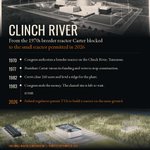
In 1981, the Energy Department photographed a finished piece of a reactor that did not yet have a building around it. It was the closure head, the steel lid that sits on top of the reactor vessel, with ports for the control rods. By then the vessel itself had been built, the sodium pumps were in testing and the steam generators were being shipped. The next year, crews cleared 240 acres beside the Clinch River in Oak Ridge, Tennessee, and leveled a ridge to make room for the plant.
But on October 26, 1983, Congress ended its funding, and the hardware was left with no plant to go into.
What was supposed to stand there was a breeder reactor; it's an ordinary reactor that burns uranium-235, which makes up less than one percent of natural uranium.
The other 99 percent, uranium-238, goes through as waste. A breeder, cooled by liquid sodium, turns that uranium-238 into fuel as it runs, so it ends up with more fuel than it started with.
With breeders, the uranium the United States has already mined, much of it sitting in spent fuel pools and enrichment tailings, would power the country for centuries without another mine being dug. The first electricity ever made from a nuclear reactor came from an experimental breeder in Idaho in 1951. Clinch River, at 350 megawatts, was meant to be the step between those experiments and a commercial fleet.
Jimmy Carter's anti-nuclear turn came after the spring of 1977, when the Ford Foundation published Nuclear Power Issues and Choices, a study run by the MITRE Corporation, which recommended putting off the breeder and the recycling of spent fuel.
Within weeks Carter announced exactly that. Members of the study group went into his administration to carry it out: Harold Brown as Secretary of Defense, Joseph Nye to run nonproliferation policy at the State Department, and the group’s chairman, Spurgeon Keeny, as deputy director of the Arms Control and Disarmament Agency.
Carter himself had come to the White House from the Trilateral Commission, David Rockefeller’s council of bankers and statesmen, and brought a good part of its membership with him.
The theory was that if America didn’t separate plutonium, other countries would follow its example. That November he vetoed the bill that funded the project, saying he meant to “terminate construction of the Clinch River facility.” Congress kept paying for it for six more years, and President Reagan supported it. But costs kept climbing, and the General Accounting Office put the final bill at $8 billion. In 1983 the votes ran out.
Other countries wisely didn't follow Carter's example. France built Superphénix. Russia connected the BN-600 breeder to its grid in 1980 and the larger BN-800 in 2016, and both are still running. India and China are building their own.
However, on September 29, 2026, the Nuclear Regulatory Commission issued the Tennessee Valley Authority a construction permit for Clinch River Unit 1. It’s a 300-megawatt GE Vernova Hitachi BWRX-300, and it’s the first permit for a commercial small reactor in the country. It will sit on the same ground that was cleared for the breeder in 1982. TVA’s filings with the NRC describe that site preparation, and the site has room for more units. TVA’s earlier target for first power was 2032.
The new reactor, it should be known, is not a breeder. It’s water-cooled and burns enriched uranium-235 like every other reactor in the American fleet. The site has waited forty-three years for a reactor, and it may finally get one.

Seven nuclear reactor projects moved forward this week on three continents, about 10,000 MW in all.
China connected Tianwan 7 to the grid. Turkey pressure-tested Akkuyu 1. Russia set equipment in its lead-cooled BREST reactor. Poland ordered its first reactor components. The NRC's draft review recommends licensing four AP1000s in Texas.

Space Commune retweeted

In 2025 Trump castigated China, India, and Europe for buying Russian energy.
In 2026 Trump is buying Russian energy.
Space Commune retweeted
Trump's midterm desperation:
1.) red-dye diesel waiver
2.) export ban threats
3.) promise not to hit Iran until after the election
4.) U.S.-Russian deal
All these things happened within a week.
Tianwan 7 was connected to the grid in Jiangsu on October 8. It is a Russian VVER-1200, the same reactor Rosatom is building in Turkey, Egypt and Hungary, and it was built by Chinese crews under CNNC. First concrete was poured in May 2021, so first electricity came five years and five months later.
For comparison, the last two American reactors, Vogtle 3 and 4, each took over ten years from first concrete to the grid. The American fleet of the 1960s averaged under six years, and Point Beach 1 was done in three and a half.
China is building today at roughly the pace the United States built at then, and Tianwan 7 is the fastest any VVER-1200 has been completed anywhere, including in Russia, where the four home units took eight to ten and a half years.
The reactor design is Russian, the construction program is Chinese, and the result is better than either country has managed alone with this machine. Unit 8 is scheduled to follow next year.

On March 8, 2022, the United States stopped buying Russian oil. On October 9, 2026, it agreed to resume doing so.
Unfortunately for Americans, the amount is small. A million tons a month is 248,000 barrels a day, when America burns 3.65 million and ships out 1.76 million.
Drawn to the same scale, Russia’s offer is a short bar under a long one. The Strait will have to reopen for diesel prices to fall. When that will happen is anyone's guess.
However, it is welcome news that the two largest nuclear powers on Earth are going to trade energy with each other once again.
In 2021, before the ban, Russia was the second-largest foreign supplier to American refiners, about 700,000 barrels a day of mostly feedstock. Russia has not confirmed the news, and it an export ban of its own to lift first.
Roosevelt recognized the Soviet Union in 1933 and American engineers built the Gorky auto works and the Dnieper dam. In 1972, in the middle of the Cold War, Nixon sold a quarter of the American wheat crop to Moscow, and American equipment went into the Kama River truck plant.
Russia’s refineries are running at three-quarters of last year’s capacity, while America’s refining fleet has shrunk by nearly a million barrels a day since 2020 and is running flat out at 93%.

Right now, 80 nuclear reactors are being built.
Not planned, not proposed. Concrete is being poured, vessels set, and people in hard hats are on site this morning. Eighty-seven gigawatts of them, across seventeen nations.
It's enough new capacity, once it’s running, to generate more electricity every year than Germany uses.
The usual way to read that number is as a competition. China is building thirty-eight of them, and the West has to catch up, energy dominance etc.
We’re not interested in that. Eighty nuclear plants are humanity’s pool of reactors.
Ten of the eighty are a nation’s first reactor, ever:
Turkey has never generated a nuclear watt. Neither has Egypt. Neither has Bangladesh. Four units at Akkuyu, four at El Dabaa, two at Rooppur, and three countries with a combined 300 million people join the club that started with the first reactor at Shippingport in Pennsylvania in 1957.
Six of the eighty are hollow on the card. Khmelnitski 3 and 4 in Ukraine broke ground in 1986 and 1987 and have been “under construction” longer than most of the people who’d operate them have been alive. Angra 3 in Brazil, Ohma and Shimane 3 in Japan, Argentina’s little CAREM, each one a decision that was made and then unmade, a capability bought and left on the shelf.
And one country isn’t on the card at all. The nation that built the first commercial reactor, that once had a hundred of them under construction at the same time, is building zero.
The permits are moving again, and this week’s Federal Register carried construction-permit filings for new units at Palisades and a new plant on the Texas coast, but that doesn't count quite yet.

Space Commune retweeted

Before it handed out heat-pump rebates and solar incentives, the agency we now call NYSERDA had a different name, and a much bigger idea of itself.
In 1962, New York created the Atomic Research and Development Authority. Two years later, the Legislature added a word. As of September 1, 1964, it was the Atomic and Space Development Authority.
It meant it. On February 4, 1964, the authority bought the Malta Test Station in Saratoga County from the federal government. In the agency’s own words, it was “the nation’s original rocket development and test installation.” The authority wrote that the American rocket program “was born at the Malta Station in 1945,” when the Army built a copy of Germany’s wartime V-2 test site in the woods north of Schenectady. Malta had six test stands, able to fire rocket engines of up to 250,000 pounds of thrust. Washington had put about $15 million into the site, and New York paid $330,000.
The goal was written down plainly: to make New York State “a focal point of the American aerospace industry.” The agency planned a Space Technology and Atomic Radiation Center at Malta. By 1967, business at the station had more than tripled.
When General Electric pulled out of Malta in 1972, the space work ended. But the agency still had its atomic mission, and in 1975 one assemblyman set out to end that.
Daniel Haley, a Democrat from Waddington in St. Lawrence County, was the Legislature’s leading opponent of nuclear power. Newspapers covered him under headlines like “Haley Proposes Halt To Nuclear.” He fought the Power Authority’s nuclear plans for the North Country and its 765,000-volt line from Quebec.
His 1975 bill, the “Safe Energy Act,” began as a moratorium on new nuclear plants.
The Legislature stripped out the moratorium, but kept the rest. Haley’s law took the Atomic and Space Development Authority and reconstituted it as the Energy Research and Development Authority, “with special emphasis on renewable energy sources, and energy conservation technologies.” Its purpose, in the words of the time, was “to reduce future dependence on nuclear power and oil.” An agency founded to bring New York the atom was rebuilt to wean New York off it.
Haley campaigned on it the next year, with ads that read: “Haley Bill Created NYSERDA.” He lost his election campaign.
In 1980, NYSERDA gave its Hermes rocket to the Smithsonian. In 2017, its board voted to sell the rocket base, calling it “outside of NYSERDA’s core mission.” Most of it is still for sale.
But the agency built to wean New York off nuclear power now writes the checks that keep New York’s nuclear reactors running. The state has ordered its Power Authority to build new nuclear. And the old rocket base sits next door to one of the most advanced chip factories in America.
New York was once the state that bought a rocket base because no one else would. It was the state that put “Space” in the name of a government agency and meant it. It was the state that said that it wanted to be “a focal point of the American aerospace industry.”
That New York built the Niagara and St. Lawrence power projects in under five years each. It ran the biggest generator in the world on the Queens waterfront, and it planned reactors on artificial islands in the harbor.
It’s time for New York to look up again. Take the base off the market. Put the atom back in the mission. And give the agency back the ambition it had when “Space” was in its name.

Space Commune retweeted
The Malthusian Caucus strikes again!


🚨 NEW YORK SOCIALISTS OPPOSE NEW NUCLEAR 🚨
In a depressing new state filing, all of the DSA Socialists in Office slate serving in the state legislature have joined other state Dems in opposing the governor's landmark Nuclear Reliability Backbone initiative. Specifically, they "oppose the use of any taxpayer or ratepayer subsidies to support the construction of new nuclear power plants in New York." Why? Because, they argue, nuclear is too expensive, too slow, and what-about-the-waste. The same old New Left shit.
When will Zohran's abundance left approach be applied to energy? When will DSA abandon its green NGO advisors on energy issues?
documents.dps.ny.gov/public/…


"The American School of Political Economy is based on the principle of harmony, to the benefit of all mankind—the antithesis of British political economy and Marx’s doctrine of class struggle.

This principle is executed through the act of increasing the productive powers of labor. Archimedes famously stated “Give me a place to stand, and I will move the Earth."
Read @FoxGGreen's latest: americanthesis.substack.com/…

Space Commune retweeted

If you are in the Hudson Valley, you need to get to this meeting with @MeredithAngwin. She is one of the best in the business.

IN PERSON EVENT: Join us in the Hudson Valley on August 20 for a very special evening with @MeredithAngwin, The Electric Grandma and author of Shorting the Grid.
As over a half-dozen battery plants target the Hudson Valley to meet a 6 GW state mandate, good information about how the grid works is needed more than ever to help keep local citizens informed and engaged.
In plain English, Meredith with engage with local residents about how their energy grid works, why their bills are going up, and what power sources are keeping their lights on.

Space Commune retweeted
Me n my crew made Twitter history that day

Space Commune retweeted
Mamdani, alongside Schumer and AOC, led the fight against the NRG Astoria Gas Turbine Power Repowering Project in 2021.
It would've turned an ancient plant of 31 oil-and-gas turbines into one modern fast-ramping unit.
Instead, the DEC retired 646 MW with no replacement.

New York ISO just issued an early warning that we must alleviate the strain on our energy grid statewide.
Please do your part in keeping our power on by:
•Setting your AC to 78 degrees.
•Turning off lights and unplugging electronics you’re not using.
•Waiting until early morning or late at night to run appliances like dishwashers or laundry machines.
During a historic heatwave, AC will save lives — but only if we keep the grid stable enough for it to stay on.
Space Commune retweeted
“We should growth the economy for war” is equally—if not more—stupid as its inverse: “we should degrowth the economy for peace.”
