

Tesla, SpaceX, Starlink, Boring and Neuralink, with the math behind the headlines. Drug safety pro by day. Montreal 🇨🇦
Canada
Joined November 2022
- Tweets3.8K
- Following481
- Followers2.6K
- Likes5.9K




Pinned Tweet
Five years ago, Starlink wasn't on a single ship. Now it's on 66,866. That's more ships than every provider had combined back then.
Before Starlink, if you were a sailor, your internet came from Inmarsat. An unlimited plan cost €3,259 a month for 2 Mbps, and the whole crew had to share it.
Then Starlink showed up in 2022 at US$5,000 a month for up to 350 Mbps. In 2027, a plan that covers an ullimited whole cargo ship comes in at US$4,650.
OneWeb, the closest rival in low orbit, is on 1,662 ships. Its cheapest unlimited plan is about US$7,400 a month, and it maxes out at 30 Mbps.
Market share at sea, by revenue:
2021: Inmarsat almost a third, Starlink 0%
2024: Starlink 39%, the biggest
To be fair, Inmarsat and OneWeb guarantee a minimum speed and Starlink doesn't. Some fleets still pay extra for that.
Zero to number one in four years, and still the cheaper option. That's hard to compete with.


Starlink round up.
Starlink Mini is US$99 in the US right now, just in time for Black Friday. Here in Canada it's C$149, down from C$299.
Both dropped 150 bucks in their own currency. The cheapest Roam plan is US$55 a month down there and C$75 here.
Starlink hasn't said when the deal ends.
If you've been waiting on a Mini, I'd grab it now and just budget for the plan, because that's the real cost.
teapawt.net/Starlink/status/212531…

1
10
616
SpaceX turned down about US$738M in US rural broadband subsidies, and the fine print shows why it's still a good deal for SpaceX.
What it still owes about 470,000 rural homes for 10 years: 100/20 Mbps, latency under 100 ms on 95% of tests, service within 10 business days of a request, the dish free (shipping extra), and a low-cost plan.
What it gets: no letters of credit, no insurance requirement, no fines or penalties. If service falls short, the state's only remedy is to take those homes back. States also agree not to enforce rate rules or net neutrality on Starlink anywhere in the state while the deal runs. And those homes now count as served, so competitors can't get BEAD money to wire them.
One thing a lot of posts got wrong: the dish is free, the service isn't. People still pay the monthly bill.
Giving up about US$1,550 a home to skip dozens of different state contracts and hold those homes for 10 years looks like a good trade for SpaceX.
2
7
462
Steph Debour retweeted

Amazon is moving its next SpaceX Falcon 9 launch for its Amazon Leo constellation up to December from next year. Several more Falcon 9 launches are set to follow quickly, after ULA's Vulcan was grounded by the Nov 15 failure that lost 40 Leo satellites.

Amazon surges launches with rival SpaceX after ULA fails to deliver arstechnica.com/space/2026/1…

Steph Debour retweeted

Japan's largest-class battery storage plant, built with 140 Tesla Megapacks, starts operating on December 1 🇯🇵
• Rated at 134 MW and 548 MWh, at the Maibara Kotō plant in Shiga Prefecture.
• One full daily charge and discharge equals the daily electricity use of about 51,000 Japanese households.
• ORIX built it on about 25,000 m² of land leased from Maibara city.
• It goes live ahead of the 2027 start Tesla Japan announced in February 2025.

One TSLA share was worth 3.06 SpaceX shares at today's close. Yesterday it was 2.89.
SPCX fell 5.6% to US$125.86 after a New York Times report on SpaceX's AI compute spending, while TSLA barely moved at US$384.68. That moved the market's implied ratio by almost 6% in one day, before any deal terms exist.
The FT says the two boards' special committees are still modelling the exchange ratio for an all-stock deal, with a year-end target, and aren't close to agreeing. If SpaceX ends up issuing the shares, every red day for SPCX means it has to hand over more of them.
6
16
4,265
Steph Debour retweeted

Manitoba calls Tesla EV rebate exclusion a budgetary decision despite past comments about Musk and tariffs
driveteslacanada.ca/news/man…

Steph Debour retweeted

Geordie and Jess Flanagan run two home businesses on Salt Spring Island, B.C. Starlink keeps them connected at home and on remote job sites where other services drop out → starlink.com/saltspring

Steph Debour retweeted

SpaceX has agreed to forgo $738 million in U.S. federal broadband subsidies and instead provide free @Starlink hardware to eligible American households.
NTIA: "To ensure that no consumer at a Covered BSL is left behind, the provider (SpaceX) will serve the covered BSLs as this agreement provides. This includes providing customer premises equipment at no cost to new subscribers, so that households at covered BSL do not face the upfront equipment costs. Additionally, the provider’s broadband service will be subject to the same delivery timelines and performance testing requirements applicable to all recipients of BEAD funds."
Under the new agreement, SpaceX would:
• Provide free Starlink hardware to eligible households.
• Guarantee minimum download speeds of 100 Mbps and upload speeds of 20 Mbps.
• Offer a low-cost monthly internet plan.
• Commit to providing service for 10 years.
• Continue to comply with federal performance testing requirements.
The agreement will save American taxpayers hundreds of millions of dollars while accelerating high-speed internet access in underserved rural communities.
In exchange, SpaceX would be exempt from most BEAD-related financial audits, procurement requirements and administrative reporting, while remaining subject to network performance testing.


Steph Debour retweeted

SpaceX has asked South Africa's Parliament to accept equity-equivalent investment programmes (EEIPs) as an alternative to the 30% historically disadvantaged ownership rule for telecom licences, as part of its push to launch Starlink there.
• The request is in its submission on the Electronic Communications Amendment Bill
• It wants the Electronic Communications Act, the B-BBEE Act, the ICT Sector Code and Icasa's ownership rules aligned under one framework
• It also backed the bill's "use it or share it" rule, so Icasa can reassign spectrum left idle for two years, which SpaceX says would help rural and underserved areas
• Minister Solly Malatsi supported the recognition of EEIPs in a policy direction in December 2025, but Icasa said the law must change first
sundayworld.co.za/business/e…
Icasa already said the law has to change first, and that request is now in front of Parliament.


Neuralink wants to end back pain one day. There's already an implant for that, it doesn't go in your brain, and it works.
It sits on the spinal cord. In 2024 the FDA approved Boston Scientific's version for low back pain, even for people who never had back surgery.
In the study behind it, 90 of 105 patients had their pain cut at least in half after a year.
It doesn't fix the disc. It turns down the pain signal on its way to the brain.
Neuralink hasn't announced a pain trial yet. Its studies so far are about controlling devices after paralysis, ALS and stroke.
So Neuralink isn't starting from zero here. It has to beat something that already works.
teapawt.net/elonmusk/status/212518…

4
7
384
Steph Debour retweeted
WattEV has taken delivery of its first Tesla Semis of its 300+ truck fleet at the Port of Oakland. evwire.com/p/wattev-tesla-se…

Lucid, Nuro and Uber just took the safety driver out in the Bay Area.
The driving is Nuro's end to end AI model, backed by lidar, radar and cameras, and it only runs inside geofenced areas.
Lucid builds the car, Nuro's AI drives it, and Uber owns it. Uber's order went from 20,000 cars last year to at least 35,000. Public rides start Q1 2027.
Tesla is using the same kind of AI with cameras only, on cars it builds itself.
Three companies taking a cut of each ride, against one. Same idea, very different cost per car. teapawt.net/SawyerMerritt/status/2…

Lucid, Nuro and Uber have announced the start of fully driverless Robotaxi testing on public roads in the San Francisco Bay Area, with no safety driver behind the wheel.
• Driverless employee rides will begin soon.
• Public launch is expected in Q1 2027.
• Testing will expand to additional Bay Area cities in 2027.
Uber has committed to purchasing at least 35,000 Lucid vehicles equipped with Nuro’s autonomous driving technology, with plans to expand the Robotaxi service across dozens of global markets over the coming years.
The vehicles will be owned and operated by Uber and its fleet partners and available exclusively through the Uber app.
1
5
350
Starlink round up.
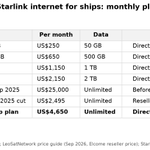
Starlink has a new plan for a whole cargo ship: US$4,650 a month, starting in 2027.
Unlimited Starlink on a ship used to cost US$25,000 a month. That's 81% less.
Also:
- The FCC wants to treat foreign satellite companies in US the way their countries treat Starlink. Vote in December.
- United's first Starlink 767 flew out of Rio. Starlink has now 52% of United's daily flights.
- Aer Lingus started free Starlink on European flights.
The biggest ship plan on Starlink's site is 2TB for US$2,150 a month. For about twice that, the cap is gone.

Steph Debour retweeted

🚀 Liftoff of Leo Europe 4 🚀

🚀 Four boosters. One powerful liftoff!
Relive the moment Ariane 6 lifted off from Europe's Spaceport in French Guiana for its 10th flight!
Powered by four P160C solid rocket boosters, Ariane 6 began its VA271/LE-04 mission carrying 36 Amazon Leo satellites into low Earth orbit.
🔥 Watch the liftoff again!
Want more of VA271/LE-04 mission?
Watch the live: arianespace.pulse.ly/m377s2e…
#LaunchingAmbitions #Ariane6
@AmazonLeo @ArianeGroup @esa @CNES @EuropeSpacePort
Steph Debour retweeted

LAUNCH! Ariane 64 launches Amazon Leo (LE-04) from ELA-4 Guiana Space Centre, French Guiana.
Arianespace live: youtube.com/watch?v=k2adMyxS…
Steph Debour retweeted
Getting online with Mini 2 is simple. Press the button and you're connected in 60 seconds, with a rechargeable battery that lasts up to 4.5 hours, or plug in with USB-C.
Preorders are open by invitation in the US. Get notified when it's available → starlink.com/mini-2
Steph Debour retweeted
Starlink now has 12,027 internet connections in La Pampa, Argentina, and ranks among the province's top five providers.
From the EMPATEL 2026 Connectivity Report:
• Satellite is 7.5% of the province's 161,286 connections, and Starlink holds 12,027 of the 12,054 satellite links
• Casa de Piedra is 66.7% satellite, Limay Mahuida 60.6%
• Rural connections rose 47.5% in two years, from 2,313 to 3,411, and satellite now carries 52% of them
• 85% of satellite connections are in urban areas, led by Santa Rosa with 1,921
• Five western departments went from 4 to 24 Mbps averages in 2024 to over 110 Mbps today
Most of La Pampa's Starlink users live in towns, where it competes with fiber and cable.
impactocastex.com.ar/la-pamp…