
Independent, data-driven, puzzler - No Dms.
Florida
Joined December 2023
- Tweets6.6K
- Following943
- Followers526
- Likes11.7K





SMiller retweeted

There will be almost no liberal news outlets or liberal "journalists" who read or report on the contents of this USAID release, despite how obviously newsworthy so many of the documents are.
That's how these information bubbles work: liberals won't even know it happeend.

If you ever questioned why Democrats lost their minds when DOGE looked under the hood of USAID — you know now.
It’s the biggest money laundering scam perpetrated on the American taxpayer in U.S. history.
I took it on as MO AG in MO v Biden and led the Rescissions bill in the Senate that ripped away $9B from the corrupt organization — but so much more must be done.
I’ve seen the leftist NGO industrial complex and what they are willing to do with money and power and it’s mind boggling. It’s even bigger than USAID and the Democrats are coming into Congress with the stated purpose of empowering the foreign policy establishment all over again.
To counter this Republicans should rally around the idea of cutting the outrageous funding we send overseas. Enough.
Also, DOJ should investigate further. How far does the corruption go? The American people deserve to know.
SMiller retweeted

WSJ is now walking back the Jensen Huang spy story that was based on nothing more than anonymous leaks.
Mainstream media ain't what it used to be.
zerohedge.com/ai/no-smoking-…

SMiller retweeted

Suggest you check on what advocacy and accountability “journalism” has done to the profession IN THE EYES OF CITIZENS
The reason no one trusts journalism today is because the entire industry, essentially, picked a side and went to war for them. (Left and right)
Certainly you know this to be true Jesse.

SMiller retweeted

Independent reporting long ago became advocacy on behalf of a political party without regard to the facts or the truth.

SMiller retweeted

The American people don’t want more government in healthcare. We want a free-market system where price transparency and competition drive costs down.
More government is never the answer.

SMiller retweeted

I have it from a solid source that NVIDIA CEO Jensen Huang used to pinch people's noses and say, "I got your nose"


SMiller retweeted

"I came here to eat, not to hack into the Pentagon" 😂
Who is this absolute queen?! I'm crying 😂😂😂
SMiller retweeted

♥️The rarest and most beautiful connection has little to do with physical attraction. It’s finding someone whose mind feels familiar to yours; someone who shares your sense of humor, understands the way you see the world, and honors the battles you’ve fought, even if they’ve never had to fight them themselves. Most importantly, it’s someone who never makes your presence feel like an obligation, but rather a privilege. Someone who sees time with you as something to cherish, not something to endure.
Because life is far too short to settle for a connection that leaves you questioning your place in someone’s life. Choose someone whose presence feels like peace, whose mind captivates you, and whose heart makes you feel genuinely wanted.♥️

SMiller retweeted

Roger Ebert on political correctness. Oh, for this kind of clarity on the mainstream Left today.
SMiller retweeted

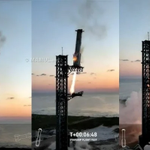
How many young lives did @elonmusk, @Gwynne_Shotwell, Bret Johnsen, and the entire SpaceX Team inspire to explore “the new world” as Mechazilla’s chopsticks caught Starship this weekend? God bless America as we enter the beginning of the mind-blowing beginning!

SMiller retweeted

This is what Elon Musk’s companies have done in the last 73 days
The world’s greatest entrepreneur.
SMiller retweeted

I was unaware of all these complications.

Have you ever wondered why catching Starship is so much harder than catching Super Heavy, even though they both return to the same launch tower? 🔥
💡 The answer comes down to four major engineering challenges that make Starship’s recovery fundamentally different 👇
⚡ The first problem is shedding an enormous amount of energy
At hot staging, Super Heavy was traveling at roughly 5,800 km/h (3,600 mph). Starship, meanwhile, had to return from orbital speeds of roughly 27,500 km/h (17,100 mph).
That’s nearly five times faster. Because kinetic energy increases with the square of velocity, each kilogram of Starship at orbital speed carries roughly 22 times the kinetic energy of a kilogram of Super Heavy at separation.
That works out to nearly 30 million joules per kilogram.
Almost all of that energy has to be dissipated before Starship can safely reach the tower.
One option would be to use rocket propulsion to cancel out its orbital velocity. However, scrubbing off roughly 7.7 km/s of speed using Raptor engines alone would require a massive amount of propellant.
The rocket equation makes this approach especially punishing. Every extra kilogram of landing propellant has to be hauled into orbit first, dramatically increasing the fuel needed at liftoff.
Instead, SpaceX uses Earth’s atmosphere to bleed off almost all of Starship’s orbital velocity.
That saves an extraordinary amount of propellant, though it introduces another major hurdle.
🔥 Surviving extreme atmospheric heating comes next
As Starship plunges into the atmosphere at hypersonic speeds, powerful shock waves compress and heat the surrounding air to blistering temperatures.
Thousands of ceramic heat-shield tiles protect its stainless-steel structure from the intense heat.
Simply keeping those tiles attached isn’t enough, though. Superheated gas can seep into the gaps between them, risking damage to the underlying structure.
For Flight 15, SpaceX carried forward upgrades from Flight 14, including extra tile-retention hardware in vulnerable areas and redesigned curved tiles that reduce heating between adjacent tiles.
Because Super Heavy never reaches orbital velocity, its return doesn’t expose it to anything close to the same thermal stress.
And there’s another complication.
A heat shield that survives one reentry isn’t necessarily ready to fly again. Starship’s thermal protection system must eventually withstand repeated missions without major repairs or refurbishment.
That’s critical, since rapid reusability is one of the core reasons SpaceX designed Starship to be caught rather than discarded.
Yet surviving reentry still isn’t enough. Starship also has to arrive at the exact right spot.
🎯 Hitting a precise target from orbit raises the stakes even further
About 56 minutes before the catch, a single Raptor engine fired for just 10 seconds to initiate Starship’s return.
That brief deorbit burn wasn’t meant to eliminate orbital velocity. Instead, it nudged the spacecraft’s trajectory so atmospheric drag could take over the much larger job of slowing it down.
Starship then entered the upper atmosphere thousands of kilometers away over the Pacific Ocean.
From there, its four aerodynamic flaps controlled its orientation and fine-tuned the forces acting on the vehicle.
Super Heavy uses grid fins to steer during its return, but Starship’s flaps have to handle a far wider range of flight conditions.
As Starship decelerates from hypersonic through supersonic and down to subsonic speeds, its guidance system continuously adjusts its attitude and flight path.
The challenge is maintaining the right balance of altitude, speed, and trajectory while aerodynamic forces shift dramatically throughout reentry.
For Flight 15, the return corridor crossed sparsely populated parts of northern Mexico and South Texas.
Starship maneuvered around major population centers in the Rio Grande Valley, passed north of South Padre Island, headed offshore over the Gulf of Mexico, and made its final turn toward Pad 2 at Starbase.
Think about the guidance precision required.
A spacecraft returning from orbit must dissipate nearly all of its immense kinetic energy while threading a carefully controlled trajectory straight back to a single launch tower.
It also has to arrive at a low enough speed, in the proper orientation, and with enough propellant remaining to pull off the final maneuver.
That brings us to the most visually spectacular part of the entire recovery.
🚀 Executing the landing flip with pinpoint precision is the final test
Super Heavy approaches the launch tower already vertical, using its grid fins and Raptor engines to guide its final descent.
Starship comes in belly-first.
It has to rapidly swing its massive frame upright, stabilize its attitude, and align itself precisely between the tower’s mechanical arms.
SpaceX’s official Flight 15 timeline allotted just 18 seconds between the start of Starship’s landing burn and the catch.
During those 18 seconds, three sea-level Raptor engines ignite to kick off the maneuver.
The spacecraft rotates upright while its flight computers constantly regulate engine thrust and vehicle attitude.
The engines then step down from three to two, giving the vehicle finer control as it nears the chopsticks.
Finally, it transitions to a single engine for the last moments of descent before shutting down as the tower takes its weight.
Consider the coordination involved.
The guidance system must balance translation, rotation, thrust, and descent rate while positioning a massive spacecraft within a narrow capture envelope.
Unlike a conventional vertical rocket landing, Starship must first transition from an aerodynamically controlled, belly-first glide to an engine-powered vertical approach.
All of this unfolds within seconds, right after the vehicle has completed one of the most punishing atmospheric reentries ever attempted by a reusable spacecraft.
🧠 What makes SpaceX’s approach so ingenious is how seamlessly the entire recovery system works together
Trying to solve every phase of the return with rocket propulsion would carry a crushing propellant penalty.
Instead, SpaceX delegates the toughest parts of the recovery to systems purpose-built to handle them.
The atmosphere dissipates most of the orbital kinetic energy without consuming onboard propellant.
The heat shield protects Starship from the intense thermal loads of that deceleration.
The four aerodynamic flaps provide the control authority needed to manage its attitude, energy, and trajectory throughout atmospheric flight.
And the Raptor engines take over once aerodynamic control alone can no longer deliver the precision needed for the final catch.
That division of labor allows SpaceX to recover an orbital spacecraft without carrying enough fuel for an all-propulsive return.
Yet the engineering trade-off goes deeper than saving propellant.
SpaceX is shifting much of the cost of returning from orbit away from expendable propellant and toward reusable hardware built to endure extreme thermal and mechanical stress.
The potential economic payoff is enormous.
Cutting back on the propellant reserved for recovery frees up more of Starship’s mass capacity for useful payload. However, that advantage only becomes truly meaningful if the heat shield, flaps, engines, and other systems can survive repeated flights without extensive refurbishment.
That’s why catching Ship 42 is such a landmark milestone.
SpaceX has proven that its thermal protection, aerodynamic controls, propulsion, and guidance systems can work in concert to recover an orbital upper stage right at the launch site.
The next engineering hurdle is proving that the same spacecraft can do it repeatedly.
If SpaceX can bring Starship home, inspect it, refuel it, and launch it again without rebuilding major systems, the economics of getting payload to orbit could change dramatically.
That first catch proves the recovery architecture works. Repeated reflights will determine just how much of its economic potential SpaceX can unlock.
SMiller retweeted
💯🎯
We're in an existential struggle with China over *the* defining technology of the next century.
And a second existential struggle whether AI will be open-source free of government control -- Jensen's goal. Or a government-allied oligarchy.
Unless Jensen provably broke laws, he should be brought back.

David Sacks: Jensen Huang’s Exit Is a Big Win for China
“You ask the question ‘Cui bono? Who benefits?’ It's China. China benefits from this.
Jensen's been working on GPUs for over three decades. The chips are being improved rapidly. There's a new generation of chips that come out every year.
And it's that momentum, it's the ability to tape out a brand-new chip that's several times more powerful than last year's chip, that's the real advantage.
It's Nvidia’s competitive advantage, and it's America's advantage. It's the momentum, it's the dynamism.
People get way too hung up on some chip that was state-of-the-art four years ago. That's not where the United States has the advantage. It's that we are rapidly iterating, and we keep coming up with better and more powerful chips.
Now, let's take into account what's just happened. Do you think that Nvidia is going to lose a tempo or two? Absolutely.
Nvidia’s success was based on the ability to tape out a new chip design every year, and Jensen is fundamental to that rapid progress, the same way that Elon is fundamental to the rapid progress at SpaceX or Tesla.
And if you take him out of the picture, there's just nobody comparable.
It means that Nvidia’s chips will not continue to advance at the same pace. That's really good news for Huawei because they will catch up a lot faster.”
SMiller retweeted
Huang helped make America the center of the AI revolution, created trillions in wealth, and is a leading champion of open-source to break the Sam Altman-Anthropic AI oligarchy.
I think shareholders will forgive him for occasionally thinking with the wrong processor.


SMiller retweeted

Mises obliterated the entire socialist project in 1920 with one devastating insight: "Where there is no free market, there is no pricing mechanism; without a pricing mechanism, there is no economic calculation." The socialists spent the next century pretending this problem didn't exist while their economies collapsed around them.
And yet here we are, watching politicians promise they can "fix" healthcare, housing, and energy markets through central planning. They can't even calculate the cost of their own programs correctly — how exactly are they going to allocate resources across an entire economy?
Every Venezuelan breadline, every Soviet grain shortage, every Chinese famine was just Mises being proven right in the most brutal way possible. But sure, let's try democratic socialism this time. What could go wrong?
SMiller retweeted

This is from a fascinating exchange between the unnamed writer below and Mark Cuban on health care and who should pay for it.

Mark, you started by saying we have no idea what healthcare costs to buy or to provide in this country. None. Then your conclusion is to propose that the people who cannot see the costs should be the ones to run it.
There is a reason nobody knows what anything costs, and you listed it yourself. Medicaid, Medicare, supplemental plans, Medicare Advantage, self insured employers under a tax code that hides the premium in the paycheck. Every layer you named is a government program or a government created structure, and in every one of them the person getting the care is not the person paying for it. That is where the price went. Prices exist where buyers pay. Remove the buyer and you get exactly the fog you are describing. Universal care removes every buyer who is left.
Then look at what you are asking for. Every private contract in the industry published by federal order. Every claim in the country handed to state and federal researchers. The DOJ turned loose on the pricing structure. Bipartisan legislation to work out what care we need to provide and what it should cost. That is not a market reform. That is the state seizing the information of an entire industry so it can set the terms of trade for every doctor, hospital, and patient in the country. You call the conglomerates Too Big To Care. The entity you want running it is the only one with a monopoly on force.
And the number. The post you are replying to has CBO at $3 trillion a year in new federal spending, 21.4 percent of payroll, with the author conceding it is illustrative and not scored. You respond that nobody knows the real cost and we should find out after we commit. No investor you have ever met would fund a company on those terms, and you have never funded one that way yourself. Only government gets to spend money first and discover the price later, because only government can send the bill to people who did not agree to it.
The information asymmetry you are describing is not a reason to negotiate blind. It is a reason to stop having a single buyer negotiating at all. Put the patient back in the transaction and prices appear on their own. Cost Plus is proof that you already know this.
Mises showed a century ago that a planner without prices cannot calculate, Hayek showed why the knowledge he needs is never in one place, and Rand showed why he has no right to try. You are proposing to prove all three wrong with a commission while you admit no one has any idea how much all of it will cost. Do you think they did not know what they were talking about, or do you just not want to find out?
SMiller retweeted

Mark, you started by saying we have no idea what healthcare costs to buy or to provide in this country. None. Then your conclusion is to propose that the people who cannot see the costs should be the ones to run it.
There is a reason nobody knows what anything costs, and you listed it yourself. Medicaid, Medicare, supplemental plans, Medicare Advantage, self insured employers under a tax code that hides the premium in the paycheck. Every layer you named is a government program or a government created structure, and in every one of them the person getting the care is not the person paying for it. That is where the price went. Prices exist where buyers pay. Remove the buyer and you get exactly the fog you are describing. Universal care removes every buyer who is left.
Then look at what you are asking for. Every private contract in the industry published by federal order. Every claim in the country handed to state and federal researchers. The DOJ turned loose on the pricing structure. Bipartisan legislation to work out what care we need to provide and what it should cost. That is not a market reform. That is the state seizing the information of an entire industry so it can set the terms of trade for every doctor, hospital, and patient in the country. You call the conglomerates Too Big To Care. The entity you want running it is the only one with a monopoly on force.
And the number. The post you are replying to has CBO at $3 trillion a year in new federal spending, 21.4 percent of payroll, with the author conceding it is illustrative and not scored. You respond that nobody knows the real cost and we should find out after we commit. No investor you have ever met would fund a company on those terms, and you have never funded one that way yourself. Only government gets to spend money first and discover the price later, because only government can send the bill to people who did not agree to it.
The information asymmetry you are describing is not a reason to negotiate blind. It is a reason to stop having a single buyer negotiating at all. Put the patient back in the transaction and prices appear on their own. Cost Plus is proof that you already know this.
Mises showed a century ago that a planner without prices cannot calculate, Hayek showed why the knowledge he needs is never in one place, and Rand showed why he has no right to try. You are proposing to prove all three wrong with a commission while you admit no one has any idea how much all of it will cost. Do you think they did not know what they were talking about, or do you just not want to find out?

We have no idea what healthcare costs to buy or costs to provide in this country. None.
States cover Medicaid at some level, but not all offer the same care. Nor do they all receive federal support in the same way.
Traditional Medicare requires supplemental and drug coverage. All of which differ by plan, and are offered by mostly huge conglomerates we should break up and are Too Big To Care
Medicare Advantage is all offered by those same Too Big To Care conglomerates. Every contract with a provider differs and while those contracts have pricing that is transparent, the fees and other charges are not.
67 pct of employees that get coverage from work get it from a self insured employer. I can tell you with absolute certainty that most get it from the same conglomerates as well. As a results they have zero idea how much they are paying for medical care or medications (even with recent legislation)
Every thing that is covered and paid for in this country has an actual cost, across the direct costs and indirect costs, that is hidden by the Too Big to Care conglomerates that should be broken up.
Market Dominant hospitals and most non profit hospitals are not innocent. They play along when they have to, use their own leverage when they can. Increasing the cost of care.
And the PBMs that are owned by the conglomerates have bastardized the cost of brand and specialty drugs in a way that should be investigated by the DOJ.
Put simply , HUGE dominant distributors are forced by PBMs to pay RETAIL Price for drugs that make them unaffordable to everyone.
If we want universal care, we can say the Feds will negotiate , but the information asymmetry is so insane, they will be negotiating blind.
The first thing a bi partisan legislation should do is require that all healthcare contracts be made public with no redactions other than personal information
AND
All claims be de-identified and available exclusively to state and federal researchers to determine what care and medications COULD cost.
Then we can start to extrapolate what care we need to provide and then determine what it costs and whether it will save or cost us money.
In parallel we can determine how we will deal with the technology and processes to handle implementation of some version of universal care