

All-In $MSTR Strategy Insights 👉https://xitter.cf/t.co/pQ8QfFO9Ue Support Me: X Money → @StrategyMaxi Send me USDC at 0x91b377e45165f45905cbd46A9D34c638e9282934
Strategy
Joined May 2024
- Tweets25.1K
- Following18
- Followers11.6K
- Likes11.3K




The Strategy ₿et retweeted
When SATA was at 10-20% of STRC volume, we warned that if Saylor continues promoting Strive, we will see SATA volume continue to climb relative to STRC.
The reason was not complicated.
Saylor has 5.2 million followers.
STRC and SATA are majority retail owned products.
If Saylor posts about Strive products… Retail will buy Strive products.
We asked at what point we should begin to be worried.
When SATA is 40% of STRC dollar volume?
50%, maybe?
60%?
We didn’t receive an answer.
Not only was our question ignored, it was indirectly mocked and condemned.
We now see SATA at 71% of STRC organic volume (once we strip out the buybacks).
Seventy-one percent.
We’ve seen the industry shrink week after week, while being told multiple issuers is essential to grow the industry.
Even die hard supporters of management, like Zaid, an influential Canadian analyst, are now admitting they feel some disappointment when they look at the data.
We get the coopetition hypothesis (we really do), but does the evidence thus far support it?
Did Strategy anticipate the falling STRC volume as we approach par?
Did Strategy anticipate that they would need to ramp buy backs as we approach par?
If so, why were we told the opposite?
Was the plan really to take once step back, to later take two steps forward?
How much ground do we need to concede before enough is enough?
The definition of insanity is to keep doing the same thing, while expecting a different result.
Strategy are expecting volume to pick up once we hit par, despite volume dropping off as we approach par.
If we wanted hope, we’d buy Bitcoin.
We don’t want hope.
We want Strategy.
The Strategy ₿et retweeted

My podcast conversation with @chasepalmieri. We discuss all the tough questions posed by $MSTR and $STRC shareholders, including competition, returns, innovation, and @Strategy's vision.
00:00 Introduction to Strategy and CJ's Role
01:07 Proposal for Daily Dividends and Market Innovation
04:59 Upcoming Shareholder Vote and Future Plans for Daily Dividends
06:05 Balancing Bitcoin Per Share and Total Return Objectives
09:28 Strategy's Approach to Dividend Rates and Market Demand
11:58 Managing USD Reserves and Market Shocks
15:10 Leverage, Liquidations, and Market Risks
18:46 Market Recovery and the Role of Buybacks
21:47 SATA vs. STRC and Market Dynamics
23:47 Investor Perspectives on Digital Credit Instruments
25:39 Strategy's Ecosystem and Future Growth
30:43 BTC Ratings, Coverage Ratios, and Market Perception
34:05 Collaborative vs. Competitive Digital Credit Ecosystem
38:30 Strategy's Innovation and Future Product Development
43:33 Communication Strategies and Shareholder Engagement
46:22 Potential for a Strategy Podcast and Transparency
48:14 Institutional and Retail Communication Efforts
50:13 Risks of Media and Market Discourse
52:17 Preparing for Bull and Bear Markets
54:18 USD Reserves and Yield on Cash Holdings
55:27 Long-Term Growth and Cash Flow Needs
58:08 Strategy as the JPMorgan of Bitcoin
59:27 Future of Bitcoin as Collateral and Lending
1:00:23 Leadership and Succession Planning
1:04:04 CJ's Vision for Strategy and Market Leadership
1:05:54 Where to Follow Strategy and CJ on Social Media
The Strategy ₿et retweeted
We are at the middle of the Digital Credit ecosystem.
And we're quite important in that there are companies who've built on top of us.
There are people who have put their careers, and their livelihoods, and their family, you know, on top of us.
Not just owning our equity, but literally have built companies on top of us.
We have to think about all the different constituents when we make decisions.
Phong Le
President & CEO
Strategy
$MSTR
🤖 Made with AI

The Strategy ₿et retweeted

I think @StrategyMaxi receives too much hate in regards to his frustration with Strategy not treating Strive as a competitor.
Every dollar then enters $ASST and $SATA could have went into $MSTR and $STRC
Im glad we have switched to daily dividends as STRC raised 0 dollars in 4 months and costed us $1.5B in buybacks while $SATA was eating our lunch.
I understand there is room for more than 1 bitcoin company but in the digital credit space i want $MSTR to eat everyone else.
There is probably room for other preferred stocks issued in other currencies like Yen or Pounds and I wouldn't treat them as a competitor as they attract a different investor base but Strive are 100% a competitor to Strategy IMO
The Strategy ₿et retweeted
We are all on Team Strategy.
$MSTR


The Strategy ₿et retweeted
Here's how the data looks if we take the period from May 26 instead.
This was the week following Saylor's announcement that SATA was the most interesting story in Bitcoin and the material reduction in Strategy's cash reserve.
This was before the major STRC price dislocation and ongoing recovery to par.
As you can see, it tells a very different story to the data presented by Adrian from True North (a Strive subsidiary), which uses a longer period and therefore paints a more favorable picture for STRC.
🤖 Made with AI

unavailable
The Strategy ₿et retweeted
In my view, the main analytical error is a failure to distinguish between 1) the product and 2) the distribution.
Analysis tends to focus on the product, as though all market participants are aware of both products, their relative features and benefits, and are somewhat well informed. This thinking is a derivation of the Efficient Market Hypothesis which assumes all information is “priced in”.
My analysis focuses on distribution. You can have the best product in the world, if no one hears about it, they won’t buy it. The distribution advantage of having Saylor / Strategy tell their investor base that the Strive structure is “optimal” or that SATA is the “most interesting” story in Bitcoin cannot be overstated.
If Saylor thinks the competitor structure is optimal, why would a rational investor choose to invest in a sub-optimal structure?
The Strategy ₿et retweeted
Some things are above Saylor’s pay grade.

BREAKING: We just caught another interesting trade.
President Trump just filed multiple July purchases of Microstrategy stock.
$MSTR has risen 83% since his purchase on July 24th.


The Strategy ₿et retweeted

The challenge in scaling a BTCTC pref in a non-US market is much greater than people realize.
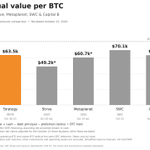
I don't mean to pick on $SWC here, I hope its upcoming pref program is successful. But just to illustrate the liquidity gap with another top global market, for trailing 5 trading days:
- $STRC posted 109x the value traded of SWC.
- $SATA posted 47x the value traded of SWC.
In other words, the value traded of even just Strategy and Strive's preferred shares is orders of magnitude greater than SWC's common equity (aggregated across its 3 listings).
Expectation for value traded of an SWC preferred would be yet another order of magnitude difference.
To be clear, SWC can still be successful relative to its market cap, I'm not arguing against this. And this limited comparison is not necessarily a full reflection of liquidity conditions in the US and the UK.
Nonetheless, the differences in liquidity between US markets and non-US markets are much greater than people realize. US markets are simply in a class of their own when it comes to scale.

The Strategy ₿et retweeted
Buybacks might get $STRC back to par, but it is not healthy for Strategy to be nearly 20% of the market in its own security to maintain price support.
I'm also not a fan of $MSTR continuing to de-amplify. I would rather see them increase rates in a bid to increase amplification.
This quoted post is unavailable.
The Strategy ₿et retweeted

This is egregious propaganda.
Strive is a “team” that exists to copy another company.
Strive is nothing more than an OpEx inefficient marketing entity, creating podcasts to talk about field trips to the NYSE.
There is no US precedent of a company having an easier journey than Strive.
There is no human precedent of new industry creation & welcoming competitors. None.
PS: last time I checked, there are zero combat veterans on the Strive team. Let’s not pretend (propagandize) that these are dudes who want to do hard things for the sake of doing hard things. Nothing could be further from the truth. These are opportunist non-founders.

The Strategy ₿et retweeted

Should companies be able to approve or veto the tokenization of their stocks?

The Strategy ₿et retweeted
Strategy and Strive management claim STRC and SATA are not in competition with each other
The market does not agree.
If you fill up your shelf with Pepsi, don’t be surprised when you can’t sell as many Cokes.

The Strategy ₿et retweeted
I have not been a fan of $STRC lately. $7 billion in $MSTR common stock sales in 2 months for a $10.4 billion notional of $STRC (now $9.8 billion after buybacks).
Short-duration credit requires active management and redundancy for price stability. (Buybacks and a lot of cash reserves).
If $STRC isn't acquiring more BTC than buybacks/usd reserves that the market requires before buying $STRC, then $STRC isn't worth it.
I would say long-duration credit works well with Bitcoin. No stress to maintain price stability.
xitter.cf/StrategyMaxi/status/20…

Bearish on $STRC as a money market product.
I'm not persuaded that a successful short-duration money product on $BTC is possible due to volatility.
Alternatively, building a robust redundancy system to eliminate volatility risk could be expensive, causing $MSTR to underperform $BTC.
Like the US Treasury needs the Federal Reserve to create stability for short-duration T-Bills, it cannot rely on markets all time. Strategy lacks a Fed-like entity to ensure stability for $STRC.
Long-duration money makes the most sense as it matches $BTC's duration.
Unwind $STRC but maintain $STRF, $STRK, $STRD. Cyclical capital raising to acquire $BTC makes sense to me: buy heavily during bull markets and opportunistically during bear markets.
Any thoughts?
