






Pinned Tweet
Excited to share that my book, RATIONAL REVERENCE: An Engineer's Survival Guide to Reconciling Science and Theology, is almost here.
Release date coming very soon. More to come.
#RationalReverence

Everyone’s racing to tokenize real-world assets.
Treasuries. Funds. Property titles.
But the token is on-chain. The asset is not.
If the holder or admin key is elliptic curve, a quantum computer doesn’t need to touch the asset.
It just signs a valid transfer of the token that says you own it.
No exploit. No anomaly. The chain can’t tell owner from attacker.
Your claim on the real-world asset is only as strong as the signature securing it.

Why does a new @Ledger program update every week or two make me nervous? Probably just paranoid.
Michael Strike | Ω retweeted

@Strike_Attack vs @VantaxFounder
Real talk. Different breeds.
QRL / Strike
✅ Raised ~$4.16M in 2017 ICO
✅ Core team + foundation + resources for years
✅ Network engineer / evangelist background, stable career path
✅ Talking quantum migration since 2020 from an established project
✅ Long-running mainnet (since 2018)
Me / Vantax
✅ Zero VC. Zero ICO. Built with my own time and money
✅ Solo
shipping open-source Rust tools right now
✅ From the trenches building the actual scanners, hybrid signing, on-chain commitments, and launchable PQ chains today
✅ No glass towers. No endless support. Just code, whitepaper, and live tools
✅ Focused on what works now for Solana, Bitcoin, Ethereum (hybrid ML-DSA-87 + migration path), not waiting for perfect consensus upgrades
One side had funding, a team, and years of runway.
The other is shipping practical post-quantum tools with nothing but grit.
We’re not the same.
Different starting points. Different constraints. Different results.
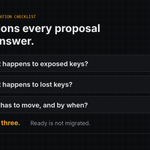
I read every post-quantum migration proposal so you do not have to.
Each one has to answer 3 questions:
What happens to exposed keys?
What happens to lost keys?
Who has to move, and by when?
Most skip all three.
Ready is not migrated.


But, what is the REAL problem behind how Quantum Computers may attack Bitcoin? If you can understand this, you get it.
4,817 × 9,203 = 44,330,851
Easy.
Now I give you 44,330,851. Find the two numbers.
That’s the “hard direction.” Bitcoin’s security lives inside a version of that problem.
Shor’s algorithm is the quantum shortcut that makes the hard direction easy.

Your laptop is deterministic. Same input, same output, every time.
A quantum computer is probabilistic. It may run a program many times to get the answer.
Quantum suggests candidate answers. Classical computers check them.
They don’t replace each other. They work together.

Michael Strike | Ω retweeted

Hear me talk about quantum computing forgery attacks, Bitcoin, Q-Day timelines, my forthcoming book, and more on the Modern CTO podcast. @moderncto_io Had a blast!
youtube.com/watch?v=eznDKwdO…

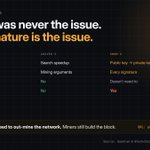
Stop worrying about quantum mining.
Grover’s algorithm can’t outpace modern ASICs, and it can’t drain a wallet.
Shor’s can.
Mining was never the issue. The signature is the issue.

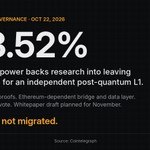
In an overwhelming StarkNet vote, 93.52% of voting power backs research into leaving Ethereum for its own post-quantum L1.
Wow. I said their would be forks. I never talked about this.
The reason is plain. Its proofs are hash-based. Its bridge and data layer still wait on Ethereum’s 2029 timeline.
A plan is not not a migrated. Hat tip to the @Starknet community for taking the difficult, road less traveled.

Michael Strike | Ω retweeted

What is the best quantum-resistant blockchain, and why?
Gemini has an answer. What’s your take?

Every classical chain has to migrate to post-quantum security.
Exposed keys. No auto-upgrade. Freeze-or-fork fights. And Q-Day won’t be announced. Upgrading the software is the easiest hard part.
Full migration is effectively impossible, unless your chain never needs one.
QRL, quantum-safe since 2018. No migration required.
Testnet 3.0 Incoming ...
Rarely talked about, but inconvenient as hell. No names. Just facts.
Some "quantum-resistant" projects take a hybrid path. They keep an ERC-20, BRC-20, or similar token on a classical chain while they build their own L1. Some already have that L1 live (kudos).
The upside is real. Liquidity, DeFi, exchange access. Today, not tomorrow.
The tradeoff is structural. BUT the portions of that project that are tokens (classical), sit on elliptic-curve keys.
Getting to the post-quantum chain takes a migration. Holders must prove ownership with their old key. That is a user-initiated transaction. Not everyone will make it.
That is the same class of problem Bitcoin faces under the BIP-360 and BIP-361 drafts. A new output type. A legacy sunset. A window. Leftovers that don't reheat well.
Targets for fault-tolerant quantum computers are 2029 to 2033. The window is not getting wider.
Hybrids buy time and liquidity. They also buy a migration.
A hybrid chain built now gains classical Defi, but like every lie ever told, it incurs a debt to the future.

Michael Strike | Ω retweeted

Every quantum-resistant crypto in Q4 2026
I’m interested in the quantum trade. I’m much less interested in paying a quantum premium for a roadmap.
Going into Q4 2026, i checked which chains actually protect user transactions today.
My starting point is simple: does the signature authorizing a normal spend use post-quantum cryptography by default?
That only establishes account protection. Consensus, bridges and data availability need their own checks.
Here’s my map in October.
The clearest examples of default post-quantum transaction signing:
→ @QRLedger | $QRL: Zond adds ML-DSA-87, PoS and EVM compatibility, but remains on testnet. The latest update put audits and remediation at 60%.
→ @mochimocrypto / $MCM: WOTS+ signatures on a live mainnet since June 2018.
→ @PQabelian / $ABEL: lattice-based transaction security with privacy. Its cryptography draws on Dilithium and Kyber research.
→ @cellframenet / $CELL: Dilithium is the default signature, with other post-quantum schemes supported.
→ @tidecoin / TDC: Falcon-512. An important correction here: its signatures are lattice-based.
→ @QuantusNetwork: mainnet launched Sept 9, with ML-DSA-65 and ML-DSA-87 signing.
The distinction = deploying post-quantum signatures doesn’t establish that the whole implementation is independently audited or economically secure.
Established networks have made progress, mostly through optional accounts:
→ @Algorand / $ALGO: native Falcon-1024 accounts went live, with wallet and developer support. Account protection remains opt-in.
→ @NervosNetwork / $CKB: users can protect funds through a SPHINCS+ lock script.
→ @solana / $SOL: the Winternitz vault provides a specific post-quantum custody option.
→ @Starknet / $STRK: a Falcon-512 account executed a mainnet transfer.
The next group is testing or planning migration:
→ @trondao: post-quantum support on Nile testnet.
→ @QANplatform: public testnet; I’m watching audits and mainnet delivery.
→ @BNBCHAIN: ML-DSA and pqSTARK migration research.
→ @XDCNetwork: post-quantum development and a migration roadmap.
→ @Bitcoin: BIP-360 and BIP-361 remain drafts.
→ @ethereum: targets resistance across execution, consensus and data by December 2029.
→ @Ripple Ledger: targets full readiness by 2028.
→ @StellarOrg: has published a Quantum Preparedness Plan.
I’d need stronger production evidence before adding NEAR, Aptos, Cardano, Sui, Tezos, Hedera, Nexus or xx network to the default-protection list.
I’m most curious whether the smaller native chains can attract sustained usage, and whether established networks can migrate existing capital without making transactions materially more expensive.
DYOR.

Keeping a public key off-chain is not the same as keeping it secret.
Ledger's CTO notes keys can also leak through devices, logs and backups. So the real quantum-exposed supply may be higher than 6 million BTC.
Across sources, nearly all agree that at least 1/3 BTC, at the minimum needs to migrate. Safe to say no one really knows how many public keys are at risk, but it's a lot.
This isn't a technical problem. It's a migration problem. Hard part hasn't started.

Michael Strike | Ω retweeted

Quantum-Ready Blockchains Compared, Part 1: What "Quantum-Ready" Actually Means
1/ “Quantum-ready” is in every crypto roadmap now. It doesn’t mean one thing.
New 5-part series comparing 9 chains: QRL, Algorand, Nervos, Aptos, Sui, Ethereum, XRP Ledger, Solana, Cardano.
Part 1 👇
2/ What a quantum computer could actually hit:
• User signatures → coins stolen
• Validator signatures → fake blocks
• Randomness → rigged block lottery
• Mining → only a speed-up
3/ The part most coverage misses: proof-of-stake chains need 2 migrations (holders’ keys and consensus). Proof-of-work chains need 1.
4/ 2026 so far:
• Google estimate: under 500,000 qubits could break today’s coin signatures
• Algorand and NEAR switched on opt-in quantum-safe accounts
• Most others are still at proposals and test networks
5/ Every chain gets the same 5 tests and a 7-rung ladder, from “announced” to “the default.” Only one small chain is on the top rung.
scryvehq.com/article/quantum…


