





Michael Strike | Ω retweeted

@Strike_Attack vs @VantaxFounder
Real talk. Different breeds.
QRL / Strike
✅ Raised ~$4.16M in 2017 ICO
✅ Core team + foundation + resources for years
✅ Network engineer / evangelist background, stable career path
✅ Talking quantum migration since 2020 from an established project
✅ Long-running mainnet (since 2018)
Me / Vantax
✅ Zero VC. Zero ICO. Built with my own time and money
✅ Solo
shipping open-source Rust tools right now
✅ From the trenches building the actual scanners, hybrid signing, on-chain commitments, and launchable PQ chains today
✅ No glass towers. No endless support. Just code, whitepaper, and live tools
✅ Focused on what works now for Solana, Bitcoin, Ethereum (hybrid ML-DSA-87 + migration path), not waiting for perfect consensus upgrades
One side had funding, a team, and years of runway.
The other is shipping practical post-quantum tools with nothing but grit.
We’re not the same.
Different starting points. Different constraints. Different results.


Michael Strike | Ω retweeted

Hear me talk about quantum computing forgery attacks, Bitcoin, Q-Day timelines, my forthcoming book, and more on the Modern CTO podcast. @moderncto_io Had a blast!
youtube.com/watch?v=eznDKwdO…

Michael Strike | Ω retweeted

What is the best quantum-resistant blockchain, and why?
Gemini has an answer. What’s your take?

Michael Strike | Ω retweeted

Every quantum-resistant crypto in Q4 2026
I’m interested in the quantum trade. I’m much less interested in paying a quantum premium for a roadmap.
Going into Q4 2026, i checked which chains actually protect user transactions today.
My starting point is simple: does the signature authorizing a normal spend use post-quantum cryptography by default?
That only establishes account protection. Consensus, bridges and data availability need their own checks.
Here’s my map in October.
The clearest examples of default post-quantum transaction signing:
→ @QRLedger | $QRL: Zond adds ML-DSA-87, PoS and EVM compatibility, but remains on testnet. The latest update put audits and remediation at 60%.
→ @mochimocrypto / $MCM: WOTS+ signatures on a live mainnet since June 2018.
→ @PQabelian / $ABEL: lattice-based transaction security with privacy. Its cryptography draws on Dilithium and Kyber research.
→ @cellframenet / $CELL: Dilithium is the default signature, with other post-quantum schemes supported.
→ @tidecoin / TDC: Falcon-512. An important correction here: its signatures are lattice-based.
→ @QuantusNetwork: mainnet launched Sept 9, with ML-DSA-65 and ML-DSA-87 signing.
The distinction = deploying post-quantum signatures doesn’t establish that the whole implementation is independently audited or economically secure.
Established networks have made progress, mostly through optional accounts:
→ @Algorand / $ALGO: native Falcon-1024 accounts went live, with wallet and developer support. Account protection remains opt-in.
→ @NervosNetwork / $CKB: users can protect funds through a SPHINCS+ lock script.
→ @solana / $SOL: the Winternitz vault provides a specific post-quantum custody option.
→ @Starknet / $STRK: a Falcon-512 account executed a mainnet transfer.
The next group is testing or planning migration:
→ @trondao: post-quantum support on Nile testnet.
→ @QANplatform: public testnet; I’m watching audits and mainnet delivery.
→ @BNBCHAIN: ML-DSA and pqSTARK migration research.
→ @XDCNetwork: post-quantum development and a migration roadmap.
→ @Bitcoin: BIP-360 and BIP-361 remain drafts.
→ @ethereum: targets resistance across execution, consensus and data by December 2029.
→ @Ripple Ledger: targets full readiness by 2028.
→ @StellarOrg: has published a Quantum Preparedness Plan.
I’d need stronger production evidence before adding NEAR, Aptos, Cardano, Sui, Tezos, Hedera, Nexus or xx network to the default-protection list.
I’m most curious whether the smaller native chains can attract sustained usage, and whether established networks can migrate existing capital without making transactions materially more expensive.
DYOR.

Michael Strike | Ω retweeted

Quantum-Ready Blockchains Compared, Part 1: What "Quantum-Ready" Actually Means
1/ “Quantum-ready” is in every crypto roadmap now. It doesn’t mean one thing.
New 5-part series comparing 9 chains: QRL, Algorand, Nervos, Aptos, Sui, Ethereum, XRP Ledger, Solana, Cardano.
Part 1 👇
2/ What a quantum computer could actually hit:
• User signatures → coins stolen
• Validator signatures → fake blocks
• Randomness → rigged block lottery
• Mining → only a speed-up
3/ The part most coverage misses: proof-of-stake chains need 2 migrations (holders’ keys and consensus). Proof-of-work chains need 1.
4/ 2026 so far:
• Google estimate: under 500,000 qubits could break today’s coin signatures
• Algorand and NEAR switched on opt-in quantum-safe accounts
• Most others are still at proposals and test networks
5/ Every chain gets the same 5 tests and a 7-rung ladder, from “announced” to “the default.” Only one small chain is on the top rung.
scryvehq.com/article/quantum…


Michael Strike | Ω retweeted
Algorand has the audacity to flex with botted transactions, lol 😂
I analyzed all of them. The truth:
- 99.2% come from wallets that look scripted
- 10 wallets sent 865K txns in 48h, then vanished
$QRL has every wallet and txn quantum-resistant since 2018. $ALGO has... bots.


Algorand is now officially #1 in post-quantum across the entire industry 🥇
Over 2.7 MILLION post-quantum transactions on mainnet, more than any other blockchain on the planet.
Others are still talking about the quantum threat. We've been shipping since 2022, and nobody has caught us.

Michael Strike | Ω retweeted

Congratulations @Algorand however that number for @QRLedger is you have is out of date the number of transactions we have done is over 6 million. Source: quantascan.io/

Michael Strike | Ω retweeted

10 years ago today, QRL's first code commit marked the beginning of a mission to build for a future few were thinking about.
From a forward-thinking idea to a live post-quantum blockchain, and now toward QRL 2.0, none of it would be possible without the builders and community behind it.
Here's a look back at how far we've come...and what's ahead ⤵️
theqrl.org/blog/10-years-of-…

Michael Strike | Ω retweeted
10 years ago today, on 16 October 2016, QRL began with a single GitHub commit.
At the time, few in the industry took the quantum threat seriously. Fast forward to today and it's an industry-wide priority.
What started as an early vision has grown into a global community building for what's next.
The next decade starts now. Be part of it.
Michael Strike | Ω retweeted
Really pleased to see this one go out. @bemagri, Boris Fouotsa and Trey Li are doing some of the most interesting work in post-quantum cryptography right now. Proud we’re backing it.

Building a post-quantum future takes more than new standards.
QRL is proud to support three cryptographers at the University of Manchester (@OfficialUoM) advancing post-quantum signatures and the cryptographic infrastructure needed for the next generation of blockchains.
Read the announcement here 👇
theqrl.org/press/qrl-backs-u…

Michael Strike | Ω retweeted
Building a post-quantum future takes more than new standards.
QRL is proud to support three cryptographers at the University of Manchester (@OfficialUoM) advancing post-quantum signatures and the cryptographic infrastructure needed for the next generation of blockchains.
Read the announcement here 👇
theqrl.org/press/qrl-backs-u…
Michael Strike | Ω retweeted
Join our Reddit AMA with Joseph Kearney.
Questions are open until October 15 at 18:00 UTC.
Cryptographers, AI researchers and skeptics are welcome.
reddit.com/r/QRL/comments/1x…

Michael Strike | Ω retweeted

Dig a hole in this sandbox and a lake appears.
The design comes from UC Davis. A Kinect depth camera above the box measures the height of the sand many times a second, and a projector paints matching elevation colors and contour lines onto it.
Hold a hand over it and virtual rain falls and flows downhill. Topographic maps would have made sense to me in school with one of these.
Michael Strike | Ω retweeted
Enigma was unbreakable.
Until a machine broke it.
Bitcoin has a machine coming for it too.
Michael Strike | Ω retweeted
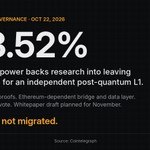
QRL is an independent post-quantum secure Layer-1 blockchain, not a token on Base or any other project.
The QRL Cashtag, "$QRL" on X currently points to an unafiliated Base token using our name and ticker.
We've reported this to X @Support and @birdeye_so, requesting a correction, and trust that both platforms are committed to accurate asset identification.
Accurate market data can be found on @Coingecko at coingecko.com/coins/quantum-…

Michael Strike | Ω retweeted
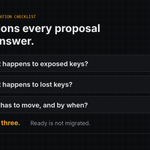
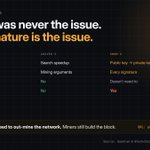
Justin Drake calls for crypto "bunker mode", warning ECDSA could break before Q-Day.
But fresh addresses only help holders who can move.
What about exposed keys and coins that never migrate: freeze, no freeze, or another way?
Catch the QRL Show with @KonstantHacker and @Strike_Attack Today @ 11 AM ET
youtube.com/live/d8MFDxhlXvA


Today I call upon the blockchain industry to calmly begin planning for "bunker mode". My personal recommendation is to set in motion a controlled mass migration of assets to fresh addresses, i.e. addresses whose pubkeys remain hidden behind a hash.
Holders, starting with large and sophisticated ones, should consider moving the bulk of their funds to addresses that have never signed a transaction. And when they do sign one, they should also move remaining funds to a new address (possibly generated from the same seed phrase).
Don't rush. While I believe there is cause for action a rushed migration would do more harm than good. Don't panic either. Moving assets to protected addresses is a simple, preventative step which does not require new cryptography or new wallets.
IMO it is now reasonable to brace for the possibility that ECDSA breaks before qday, in the worst case in months not years. By "break" I mean fast private key recovery (e.g. in one week) on available hardware (e.g. a large GPU cluster).
Recent days have been humbling for human mathematical intuition. Long-held, unquestioned hypotheses have fallen. This includes the n log(n) bound for integer multiplication and the 3SUM conjecture. In hindsight, May's unexpected disproof of the Erdős unit distance conjecture was our warning shot.
Yesterday's OpenAI drop made it clear that mathematical superintelligence is upon us. They say there are weeks where decades happen. We are about to live through weeks where centuries of mathematical progress happen. Could our magic 64-byte ECDSA signatures be too good to be true? Was it just security through obscurity all this time?
Elliptic curves feel especially vulnerable to superintelligence. Curves carry rich structure, with room for fancy tricks like Schoof, Frobenius, pairings. (By contrast, hashes are designed to minimise algebraic structure.)
Separately, as Ewin Tang can attest, an efficient quantum algorithm sometimes foreshadows an efficient classical one. We should be open to the possibility of a classical counterpart to Shor that breaks elliptic curves and RSA at once.
Also noteworthy is the striking under-representation of cryptographic breakthroughs among the 722 mathematical results OpenAI published. I've witnessed first-hand the US government censoring academic quantum cryptanalysis results. Backroom interventionism is my base case.
I urge large, sophisticated actors to lead by example. Project11's "risq list" (bitcoin-risq-list.projecteleven[.]com) is a great tracker of exposed BTC pubkeys. Binance, Bitbank, Robinhood, Bitfinex, and Tether have an opportunity to harden their cold storage. Next month I'll address institutions in London in a live Q&A (forum.ethereuminstitutional[.]org/london-2026).
Again, please do not rush. Wallets holding under 50 BTC enjoy partial cover from "Satoshi's shield", i.e. his 20K exposed addresses that hold 50 BTC each. Load-bearing signers like oracles and L2 security councils should consider rotating ECDSA pubkeys with every signed message and/or multi-signing with a hash-based schemes like SPHINCS.
Exiting bunker mode safely will require post-AI cryptography. My inclination is to go all-in on hash-based cryptography and avoid structured mathematical assumptions entirely, whether from curves, lattices, or isogenies. A single battle-tested hash (e.g. from the SHA or BLAKE families) yields plausible post-AI security.
The Ethereum roadmap on strawmap[.]org fully embraces hash-based cryptography with end-to-end formal verification as a response to the quantum threat. Those timelines must now be revisited and accelerated in light of mathematical superintelligence. I'll be pushing for maximum defensive acceleration.
Michael Strike | Ω retweeted
We're LIVE!
Justin Drake's "bunker mode" warning has raised some big questions for Bitcoin, Ethereum, and the future of crypto security.
Watch now as @Strike_Attack and @KonstantHacker discuss these topics
youtube.com/live/d8MFDxhlXvA
