

20. Published neuroscience author. CEO at @NEUROZYN, Inventor at @GramoPortTech, CO-Founder @USAFactoryNet. UMiami 28’
Miami Beach
Joined October 2021
- Tweets812
- Following66
- Followers62
- Likes569





Sebastian Feliz retweeted

USA Factory Network had the opportunity to showcase what we’ve been doing these last couple of months to the University of Miami Business School
@UMiamiBusiness thanks for having us!

Sebastian Feliz retweeted
🚨💀There was a time you couldn’t trust what was in the food in America.
All that changed until the Pure Food and Drug Act. Watch this vid to learn more about how companies like Heinz Ketchup kept their products clean for customers in the USA!
Sebastian Feliz retweeted
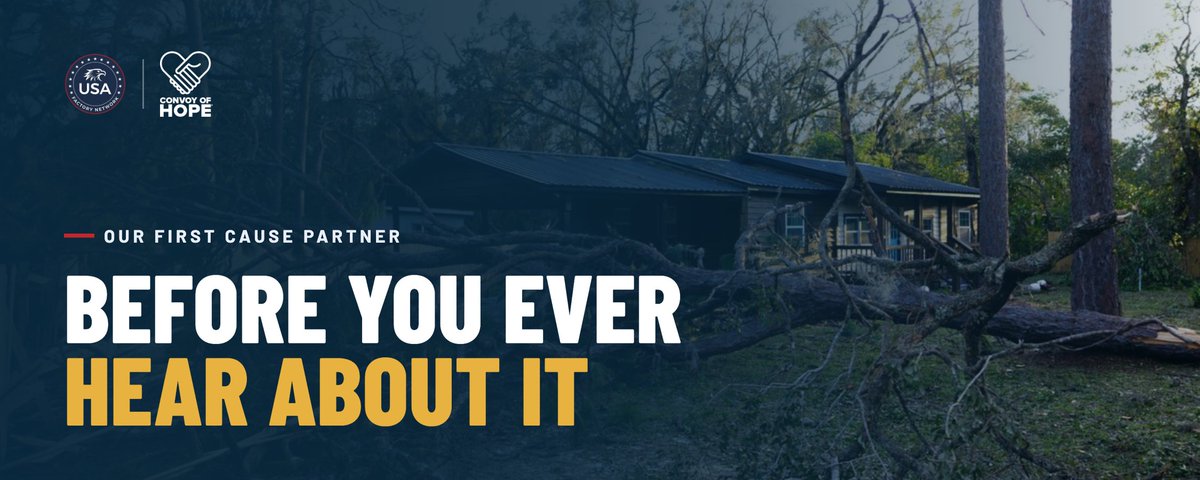
Most people hear about a disaster once. The organization that actually shows up is still there eighteen months later.
We wrote about what Convoy of Hope actually does before, during, and after the cameras leave — our first Cause Partner.
Sebastian Feliz retweeted
Customers deserve clear prices. American food plants and co packers help keep quality steady when demand shifts. That is how brands earn trust. 🇺🇸 teapawt.net/SteaknShake/status/210…

We believe in simple, upfront pricing. Today, too many businesses are beginning to use data and personal tracking to charge people different prices for the exact same thing. We believe this practice is flat-out wrong.
At Steak n Shake, our focus is simple: delivering the highest-quality food at the best possible value. We honor your trust by following the basic principle of the Golden Rule. So we keep our prices completely transparent, and consistent within our respective markets.
Sebastian Feliz retweeted
We made the news 🇺🇸
USA Factory Network just launched an AI platform that matches food and beverage brands with FDA registered U.S. plants. Send your specs and volume. Get matches in about 48 hours.
500+ American manufacturers ready to run the line.
markets.chroniclejournal.com…
Sebastian Feliz retweeted
Trade policy is plant policy. Brands need reliable American food capacity, not fragile dependency. Build here. usafactorynetwork.com 🇺🇸


"Canadians have chosen pain over prosperity. Most don’t realize it yet, but that’s the path they’ve taken. Turning our backs on the most powerful economy in history is beyond comprehension—and it will make things even more challenging for our farmers and Canada’s agri-food sector."
Listen to the Food Professor Podcast below...
Sebastian Feliz retweeted
Every co packer should understand this: the recipe is only half the product. The operation has to earn the return visit. 🇺🇸 usafactorynetwork.com

McDonald's is spending 8.5 billion dollars to find out why families stopped coming.
I can save them the 8.5 billion.
They took out the playground.
The plan, announced Wednesday at investor day. Better food, faster service, new equipment, AI tools, hospitality training, and a bigger push into chicken and beverages. They call it Next. The goal, they say, is making customers feel more comfortable.
Wall Street loved it so much the stock fell 5 percent to its lowest since 2022.
Over five years McDonald's shares are down 3 percent. Burger King's parent is up 14. The owner of Taco Bell and KFC is up 13.
This is not a hamburger problem. This is a McDonald's problem.
So let us talk about who used to eat there.
Parents. That was the whole business. Parents at 5:40 on a Tuesday with three kids in the back and nothing thawed at home.
You did not go for the burger. You went because your kids could run screaming through a plastic tube for 40 minutes while you sat with a coffee and experienced silence.
That was the product. The food was the cover charge.
The first PlayPlace opened in 1971 in Birmingham, Alabama, and for fifty years it did one job. It made small children demand to go to McDonald's.
Then 2020 arrived, every play area in the country closed, and a great many never came back. The equipment came out during a remodeling program named Experience of the Future.
The Experience of the Future turned out to be a touchscreen.
Their own chief executive said he did not know if ball pits were in their future.
Sir, you were not selling ball pits. You were selling forty minutes.
So now there is no counter, no playground, and no reason for a seven year old to want to go. A screen, a window, and a bag.
And for that we pay prices that require a moment of reflection in the parking lot.
For thin, overcooked, oddly uniform pucks that taste like a memory of beef.
I did not love them because they were good. I loved them because I was eight and there was a slide.
And have you seen the new buildings.
The old ones were unmistakable. Red roof, yellow arches, legible from a highway at 70 to a child who could not yet read.
The new ones are a flat gray box with a small logo and a drive through wrapped around it. A regional claims office with a fryer.
They removed the color, the characters, the counter, and the playground, and then hired consultants to find out why it no longer feels like anywhere.
Which is why, when I have to eat fast food, I go to Chick-fil-A.
Not for the politics. For the competence.
They have led the customer satisfaction index for fast food eleven years running, and average 8.5 million dollars per location against McDonald's 4 million.
More than double, while closed on Sundays. Fifty two days a year with the lights off, and still double.
A seventeen year old hands you a bag and says my pleasure and means it about 70 percent, which is 70 percent more than a touchscreen has managed.
McDonald's is spending 8.5 billion on hospitality training.
Chick-fil-A earns 8.5 million per restaurant by just having some.
So here is my consulting proposal, free of charge, on behalf of mothers everywhere.
Put the playgrounds back.
Not a nostalgia campaign. Not a retro cup. The structure. Tubes, slides, a door the kids cannot open from the inside, and a bench where a tired woman can sit.
And understand what you are buying, because it is not lunch.
A six year old does not know your food is bad. He has no basis for comparison and no functioning palate. He thinks the burger is incredible because he is standing in a castle made of tubes.
That is the window. That is the only window you get.
You catch them before the taste buds arrive, and thirty years later they drive past your sign, feel something they cannot explain, and pull in anyway.
That is not a menu strategy. That is imprinting, and you shut it down in 2020 to save on cleaning.
Eight and a half billion dollars for AI tools and hospitality training.
Or a slide.
🦋

Sebastian Feliz retweeted
Diesel shocks hit every food line. More American production gives farmers and brands real room to breathe. 🇺🇸 usafactorynetwork.com
"Diesel prices are keeping many people in the food industry awake at night. Farmers are spending three times more on diesel than they did last year because they have no choice, and some food prices could rise by an additional 10% to 15% over the next two months if diesel prices remain elevated. It’s not a good situation."
Sebastian Feliz retweeted

AMERICAN-MADE IS BACK.
AMERICAN MANUFACTURING IS BACK.
The Arsenal of Freedom is UNLEASHING the power of the American worker—and putting American strength back on the production line.

Sebastian Feliz retweeted
The real edge is owning the American processing step. Shelf ready volume beats a great product waiting on someone else’s line.

This guy makes $82,000 a day selling honey.
He started at 12 years old with $300 and one beehive. By the time he graduated high school he was doing six figures a year.
Now, he owns 30,000 hives and over a billion bees…. and makes $35M/year in revenue.
I met with Blake last year.
Here's how his biz model works:
He has six revenue lines…
• Retail
• Wholesale
• Pollination services
• Beekeeping supplies
• Food manufacturing
• Hot honey
Retail and wholesale is the core. He bottles the honey himself and sells it direct to stores and consumers. His facility runs 1,000 jars an hour. One tote of raw honey (about 275 gallons) is worth $15k and takes half a million bees to fill it.
Pollination services runs on top of that. Farmers pay him to park his hives on their land so his bees can pollinate their crops. This brings in extra recurring revenue that’s separate from selling honey.
Hot honey is one of the fastest growing food trends right now. It’s honey infused with chili pepper - either sweet or spicy. Blake sells them at a premium and in smaller batches. So they have better margins than straight honey and cost less to produce.
Beekeeping supplies and food manufacturing round out the rest. Supplies means gear hives, suits, or smokers sold to other beekeepers. Food manufacturing covers other honey-based products that have higher margins than just raw honey.
The numbers:
• Revenue: $35M/year
• Margins: 15%
• Employees: 125
• Bee cost: $2M/year (just to keep them alive)
• Facility output: 1,000 jars/hour (at $5 wholesale, $9 on the shelf)
• Processing facility cost: $3M to build ($1M of honey sitting in it at any given time)
One of the coolest businesses I've seen.


Sebastian Feliz retweeted
The factory side is where the promise gets real. More American food plants means more resilient brands. usafactorynetwork.com

Big day for me and my family. Big day for Chobani. We broke ground in Rome, NY—just miles from South Edmeston where it all began. A $1.2B natural food facility, 1,000+ jobs, and a new home for making good food for all.
This isn’t just a factory—it’s a promise. To our people. To our farmers. To our communities.
Grateful to the State of New York, Oneida County, City of Rome, and everyone walking this journey with us.
Let’s build the future. Together.


Sebastian Feliz retweeted
Domestic production is built by the people who keep the whole chain moving. Strong US food manufacturing keeps America fed when supply chains get shaky. Check us out: usafactorynetwork.com

This Labor Day, we honor the hardworking men and women who keep America running.
From our farmers and ranchers to food safety inspectors, foresters, wildland firefighters, and the countless workers who serve rural America every day — your dedication keeps our nation moving forward.
Thank you for all you do for American agriculture and for our country. 🇺🇸

