




Pinned Tweet
I sell data center capacity for a living. The conversation with customers has changed completely in the last eighteen months.
It used to start with price per kW. Now the first question out of everyone’s mouth is when can you actually give me power, and the honest answer in most major metros is later than you want to hear.
Everyone wants to argue about GPU supply. That is not where the wall is. The wall is a transformer you order today that arrives in three years, a permitting process that answers to a county board, and an interconnection queue with roughly 2,000 gigawatts stacked up in it. PJM ran the numbers on projects that came online last year and the average was over seven years from request to live power. Three years to get an agreement, four more years to actually energize after the agreement was signed.
And this is the easy part. We are nowhere near the peak of this demand curve. There is at least another order of magnitude coming, and the grid that is supposed to absorb it operates on utility capital planning cycles that were designed in a world where load growth was flat for twenty years.
Which is why the orbital compute argument stopped sounding exotic to me sometime around last fall. Up there you get uninterrupted sunlight, you dump heat straight into vacuum instead of running chillers, and there is no zoning hearing, no queue position, no substation to wait on.
Plenty of companies have interesting orbital compute concepts. Only one of them owns the rocket, has the scale, and deeply embedded partnership with Nvidia.
SpaceX filed with the FCC in January to launch and operate up to a million compute satellites, and there is exactly one launch provider on Earth with the cadence and the cost structure to make that number anything other than a press release. Starship is the reason this is an infrastructure plan and not a science project.
The constraint on the ground is the grid. The constraint in orbit is mass to LEO. SpaceX is the only company that has solved the second one.
$SPCX

Nvidia today announced that @spacexai will deploy Vera CPUs to accelerate its next generation of agentic AI applications.
"SpaceXAI plans to expand its AI infrastructure behind Grok on Nvidia Vera Rubin, while extending an optimized Vera Rubin NVL72 into space with its first-generation Starmind satellite.
SpaceXAI’s work with Nvidia is moving beyond AI factories on Earth. SpaceXAI is developing AI computing infrastructure for orbit, where power, thermal management, bandwidth, reliability and physical integration impose dramatically different constraints from conventional data centers.
SpaceXAI’s planned first-generation Starmind AI satellite will be based on the optimized Nvidia Vera Rubin NVL72 rack-scale system, extending the same accelerated computing architecture powering next-generation AI factories on Earth into space.
Nvidia and SpaceXAI are working to adapt that foundation to the requirements of orbital computing while preserving a common Nvidia architecture and software ecosystem.
This delivers one computing foundation across a wide range of environments: Vera CPUs accelerating increasingly sophisticated AI agents, Vera Rubin powering the AI infrastructure behind Grok and gigawatt-scale AI factories on Earth, and Nvidia accelerated computing extending into orbital AI infrastructure."


It isn’t just Elon saying it… listen to what Amazon’s CEO is saying about data center demand.
Amazon is spending $220 BILLION this year, and they’re STILL leaving meaningful demand on the table.
2026: Sold out.
2027: Largely sold out.
2028: A significant portion already sold.
That’s an incredible statement when you consider the amount of capital being deployed across the industry.
I work in the data center industry, and I can tell you firsthand that the demand is very real. We’re seeing enterprises looking for multiple megawatts of capacity with very few options available.
And despite the enormous investments being announced, bringing new capacity online takes time. Power availability, infrastructure, equipment, and construction all constrain how quickly supply can respond.
I continue to believe we’re in the early stages of a massive infrastructure buildout.
If you’re an enterprise planning your future compute needs, you should be having conversations about capacity today.
The competition for power and data center capacity isn’t going away anytime soon.


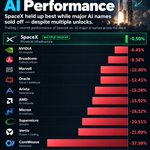
The *entire* AI trade has been getting hammered over the last month…
CoreWeave down 38%. Vertiv down 22%. Micron down 18%. AMD down 16%. NVIDIA down 6%.
Meanwhile, $SPCX is essentially flat.
And this is while SpaceX has gone through multiple share unlocks, with everyone’s parade of unlock FUD around potential selling pressure.
I think that relative strength is pretty telling.
SpaceX is building an AI compute business with economics that is the best in the industry, alongside Starlink, direct-go-cell, and launch.
The market is increasingly focused on AI infrastructure economics, and I am of the belief that SpaceX is best positioned. Period.
One month obviously shouldn’t make an investment thesis, but the relative performance is certianly hard to ignore.
My conviction grown, particularly coming out of the Q3 earnings call... hard not to be bullish.
🤖 Made with AI

unavailable
The more I look at the economics of AI infrastructure, the more bullish I become on SpaceX.
David Sacks shared some fascinating numbers on All-In:
- SpaceX: ~$50B in monetization per GW, with roughly a 1-year payback.
- CoreWeave: ~$20B per GW, with roughly a 2.5-year payback.
These are estimates, but the difference is enormous.
A big reason is how the two companies structure their contracts.
CoreWeave relies heavily on long-term commitments to finance its infrastructure. SpaceX has the balance sheet and access to capital to operate with much shorter contracts, giving it exposure to today’s significantly higher compute pricing.
That flexibility is worth a LOT in a supply-constrained market.
And consider what happens when you’re recovering your capital in roughly a year. You can reinvest that money into additional compute, bring more capacity online, and potentially accelerate growth without relying as heavily on external financing.
Now consider SpaceX is targeting ~13 GW of operational compute capacity by the end of 2027.
The economics at scale could be extraordinary if they execute.
I’ve been extremely bullish on SpaceX for years, but the AI infrastructure opportunity has become a much bigger part of the investment thesis.
There’s never been a better time to be a long-term investor.
Innovation is accelerating, productivity is improving, and opportunities to own pieces of incredible assets have never been more accessible.
The next 20 years could create extraordinary wealth.
Make sure you’re participating.

I think we’re entering one of those periods where people will look back and wonder why they weren’t buying more.
The AI/autonomy/robotics trade has a LONG way to go.
Bitcoin looks ready for its next major move.
And I think the next 12-18 months could be incredible for investors.
My advice? Buy assets you believe in, keep buying, and think in decades.
If you can’t hold for 5 years, you probably shouldn’t be buying.
You don’t need to catch every move. You need to own the right assets long enough.
My big three…
$SPCX bitcoin:native $TSLA
Pretty interesting to see the S&P 500 trading at nearly the same forward P/E as the April 2025 selloff.
Earnings have grown significantly, yet valuations have continued to compress.
I’m still very bullish on where this market is headed, especially with AI investment and adoption accelerating.
If earnings keep delivering, there’s plenty of room for this bull market to run.
This is where we’re @ on the S&P 500:


And this is what makes the valuation compression even more interesting …
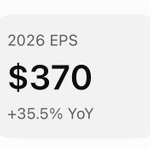
S&P 500 earnings estimates continue hitting record highs, with $370 projected for 2026 and $424 for 2027.
Earnings are accelerating while valuations are compressing.
Pretty bullish setup if you ask me. Especially with AI adoption still in its early stages.


Imagine building a technology so consequential that it literally helps prevent an entire country from being overrun.
Then imagine being criticized for setting limits on how your COMMERCIAL product can be used to kill people.
Elon and SpaceX deserve tremendous credit for what they’ve built and what they’ve contributed.
Starlink is an incredible achievement for humanity, and we’re still in the early days of what this technology will make possible.
Correct.
Using Starlink, a civilian commercial service, for offensive drone strikes to kill people has never been allowed, nor should it be.
Starshield, a different system, is controlled by the US government. What they decide to do is up to them.
Ukraine military violated Starlink terms of service and used it for offensive drone strikes to kill people. That loophole was closed last week.
Starlink remains critical to the defense of Ukraine, as it is the only system that cannot be jammed or blown up, at least for now. Were Starlink to be turned off, the Ukrainian front line would collapse immediately. This is NOT a threat, it is simply a statement of fact.
Starlink was also crucial to preventing Russia from overrunning Ukraine in the early days of the war, as all other means of communication were destroyed or jammed by Russia.
SpaceX has done more to defend Ukraine than any private company on Earth BY FAR.
That said, I have nothing but UTTER CONTEMPT for the virtue-signaling evil warmongers who push for endless slaughter and offer no realistic solution to the conflict. May you burn in hell.
End of story.
and yes. Politics is so tribal that one side is no longer willing to openly recognize Starlink’s importance. Particularly in savings lives. The willful ignorance is astounding and quite sad.
but the facts are the facts.
What if Elon and other Entrepreneurs just gave up? What if we didn’t have people willing to try to build things? What if ambition was lost b/c people are so tribal and vicious?
One of the things I admire most about Elon is his willingness to build technologies that tackle problems most people consider impossible. We should encourage that. It deserves praise.
Starlink started as one of those ambitious ideas and has become communications infrastructure that can make an enormous difference in war, natural disasters, and everyday life. In fact, it has already.
I have tremendous respect for @elonmusk’s willingness to take criticism.
Few entrepreneurs have built something with this level of global impact.

This is a HUGE accomplishment and deserves some attention.
Since January 2025, the federal government has shed 328,000 jobs, an almost 11% reduction.
Federal employment is now at its lowest level since 1966.
And federal workers now account for 1.69% of all U.S. payroll jobs, the lowest share on record dating back to 1939.
That’s pretty incredible progress.
For decades, we’ve heard politicians promise to shrink the size of the federal government. Actually following through is a different story.
I want a government that operates efficiently, spends taxpayer dollars responsibly, and does more with less.
There’s still plenty of work to do, and the results should be measured by both savings and the quality of government services.
But cutting nearly 330,000 federal positions in less than two years is a historic accomplishment.
Credit where it’s due. 🇺🇸


“I continue to be impressed by Bitcoin’s resilience. I think it will be eating gold’s lunch for a while…”
-Director of Global Macro @ Fidelity.
🎯🎯🎯

No matter how farfetched the idea might be of the Treasury Department repricing its gold to create cashflows out of thin air, even a remote possibility that desperate governments will do desperate things is a reminder to always have real assets in the portfolio. On that note, I continue to be impressed by Bitcoin’s resilience. I think it will be eating gold’s lunch for a while, although I remain bullish on both.

I think we’re entering one of those periods where people will look back and wonder why they weren’t buying more.
The AI/autonomy/robotics trade has a LONG way to go.
Bitcoin looks ready for its next major move.
And I think the next 12-18 months could be incredible for investors.
My advice? Buy assets you believe in, keep buying, and think in decades.
If you can’t hold for 5 years, you probably shouldn’t be buying.
You don’t need to catch every move. You need to own the right assets long enough.
My big three…
$SPCX bitcoin:native $TSLA
The report that SpaceX is pursuing access to at least 80,000 U.S. cell sites (if true?) certainly makes it obvious that they intend to build a genuine nationwide wireless business, directly competing with AT&T, Verizon, and T-Mobile.
If so… the size of the opportunity is significant and it makes sense why Musk and Team are pursuing it.
The U.S. wireless services market alone generates ~$240 billion in annual revenue.
1% market share = $2.4B annually
3% market share = $7.2B annually
5% market share = $12B annually
10% market share = $24B annually
And that’s just the U.S. market!! 👀
What’s particularly interesting is that the addressable market already exists. Consumers and businesses collectively spend hundreds of billions annually on wireless connectivity.
SpaceX has an opportunity to capture a portion of that spending by combining terrestrial cellular infrastructure with its growing satellite network, while offering coverage advantages traditional carriers CANNOT replicate. HELLO!
Even modest market penetration could establish another substantial recurring-revenue stream for SpaceX.
Plausible to think it becomes a $10B+ annual business in the mid-term... I don’t see why they don’t get 10% or so of the market given the differentiator. Ppl also don’t love the big 3, sooo…
But as an investor, I think the potential size of this business is being underestimated, especially when viewed alongside everything else SpaceX is building.
Curious where SpaceX’s internal estimates are for market share capture over the next 10 years. My guess is it’s >10% and I’m being too conservative. @elonmusk
There’s a lot of misunderstanding around the $SPCX unlocks.
People see the stock declining on an unlock date and immediately assume newly unlocked shareholders are dumping shares.
I’m a pre-IPO shareholder. Let me explain how this actually works.
Shares first have to arrive at Fidelity Stock Transfer agent. From there, shareholders have to transfer them into a tradable brokerage account, which can take another 2-3 days.
For perspective, my shares from today’s unlock haven’t even arrived at the transfer agent yet. I don’t expect to be able to trade them until Tuesday or Wednesday next week.
Now look at the previous unlocks:
Aug 6: +6.1% on unlock day, +16.0% over the next 3 trading days.
Aug 20: -4.0% on unlock day, +2.9% over the next 3 trading days.
Sep 9: -3.9% on unlock day, +0.4% over the next 3 trading days.
Sep 24: -0.2% on unlock day, +0.8% over the next 3 trading days.
Oct 9: +1.2% on unlock day, -6.4% over the next 3 trading days.
Four of the five were higher three trading days later.
None of this proves when unlocked shares actually hit the market, but it illustrates why the unlock date alone tells you very little about actual selling.
The market can price in anticipated selling well before shareholders can physically execute a trade.
Today’s volume doesn’t establish that newly unlocked shareholders are dumping.
And for this particular tranche, the actual ability to sell for most (if not all) holders may not even begin until next week.

I was wrong on $SPCX unlock. This is clearly u lock selling , already over half the usual daily volume.
That means it’s time to LOAD UP.
Selling could co time for a few days - but this is a huge discount to market.
One final point.
Of the pre-IPO shareholders I regularly speak with, none are selling, and none have plans to sell.
Obviously, that’s anecdotal, but I think it’s worth sharing.
We invested in SpaceX years ago because we believed in what this company could eventually become. Since then, the opportunity has expanded dramatically beyond what many of us originally envisioned.
Starlink, Starship, AI infrastructure, orbital compute, and the broader ecosystem Elon is building have only strengthened that conviction.
Many of us held through years of illiquidity because we believed in the long-term potential. Having liquidity today doesn’t suddenly change that investment thesis.
I invested for the long term. My conviction has only grown. I’m not selling.
Timbo retweeted

SpaceX has just officially received FCC approval to acquire three additional spectrum licenses from Tristar to expand its upcoming next-gen @Starlink Mobile network.
The licenses cover 15 MHz of spectrum in the 1695–1710 MHz band.
The FCC also granted waivers allowing SpaceX to use the spectrum for satellite communications instead of building traditional cell towers.
This approval comes just two weeks after SpaceX announced an agreement to acquire nationwide 800 MHz low-band spectrum to improve indoor coverage and outlined plans to combine its satellite constellation with terrestrial infrastructure.
Starlink Mobile will become the first network operator to deploy both satellite and terrestrial spectrum: "One network that provides Americans with a reliable service indoors, outdoors, in cellular dead zones, and everywhere in between."

