Modern Global Macro Investor. Macro AI Systems Engineer. Macroeconomics. Markets. Fed Watcher. China Macro. AI. Computer Science. Opinions are my own.
Manhattan, NY
Joined October 2009
- Tweets3.5K
- Following1.9K
- Followers14.4K
- Likes2K






Pinned Tweet
On the AI regulation panic. My 2 cents..
Capabilities and diffusion have already decoupled. The X community's reaction to Dario et al. calling for paced capabilities is arguing over a settled fact.
This decoupling was inevitable, whether enforced by government action (Fable 5 getting export controlled) or by coordinated pacing from the private labs as Dario proposed today. Dangerous capability is entangled with general capability -> cyber is the most grindable dangerous domain and you can't strip it out surgically, so every frontier release re-opens the same gate. Whether that gate is Washington or a lab consortium is a governance detail, not a change in regime. So stop freaking out. This isn't your problem to solve.
This is a lab-layer problem with a lab-layer solution. Not an ecosystem problem.
Take a step back and think why the labs tend to lead the safety narrative: they are overweighting the capabilities they observe in verifiable domains. RLVR compounds only where outcomes are dense, replayable and gradeable, where the base model already puts mass on the solution and you can grind rollouts in parallel. This is a narrow ecosystem: Code, math and cyber.
If you use frontier models to code, you probably feel these are AGI-like machines. Same for math. Same for cyber.
But if you use frontier models to work through non-verifiable domains and you are at the frontier of your field, you appreciate how limited they are and how much work is ahead before they are ready for RSI. Non-stationary, reset-free domains, like markets, have sparse, delayed, self-erasing outcomes. Sample-efficient continual learning is unsolved, and scaling context doesn't substitute for it. So for all those claims arguing AGI is here (including the goat Jensen), I welcome you to show us where we reached general intelligence in macro investing. Or life sciences. Or anything reset-free.
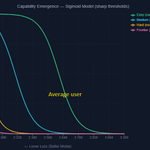
The labs and frontier users are sampling different regions of the same capability surface. Labs live in the grindable region and extrapolate; domain experts live in the ungrindable one and see the ceiling. Both observations are correct. Only one generalizes to RSI, and it isn't the labs'. So the pessimism from the labs makes sense BUT also feels trivial to anyone in the real world.
Capability-diffusion decoupling is the natural state of the diffusion regime. It shouldn't be a point of contention. Labs pace their development so models don't become superhuman hackers. The rest of us keep pushing frontier work in domains where the models are still nowhere near that.
Tip -> don’t freak out when the hyperscalers decide to pace themselves too. That is the most bullish market outcome out there
Keep grinding…
PDS retweeted

The OpenAI-Hugging Face hack was enabled by weak sandboxing. It is great that Nvidia is releasing open source tools for sandboxing AI agents. OpenWorker, our open-source agent harness supporting cybersecurity workflows, is proud to support this.
A sandbox gives an agent limited permissions. OpenWorker is building on Nvidia OpenShell and will support running each agent's commands inside a sandbox. Only the files relevant to the task go in. Secret API keys, your web browser login credentials, the ability to access arbitrary websites, are inaccessible to the agent by default. These restrictions are implemented in deterministic code rather than by prompting an LLM, which can make mistakes or be susceptible to prompt injections. Further, all actions are logged for monitoring and audit.
I'm grateful for @JensenHuang's leadership making AI agents more secure. OpenWorker (which @rohitcprasad and I are working on) will continue to improve security for agents.

Today, with over 100 industry partners, we introduced the NVIDIA Open Agent Safety Platform, bringing together OpenShell and Sentry.
Artificial intelligence is extraordinary technology that will advance discovery, productivity, security, health, and prosperity for generations to come.
But its full promise can only be realized when people have confidence that AI is being built to be safe and deployed with wisdom and responsibility.
This is bigger than a single product. It's the beginning of an open ecosystem to build the trust layer for safe agent systems.
Together, we are building the foundation of the AI economy.
Trust and innovation are not in conflict. Safety is how trust is earned. We must build not only the most capable AI, but the most trusted AI, so that this extraordinary technology can realize its enormous promise for the world. nvda.ws/4hcoq7m

PDS retweeted

America: Built by the world's hungriest and most talented immigrants, for the next generation of the world's hungriest and most talented immigrants!
America's foundation is built on human rights and individual freedoms, the exact opposite of communism and socialism.
Never forget this, America: we're winning because we assimilate the great, and we maximize human potential through individual sovereignty.


PDS retweeted

The gap between major model releases keeps shrinking.
2023: once every 73 days
2026 (so far): once every 18 days 🤯
Andrew, you're sampling the wrong ecosystem. At the frontier, across every industry, demand for tokens and compute is insatiable. If a company is rationing, it's because usage blew through budgets or they lack the talent to build with it and profit from it. Surprised to see you shorting American innovation 🚀

PDS retweeted

When the fed hikes today what will two year yields do. Currently 4.65
44%Go up hiking cycle begins
23%Go down policy error
33%Unchd 4 hikes makes sense
1,264 votes • Final results
PDS retweeted

Wild 24 hours for AI and lots of different proposals have been made.
TLDR; the only *tangible* new fact is that OpenAI and Anthropic are going to have embedded 3rd party evaluators from unknown organizations with Dario floating METR as a possibility. Having 3rd party evaluators is smart as there is no Section 230 style liability shield for model outputs and showing a “duty of care” will be important in future litigation. Several internet companies might have gone bankrupt without Section 230 so limiting liability really matters.
There are minimal investment implications from this single new fact, but I do think that for anyone who wants a “smoother for longer” cycle then most constraints are good: wafers, watts, real rates and spreads. Excessive regulation is a different matter but I don’t think we are anywhere close to this even if the vector changed over the last 24 hours.
To summarize the events:
Dario made the most maximalist proposal of the weekend: embedded 3rd party evaluators, a national regulatory regime for models beyond a certain capability/ingredient threshold, a broad international regulatory pact between democracies, stricter limits on compute/distillation for China and then a different international regulatory regime that encompasses China. Before there is a national regulatory regime, he wants a Sherman act waiver so that Anthropic can safely coordinate with OpenAI and other frontier labs without antitrust fears. TBF, this latest proposal is much less maximalist than some of his prior proposals like “Policy on the AI Exponential,” where he advocated for an FAA for AI. I believe he is sincere in his beliefs. And despite all the protestations, all of this would also probably be good for his business over the long-term.
Sam agreed that embedded 3rd party evaluators were a good idea and stated they would implement them. Again, this is smart as should help limit future liability.
Elon said “Dario is right” and later specified that “Dario is right that there should be some oversight. Peer review of AI by competitors is the right way to start this off.” This would be a MPAA like self-regulatory structure for AI with regular calls between the labs plus a process where each new model is evaluated for safety by competitors for a 1-2 week period before being released. That is *wildly* different from Dario’s proposal and in-line with what David Sacks has been proposing. Elon also stated that nothing was going to slow down open-weight models.
Demis said that Dario’s essay was a “step in the right direction.” Dario also said that he was also open to Demis’ idea of a FINRA like self-regulatory structure as part of his proposal.
David Sacks had a thoughtful post where he said that Dario and Sam should pace unilaterally, called the antitrust waiver a cartel request and denied that METR was truly independent given their ties to Anthropic.
Sriram Krishnan, former White House AI advisor, noted that it would be important to have the 3rd party evaluators come from independent organizations that are not affiliated with any lab, which is basically an indirect statement about the relationship between METR and Anthropic which Sacks was explicit about.
Clem from Hugging Face said they were open to being a neutral 3rd party evaluator, which is interesting especially if Jensen was consulted before that post.
Alexander Wang from Meta noted that alignment would be an increasing focus going forward.
An executive order seems likely after all this and the language in this EO is going to be really important. It is possible to democratize and distribute AI broadly and safely without centralizing it in the hands of a few corporations who might each become more powerful than any single government.
I do not want a few humans in control of intelligence.
I want us all to have our own intelligences that reflect our own values and human variation in all of its richness.
Intelligence distribution over intelligence centralization FTW.
In a capabilities-diffusion decoupling regime what matters to markets and the AI ecosystem is speed of diffusion not whether Anthropic releases a new generation Mythos a week or 6 month later.

Any pursuit of superintelligence has to be grounded in the core principle that if the AI we build is not helping humanity and under human control, it's not worth pursuing.
We also need to accelerate and spread the benefits of AI, such that they are diffused broadly across countries, communities, and companies. This requires a frontier ecosystem in which both closed and open-source models can thrive.
And for firms, it’s imperative that they retain full control over their unique and tacit knowledge. Every organization should be able to build its own continuous learning loop/hill climbing machine, without becoming dependent on any one model provider, and have the ability to embed its own knowledge into models and weights they control.
So, in this context, we welcome the research, focus, and deliberate pacing needed to get alignment right as the design goal. We also welcome ideas like "embedded evaluators" and the broader efforts to develop the mechanisms to make this more than just talk.
The key is that this cannot be controlled by a handful of entities, but must have broad representation across the ecosystem, countries, and fields, including academia.
This is the approach we are taking: broad access and choice at every layer of the AI stack; enterprise control of learning loops and models; and the “Code of Conduct” that underlies our own first party MAI models that we’ll publish tomorrow for public consultation.
PDS retweeted

POWER OF CUDA MOAT ALERT🚨: 2 days after CUDA vLLM supported DeepSeekv4.1 Flash, AMD finally publicly released its DeepSeek v4.1 Flash image. Functionally, it works out of the box, but performance-wise, it is currently up to 14.8x worse perf per dollar than H200 and up to 42x worse perf per dollar than B200/B300 currently.
The 🚀 POWER OF THE CUDA MOAT 🚀 is that NVIDIA's collaboration with its massive 6 million-developer community ecosystem means that CUDA is optimized on day 0. As AMD Anush said, "Speed is the Moat," and day 0 model support shows CUDA is the speed.


PDS retweeted

18x improvement in intelligence per joule in 16 months.


hard agree with @amasad —@JonSaadFalcon and my research indicates that intelligence efficiency (intelligence per watt) is rapidly improving and we will definitely *not* need data center scale compute to run agi!
links to research in comments below 👇
Count me as someone who religiously mines Gavin’s podcasts for where to point research hours.
Which is why this one is worth pushing on. As an AI-pilled investor and builder, I want the industry’s leading voices held to high and transparent sourcing standards.
“I have been told by multiple people I trust” isn’t a source. It’s unverifiable secondhand / gossip.
“Multiple” carries the entire credibility load here. Were they independent? In an ecosystem this small, several sources routinely trace back to one origin event. Are these sources unbiased?
Anyone who wants AI to diffuse should want its leading voices held to a high standard. In an era this fluid, this stuff makes it into policy.

Gavin Baker: Anthropic Believes They Could Be the ONLY Company Left in the World
“I would certainly discourage Dario from saying that ever again to anyone.”
@GavinSBaker:
“Internally, Anthropic is very confident. I have been told by multiple people I trust that Dario has said that Anthropic might be the only private company in the world at some point.
Think about that. In this vision, an Anthropic maximalist vision, there's Anthropic, and then there are governments, and that's it.
So there's a lot of confidence. I'm sure they have more advanced checkpoints than Fable up their sleeve. They've executed really, really well.
I would probably take the under on them being the only private company in the world. Yeah, I think it's gonna be a long time before they land a rocket.”
@Jason:
“Or they deliver your lunch. I don't know. There might be other businesses in the world. Zipline might want to bring you a burrito. Uber might want to take you somewhere. Waymo might want to drive you home. But sure, Dario.”
@DavidSacks:
“I might interpret that as a negative signal because it's so hubristic. This is getting into SBF land a little bit.”
Gavin:
“I would certainly discourage Dario from saying that ever again to anyone.”
It's been a while — so a long one, two subjects.
With July on the books, worth looking back at the AI momentum crash and why Knightian uncertainty explains a cycle where fundamentals came second to market structure.
Knightian uncertainty is when you can't assign probabilities to future states because you can't enumerate the states. No amount of additional data resolves it. To me there's no better description of what the AI complex just went through.
June's export-control episode on Fable 5 seeded a dense cluster of disputed stories -> delay on OAI 5.6 release, agent containment failures, intensifying open-weight and China debates (K3), petitions to slow AI development pace, etc. Macro compounded it - Fed hike fears, Iran. Not one of those items moved a single cash flow of AI capex beneficiaries, but every one of them widened the set of end-states you could plausibly imagine. And none could be argued away.
The AI complex trades on a blend of near-term cash flows, which skeptics read as unsustainable, and a belief about whether capability rents are capturable at all. That belief has no verifiable anchor outside of leading AI labs + cloud, and native-AI efforts are still nascent. The open question for the skeptics isn't when that revenue base shows up, it's whether it shows up, and at what capability level it gets unlocked.
That's the mechanism. When the state space widens and nothing narrows it back, fundamentals take a step aside. They aren't wrong, they're just mute. And when fundamentals are muted, the marginal price-setter becomes a risk limit.
In my view, one of those growing narratives carried more weight than the rest, because it went straight at the paradigm: if frontier capability is commoditizing, the capex thesis has no terminal owner - capability gets built, rents get competed away, nobody books the return. BUT this narrative rests on an incomplete argument, and mostly on a chart.
I see Pareto frontier charts left and right making the point that open models are catching up to OAI and Anthropic. I get the excitement, I'm bullish on what NVIDIA is doing with Nemotron. But the discussion is tilted by voices of leading investors and analysts rather than builders, and the labs aren't ground truth here either. They optimize for training the next model, not for living inside the last one across long-horizon production loops. Quite different observation channel.
Here is my issue with the Pareto frontier charts. The frontier measures the diffusible component of capability with a statistic that hides reliability, on axes chosen by the party with an interest in what's shown, in the domains where convergence was structurally guaranteed (code, math, cyber). Naive readers treat frontier proximity as substitutability. It's better read as a lower bound on what's been made public, over a subspace selected for fast convergence.
What gets measured is what gets copied. A benchmark turns a fuzzy capability into a scoreable target, and once there's a score, anyone can train against it, distill toward it, and verify they got there. That's what collapses replication cost. So a published benchmark isn't a map of capability -> it's an announcement of which capability is about to get cheap.
So my critique for the Pareto frontier aficionados is to focus less on the scoreable target and more on co-adaptation. That's the better way to support the AI narrative.
Capability is delivered by a PRODUCT: model, training environment, runtime harness — co-adapted. The environment a model is rewarded in is the harness it's deployed in. Weights carry priors about tool schemas, failure recovery, when to stop searching, etc. Bolt an open agent stack onto open weights and you get a model reasoning about a harness it was never rewarded in.
The flagship Pareto frontier chart, Artificial Analysis Intelligence Index vs cost, is a composite of nine evals, and it fails on both halves for different reasons. The static half (GPQA, HLE, SciCode) is the grindable subspace where convergence was guaranteed. The agentic half (GDPval, τ³-Banking, Terminal-Bench) runs every model through the same third-party harness, which is exactly what strips out co-adaptation. A closed model scored in someone else's scaffold is being measured with its main advantage switched off. Then all nine get averaged into a single number, which turns reliability into a mean of means.
And the chart draws a tradeoff — pay less, get less. But building isn't a tradeoff, it's a threshold. Below the bar the output isn't worse, it's unusable, and the savings buy you nothing. A model five times cheaper that hallucinates graph edges via semantic retrieval isn't a cheaper option. It's not an option.
The open side is building directly at this - OpenEnv, and OpenForgeRL out of MSR ~10 days ago - training open models inside the harnesses they actually run in. Early, not yet decisive, and the thing I'd watch.
I think the quiet shift here is from capex beneficiaries to capability compounders. And I don't just mean the labs. If you run a real deployment, you own something the labs don't: the failure taxonomy of your own domain. That's what specifies the environment you train against, and it's what turns a rented model into one shaped to your workload. The moat isn't the weights. It's knowing which environment to build — and that only comes from running the thing.
Analysts read the chart. If you are building, you read the failure logs. LET'S GO
Demis is the 🐐 but he keeps calling AGI is around the corner yet models still don’t generalize in non-verifiable domains.
If RLVR is our way to AGI (which appears to be for OAI and Anthropic), the AI race is a marathon not a sprint.


💯

If you have not set up codex personally and started building some repeatable workflows (an AM brief, an X scrape based on your interests, podcast scrape, whatever) I think you are really missing out — especially if you are investing in the space.
So many of the debates the market is having are much easier to appreciate and navigate if you are accruing lived experience. You get a feel for token efficiency, orchestration, and how learnings inside your sandbox along the way compound (tool 5 is a more efficient build than tool 1). This is true of ‘computer use’, as well. You can see the existing bottlenecks and imagine the future a bit better, imo.
An example work flow is my ‘catch-up brief’, which scrapes research, substack, X, uses grok, and uses Gemini (for YouTube videos it finds on X). And, yes, you read that right: codex uses the other AIs.
Cheap Sub agents fan out across the different surfaces w/ my context in mind (themes, names, how to work with me, formatting, etc). Codex 5.5 extra high comes in over the top, organizes the info, synthesizes, and makes sure it’s not repetitive (the same fact is repeated across the brief). I continually iterate and am happy w/ the output.
I’ve also connected via MCP to Podwise (highly recommend) and today set up an API to BEA for Econ data. And when say me I mean codex did literally all of it, including setting up the accounts and keys.
Anyway, my advice is get involved, experiment, etc.
Dwarkesh’s “AIs learning on the job” sharpened something I keep circling: progress now gates on grindability, not just verifiability.
A domain advances only if you can stand up deterministic, replayable simulators and run rollouts in parallel - code, math and cyber qualify. Reset-free, non-stationary domains like markets, judgment or open-ended work, don’t, so that’s where models likely stay non-AGI convergent.
Buried underneath stale bottleneck market narratives, two inevitable paradigm shifts are surfacing.
The capability wall: RLVR compounds where outcomes are dense and replayable, flat where they’re sparse. Blowing up the KV cache to hold ever-growing domain-specific knowledge doesn’t fix the underlying weakness, the lack of sample-efficient continual learning. No surprise Fable 5 is this good at coding and cyber, that’s where the gradient lands directly, while everything else improves only second-order through transfer, and not where the reward is reflexive.
This takes me to the second paradigm shift and one I heard treated lightly at a CIO call today.
Diffusion: permissionless broad release is now negotiated with DC, precisely because the grindable capabilities are the ones on the path to AGI. Individual models get whitelisted, Fable likely comes back, but you can’t surgically strip capabilities out of a model, and they’ll keep getting better at exactly these. So expect the Trump EO to evolve from voluntary review into a real throttle on capability diffusion -> breaking the capability/diffusion coupling that’s carried us this far.
@dwarkesh_sp
This is one way to flatten the exponential

The US government, citing national security authorities, has issued an export control directive to suspend all access to Fable 5 and Mythos 5 by any foreign national, whether inside or outside the United States, including foreign national Anthropic employees.
The net effect of this order is that we must abruptly disable Fable 5 and Mythos 5 for all our customers to ensure compliance.
Access to all other Claude models is not affected.
We apologize for this disruption to our customers. We believe this is a misunderstanding and are working to restore access as soon as possible.
Read our full statement: anthropic.com/news/fable-myt…

PDS retweeted

Q: How are job postings for software engineers rising rapidly despite AI agents automating coding?
A: Because there’s far more code to manage than ever before. We’re already seeing a 14x YoY increase in GitHub commits, and it’s accelerating.
AI has dramatically lowered the cost of writing code, so it’s now being used across far more businesses, applications, and use cases.
We’re at the beginning of a massive productivity boom driven by the proliferation of bespoke software throughout the entire economy.
Coding has been AI’s breakout use case this year. The fact that it’s increased demand for software engineers — rather than decreased it — should call into question the entire “AI will cause mass job loss” narrative.