

Buy-side investor researching AI infrastructure & semiconductors.
Hong Kong
Joined March 2016
- Tweets152
- Following348
- Followers750
- Likes168



Pinned Tweet
Great point. I think a lot of people are missing what Gavin is saying.
Just look at what Jensen keeps showing at GTC. Tokens per watt are improving dramatically, and better hardware and prefill/decode optimization are driving down the cost of producing tokens. Meanwhile, GPU rental prices are actually going up.
Open-weight models are driving a huge increase in token usage, and all that demand still needs compute.
For CSPs and neoclouds, this creates a pretty interesting opportunity. Higher GPU utilization, strong rental pricing, and for those running their own inference services, potentially much better margins as production costs fall faster than API prices.
Even existing A100 and H200 fleets can become more economically valuable as inference software improves.
What’s really interesting is the growing gap: the cost of producing each token keeps falling, token demand is exploding, and GPU rental prices are still holding up.
Cheaper tokens don’t necessarily mean less money for AI infrastructure. They could actually make the whole market much bigger.

1) Trying again.
TLDR: Everyone can win. Open-source, frontier labs, infrastructure, applications and most importantly the American people.
I understand all of the jitters about Anthropic losing share, real rates, spreads and second derivatives. Still think the most likely future outcome is a hybrid, multi-model future where almost everyone wins, open-weight tokens are likely the overwhelming majority of tokens, the dominant frontier model companies still do well albeit perhaps not the outcome that seemed possible in May and AI infrastructure/applications benefit immensely from the increased fragmentation, competition and lower margins at the model layer.
Lower margins at the model layer mechanically drive higher compute demand as long as someone is willing to pay for the training. And Jensen is obviously willing to be the “trainer of last resort.” As below-market compute contracts signed in 24/25 roll-off and reprice higher, cloud and neocloud revenue should continue to accelerate which will help address financing fears; I think we may be near peak external financing for this buildout. Noteworthy that using data from 3Fourteen Research, B200 clusters will generate a 37% IRR *if* their rental price declines 40% per year. Prices are still going up, but that IRR math is too ridiculous to print. 37% IRRs available at scale should get funded.
Re: this weekends controversy about MOUs, Anthropic’s $413 billion of real contractual commitments sounds scary. Reality is that it works out to roughly $31 billion of annual cloud spend, which is easily internally financed given their reported ARR, and $161 billion of spend at Broadcom which will be financed by Broadcom and private credit.
Continue to believe fragmentation at the model layer is the best outcome for ordinary Americans and humans everywhere. As I have said before, do not trust any 5-20 individuals to make the best possible decisions about the direction of this technology. I want as many AIs as possible to maximize the odds that they encompass the diversity of human values across the world and richness of human variation. And I want an AI that shares my own personal values. Safety, freedom and the maximization of human agency through democratization, distribution and diffusion vs. centralization. History has spoken on the dangers of the latter path.
Finally, from my perspective anything that slows this buildout down is net positive over the long-term as the biggest risk and worst outcome is an *actual* overbuild. We are structurally short watts, wafers and increasingly capital. That is all good. God forbid we were still in ZIRP, TSM ramped capex to 3x their current plan and we weren’t short turbine blades: there would almost certainly be an overbuild and a bubble. That would be terrible. Slower and smoother for longer is better both for investors and for the world. A terrible cyber event is the most plausible near term bear case IMHO, but AI cyberdefense ramping quickly and I was happy to hear Sholto say that cyber probably becomes defense dominant in the near future.
Longer, threaded version follows:

transLog1c retweeted

A few interesting takeaways from Zhongji Innolight (300308.SZ) mgmt latest earnings call (Oct 29th):
- 2027 demand visibility remains exceptionally strong. Firm POs from major customers already cover the full year, with no signs of order cuts. Early 2028 guidance from some key customers points to further growth.
- NPO and other next-gen optical interconnects are expected to start ramping in 2H27, with large-scale deployment anticipated in 2028.
- Most of the company's future capacity expansion is expected to take place in Thailand and other SEA countries.
- DSP supply remains tight, but mgmt is confident in securing sufficient supply to meet customer demand and believes concerns over the potential $MRVL $LITE deal are overblown.
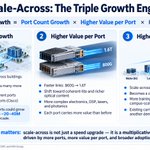
- Mgmt cited industry research projecting 70%+ CAGR for the scale-across market over the next few years, driven partly by power constraints that are pushing AI clusters toward greater interconnectivity.
Overall, mgmt remains very confident in both the industry outlook and the company's competitive position heading into 2027–2028.


A few things I've been hearing from some Hong Kong-based funds:
They believe 2027 will mark the peak in AI capex growth. Spending may continue to rise in 2028–2029, but a slowdown in the growth rate is inevitable. Interestingly, I've been hearing this same argument from them for the past 2–3 years.
Quite a few remain skeptical that CSPs will ever earn an adequate return on their massive AI investments. They also doubt that the current profitability of memory companies is sustainable.
Their valuation argument follows from this: once capex growth starts slowing, these stocks can no longer justify 20–30x earnings.
One of them put it this way: "Even if a stock looks cheap at 10–15x today, that valuation doesn't mean much if capex growth starts decelerating next year."
They also believe the market needs a much stronger "new narrative" to trigger a meaningful reversal in sentiment.
Personally, I find this reasoning a little amusing. It's almost the complete opposite of what I've been hearing from funds in Taiwan and the US.
Same industry, same data, yet such different conclusions.

I've been hearing that many Hong Kong-based funds see the recent weakness in $SOXX as the beginning of a bear market, with some even moving to outright short positions.
Interestingly, the sentiment I'm hearing from funds in Taiwan and the US is quite different. They don't seem nearly as bearish.
Pretty interesting divergence in positioning and sentiment across regions.
I've been hearing that many Hong Kong-based funds see the recent weakness in $SOXX as the beginning of a bear market, with some even moving to outright short positions.
Interestingly, the sentiment I'm hearing from funds in Taiwan and the US is quite different. They don't seem nearly as bearish.
Pretty interesting divergence in positioning and sentiment across regions.
Amazon Q3 2026 Earnings Call:A few interesting takeaways
1. On the core side, it's important to remember that the vast majority of global IT spend, about 85%, is still on-premises.And we're in a 10 to 20 year cycle where that equation will flip to the cloud.Conventional wisdom has been that lynchpin workloads like mainframes or storage array networks would never move to the cloud, but these workloads are moving.
2. For example, as customers generate increasingly more data and seek to get value from it in analytics and AI, the complexity of moving data between data stores and analytics engines is onerous and expensive. With our acquisition of Duck Labs, DuckDB will become the universal SQL dialect of AWS storage and analytics, simplifying data processing with a modern analytics engine that is fast, simple to use and ubiquitous, and where customers will be able to write SQL queries once and then execute using any AWS analytics service.
3. On the AI side, we continue to expand the capabilities of our inference service, Amazon Bedrock, and it's leading to remarkable growth with Fortune 500 companies spending nearly seven times more on Bedrock year over year, and total Bedrock token volume growing nearly 17 times year over year. Bedrock is the fastest growing multibillion dollar service in AWS's history.
4. We believe that AWS can grow north of 40% in each of 2027 and in 2028. And be a trillion dollar revenue business in the next five to 10 years. We're in the very early days of this inflection. Our strategy is working and I expect it will for the foreseeable future.
$AMZN
Exactly. Having a third DSP supplier enter the market is the kind of competitive landscape other optical module makers would welcome.
Regardless of whether the deal goes through, I think CRDO has a real opportunity to capture more optical DSP business going forward.
That said, I personally think the MRVL-LITE deal is unlikely to happen.

If $mrvl acquires $lite, it would likely be accepting heavy dilution to secure scarce lasers and an optical switching business that sits alongside its electrical switch silicon.
Marvell’s bargaining power vis-à-vis module makers would increase, raising the question of whether the deal would be approved by regulators.
$cohr will benefit from tighter laser supply and other DSP manufacturers will also benefit as Lumentum’s Cloud Light transceivers compete with the module makers that buy Marvell DSPs; some may move DSP volume toward Broadcom, Credo and others.
If MRVL really ends up acquiring Lumentum, I wouldn't be surprised if Google is involved in some way
Both are key suppliers to Google, especially with OCS expected to ramp significantly next year. Google has every reason to help secure that supply chain and support further capacity expansion
That said, I still don't think the deal will actually happen


Interesting article from Light Reading on why SpaceX could be a major opportunity for $NOK and its AI-RAN partnership with $NVDA.
$SPCX is reportedly looking to secure access to 80,000 cell sites across the US, potentially building a fourth nationwide wireless carrier.
The size of this opportunity could be significant.
According to BNP Paribas, deploying 80,000 macro sites could require around $25B in investment over roughly five years, as part of a broader $75B capex program.
Not all of that $25B would go to equipment vendors, of course.
But assuming 25–40% goes toward RAN equipment and software, that's a potential $6–10B market.
If Nokia could capture 50–60%, we're looking at roughly $3–6B in cumulative revenue over the deployment cycle.
That's an optimistic scenario, not a confirmed order.
The Light Reading article highlights several reasons why Nokia could be a particularly good fit for SpaceX.
1. A network built from scratch
Unlike AT&T, Verizon or T-Mobile, SpaceX wouldn't be tied to an extensive legacy RAN infrastructure. That could make it easier to adopt a new architecture like Nokia's GPU-based AI-RAN.
2. Spectrum efficiency
The article cites T-Mobile's CTO, who estimates Starlink has around 80MHz of spectrum, compared with nearly 400MHz for T-Mobile.
Nokia's AI-RAN partnership with NVIDIA aims to improve spectrum efficiency through AI-driven radio optimization. That could be especially valuable for an operator with limited spectrum resources.
3. Supporting future AI applications
SpaceX has ambitions beyond traditional mobile connectivity, including autonomous vehicles, robotics and AI-powered devices.
The article suggests Nokia's AI-RAN architecture could be a natural fit, potentially allowing GPU infrastructure to support both wireless network processing and edge AI workloads.
Of course, none of this guarantees Nokia a contract. Ericsson, Samsung and other vendors would also be competing, and AI-RAN still needs to prove its economics at scale.
But if SpaceX were to become a major AI-RAN customer, the implications could extend far beyond the initial equipment orders.
It could provide an important real-world validation of Nokia's AI-RAN strategy and potentially accelerate adoption across the broader telecom industry.
Another interesting potential growth driver for $NOK alongside AI optical networking and DCI.
Source: Light Reading, Iain Morris (Oct. 26, 2026)
lightreading.com/5g/nokia-ba…

I think the market is still assigning very little value to $CRDO's optical business.
Interestingly, CRDO was trading about 10% higher than today when management first discussed the potential TAM for ALC.
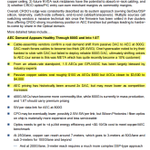
I've reviewed several sell-side models from major investment banks. Most are forecasting around $4B in FY28 revenue, with roughly $3B coming from AEC. Based on my own estimates, the AEC business alone could generate $1.5–2B in earnings by FY28.
Yet CRDO's market cap is only around $30B.
And I don't think the AEC growth story is anywhere close to being over.
As management has repeatedly emphasized, they still don't see a clear slowdown in AEC demand over the next several years.
More importantly, the AEC TAM itself is still expanding.
Beyond existing GPU cluster connectivity, management has highlighted several additional opportunities:
1/Agentic AI is driving demand for CPU servers, creating more NIC-to-ToR connections in front-end networks.
2/Disaggregated switch racks are replacing traditional chassis backplanes with high-speed cable connections between switches.
3/PCIe Gen6 and CXL could open up new scale-up connectivity opportunities across CPUs, GPUs, memory, and storage.
These are not simply incremental upgrades to existing deployments. They represent additional areas where AEC adoption can expand.
In other words, I think the market is underestimating how much room the copper business still has to grow.
Meanwhile, CRDO's optical opportunity is only beginning to materialize.
As I mentioned yesterday, I believe ZeroFlap optical module capacity alone could support over $1B in annualized revenue by FY28. Management has not provided that specific revenue guidance, and I don't think the full potential is reflected in the sell-side models I've reviewed.
And that is before considering the longer-term opportunities from ALC, OmniConnect, and NPO.
This is where I see the biggest disconnect in valuation.
The market is compressing CRDO's copper multiple on concerns that growth is approaching a ceiling, while giving very little credit to its emerging optical business.
Yet copper demand continues to expand into new applications, and optical is becoming an entirely new growth engine.
From a long-term perspective, I find CRDO very attractive at these levels.
The market is discounting copper growth before it has slowed, while barely pricing in optical growth before it has fully materialized.
That's the opportunity I see here.
Hope this perspective is helpful!
Great!

The $CLS report might be the best news $CRDO has gotten all month, and I do not think people have connected it yet.
Celestica designs and builds the networking switches and server racks for the hyperscalers, the exact systems that Credo’s cables wire together. When Celestica ships more switches and racks, more cables get pulled with them. It is one of the cleanest real-time windows into the demand Credo actually sells into.
Now look at what they just reported. Revenue up 83%. The networking-heavy segment up 102%. And then the stunner, they guided 2027 revenue to DOUBLE to $40 billion, with their 800G and 1.6T networking programs named directly in the outlook, and said customer demand forecasts for 2028 are meaningfully higher than even that.
Remember what $CRDO just fell 20% on. Fear that 1.6T adoption was coming slower than hoped and that demand was wobbling. The company building the actual 1.6T systems just filed an outlook that says demand is doubling and accelerating into 2028. Inside those racks, at those distances, copper wins on cost and power, and Credo holds 93 to 99% of that cable market by its own competitor’s estimate.
The share questions, MaxLinear’s ambitions and the one deployment flirting with optics, still get answered by Credo’s own print. But the market priced a demand slowdown into a stock whose demand pipe just doubled on paper.


A great start to earnings season!

$CLS delivered strong results (as expected)... corporate.celestica.com/news…
Q3 revs up +83% YoY
Q3 eps up +109% YoY
$CLS also raised CY2026 revenue guidance to $21B and said 2027 revenues will be $40B+ (+12.4% above current estimates) which implies ~90% growth, also giving CY2027 eps guidance of $21.50 eps which implies +85% YoY growth... I suspect there's upside to both these CY2027 numbers... this is just the starting point... this management team likes to underpromise and overdeliver... this means $CLS is trading AH at ~12x CY2027 eps with a forward PEG ratio of 0.15x
$CLS up +9% AH although it was selling off into the close so it should be up much more on these results and that guidance.

Exactly
This is something a lot of people are overlooking
Revenue per GPU can increase as token prices decline if per GPU token throughput increases enough.
So both Anthropic revenue *and* margins can go up as token prices go down *if* GPU prices go up less than the product of (token price decline * per GPU throughput increase).
But I have super enjoyed all the commentary to the contrary!
transLog1c retweeted

I am shocked, absolutely shocked, that Anthropic ARR has likely gone vertical in October after they cut token prices.
Except the exact same thing happened for the entire AI market, which is why GPU rental prices have surged while token prices declined.
$100b plus in year-end ARR looks possible again.


One thing I think is being overlooked in the copper-to-optical debate is the actual cost of moving to optics.
Evercore's channel checks with nearly 20 AI networking and cabling engineers suggest the following rough link costs:
• Passive DAC: ~$100
• AEC: ~$900
• AOC: ~$3,600–4,000
That's roughly 4x the cost of AEC for AOC, based on those industry estimates.
If SpaceX/xAI is considering moving more of its ~10m interconnects to optical solutions, I think the economics deserve closer scrutiny.
Beyond the upfront cost, there are also power consumption, thermal management and link reliability considerations at scale.
Of course, optical may be necessary where copper simply cannot meet the reach or bandwidth requirements.
But moving to optics isn't automatically an upgrade in total cost of ownership.
The real question is whether the additional reach and architectural flexibility justify the higher cost and operational trade-offs.
That's why I think the copper-to-optical transition may be more gradual and application-specific than some investors expect.
That said, this emerging demand could also create a great opportunity for $CRDO to introduce its ALC or ZeroFlap optical solutions to SpaceX/xAI, potentially turning a threat to its copper business into a new growth opportunity.

I think the Street may still be underestimating the optical opportunity at $CRDO.
And importantly, I believe my assumptions here are deliberately conservative.
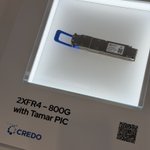
Management has indicated that monthly optical module production capacity could reach hundreds of thousands of units by the end of FY27.
I'm conservatively assuming just 200K units per month, at the low end of that range, which would translate into 2.4M units of annualized production capacity.
At an assumed ASP of only $500, that's $1.2B in potential annualized module revenue, assuming full utilization and sales of complete ZeroFlap modules.
To be clear, this is an illustrative run rate based on potential capacity at the end of FY27, not a forecast of actual FY28 revenue.
At an assumed ASP of only $500, that's $1.2B in potential annualized module revenue, assuming full utilization and sales of complete ZeroFlap modules.
To be clear, this is an illustrative run rate, not a forecast of actual FY28 revenue.
Recent supply-chain checks suggest a CY27 target of 3.5–4M 800G modules using Credo's DSPs. At the same $500 ASP, that's $1.75–2.0B in potential module value. Actual revenue recognition depends on how much Credo sells as complete modules rather than standalone DSPs.
Here's the part I find most interesting: these supply-chain estimates focus on 800G alone.
Credo also expects additional 1.6T ZeroFlap customer ramps, with 1.6T entering the product mix through 2027.
If that ramp materializes, the combination of additional volume and potentially higher ASPs could create meaningful upside beyond an 800G-only model.
In other words, even before considering 1.6T, I think there's a strong case that current forecasts may be too cautious.
And that's before the longer-term opportunities in ALC, OmniConnect and NPO, which are still at an early stage of commercialization.
Of course, macro and liquidity headwinds remain significant. The market is compressing valuations for companies with strong FY27–28 growth potential.
But if we get through this period and Credo executes on its roadmap, I think the current valuation offers a very attractive risk/reward setup.
On my FY28 earnings scenario, $CRDO trades at a low-teens P/E, with several additional growth opportunities that may not yet be fully reflected in expectations.
The market may not be willing to pay for future growth today. That doesn't mean the growth won't materialize.
I'll be publishing a more detailed research article on Credo over the next couple of days, covering its technology, supply-chain insights and potential upside beyond current Street expectations.
It'll be free to read on my Substack. If you're interested, I'd love for you to check it out!
I've seen another explanation for the $CRDO selloff.
Apparently, an Edgewater Research note flagged a Cisco 1.6T cable program that could use $AVGO or $MXL chips instead of Credo's.
Nothing has been confirmed yet, but this kind of scare story couldn't have come at a worse time. With the market already so sensitive to liquidity, it was enough to trigger a massive selloff.

$CRDO dropped on Friday after $MXL 's CEO mentioned on their earnings call that they are targeting ~25% share of 1.6T AEC market despite not expecting their first revenue until year 2027.
For context, MaxLinear have not yet shipped their 1.6T DSP Rushmore after a few engineering samples didn't offer good-enough results. Revenue for that product is expected to ramp in 2028 so definitely an execution issue there, but that's just from channel checks and industry discussions. I can't see them executing and taking a large chunk of market share from Credo's AEC business, but hyperscalers prefer multi-sourcing and at the end of the day, the AEC market , and Credo will maintain the lead in that growing market.
Credo's stock droppe mostly on Edgewater mentioning that SpaceX might not use 1.6T AECs anymore, as their new data center architecture requires 10m 1.6T AECs when the max they can reach is 6.5. Something ALCs can resolve. Perplexing dynamic to me, but definitely something worth digging more into.
I think the market is seriously underestimating $CRDO's lead in AECs.
People seem to think that just because $MXL or $MRVL can develop a 1.6T AEC chip, they can easily take market share from Credo. I don't think it's that simple.
Here's why.
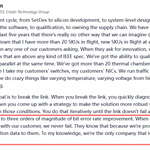
Credo doesn't just sell chips. It owns the entire solution, from SerDes and cable design to firmware, system testing, qualification and delivery.
Bill Brennan once talked about Credo's testing facility in Taiwan. They have over 20 thermal chambers running real customer switches and NICs under heavy traffic.
And the goal isn't just to pass the tests. It's to deliberately break the links, find every weakness, and fix it before the customer ever sees the product.
He said this process has improved bit error rates by 100–1,000x.
Frankly, I'd love to see another AEC competitor put its entire solution through the same kind of torture test. So far, I haven't seen anyone else publicly talk about testing their links this aggressively.
And Credo has the track record to back it up. According to the company, its AECs have accumulated over 6 billion hours of real-world operation without a reported link flap.
That's not something a competitor can replicate overnight.
Just look at Meta's recent Prometheus report. It took extensive engineering work to reduce cluster interruptions by 99%. Not all those issues were related to cables, of course, but it shows how important reliability has become.
When you're running tens of thousands of expensive GPUs, saving a few dollars on a cable means nothing if an unstable link costs you hours of compute time.
That's why I think ZeroFlap is such a big deal.
Even $MXL's own CEO admitted that Credo controls roughly 93–99% of the AEC cable market.
I'm not saying competitors won't win orders. I'm sure some will, especially as the industry moves to 1.6T.
But winning a design is one thing. Getting qualified, proving reliability and delivering at scale is something else entirely.
Credo has already demonstrated its 1.6T AECs in Rubin rack configurations, while new entrants still have a lot to prove.
And let's not forget, $MRVL and others have been working on AECs for years. None of them has meaningfully challenged Credo's dominance so far.
I think competition will eventually come, but the market is underestimating how hard it is to catch up.
ZeroFlap isn't just a product feature. It's the result of years of engineering, testing and real-world deployment.
$CRDO’s premarket selloff may partly be driven by $MXL’s comments last night about entering the 1.6T AEC market. Investors may be worried about the impact of new competition.
But here’s what’s interesting: MXL’s own CEO estimated that Credo controls roughly 93–99% of the AEC cable market.
Credo has a mature, proven end-to-end solution, from silicon and cable design to qualification and delivery. MXL, meanwhile, plans to sell chips rather than complete cables.
And competition isn’t new. $MRVL has been developing AEC silicon for some time, yet it hasn’t visibly dented Credo’s market dominance.
Of course, more competitors will eventually enter this market. But I think investors may be overestimating the near-term threat from MXL.
There’s a big difference between developing an AEC chip and taking meaningful share from Credo.