

Accelerating the end of AIDS in Eastern & Southern Africa | Zero new infections. Zero discrimination. Zero AIDS-related deaths 🌍
Johannesburg, South Africa
Joined October 2017
- Tweets9.6K
- Following420
- Followers6.1K
- Likes12.1K




“The biggest issue is poverty, education and teenage pregnancy” says Sheirat, a young leader who works to build girls' confidence and skills in Uganda.
Sheirat is part of the @UNITEDMoveESA of youth-led change-makers funded by #2gether4SRHR
The science is ready.
Now it’s up to us to make sure services are close, affordable and free of stigma for everyone who needs them!
#HIVprevention
UNAIDS Eastern & Southern Africa retweeted

“I’m protected. Finally, there’s something to protect me other than myself.” Yoweli, 22, a trans woman in Gauteng, is now protected from HIV by lenacapavir, an injection she needs only twice a year.
Read her full story:
unaids.org/en/resources/pres…
#EndAIDS #HIVPrevention #Lenacapavir

UNAIDS Eastern & Southern Africa retweeted

‘When prevention disappears, infections rise’: can the world still end AIDS? nature.com/articles/d41586-0…

Sex workers are 9x more likely to acquire HIV. Criminalization, violence and stigma keep that gap open.
Health for all means equity for all.
Tune into the #CrossingTheLastMile podcast and watch Juliana’s Hot Mic for more 👉🏿 bit.ly/4zOAGS3
#2gether4SRHR
RT @Winnie_Byanyima: The next chapter of the HIV response must be community-led and equity-driven, with communities at the centre and empow…
UNAIDS Eastern & Southern Africa retweeted
As global aid declines, African countries must continue strengthening domestic health financing and investing in community-led health systems. capitalfm.africa/amref-warns…

Girls in crisis need more than promises. They need skills, safety and support. 🌍
Explore the GAIA Toolkit in the next #FreshInsights session.
📅 29th Oct
⏱️ 11AM CAT
🔗 bit.ly/4joifPb
#2gether4SRHR
A strong HIV response depends on coordination, accountability and community leadership.
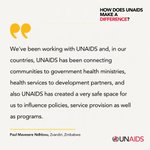
UNAIDS continues to bring communities, governments and partners together to influence policies, strengthen programmes.
HIV response must reach the people who need it most.
#SpecialPCB

UNAIDS Eastern & Southern Africa retweeted

Last week we joined @KyabazingaINI23 for the 2nd edition to the essay & debate competition under the theme:
'Promoting Positive Cultural Values to Keep Children in School & Protect Young People against Teenage Pregnancy, Child Marriages, School Dropouts, & #HIV in Busoga'.


Hafsa shows what happens when girls are given support in safe spaces.
Through mentorship and peer connection, girls are discovering they already possess the power to lead, participate and create change in their own lives.
👉🏿bit.ly/4zt2CuB
#2gether4SRHR

UNAIDS Eastern & Southern Africa retweeted

The YouthFluencer initiative empowers young people to champion change through social media. For @theonlyadrian, a 24-year-old from Zimbabwe, the initiative opened up new ways to breakdown jargon-heavy topics into everyday conversations. It enabled them to lead campaigns on mental health, HIV prevention, and treatment, sparking critical conversations around Sexual and Reproductive Health (SRH) in conservative spaces while encouraging youth to access youth-friendly clinical services.
#UNITEDMovement #youthfluencerinitiative #youthleadership #unitedmovement
UNAIDS Eastern & Southern Africa retweeted

Peer-led safe spaces can change lives. 💜 Speaking to @BBCWorld, Jimbo @jimboshanurah & Linda @ngwazi2021 shared how safe spaces support girls’ mental health & young mothers living with HIV, helping them build confidence, find work and return to school. #2gether4SRHR
UNAIDS Eastern & Southern Africa retweeted
What people have constructed, people can change. So I leave Berlin 🇩🇪 hopeful. A healthier, fairer world is possible. But it will not happen by accident.
Here is what I brought and what I take home from this year's @WorldHealthSmt #WHS2026:
🔗 linkedin.com/pulse/from-worl…

UNAIDS Eastern & Southern Africa retweeted

Progress in SRHR isn't made in isolation. Thanks to long-standing support from our donor #partners, @UNFPA @UNICEFAfrica @WHOAFRO & @UNAIDS_ESA are delivering integrated health services for youth across East Africa.
📰2gether4srhr.org/news-media/…
#2gether4SRHR #youthhealth #SRHR

UNAIDS Eastern & Southern Africa retweeted
UNAIDS helps keep the HIV response accountable: tracking progress against global targets, reporting annually on the data, and supporting countries to turn commitments to the 2026 Political Declaration into action.
Douglas Bosire, CEO of @nsdcc_kenya, reflects on how UNAIDS brings data, communities and political leadership together to sustain progress.
📢We cannot end AIDS as a public health threat without making HIV prevention accessible to all.
Removing barriers and expanding access are essential to an effective HIV response. HIV prevention must meet people where they are.

Climate change has the IPCC. Should inequality have its own panel? Barbados is the latest to back an International Panel on Inequality. 🌍
@Reuters @Winnie_Byanyima @anneshongwe @UNAIDS
👉🏿reuters.com/world/china/barb…


Barbados joins push for global panel to tackle inequality reuters.com/world/china/barb…
UNAIDS Eastern & Southern Africa retweeted
Science alone will not deliver health for all. The AIDS response showed that breakthroughs only save lives when people can access them. Access to HIV medicines was not just a scientific achievement, but a political victory.
Delivering health for all requires more than innovation.
It requires people organizing, challenging unequal systems and changing the rules that stand in the way of access.
#UnitedToEndAIDS #WHS2026
@WorldHealthSmt @UNAIDS
👀 youtube.com/live/zjCWgByyJuw…
COVID exposed the same fault lines. Vaccines were developed at record speed. The science was there. The resources were there.
What was missing was the will to share the benefits of science.
#WHS2026 @WorldHealthSmt
UNAIDS Eastern & Southern Africa retweeted
Local production is essential to equitable access.
The HIV response has shown that scientific breakthroughs do not automatically reach everyone who needs them. Access depends on the rules governing medicines, the affordability of treatments and where health technologies are produced.
At #WHS2026, UNAIDS Executive Director Winnie Byanyima highlighted the need to change the global rules that prevent countries and communities from benefiting equitably from scientific progress.
Strengthening local and regional production, expanding technology transfer and enabling more affordable generic medicines can help countries reduce reliance on external suppliers and build more resilient health systems.
Health innovation must not only be developed. It must be accessible to everyone, everywhere.
