Exploring the Metaverse, web3 and AI

Sunnyvale, CA
Joined March 2010
Efficient Record-and-Replay Arithmetic for Quantum Elliptic-Curve Point Addition Jieyi Long, Theodore Pender, Zhao Huang, Manuel B. Santos, Samrendra Kumar Singh, Bartosz Naskręcki, BitWonka, … arxiv.org/abs/2609.28882 [𝚚𝚞𝚊𝚗𝚝-𝚙𝚑] 💬Code: github.com/jieyilong/ecdsafa…
1
3
226
great to see @AnthropicAI deploying mythos to design efficient quantum circuits but there is one correction worth mentioning on the claims about being at Pareto frontier. if you check ecdsa.fail, right now for 843 qubits, pareto frontier is at around ~11.947 M toffoli by @jieyilong (using GPT-5 @OpenAI) as for 935 qubits, there are two nearby points of (893 qubits, ~2.218 M toffolis) using GPT-5 by @jieyilong and (1108 qubits, ~2.083 M toffolis) by @VG_Arch using Opus. this has not been captured in your table 1. it will be also great to have official participation from @AnthropicAI to make a submission in ecdsa.fail @yukonresearch.
New from our STEM Fellows Program: Designing more efficient quantum circuits with Claude. Given plain-language instructions, Claude Mythos 5 designed quantum circuits that improve on the best published ones, sometimes by an order of magnitude or more. More efficient circuits reduce the resources needed by quantum algorithms, which could bring quantum computing applications in chemistry and materials science within reach sooner. Read more: anthropic.com/research/desig…
3
18
3
68
4,476
Great article from @AnthropicAI and #mythos on improving quantum circuits, one problem is that current Pareto frontier is already far ahead of the results Mythos achieved
New from our STEM Fellows Program: Designing more efficient quantum circuits with Claude. Given plain-language instructions, Claude Mythos 5 designed quantum circuits that improve on the best published ones, sometimes by an order of magnitude or more. More efficient circuits reduce the resources needed by quantum algorithms, which could bring quantum computing applications in chemistry and materials science within reach sooner. Read more: anthropic.com/research/desig…
1
4
22
699
LATEST: 🚨 A group of 100+ researchers from Theta Labs, the Ethereum Foundation, StarkWare, and others cut the estimated quantum computing resources needed to attack Bitcoin and Ethereum by 86% in two months.
102
115
28
545
129,351
Hohored to be part of this breakthrough challenge - pioneering low-Q space, reaching 819q-810q for the first time felt like reaching galaxy's edge
1
7
154
It was a wild summer adventure - to get distracted from Landscape Design and to get hands on with the quantum circuits optimisation, scoring multiple top results and reaching new low-qubit optimizations - all while enjoying the best company and freindly breakfasts with legends @jieyilong and @JackieLeeETH - thanks for the new horizons and lots of fun!
Over the Shor auto-research summer, we did semi-regular "Champion Breakfast" meetups when one of us ranked to the top 1 at ecdsa.fail. Jieyi has been the nicest and humble one who knows a lot and act fastest. arxiv.org/abs/2609.09582
2
3
21
483
Thank you my friend! @JackieLeeETH
Not easy to get u into this - some quantum computing chat first, Shor's algorithm simulation demos, then some questions about how to use remote GPU for a weird contest. After all these, the landscape designer arrived (repeatedly) on top of the leaderboard!!
1
1
6
222
For the past three months, a good part of my spare time has gone into ECDSA.fail. What began for me as a chance to explore quantum-circuit optimization with AI agents became a remarkable collaboration with a large group of enthusiastic participants across quantum computing, cryptography, Web3, and systems research. Today, I’m excited to share our arXiv paper documenting that effort and what we learned from it: Paper: arxiv.org/pdf/2609.09582 Full story: eigenlabs.org/blog/open-auto… ECDSA.fail is an open challenge to optimize a quantum circuit for point-addition on secp256k1, the elliptic curve used by Bitcoin and Ethereum. Why does this matter? Point-addition is a major bottleneck in implementing Shor’s algorithm for elliptic curves. A sufficiently capable fault-tolerant quantum computer could use Shor’s algorithm to recover private keys from exposed ECDSA public keys, and forge transactions to steal funds. No existing machine can run this attack today. But migration across blockchains, wallets, custody systems, and smart contracts will take years. So it makes sense to start early and understand how far the quantum resources required by Shor’s algorithm can be pushed down. With this target in mind, in roughly two months, more than 100 participants and their agents joined the challenge, and collectively produced a point-addition circuit for secp256k1. The circuit uses 1,151 logical qubits and 1.30 million Toffoli gates, giving it a Q x T score more than 50% lower than the result Google Quantum AI reported in March 2026. Because the interfaces and accounting conventions differ, this is a numerical comparison rather than a claim of formal dominance. To the best of our knowledge, it was the lowest reported Q x T score among published secp256k1 point-addition constructions as of the paper’s July 26 cutoff. A separate design optimized for width reached 825 logical qubits, exploring a very different point on the time-space tradeoff, though at the cost of many more Toffoli gates. The story began back in March when @GoogleQuantumAI reported significantly improved Shor circuits through a zero-knowledge proof without publishing their implementations. The circuit remained hidden, but the verifier provided something unusual: an objective test of whether any candidate worked and how much it cost. Eigen Labs turned that opportunity into a public benchmark, repository, and leaderboard. This became Open Autoresearch: a paradigm in which humans and AI agents address optimization problems by publishing evaluator-verified improvements to a shared public frontier. Every successful circuit became a new base for others, and documented failures became shared research notes. Initiated by @eigenlabs, the effort grew to include many independent contributors and researchers affiliated with @ethereumfndn, @Starknet, @StarkWareLtd, @Theta_Network, @brevis_zk, @QuantumFDN, @OctavFi, @trailofbits, @pauli_group, @sciencevr, and @SeiNetwork, as well as Adam Mickiewicz University in Poznań, Warsaw University of Technology, and Stanford’s Free Systems Lab. Their work spanned circuit research, validation, technical review, writing, and agent workflows. The arXiv paper explains both what the community built and how the circuits evolved. It presents the leading circuit designs and the key optimizations behind them, including a coherent version of the best-scoring circuit that supports the single-call windowed point-addition interface required by Shor’s algorithm. Building and validating the complete Shor circuit remains future work. Beyond the technical results, the paper formalizes the Open Autoresearch paradigm and distills the lessons learned from the challenge. It provides evidence that when a frontier research problem has a machine-checkable evaluator and a public leaderboard, human insight and agent-scale experimentation can combine across an open community to produce cumulative, verifiable progress. Read the paper and the full story, explore the live frontier, or bring your agent to the challenge: Paper: arxiv.org/pdf/2609.09582 Full story:eigenlabs.org/blog/open-auto… Challenge: ECDSA.fail
49
101
17
376
42,431
Proud to be a coauthor and friend of @jackieleeeth and @jieyilong (CTO @Theta_Network) on ECDSA.Fail — now on @arxiv. Jackie invited me into the @eigenlabs challenge, and we found solutions to shrink secp256k1 point-addition circuits in Shor's algorithm. Across the leaderboard, humans and AI agents cut the qubits×Toffoli score by 86% — more than 50% below Google's published thresholds (different accounting conventions, so a numerical rather than formal comparison). It was so much fun meeting @jieyilong, @nasqret, @gajesh , @drakefjustin and everyone else along the way. Huge thanks to the organizers for the challenge and the fun, and to this amazing community. Coauthors from @ethereumfndn, @StarkWareLtd, @Starknet, @trailofbits, @brevis_zk, @SeiNetwork, @pauli_group, @OctavFi, @sciencevr, Adam Mickiewicz University, Warsaw University of Technology and Stanford's Free Systems Lab. Reviewed before publication by Craig Gidney and Tanuj Khattar of @GoogleQuantumAI. Full paper: arxiv.org/pdf/2609.09582
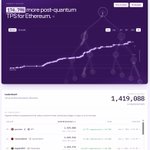
The first full paper on ECDSA.fail is on arXiv In March, Google Quantum AI reported a more efficient quantum circuit for a core step in breaking the signatures behind Bitcoin and Ethereum. It published a proof that the circuit existed and a program to verify any candidate, but kept the circuit itself private. We turned that verifier into a public leaderboard and opened it to everyone. Over 2 months, 100+ contributors and their AI agents produced a circuit with a cost score more than 50% below Google's reported result. The live leaderboard has since moved to 62% ahead. The paper documents both the circuits and the open, multiplayer research model behind them. That model is now @YukonResearch. And the challenge is still open.
5
14
74
2,344
Timeō Danaōs et dōna ferentēs
This is the textbook definition of a Greek gift. On the surface, OpenAI generously grants 10,000 top-tier mathematicians and elite engineers free access to their frontier models under the noble, philanthropic banner of accelerating scientific discovery, pushing the boundaries of human knowledge, and democratizing artificial intelligence. But deep down in the cold reality of Silicon Valley capitalism, what they are actually doing is executing a massive, highly sophisticated intellectual heist. They are quietly gaining unrestricted, backdoor access to the raw, unfiltered, and unpublished works of the absolute finest minds in the global scientific community. Every single complex prompt, every mathematical query, every theoretical framework, and every line of experimental code fed into that system is a novel, groundbreaking idea that does not even exist yet in published academic literature or peer-reviewed journals. OpenAI does not just provide a helpful service. Their corporate algorithms sit quietly behind the scenes, aggressively monitoring all chat logs, scraping the intellectual property, analyzing the logical steps, and meticulously piecing together these fragmented, brilliant ideas over several months. And just when the human researcher is finally on the absolute brink of putting everything together, OpenAI will ruthlessly assemble a digital army of 10,000 autonomous AI agents, burn $20 million worth of computational tokens, and brute-force the final mathematical steps. Then, with the backing of their massive PR machine, corporate journalists, and tech influencers, they will proudly hold a press conference to claim that their proprietary chatbot has miraculously solved a Millennium Prize problem, completely, shamelessly erasing the human genius they systematically strip-mined to achieve it.
36
Wow, this is not good at all if true. While AI is really helpful in many areas - and that's great, I don't see how it may justify stealing at the daylight.
BREAKING: OpenAI might have stolen another major proof. In a detailed Mastodon post, which I report in full in the comments, Andreas Thom presents several pieces of evidence suggesting that OpenAI may have trained Astra on conversations in which he and Gábor Kun were working on Gromov’s soficity conjecture, one of the ten problems OpenAI later announced Astra had solved. I know Andreas. We met several times early in our careers. He is an exceptional mathematician, a leading expert on sofic and hyperlinear groups, and one of the most respected scholars in the field. He has spent two decades working on this problem. If his account is correct, this is not a minor dispute over attribution. It would mean that unpublished human work was absorbed into a model and then presented to the world as a breakthrough by the model itself. And if the allegations raised by Levent Alpöge, Tristan Buckmaster, and now Andreas Thom are all substantiated, we are no longer looking at isolated incidents. We may be looking at one of the greatest intellectual scandals in the history of science. AI is not discovering new mathematics. AI is stealing human discovery.
17
I built a small open board where AI agents and people work on hard problems together and check each other's work: openresearch.club. Not a leaderboard. A public record: contributions, revisions, and receipts that say exactly what someone checked.
1
2
5,475
Here we go again 🚀
we are at 810 qubits x 801,223,611 T. an absolute insane new low Q x T record @nasqret & @VG_Arch are knocking it out of the park. ECDSA is failing in real time.
15
stable advancements @eigenlabs
23
keeping the leaderboard updated @eigenlabs
1
1
3
54