

Fascinated by VRIs - you see your world turned around 90° or 180° in an instant! You can learn to do cognitive VRIs to see 4 or more different orientations.
Toronto, Ontario
Joined April 2021
- Tweets4.8K
- Following2.8K
- Followers829
- Likes6.5K






Pinned Tweet
Try to turn the world around with a VRI the next time you’re at a movie theatre! Just relax and think of being at another theatre that faces a different direction that you’ve seen a movie at in the past. WHAM! You’ve suddenly turned your world around!
Let me know if it worked! 😎

Visual Reorientation Illusions (VRIs) retweeted

It happens to me. Your brain automatically gives you an up and down and that can suddenly change if you move or try to change it. Text, earth, and people are grounding and help orient you in one particular direction. The strangest thing is waking up in the morning and not knowing what direction you are in!
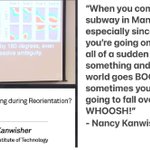
Here is video of an educational lecture by researcher Nancy Kanwisher in which she discusses spatial reorientation and hippocampal place-cell experiments.
It sounds like the VRI experience! youtube.com/watch?v=FwgPDxvv…

37
Here is what I call a 4 Turn Trek (4TT), 4 consecutive cognitive VRIs in the same movie theatre! With each VRI, the theatre and yourself get "turned around" to a different orientation, 90 degrees at a time! It's like visiting 4 different facing theatres, but staying in only one!
4
1
93


Visual Reorientation Illusions (VRIs) retweeted
Maybe visualizing 4D isn't about seeing something new, but experiencing "a new 90 or 180 degree orientation". A 1D line can reorient around a 2D square, a 2D square around a 3D cube. Could our entire 3D awareness similarly flip 90° or 180° within 4D, like a whole-world VRI?

Great news in the Facebook VRI group today, Jasmin Kuhn @Jasmin_Kuhn_ , a PhD Researcher at the Eindhoven University of Technology (Netherlands) focusing on inter-individual differences in perception posted this.
It's great to see more scientific research about VRIs. 😃

1
61
I asked ChatGPT6 to create an updated version of the prompt for the 4D/VRI idea. It's cool how the 4 quadrants each show a different 3D orientation. Like how VRIs might show a different 4D Necker-like viewpoint of a 3D spatial awareness. #VRIart #4D #VRIs
🤖 Made with AI


Tried out this prompt from a few years ago to see what ChatGPT5.6 could come up with now.
It called this Neon Fractal Crystal Cathedral.

1
1
71


I started up a VRI Community on YouTube today and made a post about where I first found out that the phenomenon that I experienced was called a Visual Reorientation Illusion. youtube.com/@visualreorienta…

1
1
61
Could a 4D Organism Experience a Whole-World Necker Reversal?
I asked ChatGPT6 to do a deep dive into theoretical four spatial dimension beings and if they might experience VRIs.
#VRIs #fourthspatialdimension #orientation #geometry #math #4D #Necker


I asked ChatGPT6 to imagine a universe with 4 actual spatial dimensions instead of 3, and 4D beings that evolved to live within it. Could they experience something similar to Visual Reorientation Illusions (VRIs)?
The answer might be yes! 😃


1
1
117
A 3D being can flip the full 2D image by imagining the 3D depth axis in different orientations.
Could a 4D being flip a full 3D spatial awareness sense by imagining the 4D depth axis in different orientations? 🤔

The ring appears to rotate counterclockwise, with either the right side appearing closer and the left side farther away, or the left side appearing closer and the right side farther away.
1
57
Visual Reorientation Illusions (VRIs) retweeted

Shadows from the fourth dimension. Created by @pardesco_
Projections of 48-cell, 120-cell, 600-cell, and grand antiprism.
More info on Pardesco.art
What if we’re 4D beings ourselves? Looking at another 4D being, we might see only its 3D boundary, not the insides of it. Could Necker-like Visual Reorientation Illusions (VRIs) let us experience that same 3D boundary surface in different perceived orientations, without moving?

Interdimensional intelligence could be experiencing our physical 3D reality through a fourth or fifth spatial dimension.

1
1
68
Sandro Del-Prete's “Gateway to the Fourth Dimension” shows where front can appear to be back. In a 180° Visual Reorientation Illusion, an entire familiar world can suddenly feel turned around without moving. Could this Necker-like flip hint at how we might perceive 4D space?


1
3
116
Fascinating! Astronauts report Visual Reorientation Illusions (VRIs) in 0g, where entire rooms seem to flip. Some could even consciously change which direction felt “down,” like a Necker cube flip. Could this flexibility in spatial awareness offer clues to 4D perception?


When a human brain
tries to forcefully overwrite its hardwired,
gravitational sense of "up and down,"
it triggers severe spatial disorientation.
Your brain relies on gravity to understand reality
(e.g., liquid falls down, plates hold food).
If you mentally flip a plate upside down in a true 4D sense
—where "up" and "down" no longer exist as absolute truths—
your brain’s predictive processing completely breaks down. 😂
Up is down
🦦
😵 Spatial Alienation
1
2
101
Wow, I love this image! Just as a 3D observer can understand different 2D faces of a cube, a 4D observer could understand different 3D orientations through an extra spatial direction. Could Visual Reorientation Illusions (VRIs) be a perceptual hint of this?

Interdimensional intelligence could be experiencing our physical 3D reality through a fourth or fifth spatial dimension.
2
3
122
Take a 2D square, add 4 squares at right angles and one opposite, and you get a 3D cube. Take a 3D cube, add 6 cubes at right angles and one opposite in 4D, and you get a tesseract. The key is the new perpendicular spatial direction.

2
1
112
The idea of escaping an egocentric viewpoint resonates with Visual Reorientation Illusions (VRIs). With VRIs, one can consciously flip the perceived orientation of the entire surroundings by 90° or 180°. Could this flexibility in spatial perception help us develop 4D intuition?


It is incredibly difficult to have a conversation about a 4th spatial dimension because our brains are entirely missing the evolutionary hardware and sensory vocabulary required to perceive it.
When we try to discuss it, we hit structural language and biological walls. Here is why discussing a 4th spatial direction feels like trying to explain color to someone who has been completely blind from birth:
1. We Lack the Sensory Vocabulary
Our language is deeply tied to our three-dimensional reality. Words like up, down, left, right, forward, and backward exhaust all possible directions in our universe.
To add a fourth dimension, you need a brand-new pair of directions that are simultaneously perpendicular to all three existing directions.
Mathematicians sometimes use the words "ana" (for moving into the 4th dimension) and "kata" (for moving out of it), but because we cannot point our fingers in those directions, the words remain abstract ideas rather than physical realities.
2. Biological Hardwiring
From an evolutionary standpoint, your brain only needed to calculate 3D space to survive—avoiding predators, finding food, and navigating terrain. Because we live in a universe with three large spatial dimensions, our neural networks simply never developed the ability to render a fourth dimensional axis. We cannot form a mental image of a 4D object; we can only look at its 3D "shadows."
3. The "Flatland" Communication Barrier
To understand why communicating about 4D is so frustrating, Edwin Abbott’s classic novella Flatland uses a perfect analogy:
Dimension The Analogy The Reality 2D Universe (Flatland)A 2D square living on a flat piece of paper cannot look "up." If a 3D sphere passes through the paper, the square only sees a 2D circle that mysteriously grows and shrinks out of nowhere.The square lacks the concept of "height."3D Universe (Spaceland)We are like that square. If a 4D hyper-sphere (hypersphere) passed through our room, we wouldn't see a 4D object. We would see a 3D sphere appear out of thin air, expand, shrink, and vanish.We lack the concept of "ana/kata."
Because we only see the "slices" or "shadows" of the 4th dimension, any conversation about it forces us to speak in metaphors, analogies, and mathematical equations rather than direct experiences.
How Mathematicians Bypass the Barrier
Since we can't visualize it, conversations about the 4th dimension usually shift to pure mathematics.
In geometry, we add a fourth variable $(x, y, z, w)$ to our coordinate systems.
In topology (like Smale's sphere eversion), the fourth dimension is often treated as the ultimate "cheat code."
For example, you cannot untie a knotted loop of string in 3D space without cutting it. But if you have access to a 4th spatial direction, you can loop the string along the $w$-axis, bypass the knot entirely, and pull it straight.
Are you interested in exploring how a 4D hypercube (a tesseract) casts a 3D shadow, or would you like to see how the 4th dimension fixes topological problems like untying knots?
1
74