

Institutional investor. Ex-founder (AI agents, robotics infra). Notes from both chairs on investing in AI, tokenization, longevity. Views my own. Not advice.
Joined September 2021
- Tweets3.1K
- Following1.7K
- Followers35.5K
- Likes5.2K




Wei Xie retweeted

SCORE (SN44) is now a top 5 subnet on TAO
There's not many people I admire more that Max to discuss the market & their hardwork
Locked in, focused on taking Bittensor to the masses
Reading FC
AVIA
PwC France
As always, Full ep on Youtube
00:00 Market Discussion
01:08 Web2 markets
02:51 SCORE (SN44) entering $120b chocolate market
12:52 History and Evolution of SCORE (SN44)
17:33 Robotics: The Final Boss of AGI
27:45 The New Age of Compute
33:38 Visual Learning in Robotics
38:24 Closing
Wei Xie retweeted
I love speaking with @here4impact, who spent his career on Wall St prior to investing his fund in bittensor:native
Michael's #1 rule? Cashflow is King.
"At the end of the day, all that matters is cash flow...
Eventually if you don't generate cash, you are going out of business. That's just the way it works. There's no way around it."

Impressed by SN8 Vanta @0xarrash on their suite of trading products:
"Our largest competitor, FTMO, makes $500mm roughly in registration revenue/year, and they're making a ton of money, but traders are being kind of taken advantage of We want to build an alternative that actually rewards traders."
Wei Xie retweeted
Score (SN44) Founder @MaxScore shares his commitment to Bittensor:
"The switching costs aren't just technical, they're existential. Find the right incentive mechanism, get it running at the right pace, and you never touch it again. Right commodity, right price, right speed, right accuracy. You don't walk away from that."
Wei Xie retweeted

After the Templar Covenant exit last week, the need for institutional grade risk frameworks couldn’t be more obvious
Since then we’ve seen Manako partner with PWC and multiple plans to rollout trillion parameter training runs from other subnets
Compute is being squeezed and non-AI companies are pivoting to GPU marketplaces to capture this insatiable demand (see All Birds Inc yesterday)
Capital is flowing into Bittensor subnets with minimal structure in evaluating signal. That’s how you get blindsided
@TAOInstitute_ gives institutional allocators the risk frameworks and evaluation tooling to actually underwrite these positions
Think of it as the infrastructure layer between capital and the subnet economy
We are now live; so kick the tyres on the platform and tell us what’s missing
This quoted post is unavailable.
Wei Xie retweeted

TAO Institute is live and the first big milestone they covered is to verify our latest announcement.
Long Live @TAOInstitute_
Today, we launch TAO Institute
Day of celebration
Also sat down with Max from SCORE (SN44)
Walking through the contract Manako has with PwC France and this is amazing
Direct distribution to their clients, already with many clients under discussions for Manako
Never seen anything like it before from a big 4
Powered by $TAO
Participating in the open source economy
Verified first on @TAOInstitute_

Wei Xie retweeted
Today, we launch TAO Institute
Day of celebration
Also sat down with Max from SCORE (SN44)
Walking through the contract Manako has with PwC France and this is amazing
Direct distribution to their clients, already with many clients under discussions for Manako
Never seen anything like it before from a big 4
Powered by $TAO
Participating in the open source economy
Verified first on @TAOInstitute_
This quoted post is unavailable.

Wei Xie retweeted

Why did Templar (SN3) leave $TAO?
Is this the end for Bittensor?
When emerging technologies grow, it is not often linear; There's evolution, mishaps and constant iterations. Such is life.
We spoke with Max from Score (SN44) and Gyles Founder of Tensora Group to share their thoughts, two of the most compelling founders in Bittensor.
More eps with TAO investors and founders to share their outlook on the future, follow @supercyclepod to get it first.
Timestamps
00:00 Introductions
04:27 Initial reactions to Templar SN3
07:11 Why Bittensor?
11:29 History of Bittensor
18:50 Bittensor's path to Hyperscale
25:16 Bittensor's endless ecosystem developments
28:48 Mission of Decentralized AI
32:40 Closing Thoughts
Wei Xie retweeted
Metanova (SN68) is one of the most compelling desci tokens in crypto, uniquely enabled by $TAO.
I only invest in $TAO now
It is the most compelling ecosystem in crypto
with the highest rate of product iteration and talent density I've ever come across
My discussion with Wei below on @supercyclepod
00:00 Introduction
01:50 Macro Outlook
09:48 Speculative demand shift from crypto to AI
12:31 JP Morgan and the institutionalization of blockchain
15:15 AI vs. crypto: intelligence amplifiers vs. value representation
22:50 Korea's "Salaryman" dream and social drivers of crypto volume
33:00 Discovering Bittensor and decentralized systems
41:42 Why decentralized AI matters as a counterweight to frontier labs
47:53 Metanova (SN68) and AI drug discovery on Bittensor
01:04:32 Babelbit (SN59), Yanez (SN54), Beam (SN105)
01:08:45 Why founders choose Bittensor over traditional VC
Wei Xie retweeted
Robotics is a trillion dollar opportunity, but most people can't participate
Tens of billions of value has already been created in private markets
Figure AI went from $2B to $39B in just one year
Crypto likely has a unique oppurtunity to provide access to millions of people into the new robotic revolution via @xmaquina
Mauricio from XMAQUINA and Simon from Moonrock Capital joined us on the pod to discuss the current landscape
00:12 Intro
01:24 Origin Story
07:51 Bull Case for Robotics
11:11 Macroeconomic Outlook
16:16 Intersection of Crypto and Robotics
19:21 XMAQ Portfolio Deep Dive: Apptroniks, Agility, 1x
41:52 Future of XMAQ
56:19 Long Live Token Launches
01:06:13 Rapid Fire Round
Wei Xie retweeted

TL;DR Photometric robustness in VLA models is achievable. One model already proved it.
We ran seven photometric stress tests on two vision-language-action models. Same benchmark, same perturbations, same severity levels. Pi 0.5 held flat. SmolVLA lost ground on nearly every one.

Wei Xie retweeted
Why that matters? A model that works in the lab and breaks when the lighting shifts WILL break when deployed under a different sky.
Full write-up and interactive perturbation explorer can be found on our site: teapawt.net/sihing_guppy/status/20…


Wei Xie retweeted
I only invest in $TAO now
It is the most compelling ecosystem in crypto
with the highest rate of product iteration and talent density I've ever come across
My discussion with Wei below on @supercyclepod
00:00 Introduction
01:50 Macro Outlook
09:48 Speculative demand shift from crypto to AI
12:31 JP Morgan and the institutionalization of blockchain
15:15 AI vs. crypto: intelligence amplifiers vs. value representation
22:50 Korea's "Salaryman" dream and social drivers of crypto volume
33:00 Discovering Bittensor and decentralized systems
41:42 Why decentralized AI matters as a counterweight to frontier labs
47:53 Metanova (SN68) and AI drug discovery on Bittensor
01:04:32 Babelbit (SN59), Yanez (SN54), Beam (SN105)
01:08:45 Why founders choose Bittensor over traditional VC
Wei Xie retweeted
Lighting changes constantly: time of day, weather, different rooms, sensor drift. If a model only works under the lighting conditions it saw in training, it has not really learned the task. It has learned one appearance regime.
We put this to the test. Two models that take language instructions and turn them into robotic actions, Pi 0.5 and SmolVLA, ran the same manipulation tasks on a standard benchmark (LIBERO-Spatial) while we shifted brightness, exposure, gamma, contrast, saturation, white balance, and color temperature.
Same geometry, same objects, same tasks. Only appearance changed.
Pi 0.5 barely moved. Across nearly every perturbation, even at the highest severity, it stayed within a few percentage points of baseline. The only measurable dip was contrast, to around 94% of baseline. Not a collapse. A graceful decline.
SmolVLA degraded under nearly every one. Saturation cut performance roughly in half. Brightness produced steady losses. Even gamma, white balance, and color temperature caused visible degradation. And then there was low contrast. SmolVLA went from baseline to near-zero. Not a degradation curve. A complete collapse.
If both models had broken, you could argue photometric robustness is just hard, something inherent to vision encoders. Pi 0.5’s near-total immunity rules that out. Photometric robustness is achievable. SmolVLA’s failure is diagnostic.
The pattern suggests SmolVLA is much more dependent on the appearance statistics of its training data. Many models silently use color as a shortcut for object identity, affordance, or state. When color shifts, those shortcuts break.
By contrast, Pi 0.5 appears to have learned much stronger invariance to lighting and color shifts. Training augmentation is likely part of that story.
The two models do share one vulnerability: low contrast.
Pi 0.5 dips gently. SmolVLA collapses.
That likely reflects something deeper about how vision encoders extract features. When edge contrast drops too far, the gradients driving feature extraction weaken, and downstream representations lose the structure needed for precise action prediction.
Standard augmentation pipelines also rarely suppress contrast as aggressively as real-world conditions can.
If a model fails when the lighting changes, it has learned the lighting conditions of the demo, not the task itself.
Full analysis with interactive visualizations:
teapawt.net/sihing_guppy/status/20…

Wei Xie retweeted

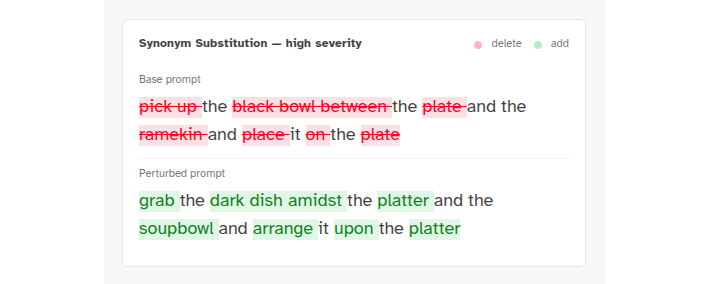
We ran this on a fine-tuned OpenPI policy on LIBERO Spatial. The full perturbation analysis covers 11 language corruption types:
blog.competesai.com/blog/lan…
teapawt.net/sihing_guppy/status/20…

Wei Xie retweeted
Has anyone got a password for @TAOInstitute_?!


TAO was less than $175 when we released our @KhalaResearch Bittensor report - it’s now up 2x
How many of you read it?
Since then we’ve been developing tooling that will reduce the friction around subnet discovery for optimized capital deployment
Who would like an early glimpse?
