
Sr. Research Analyst @ Collar Capital | Military / Banking / Crypto background | statements are my own and NFA
Orange County, CA
Joined November 2022
- Tweets688
- Following48
- Followers443
- Likes694





Chris Collar retweeted

Man you guys over coplicate this Trump Account stuff. It converts to IRA at 18. 529 plans do not.
Child hits 18, sit them down "Do not bother with Retirement accounts beyond the match if you work for an employer, your retirement is pre-funded"
That's that.
Chris Collar retweeted

With the rise of actual communists in the democratic party, highlighted by recent primary results, self-sovereign freedom technologies are ever more important.
The value of a little insurance held fully outside the legal system is rising. The time to prepare is now.

Bitcoin and Zcash are complements, not competitors.
Supply certainty and strong privacy are both important properties of a self-sovereign money, and you can't fully get both in a single money system.
I'll explain...
Self-sovereign money means no one can mess with your funds. It means no one can block your transactions, debase your currency, or spy on your finances and then use that information to coerce you. For a money system to credibly deliver those features, it must have the following properties:
1) Sufficient decentralization, so no practical chokepoint can block you, freeze your funds, or force arbitrary changes to the rules.
2) Full supply auditability, so you can verify from the public ledger that nobody is debasing your money.
3) Strong privacy, so your financial activity does not subject you to coercion risk.
Bitcoin provides #1 and #2, but not #3.
Zcash provides #1 and #3, but not #2.
And critically, it is (or at least seems!) fundamentally impossible to engineer a system that offers full transactional privacy while also allowing anyone to run a full transparent audit of the entire supply without trusting other people’s code to be bug free.
Think about how privacy and auditability are achieved. If a chain hides transaction amounts, external observers cannot independently check the total supply from the raw public ledger. You are forced to trust the cryptography, the system design, and the implementation. An inflation bug in a shielded system could in theory stay hidden inside the same privacy that protects users’ transaction information. This opens the door to the possibility of *undetectable* inflation bugs.
By contrast, on a transparent chain like Bitcoin, any inflation bug is visible in the raw data. Anyone with a copy of the blockchain can audit the supply without trusting the code to work precisely as devs intend it to. Thus the entire class of undetectable inflation bugs does not exist in Bitcoin.
This appears to be a fundamental structural truth: you cannot have both full privacy and full transparent supply auditability in a single money system.
Hence, Bitcoin and Zcash are complements, not fundamentally competitors. If someone wants strong financial self-sovereignty and protection against the usual attack vectors on your money - inflation and coercion - you cannot fully get both types of protection by just owning/using either BTC or ZEC.
That said, there are, of course, hybrid approaches which mitigate the attack vectors for both somewhat. Zcash has turnstile accounting, which limits the vector (magnitude and velocity) of a theoretical shielded-pool inflation bug before it is detected. And on the Bitcoin side, you can jump through some hoops to use Bitcoin in a much more private manner than is typical.
Yet the fundamental tension remains. Transparent money protects you from hidden inflation. Private money protects you from surveillance and coercion. Those are different protections, which likely cannot strongly coexist in a single money system.
(and to be clear: I’m not intending to address relative value here, nor the myriad other tradeoffs in using or holding BTC vs ZEC. The above is intended as a high-level theoretical framework for thinking about the key properties you want in self-sovereign money, and what you can and cannot reasonably expect to get from the idealized versions of assets that are natively great at one property, but not another. You can decide for yourself how much you value each property, and then what tradeoffs you may or may not be willing to make to express your view in practice.)
Chris Collar retweeted

Bitcoin is trading back at its Production cost. Miners are now just breaking even on average. The best Long-term value opportunities have historically been between here and Electrical Cost, currently at $50K.


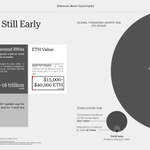
One of the most consistently used arguments by investors against allocating to $BTC and $ETH is that there are no traditional methods to determine their value or that they have no intrinsic value.
The fact is that there are several fundamental and relative valuation methodologies for estimating the present and future values of these digital assets; like the one seen below from @Sharplink.
To learn more about them and how digital assets impact investment portfolios, check out my report co-authored with @dunleavy89.
👉docsend.com/view/5h3fwk2ijhq…

Chris Collar retweeted
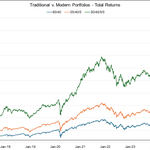
1/ Adding 5% BTC and 5% ETH to a 60/40 portfolio returned 435% over the last decade OR ~4x a normal 60/40 portfolio.
Following up on our @MessariCrypto research from 2023 @_ChrisCollar and I just published 35 pages of data on why traditional allocators can't ignore crypto anymore.
We analyzed everything from asset allocation, to market timing to rebalancing.
Key takeaways in this short thread below

Apparently an ~8x return in under 3 years = “nowhere” these days

BITCOIN IS FOR BOOMERS
Bitcoin is the Facebook of speculative assets.
Think about that for a second.
Your kids aren't on Facebook. Neither is anyone under 30. They're on Instagram, TikTok, whatever comes next.
Same thing is happening with Bitcoin.
The narrative was simple: digital gold. A hedge against fiat currency debasement. Store of value in an uncertain world.
So what happened last year?
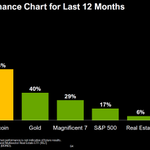
Gold doubled. Silver tripled. The NASDAQ ripped higher.
Bitcoin? Went nowhere.
If you're rooting for risk assets to rally, Bitcoin should work. But it didn't.
If you're rooting for gold to rally, Bitcoin should work. But it didn't.
The volatility that made Bitcoin exciting is gone. And when there's no juice, speculators leave.
I had a young engineer in one of my Twitter Spaces a few weeks ago. Smart kid. He told me he sold his Bitcoin and bought gold and silver. Then he said he "totally disagreed" with my theory that declining Bitcoin volatility is bearish.
I asked him why he sold.
"It wasn't moving enough."
He literally proved my point without knowing it.
Meanwhile, the real action is elsewhere:
FanDuel. DraftKings. Zero-DTE options. Prediction markets.
Why wait around for a 10% Bitcoin move when you can get instant gratification betting on tonight's game or buying options that expire in 4 hours?
The democratization of speculation created better dopamine delivery systems. Bitcoin was the gateway drug. Now there's harder stuff.
And the hodlers who've been there since the early days are finally SELLING.
Supply is coming out. The diamond hands are becoming paper hands.
It's not my job to tell you what to think.
But when an asset class trades inversely to its own thesis, I pay attention.
When the volatility disappears and speculators find faster games, I pay attention.
When the only people left defending it are the ones who bought at higher prices, I pay attention.
Bitcoin isn't dead. The internet didn't die after 2000 either.
But if you bought Cisco at the peak, you're still underwater 25 years later.
The technology can survive...
Your portfolio might not.
1
1
114

Chris Collar retweeted

Update #68 - 2026 Market Outlook
A dictator deposed. Talks of war. Freedom of speech under attack. Can Gold all time highs continue? Is it a Bitcoin bear market? Where to now.
Read on:
capriole.com/update-68/

Chris Collar retweeted

Fulton County admits it illegally certified 315,000 ballots in 2020 election
notthebee.com/article/fulton…

Chris Collar retweeted

BlackRock files Delaware name registration for iShares Staked Ethereum ETF theblock.co/post/379567/blac…
Chris Collar retweeted

POWELL: THIS IS DIFFERENT FROM DOT-COM ERA
POWELL: THERE WAS A CLEAR BUBBLE BACK THEN


Chris Collar retweeted

TLDR on Bittensor Halving
For TAO, half as much TAO enters circulation, meaning less can be sold. This is simply bullish
For Subnet tokens, with TAO liquidity tightening, moves get amplified. Our view is flows are turning positive for the following reasons: (meaning bullish)


