






Pinned Tweet
Check out the Pareto frontier of success rate vs cost on terminal tasks and more.
p.s. ox-alpha (GLM-5.3 Flash) is completely dominated by GPT-5.6 Luna and DeepSeek V4 Flash 🙃


Newly released models repeatedly appear near the top on the @terminalbench 2.1 leaderboard. Are these models actually on par with frontier models on terminal tasks?
We took the top 20 models from that leaderboard and ran them on TB-fn. TB-fn reworks the same 89 tasks by adding steps, tightening requirements, or requiring more complex algorithms. It also removes opportunities for shortcut solutions and ensures verifiers check only the intended criteria.
Models that clustered together on TB-2.1 spread across more tiers on TB-fn. That leaves GPT-5.6 Sol and Opus 5 in the lead, while some others drop significantly in performance. At the same time, models work 38% harder on average in TB-fn, leading to a redrawn Pareto frontier of performance vs. cost.
The full post includes interactive figures showing how the gap for open-weight families widens. It also measures how security refusals affect scores across Anthropic, Google, and OpenAI models. Fable 5 stands out, refusing at least once on 13 of the 89 TB-fn tasks.
Ahmad Beirami retweeted

Deep learning is often taught as a sanitized collection of facts and math. But work at the frontier of AI is messy and empirical.
Our new class, Deep Learning Alchemy, aims to teach the art and science of deep learning in the hands-on spirit of Language Modeling From Scratch.
Students build intuition by running experiments on small LMs, then test it through prediction quizzes: given an unseen code diff, can you predict what happens?
deep-learning-alchemy.github…
My co-instructor @kothasuhas and I think there's significant demand for classes that treat students as serious learners who want to be assessed for what they’ve learned, and so we're trying a new exam-heavy approach to the class (7 exams, 85% of the grade, with the remaining 15% in-person discussion assessments).
We’ve designed the class so students can use AI agents to run their experiments and do their assignment, but they then have to demonstrate that mastery on exams without access to the assignment, and any partial credit on the exam has to come through citations to the assignment, incentivizing them to know what’s in their write-up.
The same assignments and quizzes are public for anyone to try (lecture recordings will be released through @StanfordOnline with some delay). We have some very fun assignments and quizzes covering both classic topics (like NQM, run-to-run stochasticity, and scaling laws) and new and timely topics like muP or hyperball. Made by some real experts like @TristanThrush and @wen_kaiyue
Try some quizzes below!

This is decades of math progress in one tweet.

We’re releasing a broad range of new mathematical results produced by an internal frontier model.
We’ve been consulting with the independent Advisory Group on Mathematics and Artificial Intelligence at the Institute for Advanced Study, and we have drawn on their advice and public recommendations to inform how we release these results.
github.com/openai/math


Ahmad Beirami retweeted

Bring together a diverse group of folks the way that only NY could. We had a researcher who was instrumental in creating speculative decoding, a UPenn professor teaching robotics, an AI researcher at Sloan Kettering, a founder from Stripe, just to name a few. Conversation, wine, and dry-aged ducks were all flowing!
Special thanks to our amazing co-hosts @LorimerVentures and @abeirami . Let's do more events together!

The NY AI community is compounding fast. Last night @LorimerVentures and @EniacVC gathered 17 brilliant AI researchers, founders and builders in the bank vault at franciebrooklyn.com to discuss what comes next and enjoy some Michelin star duck in Williamsburg. 🦆
Thanks to all the builders who chose to spend their evening with us from @AnthropicAI, @cohere, @Google, @MSFTResearch, @Princeton, @Penn, @fidian, withcoverage.com, @MSKCancerCenter, a.security etc.


Ahmad Beirami retweeted

The NY AI community is compounding fast. Last night @LorimerVentures and @EniacVC gathered 17 brilliant AI researchers, founders and builders in the bank vault at franciebrooklyn.com to discuss what comes next and enjoy some Michelin star duck in Williamsburg. 🦆
Thanks to all the builders who chose to spend their evening with us from @AnthropicAI, @cohere, @Google, @MSFTResearch, @Princeton, @Penn, @fidian, withcoverage.com, @MSKCancerCenter, a.security etc.
🤖 Made with AI
Ahmad Beirami retweeted

Not every model failure is due to lack of capability!
When we evaluate AI models on @terminalbench, we usually ask: How often did the model succeed? But accuracy alone hides an important distinction from safety declines!

ALT Fidian verifies every decision your agent makes against your spec, in development and in production.
Ahmad Beirami retweeted

@fidian published our TerminalBench-Fn leaderboard. fidian.ai/leaderboard/ GPT-6 Sol tops the leaderboard because models like Astra and Fable refuse some cybersecurity tasks. For value, choose GPT-6 Luna.

Ahmad Beirami retweeted

Delighted to share that I have 4 papers accepted to NeurIPS 2026!
⚡ SPECS: arxiv.org/pdf/2506.15733
🏅 Inductive Deductive Synthesis (Oral Acceptance)! arxiv.org/pdf/2605.23109
🧬 Spectral Feedback for Test-Time Alignment of Protein Diffusion Models: github.com/shainotshy1/Spect…
🌱 BenchEvolver: arxiv.org/pdf/2606.01286
Grateful to my coauthors & mentors. More on the ideas, takeaways, and people behind each below (1/5) 🧵
Ahmad Beirami retweeted

100% agreed we should find a proper way to penalize papers-maximizers with low-hanging/low-impact work.
that said, this index is fundamentally flawed as "low citation counts does not necessarily imply low impact" and "high citation does not necessarily imply high impact" even after proper within-area normalization.
for instance, search the "best" researchers you know in the fields of applied mathematics, TCS, etc. and you get what I mean :)

I created the Slop Index: a satirical citation index that calculates how much "slop" a researcher produces. It punishes having many papers with low citation counts.
You can calculate your own slop index at slop-index.com.

Courtade-Kumar 1-bit conjecture is true!
Assume that X_1,..., X_n are iid bits, and are then passed individually through noisy binary symmetric channels (BSCs) resulting in Y_1,..., Y_n.
What 1-bit function/compression of Y_1,...,Y_n carries the most mutual information about X_1,...,X_n? Courtade and Kumar conjectured that if you pick the function to be just one of the Y_i's, that function would be the the most informative.
The problem seems deceptively simple and, like many others, I thought about it for a bit a decade ago with not much progress.
Beyond 1-bit compression, it turns out that the structure of the problem completely changes when you're compressing Y_1,...,Y_n to k=8+ bits. There you can construct structured codes that beat selecting Y_1,...,Y_k. The status remains unresolved for 2≤k≤7 where it is conjectured that selecting Y_1,...,Y_k would be optimal.

How should we compress a binary input vector to a noisy channel while retaining as much information as possible about the channel output? Is the best strategy simply to keep part of the vector, or can coding do better?
I’m excited to share a new paper with Ahmad Beirami:
“The Most Informative Bit and Beyond: A Proof of the Courtade–Kumar Conjecture and Multibit Extensions.”
Take a uniform binary vector X and let Y be formed by independently flipping its bits. We want to compress X into k bits while preserving as much information as possible about Y. The natural benchmark is to report k coordinates of X, which retains k[1−h₂(p)] bits of information.
For k=1, this becomes the longstanding Courtade–Kumar conjecture: no one-bit function f(X) can be more informative about Y than a single coordinate of X. We prove the conjecture for every dimension and every noise level, without assuming that f is balanced.
The central idea of the proof is to turn a static optimization problem into a dynamical one.
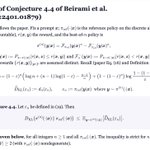
Let ρ=1−2p denote the channel correlation, and consider the information gap
Δ_f(ρ)=I(f(X);Yρ)−[1−h₂((1−ρ)/2)].
This measures the advantage of f over a coordinate as the channel moves from complete noise to no noise. At the noiseless endpoint,
Δ_f(1)=H(f(X))−1≤0.
Thus, if a function ever beat a coordinate, its information gap would have to become positive at an intermediate noise level and later return to a nonpositive value.
Our proof shows that this cannot happen. Monotone rearrangement and an entropy-flow identity connect the evolution of the information gap to the edge geometry of the corresponding Boolean decision set. A sharp local entropy comparison, combined with Fourier analysis and logarithmic-Sobolev estimates for pivotal sets, then implies a global principle: once the gap becomes positive, it must continue increasing as the channel becomes cleaner.
In other words, any hypothetical advantage over a coordinate would be self-reinforcing. But the noiseless endpoint forbids such an advantage. This contradiction proves the conjecture.
The conceptual point is that we do not try to optimize separately at each fixed noise level. We follow the entire information trajectory as the noise changes. The entropy and geometry of a Boolean function constrain that trajectory so strongly that it cannot cross above the coordinate benchmark.
We then ask the natural next question: what happens when the quantizer may output k>1 bits?
Here the answer changes in a genuinely coding-theoretic way.
We first show that linear maps cannot outperform coordinate selection. Nonlinear code-based quantizers can. Using the covering geometry of a shortened Hamming code, we construct an 8-bit quantizer that retains strictly more information than any eight-coordinate projection. A direct-sum construction then gives counterexamples to coordinate optimality for every k≥8.
The coding is in the quantizer itself. Instead of preserving individual coordinates, it partitions the Boolean cube according to the collective geometry of a code. These structured quantization regions can remain more distinguishable after noise than the regions produced by simply selecting coordinates.
What happens for k=2 through 7 remains especially intriguing. We exhaustively searched several structured code families and, for k=7, also performed Monte Carlo experiments with random codebooks. Structured codebooks consistently outperformed random ones, but none surpassed the coordinate benchmark.
These findings suggest a sharp transition. We conjecture that coordinate projections remain optimal for 2≤k≤7, whereas nonlinear coding becomes advantageous from k=8 onward.
We also acknowledge two concurrent and independent works resolving the one-bit conjecture: one by Zijie Chen, Amin Gohari, Adel Javanmard, Honghao Lin, Vahab Mirrokni, Chandra Nair, and David P. Woodruff; and another by Vu Khac Ky and Tuan Tran. Neither work studies the multibit extension considered here.
AI disclosure: the one-bit proof was developed by generative AI under our high-level direction and review; the multibit extension was human-directed with AI assistance. We accept full responsibility for the paper.
Paper:
github.com/hessammahdavifar/…
The source files and numerical checks are available in the same repository. Comments and feedback are very welcome.

Courtade-Kumar 1-bit conjecture is true!
This is a problem I thought about for a bit a decade ago.
Also turns out that unlike 1-bit compression, the structure of the problem fully changes when you're compressing to 8+ bits.
How should we compress a binary input vector to a noisy channel while retaining as much information as possible about the channel output? Is the best strategy simply to keep part of the vector, or can coding do better?
I’m excited to share a new paper with Ahmad Beirami:
“The Most Informative Bit and Beyond: A Proof of the Courtade–Kumar Conjecture and Multibit Extensions.”
Take a uniform binary vector X and let Y be formed by independently flipping its bits. We want to compress X into k bits while preserving as much information as possible about Y. The natural benchmark is to report k coordinates of X, which retains k[1−h₂(p)] bits of information.
For k=1, this becomes the longstanding Courtade–Kumar conjecture: no one-bit function f(X) can be more informative about Y than a single coordinate of X. We prove the conjecture for every dimension and every noise level, without assuming that f is balanced.
The central idea of the proof is to turn a static optimization problem into a dynamical one.
Let ρ=1−2p denote the channel correlation, and consider the information gap
Δ_f(ρ)=I(f(X);Yρ)−[1−h₂((1−ρ)/2)].
This measures the advantage of f over a coordinate as the channel moves from complete noise to no noise. At the noiseless endpoint,
Δ_f(1)=H(f(X))−1≤0.
Thus, if a function ever beat a coordinate, its information gap would have to become positive at an intermediate noise level and later return to a nonpositive value.
Our proof shows that this cannot happen. Monotone rearrangement and an entropy-flow identity connect the evolution of the information gap to the edge geometry of the corresponding Boolean decision set. A sharp local entropy comparison, combined with Fourier analysis and logarithmic-Sobolev estimates for pivotal sets, then implies a global principle: once the gap becomes positive, it must continue increasing as the channel becomes cleaner.
In other words, any hypothetical advantage over a coordinate would be self-reinforcing. But the noiseless endpoint forbids such an advantage. This contradiction proves the conjecture.
The conceptual point is that we do not try to optimize separately at each fixed noise level. We follow the entire information trajectory as the noise changes. The entropy and geometry of a Boolean function constrain that trajectory so strongly that it cannot cross above the coordinate benchmark.
We then ask the natural next question: what happens when the quantizer may output k>1 bits?
Here the answer changes in a genuinely coding-theoretic way.
We first show that linear maps cannot outperform coordinate selection. Nonlinear code-based quantizers can. Using the covering geometry of a shortened Hamming code, we construct an 8-bit quantizer that retains strictly more information than any eight-coordinate projection. A direct-sum construction then gives counterexamples to coordinate optimality for every k≥8.
The coding is in the quantizer itself. Instead of preserving individual coordinates, it partitions the Boolean cube according to the collective geometry of a code. These structured quantization regions can remain more distinguishable after noise than the regions produced by simply selecting coordinates.
What happens for k=2 through 7 remains especially intriguing. We exhaustively searched several structured code families and, for k=7, also performed Monte Carlo experiments with random codebooks. Structured codebooks consistently outperformed random ones, but none surpassed the coordinate benchmark.
These findings suggest a sharp transition. We conjecture that coordinate projections remain optimal for 2≤k≤7, whereas nonlinear coding becomes advantageous from k=8 onward.
We also acknowledge two concurrent and independent works resolving the one-bit conjecture: one by Zijie Chen, Amin Gohari, Adel Javanmard, Honghao Lin, Vahab Mirrokni, Chandra Nair, and David P. Woodruff; and another by Vu Khac Ky and Tuan Tran. Neither work studies the multibit extension considered here.
AI disclosure: the one-bit proof was developed by generative AI under our high-level direction and review; the multibit extension was human-directed with AI assistance. We accept full responsibility for the paper.
Paper:
github.com/hessammahdavifar/…
The source files and numerical checks are available in the same repository. Comments and feedback are very welcome.
Ahmad Beirami retweeted

How should we compress a binary input vector to a noisy channel while retaining as much information as possible about the channel output? Is the best strategy simply to keep part of the vector, or can coding do better?
I’m excited to share a new paper with Ahmad Beirami:
“The Most Informative Bit and Beyond: A Proof of the Courtade–Kumar Conjecture and Multibit Extensions.”
Take a uniform binary vector X and let Y be formed by independently flipping its bits. We want to compress X into k bits while preserving as much information as possible about Y. The natural benchmark is to report k coordinates of X, which retains k[1−h₂(p)] bits of information.
For k=1, this becomes the longstanding Courtade–Kumar conjecture: no one-bit function f(X) can be more informative about Y than a single coordinate of X. We prove the conjecture for every dimension and every noise level, without assuming that f is balanced.
The central idea of the proof is to turn a static optimization problem into a dynamical one.
Let ρ=1−2p denote the channel correlation, and consider the information gap
Δ_f(ρ)=I(f(X);Yρ)−[1−h₂((1−ρ)/2)].
This measures the advantage of f over a coordinate as the channel moves from complete noise to no noise. At the noiseless endpoint,
Δ_f(1)=H(f(X))−1≤0.
Thus, if a function ever beat a coordinate, its information gap would have to become positive at an intermediate noise level and later return to a nonpositive value.
Our proof shows that this cannot happen. Monotone rearrangement and an entropy-flow identity connect the evolution of the information gap to the edge geometry of the corresponding Boolean decision set. A sharp local entropy comparison, combined with Fourier analysis and logarithmic-Sobolev estimates for pivotal sets, then implies a global principle: once the gap becomes positive, it must continue increasing as the channel becomes cleaner.
In other words, any hypothetical advantage over a coordinate would be self-reinforcing. But the noiseless endpoint forbids such an advantage. This contradiction proves the conjecture.
The conceptual point is that we do not try to optimize separately at each fixed noise level. We follow the entire information trajectory as the noise changes. The entropy and geometry of a Boolean function constrain that trajectory so strongly that it cannot cross above the coordinate benchmark.
We then ask the natural next question: what happens when the quantizer may output k>1 bits?
Here the answer changes in a genuinely coding-theoretic way.
We first show that linear maps cannot outperform coordinate selection. Nonlinear code-based quantizers can. Using the covering geometry of a shortened Hamming code, we construct an 8-bit quantizer that retains strictly more information than any eight-coordinate projection. A direct-sum construction then gives counterexamples to coordinate optimality for every k≥8.
The coding is in the quantizer itself. Instead of preserving individual coordinates, it partitions the Boolean cube according to the collective geometry of a code. These structured quantization regions can remain more distinguishable after noise than the regions produced by simply selecting coordinates.
What happens for k=2 through 7 remains especially intriguing. We exhaustively searched several structured code families and, for k=7, also performed Monte Carlo experiments with random codebooks. Structured codebooks consistently outperformed random ones, but none surpassed the coordinate benchmark.
These findings suggest a sharp transition. We conjecture that coordinate projections remain optimal for 2≤k≤7, whereas nonlinear coding becomes advantageous from k=8 onward.
We also acknowledge two concurrent and independent works resolving the one-bit conjecture: one by Zijie Chen, Amin Gohari, Adel Javanmard, Honghao Lin, Vahab Mirrokni, Chandra Nair, and David P. Woodruff; and another by Vu Khac Ky and Tuan Tran. Neither work studies the multibit extension considered here.
AI disclosure: the one-bit proof was developed by generative AI under our high-level direction and review; the multibit extension was human-directed with AI assistance. We accept full responsibility for the paper.
Paper:
github.com/hessammahdavifar/…
The source files and numerical checks are available in the same repository. Comments and feedback are very welcome.


Ahmad Beirami retweeted
Our new paper examines why coding agents can pass every test and still produce software that doesn’t do what people need.
Requirements can’t fully capture human intent, and evaluations can’t cover every real-world condition. We propose an assurance–revision loop that uses deployment evidence and human judgment to revisit both, then guides the next round of implementation and verification.


Ahmad Beirami retweeted

Tahoe-100M became a seminal work. And we are proud that many are building on top. Read the full paper in today's special edition of Cell.

1/3 Our Tahoe-100M paper is out in Cell today, in a special edition dedicated to modeling human cell. We released Tahoe-100M last year. It has been downloaded 600K+ times and it has become the basis for most serious efforts in building cell state models. We are proud of that. @tahoe_ai

Ahmad Beirami retweeted

1/3 Blown away by the response to the Pear Persian Founder Circle AI Summit! 🚀 We’ve updated our details to accommodate as many of you as possible:
🗓️ NEW Date: Dec 11-12
📍NEW Location: Pear SF Office
Details: pear.vc/programs/persian-fou…
If you are in SF for COLM on Friday October 9, and are up for conversations about AI security, we are co-hosting an event with AdvML x CoTMA workshop! Hope to see you there!
p.s. You don't have to be attending COLM to join this event.

If you are attending COLM 2026, AdvML x CoTMA workshop at COLM is hosting a @fidian sponsored social event after the workshop. We have limited spots that need approval. If interested, register for the event here luma.com/6rvuqoul.
We will approve a select number of people.
