






ACLLC retweeted

Recent widening in select credit spreads, particularly across the technology complex, suggests restrictive monetary policy is increasingly weighing on risk appetite and capital allocation.
As markets transition from pricing persistent Fed restraint toward its consequences for growth, duration could regain its defensive characteristics.
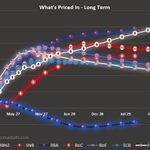
Despite this, SOFR futures continue to imply restrictive policy through 2027, leaving the back end of the policy curve vulnerable to dovish repricing.
The rolling 20-day R² between the implied trough fed funds rate and the SFRZ6Z7 spread has risen to approximately 75%, suggesting the curve is increasingly sensitive to changes in terminal easing expectations.
With SFRZ6Z7 having steepened well beyond its one-year median, relative valuations also appear extended.
Further deterioration in financial conditions could therefore favor SFRZ6Z7 flatteners as markets price a lower policy-rate trough, alongside potential compression in term premium.

ACLLC retweeted

new plumbing post just dropped
a primer on the cross-currency (XCCY) basis market conks.plumbing/p/primer-the-…

ACLLC retweeted
PCE Forecast for tomorrow:
In our PCE forecast, energy is driving the marginal acceleration, while core services are continuing to drive the underlying persistence. Air fares I believe will be a fairly large contribution this month in PCE as well.
MoM: 0.52%
YoY: 3.47%


ACLLC retweeted

Force majeure used to cover things such as natural disasters, wars, etc. Now PE wants it to cover AI too.
HIG's latest LBO loan suspends lenders’ remedies on an interest default for as long as the company is “impacted” by AI...
What are we even doing here?


ACLLC retweeted

16 years ago, on Oct 25, 2010, the U.S. Treasury auctioned 5-year Treasury Inflation-Protected Securities (TIPS) at a negative real yield. It was the first TIPS auction in U.S. history to sell at a negative real yield.
The auction of the 4-year 6-month TIPS (CUSIP number 912828MY3) resulted in a real yield of -0.55%. Negative real yields on TIPS continued for a few more years after 2010 and then returned during the zero interest rate period of the COVID pandemic. Five years ago, a 5-year TIPS auction resulted in a real yield of -1.685%.
Even though the real yield of TIPS have sometimes been negative, some of those TIPS have generated nominal returns that have exceeded Treasury notes with the same maturities due to the increase of TIPS principal from inflation.
In recent years, TIPS real yields have been at highs not seen since the late 1990s and around 2008.
#OnThisDay
Sources:
treasurydirect.gov/instit/an…
web.archive.org/web/20120927…
tipswatch.com/2025/10/15/a-5…
tipswatch.com/2025/10/15/a-5…
kitces.com/blog/negative-tip…

ACLLC retweeted
France continues the sell-off in the curve, with 2 to 10 year rates rising 10bps to 14bps. Meltdown in French bonds coupled with swoon in tech stocks, further shown by an almost 4% dip in the Kospi has spurred a 7bps to almost 10bps rally in the red, green, and blue packs.

ACLLC retweeted

My interview with @BloombergTV this morning...
on France
bloomberg.com/news/videos/20…

ACLLC retweeted

Over the weekend, I ran an experiment: Can LLM agents, individually or in teams, manage a weekly cross-asset portfolio better than simple systematic rules?
1/8

ACLLC retweeted

HAPPENING NOW in downtown Chicago, outside the Chicago Mercantile Exchange, the historic center of onion futures trading
ACLLC retweeted
I will comment on the French news only from a market perspective.
It is rare that markets respond to news of this kind, as it is generally viewed as temporary and not enough to ultimately move the economy
BUT:
- This could move politics, and impact voting into the crucial elections in 2017 (further away from the center).
- These riots are so severe that there may be an impact via a/ lower tourism, b/ lower business/consumer confidence
- OAT spreads widened to 140bp in Sep (on levered selling), but we have seen some consolidation in Oct (as real money is watching, but have not reduced yet). The images from this weekend, will not make real money more comfortable.


ACLLC retweeted
Our model suggests that current market stress is more concentrated in rates than in corporate credit.
Elevated rates volatility can reflect monetary-policy uncertainty, inflation risk, or duration repricing without necessarily signaling deteriorating corporate credit fundamentals.
The relatively subdued credit factor suggests that corporate risk pricing has not deteriorated to the same extent.
However, the positive credit residual indicates that credit is slightly weaker than the historical relationship with rates and equity/FX would predict.

ACLLC retweeted

The Month I Ran My Hedge Fund from the Local Chase Bank
After Enron went bankrupt in 2001, I decided to start a hedge fund. Until then, I’d spent my entire career at a large company, trading off its balance sheet. I knew how to trade, but knew little about the logistics of launching and running a fund. Plus I had no peers in Houston who could help guide me through the process.
I found out-of-town legal help. My clearing broker was a NY investment bank, Smith Barney. I knew I needed two bank accounts: one for the business to pay rent, salaries, etc and one for the investor money that supported the trades. I figured, incorrectly it turned out, that I could stay local for the latter.
I figured I needed a national, sophisticated bank so I went to my closest Chase branch and asked to open a business account. They were very accommodating and asked some basic questions. Suffice it to say, they were as new to hedge fund finances as I was. But they were happy to have the new accounts, especially since one would be funded with a 6-figure deposit and the other would eventually be funded with millions.
In the spring of 2002, I opened the first account. I used it to pay for normal business expenses: rent, office equipment, legal fees, etc. All was fine.
In August, I called my external investors and told them to send their funds to join my personal investment in the fund to the second Chase account, the limited partnership account. They did. Chase confirmed they received the funds and had no problem.
Quick aside, energy trades in 2002 could be done on an exchange or over-the-counter directly with a counterparty. Most trades could be executed on exchange and be relatively capital efficient but some instruments only traded directly with counterparties. Today, exchanges clear almost any nat gas product one would want to trade but it was less so back then.
I had friends at another trading house, Sempra, who fast-tracked a credit arrangement for me to trade OTC there. I would have to post cash as margin to support my trades given I was not a so-called “credit-worthy counterparty,” but it was fine. I wasn’t planning on taking large net positions given my small capital base, though sometimes I might be long on the exchanges and short to Sempra, or vice versa. I would need to post initial margin and maintenance margin both at my clearing broker and with any direct counterparty to account for the daily price swings at both places. This meant I would have to move money between my prime broker, where I kept my exchange trades, and Sempra, several times a week.
The second week of August I started trading. The first thing I needed to do was send more than half of the LP account funds to my prime broker, where most of my trades would be. The neighborhood Chase branch executed this wire with no problem. Trading at first was small. The second week I did my first trade with Sempra. I had to post margin with them. Chase executed that wire with no problem.
By the third week my trades were picking up. I ended up long with Sempra and short on the exchanges. When the market went up, I had a surplus at Sempra and would ask them to send me those funds, as the credit agreement allowed to me to do. I needed that money to cover the offsetting exchange losses. Very quickly I was moving hundreds of thousands through my local Chase branch several times a week. Red flags quickly went off at the bank. Suffice it to say, I had not prepared them for this level of activity.
The following week the market fell. I needed to send money to Sempra hundreds of thousands of dollars. I told my prime broker to send some of my account surplus there to Chase, and asked Chase to send some of that to Sempra. That’s when my 4 week old hedge fund was hit by an almost fatal blow. Chase accepted the wire from Smith Barney, but I found out the next day that they did not send the wire out. Sempra was calling to ask where the margin money was. I didn’t know. I called Chase and they told me there was a hold on it but it would go out later that day. I checked in the late afternoon. It had not gone out.
I was at the bank went it opened the next morning. I explained how I needed this wire to go out. The account had been frozen, they said, until they got a green light from their compliance department. They didn’t properly “know your customer” and froze my account until they could understand what was going on. This level of activity out of a new account of this size was not something this branch had ever seen before. Nor did they understand an energy hedge fund with over-the-counter trades.
I was furious they had not explained this the previous day and asked them to just send out this one wire and then we’d sort it out. I’d move to another bank asap. They declined. I pleaded, just send this one. It wasn’t working.
I panicked. I had failed to meet my Sempra margin call. They could close my trades. I called Sempra from the bank, explained the issue, and convinced them to give me a 24-hour grace period. But if I didn’t meet my cash call by the next business day, they would close my trades. Then I would be imbalanced on the market with my just my short trades on the exchange. With a sharp market move in the wrong direction, my little hedge fund would have been toast within a month of opening.
Throughout this, normal bank customers were flowing in/out of the bank. I told them I wasn’t leaving the bank branch until they sent the wire. It was my money. I started to raise my voice and cause a scene, the best I could. I hoped they would send the wire just to get me to quit disrupting their normal flow of customers. I’m normally a quiet guy but my business, and maybe career, depended on convincing the branch manager to send this wire out. After two hours and a lot of calls with higher-ups, they consented, but they said they had to send a team to my office the next day to inspect my “business.”
The office space I had was nothing to fancy, to say the least. The building was fine, an 11-story class A. The office, a sublease, was 3 rooms. Open the door and you were immediately on the “trading floor”, which was one row of desks where the 5 of us sat. It had a small kitchen and a tiny conference room to the side. There were a lot of computers but of course no receptionist, no art, no waiting area, just a handful of 20 or 30 something year olds in shorts (August in Houston) with a football nearby.
Chase sent 3 bankers in suits. It was… awkward. I led them to the conference room and tried to explain what we did and why the funds had the velocity they did. They quickly told me that they were not equipped to handle my account and I needed to find another bank by the end of the week. I asked them to facilitate the wires for another couple days until I could, which they agreed to.
I called Smith Barney, my broker in NY, and explained the situation. They immediately understood and helped me open a bank account there. In retrospect, I should have had my investment account there from the beginning. I’d already had my business account at the local Chase and figured they were my bank. I had not properly distinguished between local Chase and JPMorgan Chase. I didn’t know any better.
As I later learned more about banking regs and KYC rules, I realized the local branch acted exactly as to be expected given the circumstance. It was my fault. Luckily, it got straightened out and I can laugh about it now. I still think about how naive I had been every time I drive by the bank branch.

ACLLC retweeted

OK so in the spaces I did Friday night w/@Dcpcooks & @GtcTraders I proposed what I think is ‘the’ key spread to ponder going forward $SR3 Z7-Z8 & asked which way he’d trade it if I made him NOW. Bourbon clouded the answer lol so we can pick up where we left off here… #SOFR #STIR

ACLLC retweeted

US Treasury Secretary Scott Bessent is likely to reduce the auction sizes for long-dated government bonds — and could even cancel sales of 20-year debt altogether, according to Citigroup bloomberg.com/news/articles/…



ACLLC retweeted

Stuff I learned today which kinda surprised me
The SP500 has never closed the year after mid terms red, going back to 1954. Nov -nov not year end.
It was never red at the 6 month mark either. (Including 1987)
The 10 yr yield was higher 11 times and lower 7
Inflation was higher 5 times and lower 12
Going back to Lincoln only FDR Teddie Clinton and W added party seats to the house.
Every other president since Lincoln lost seats in the house at midterms
Scatter plot in the second pic is interesting

