
Cofounder of Distilla AI AI-pilled, but resisting cognitive offloading
Palo Alto
Joined May 2009
- Tweets78
- Following345
- Followers135
- Likes67




Nobody on X has broken down $ANT unit economics model by model. So I did.
Think of Anthropic less like a software company and more like a biotech or semiconductor company.
Every new model requires massive upfront investment. And each model has a finite economic lifespan to earn back that investment and generate an attractive ROIC.
I put the economics together in a 3-minute video. Before the market prices it in. 👇
1
2
92
85% gross margin excludes training and analysts get ~40% counting all compute. $10B estimate on the latest model family training from @jukan05. ~3x training annual incr based on epoch. The numbers align with Dario's Good Company podcast (Jul 2024): "today's models cost about $100M, $1B models are in training, and $10B–$100B models are coming in 2025–27." Lifecycle based on Openrouter and S1.
12
Qwen and Kimi latest models are not so hot. OSS models will likely lag for a few months, until DS or Seed hopefully figure out sth and surprise the world.


1
42

shows how vulnerable Sota models are. I am in the camp that LLMs will eventually be public utility.

This slide from the Anthropic IPO roadshow was a big factor in my decision to leave. It’s an insane plot and I’m surprised they made it public.
It shows the compute efficiency of pretraining over time. The y-axis is a **log scale**: they are seeing continued superexponential algorithmic progress.
Mythos was not a one-time deviation, but a point on a superexponential. They could already retrain Mythos with a fraction of the compute originally needed.
It doesn’t strictly imply a software-only intelligence explosion- they have been spending more on R+D. But algorithmic improvements do not require ridiculous creative genius and are on the verge of being automated. You do the math.

33
Overheard this from a hf pm on $NVDA situation and I think it makes sense.
Jensen episode may have a much bigger negative impact on China open source model effort.
He has been a big advocate for less export control.
Whoever takes over will be extra strict and all the semi / neocloud leaders with ties to Asia will be extra careful.
Alice Huang channelled many chips to $BABA and cutting that supply off will hurt Qwen training. Likely more labs in China will find it harder to source.
The other victim here may be Singapore / SEA data center industry.
Great for $ANT and I am sure there are a lot of drama fighting for or against the removal of Jensen right now, both in the name of national security.
127
8% of my portfolio is in $META. Here is why:
1/ cheap based on SOTP:
Model: $200B in value (DeepSeek is ~$90B)
Muse: $70B (Instinct at $10B, probably higher)
Smart Glasses: $30B (may be a $15B+ rev biz soon)
Core would be $1.37T, which is 13.7x 27E EBIT (~$100B), for a growing business
2/ strategic positioning:
Whatsapp, Instagram and FB, network effects, are hard to replicate by labs. More importantly, VC money will go to tokens and GTM via many more startups, and ads on human networks is a great business, esp. when those are hard to disintermediate.
3/ founder-led:
Things move fast now with AI. Zuckerburg + Alex both have founder mode. I bet they will do better than professional CEOs at some other large firms.
We already saw that - they could break things, reorg quickly, pivot without fear, and bet big.
4/ upside from metaverse:
AI makes metaverse possible and inevitable. Meta was the first mover, and has accumulated alot of knowhow / lessons.
5/ not tied to OA or ANT:
Some reason to own, after both go public.
1
119
Before buying $ANT, here are 7 things investors should understand.
1/ The valuation: $1T or $1.4T?
At $70–78/share:
~$1T headline market cap
~$1.4T fully diluted equity value
~$132B existing cash
~$85B estimated net IPO + strategic placement proceeds
~$215B pro forma cash
At $81B October ARR, that's ~15x pro forma EV/ARR. If ARR reaches $160B in 2028 (40% annual growth), ~7.5x.
ANT pitched $190-200B revenue for 2028, so ARR for YE28 could be $250B or more.
But there's another number: ~$900B in aggregate compute/infrastructure commitments. Not conventional debt, but a massive future capital burden.
Given what we know today, I personally think $1.4T is a very fair valuation ($2T would have been too expensive).
2/ Who is funding the IPO?
The public offering could raise ~$58–64B gross. Separately, seven strategic investors are committing $26B:
Google: $10B
Nvidia: $10B
AMD, Broadcom, Micron, Microsoft and TSMC: remaining $6B
Reported retail allocation could reach 15–20% — unusually high for a mega-IPO.
3/ Free float and lock-ups: don't confuse IPO size with available supply.
825M shares are offered, only ~6.3% of fully diluted shares.
But up to 316M additional shares may become eligible for sale from day one. Most other holders face a 180-day lock-up, while founders and certain large holders face up to 365 days, subject to early-release provisions.
The supply calendar matters as much as the IPO float.
4/ Index inclusion could bring passive demand quickly.
Nasdaq-100 Fast Entry:
Top-40 market-cap eligibility.
Assessment after 7 trading days.
Potential inclusion after 15 trading days.
No existing constituent needs to be removed.
S&P 500 is different: at least 12 months of trading, plus profitability and other eligibility requirements.
Potential Nasdaq passive buying within weeks; no need to assume massive forced selling elsewhere.
5/ Investors are bullish - some don't buy the story, but it's risky to be publicly negative.
The bulls:
Brad Gerstner (Altimeter): Says sentiment among major investors is 9–10/10 bullish over 1–3 years; Altimeter plans to participate substantially in the IPO.
Erica Brescia (Redpoint): Calls Anthropic an "absolutely blockbuster business" with impressive profitability trends.
Denny Fish (Janus Henderson): Calls AI a generational technology shift.
Menlo's Matt Murphy and Bessemer's Byron Deeter: Anthropic is reportedly their respective firms' largest investments by historical significance/cost basis.
Gil Luria (D.A. Davidson): Sees strong potential if the IPO is priced correctly.
The skeptics:
Li Lu (Himalaya): Warns against treating AI as a human-made god. AI should remain a tool, and investors should return to fundamentals, financial discipline and long-term value creation.
Roger McNamee: Calls the S-1 "speculative fiction" — a compelling story that still leaves key questions unanswered. By the way, Roger is a legend (Facebook, Silver Lake, etc.), but turned negative on tech / AI in general over the last few years.
New Constructs (David Trainer): Calls it potentially the "most ridiculous IPO of 2026"; its reverse DCF suggests equity value as low as ~$144B under certain assumptions.
Remember: several bulls are existing investors. Their enthusiasm is meaningful, but not independent price discovery.
6/ Chinese AI labs offer a useful valuation comparison.
Indicative figures:
MiniMax: ~$7.8B market cap / ~$0.8B ARR = ~10x.
Z.AI (Zhipu, GLM model): ~$29B / ~$1.8B ARR = ~16x.
DeepSeek: ~$52B estimated private valuation / $0.5–1B estimated ARR = ~52–104x.
MiniMax and Z.AI have also fallen roughly 87% and 84% from their 52-week highs.
These ARR figures are estimates, not audited revenue. The comparison illustrates how much valuation depends on growth expectations and perceived strategic importance.
7/ Cloud companies may be the closest public-market proxies.
Amazon, Google and Microsoft are major compute and distribution partners.
Anthropic generated 44% of revenue through cloud-provider marketplaces in the first nine months of 2026. AWS grew 39% YoY in Q3.
As Anthropic scales, investors may increasingly prefer direct exposure to the model company rather than relying only on chipmakers and cloud providers. The caveat: Anthropic's growth is not the only driver of cloud growth, and it may increasingly build its own compute infrastructure.
248
How do you value a 4-year-old startup at $1T?
Anthropic is arguably a venture-capital bet wearing a public-market valuation.
The upside: global dominance. The downside: intelligence becomes a commodity, and models become utilities with collapsing margins.
In between lies extraordinary uncertainty:
Supply & demand: What comes after coding? How much AI demand will materialize, and how many gigawatts of compute will actually come online?
Technology: Falling behind SOTA could destroy competitive advantage almost overnight.
Human capital: Extreme dependence on a small number of people, researchers and organizational culture.
Economics: Who captures the value? Frontier labs, cloud providers, or application-layer companies?
Politics: Alignment, regulation and geopolitical competition could fundamentally change the industry's trajectory.
You can build elaborate revenue projections, DCFs and TAM models. But the terminal assumptions are doing an extraordinary amount of heavy lifting.
Anthropic may become a $3T+ company. It may also become a much less differentiated, capital-intensive utility.
The challenge isn't forecasting ARR. It's underwriting which version of the AI industry will emerge.
We're pricing an early-stage industry equilibrium, not just an early-stage company.

HERE'S THE ANTHROPIC MODEL: Anthropic will go public at $2T in Oct '26 and will be a $1T ARR company and $10T+ company Dec' 2030 as the winner of AI.
Here's how Anthropic gets to $1T ARR in 2030:
- 2026E: $125B ARR +14x YoY w/ 5 GW live
- 2027E: $266B ARR + 114% YoY w/ 10 GW live
- 2028E: $462B ARR +73% YoY w/ 16 GW live
- 2029E: $700B ARR +52% YoY w/ 23 GW live
- 2030E: $1T ARR + 42% YoY w/ 30 GW live
I'm dropping my full Excel model modeling out:
- ARR by business model (e.g Consumer, B2B, Enterprise, API)
- API business broken down by model type (e.g Fable 5.1, Mythos, Opus, Sonnet)
- Training costs and inference cost as a % of revenue
- Gross Margin ($ ARR per MW and Cost of Compute per MW) as well as forecasting GW secured.
- Net ARR (vs Gross ARR reported by trackers) removing marketplace pay out, Meta, Chinese AI labs
- and more
I also share the @artemis thesis for WHY Anthropic is the AWS of AI and winner of AI in the enterprise (and open source and ANT / OpenAI can win)
Get the full model here: artemis.ai/anthropic-thesis
Full Disclosure: I don't have inside information. I took what's publicly available from the July '26 @SemiAnalysis_ model and added my own judgement based on public information and my own world views. I've spent a life time modeling as a former HF and VC analyst. I'll update the model as soon as the S-1 drops.

If you’re bullish on AI and blaming the midterms for the selloff, you’re missing the point.
1/ A slowdown is healthy. The diffusion gap is already too wide and growing too fast. Wealth concentration and job displacement are happening faster than society can absorb. Dario pushing for caution was probably self-interest. It was also directionally correct.
2/ Political pushback is a feature, not a bug. Letting states block data centers and express anti-AI sentiment is a controlled release. The alternative is a slower, uglier backlash aimed directly at AI labs and founders. A messy political fight is better than a Luddite one.
3/ Technology exists to benefit people. Right now the industry is moving faster than our ability to understand the downside. Slowing down for a year or two to see what actually breaks is not anti-progress. It’s how you avoid building something you can’t control.
4/ Constraints force better outcomes. DeepSeek didn’t happen because money and power were unlimited. Scarce electricity and expensive capital will produce better chips, better cooling, and more efficient models. Unlimited capital mostly produces waste.
5/ Deflate the bubble early. More 401(k) money concentrating in semis would have made the eventual correction worse. Even disciplined hedge funds were FOMO-ing with no real edge. The market rotating away from pure AI concentration is healthier than most people want to admit.
The people most convinced this is a disaster are the ones who needed the narrative to stay simple.
I long AI and I like this selloff.
4
159
Interesting stat from Menlo's State of Enterprise AI Report... Anthropic’s share of enterprise API spend increased from 40% to 55%, OpenAI’s from 27% to 31%, while Google’s fell from 21% to 9%. $GOOG did fall behind fast.

This just in: Menlo Ventures’ 2026 The State of Enterprise AI report is live.
In 2026, enterprise AI spend skyrocketed 5.4x from $33B to $177B in a single year.
The full report covers how AI became an economy-scale force this year, and shows where the dollars are going, which markets are working, and which models buyers choose.
More from @timt, @mejoff, @deedydas, and @derekgxiao: mnlo.vc/enterprise-ai-26

93
AI is going to cause a monkey shortage.
Sounds like a joke. It’s the least discussed bottleneck in AI drug discovery. 🧵
1/ AI can design 1,000 drug candidates in a week.
Regulators still want tox data in a living animal, often a macaque, before a human gets dosed.
Models scale with GPUs. Monkeys scale with 4-year pregnancies.
2/ The supply was already broken before the AI boom.
China stopped exporting research monkeys in 2020. Before that it was roughly 50-60% of US lab-monkey imports.
Cambodia, Mauritius and Vietnam filled the gap. Then the DOJ indicted Cambodian officials over wild-caught monkeys sold as “captive-bred.”
3/ Price per monkey: ~$3K in 2019 vs. $20K today
4/ So Palantir cofounder Joe Lonsdale’s 8VC backed Safer Human Medicine, which reportedly plans a facility with up to 30,000 macaques in Georgia.
Reportedly ~$28M raised. It would start with 500 to 1,000 animals and take about 20 years to ramp.
“America needs a reliable domestic supply of research primates.”
5/ China is short too.
~220K captive lab macaques at the end of 2024.
~30K a year of output against 40K+ a year of demand, a gap of about 10K a year.
Prices hit ~$25K in June. JOINN’s H1 net profit is forecast up 884% to 1,377%, mostly from marking up its ~30K-monkey herd.
WuXi bought Suzhou Kanglu for ~$100M to become China’s biggest breeder. Pharmaron and JOINN are also locking up breeding capacity.
6/ Charles River saw it coming.
In January it agreed to buy Cambodia’s K.F. for ~$510M. K.F. supplied ~30% of the monkeys used by its drug-discovery and safety unit.
It now plans to own most of its own supply. That’s a moat built out of primates.
7/ Now the AI part. Anthropic’s S-1 calls drug discovery “a leading use case.” 9 of the 10 largest pharma companies are customers. It also describes AI agents running lab robots.
The US imports ~20K monkeys a year. If AI doubles or 5x’s the number of candidates reaching tox studies (my extrapolation, not a forecast), demand rises about the same multiple. Supply can’t, because a female macaque matures at ~4 years and has one infant a year.
8/ What’s the bottleneck after monkeys?
Not compute. The queue is: breeding cycles, then GLP tox capacity, then regulators’ willingness to accept non-animal data.
The FDA has already started a plan to cut animal testing for monoclonal antibodies, using organ-on-chip systems and AI tox models. If it works, monkey prices fall. If it doesn’t, they keep climbing.
9/
Where I’d look (not advice, do your own work):
🇺🇸 $CRL: owns its supply, but it’s already up ~73% YTD and reports earnings today.
🇨🇳 WuXi AppTec ($2359.HK / 603259.SS): largest Chinese breeder.
🇨🇳 JOINN ($603127.SS): the most levered to monkey prices, and its profit is mostly mark-to-market gains, so it’s volatile.
🇨🇳 Pharmaron ($3759.HK): securing supply.
The bear case (and a good case for monkeys) is that animal-free testing wins. Watch FDA NAM pilots.

1
159
Let's not shift the blame. Yes, credit plays a role, but also the AI trade needs a breather. I'm long-term bullish on AI demand, but isn't it more dangerous to link the AI trade to Iran? At this rate my semis position depends on whether Tucker is right about the nuke. 😂

43
Spoke today with the head of AI at one of the largest banks. Not great news for AI vendors trying to sell into them.
1/ Scale: 5–10K engineers. Every business, from core banking to wealth management to HR, is actively looking for AI enablement.
2/ They can build it all in-house. They meet plenty of AI startups and kick off lots of POCs, but none have impressed them. Their view is that most of it is easy to replicate.
3/ The bottleneck isn’t how fast they can build. It’s regulation and internal politics.
– Many back-office roles have already been cut, so it’s no surprise teams push back on rolling out AI workflows.
– Regulatory ambiguity (e.g. KYA, “know your agent,” for agentic investing or transfers) makes projects hard to scope and ship.
4/ They don’t train or fine-tune models. That’s not because they can’t. Frontier models are improving too fast to make it worth it.
Takeaway: large banks are already tech companies, and they’re AI-forward.
Then, the same day, I heard a large European bank outsourced its wealth management MCP development to a startup....
2
157
$RDDT down big time last week. This is not an incident, it's an emerging theme.
See below a list of potential other "AI search victims" reporting in the next 2 weeks.
Hypotheses:
- Owned traffic decides who is hurt. Logged-out, informational, free traffic is being absorbed into Google's answers. Direct visits, apps, subscriptions and standing orders are not.
- Agents favour whoever owns supply, payments and service. Booking, Expedia, Shopify, Chewy and Wayfair are wiring themselves into Google, OpenAI and Meta agents. Review and lead layers (Tripadvisor's hotel ads, Yelp's audience, comparison sites) are more at risk than the businesses holding the inventory.
- Google is a channel cost as well as a traffic source. AI Mode has, for now, made Google ads cheaper, which flatters companies that buy traffic (Etsy, lead-gen). If Google recovers the lost monetization, those margins reverse. Model cost per click as a risk alongside lost clicks.
More in comments.

2
1
99


My daughter turned 8 months old recently. I have been thinking more about the world she'll grow up in, one where intelligence is cheap.
Every industrial revolution has been a deflation machine. Steam and electricity mostly didn't invent new things. They made old things far cheaper with far fewer people.
AI is doing the same to intelligence: code, contracts, decks, diagnoses.
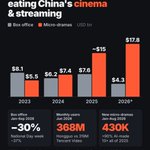
The usual optimism is Jevons: make it cheaper and we'll use more. But demand for most knowledge work is inelastic. Nobody files more tax returns because filing got cheaper. You see already more AI micro dramas led to lower margins, not increase in screen time.
Call it the inelastic trap. For most knowledge work, expect falling prices, profits and salaries, with little gain for the public. Real abundance will come where AI meets atoms: robotics, drugs, science.
Last time, the transition came with the Long Depression of 1873–1896, which historians also call the Great Deflation. Millions went from farms & mills to factories, and millions migrated from UK to US. I don't expect this one to be gentler.
Elites will be hit harder this round. "Managers" is an industrial concept, and Ivy degress or JD / MD / MBA will be replaced by "$15 / hr experts" (I agree with YC's RFS).
When everything can be commoditized, happiness and meaning can't be. That's what I want her to chase. Be inwardly wealthy, and be helpful to other humans.
1
144
Lag and arbitrage between prediction markets and stock moves? I did a small experiment.
As part of prototyping a new product, I pulled Polymarket's price history at 10-minute resolution, found every big jump, and measured what about 50 stocks per theme did right after. I adjusted for the overall market so a broad rally doesn't count.
Here are some interesting learnings:
1. Iran war → peace (13 markets, about $1.1B traded). The whole chain repriced within the first hour. Per +10 points of peace odds. Second-order names were not slower. The market trades the war as one basket. The exceptions were defense stocks: their day-5 move was 5–7× their first-hour move.
2. Fed rate path (Polymarket's Fed decision markets, $100–660M each). On 5-minute bars, Treasuries and the dollar finish moving within 15–30 minutes, and small caps move in the right direction 9 times out of 9. But the housing and consumer-credit chain drifts for days. Per +10 bps of expected cuts, by day 5: 3–8× their first-hour moves.
3. AI labs (the "best AI model" monthly markets and the Anthropic/OpenAI IPO markets). The owners didn't move at all. What did move, and kept moving for days, When a lab gets richer or more competitive, its suppliers' backlog gets safer.were the companies the labs pay for compute.
Things I expected that didn't happen:
Tankers didn't fall on peace news. Reopening Hormuz brings shipping volume back.
Gold didn't care about Iran.
REITs fell on dovish Fed news. The dovish jumps came with weak economic data.
Airlines looked great before adjusting for the market, but most of that was just high beta.
How fast, in one line: when there's an obvious basket to trade (oil and war), everything reprices in an hour. When the effect runs through earnings (rates into housing, AI labs into suppliers), it takes days. Those slow names are where the odds are actually useful as a signal.
Caveats, honestly:
The samples are small: 7 clean events for Iran, 9 for the Fed, and 9–31 per AI signal, all from a single year.
I ran about 500 tests, so some "significant" results are noise. Oracle is the only one that replicated across independent markets.
This is co-movement, not causation. The same news moves the odds and the stocks.
Hourly bars for most events. 5-minute bars only for the last 60 days.
(Disclosure: I'm building a research tool for thematic investors and this came out of that work. No link, just sharing the data. If you are interested in the topic, DM me or leave a comment.)

124