

Cyber-Security Enthusiasts AWS Developer
0.0.0.0
Joined February 2021
- Tweets175
- Following171
- Followers59
- Likes40




Adarrsh Paul 🧑🏾💻🎹 retweeted

You already gave the LLM the answer. So why is it writing it out from scratch?
Introducing a new AI model architecture: Constrained Decoding Models (CDMs)
LLMs were built to write. Most production workloads just need an answer: fast, consistent, and affordable.
CDMs are purpose-built for 1 task each. They read your input once and skip the token-by-token generative loop that makes LLMs slow and expensive.
Not just a decision model, but a family of 3 CDMs live today:
• Classify: define your labels and get back a calibrated probability + reason for each. Used for routing, tagging, and intent detection.
• Extract: describe the entities in natural language and get back well-formed JSON with confidence scores + citations. Used for web scraping, document processing, and PII redaction.
• Summarize: pass in long text, images, or PDFs and get back a consistent summary under 1,000 tokens. Used for context compaction, metadata generation, and transcript digests.
Built for production:
• 1M tokens of multimodal (text + image) input, 31x larger than Jev
• 77.2% on DecisionBench vs Jev's 72%
• 200x faster, 467x cheaper than frontier LLM APIs
• $0.05/M input tokens. Output is free (yes, even for summarize)
Live on your favorite platforms today:
@OpenRouter @vercel_dev @LiteLLM @LangChain @TrustedRouter @itsArthurAI @useRouterPlus
Get 50M input tokens for free (for the first 50 hours) at link below 👀
🤖 Made with AI
Adarrsh Paul 🧑🏾💻🎹 retweeted

Introducing Indra, a 1M parameter OCR model:
- 49 pages/s on CPU, 11x faster than PaddleOCR and 17x Tesseract
- Beats them on OmniParseBench text (41.3 vs 35.8 and 19.3)
- Full layout and line bounding boxes
Adarrsh Paul 🧑🏾💻🎹 retweeted

I am raising investment for building a next generation AI lab from India. The vision is simple, build greater models for open community, the same way I built laya, the type 1 decision model that reached the global audience , what if we could build novel Recursive Language Models, Symbolic Reasoning Models. Maybe world models with physics engine, just like Vega series of decision model I recently launched. Like a next mistral from India or maybe more. If you are a VC or have connection, chat is open.
Adarrsh Paul 🧑🏾💻🎹 retweeted

Dear Prime Minister Ambani,
Please accept my humble apologies for not realizing that you are the real boss of India.
Naturally, you would prefer to maintain your monopolistic exploitation of the great people of India, but would you nonetheless consider allowing Starlink to compete?
There are many areas of India, as there are in all countries, with no Internet access, which denies children the opportunity for education and for small businesses the opportunity to sell their goods to a global market. Starlink would change their lives for the better.
Thank you 🙏
Adarrsh Paul 🧑🏾💻🎹 retweeted

IIT, chalkboard, zero slides
A 22-year-old at IMC gets paid $500,000 in year one for exactly one skill. Not picking winners. Seeing every trade as a full spread of outcomes, each one with its own odds attached.
Her name is Prabha Sharma. She teaches this exact skill on a bare chalkboard, for free, in a lecture almost nobody outside that room has ever watched.
Most people see a trade as a coin flip. Win or lose. Nothing else.
You already think this way about your own trades, don't you.
That's the mistake. A trade is never just win or lose. It's a spread of outcomes, each with its own odds and its own payoff attached before a single dollar moves. The formula for this is called the binomial distribution, and it's far simpler than it sounds.
Here it is:
P(X = k) = C(n,k) × p^k × (1-p)^(n-k)
n = how many bets you take
p = your real win probability on each one
k = how many of them you actually want to win
Try it yourself right now. Say you have a genuine 55% edge (p = 0.55) and you take 10 trades (n = 10). What's the actual chance you win at least 6 of them?
Plug in k = 6: P(X=6) = C(10,6) × 0.55^6 × 0.45^4 ≈ 23.8%
Add that up across every value of k from 6 to 10, and your real odds of winning at least 6 out of 10 land around 47%. Just under a coin flip, with a genuine edge in your favor.
Sit with that for a second. A 55% edge does not feel like 55% once you actually run the math over a small number of trades.
This is the exact formula that decides how much to risk on any single bet, once you actually know your edge. Sharma builds the whole thing from zero, in notation simple enough for a complete beginner to follow every step.
Wall Street pays $500,000 a year for this one skill. An IIT professor already gave the entire thing away, for free, on a blackboard nobody bothered to watch.


Adarrsh Paul 🧑🏾💻🎹 retweeted

CLAUDE AHORA OPERA MI TRADINGVIEW SOLO
NO TOQUÉ EL RATÓN NI UNA VEZ
Le pedí:
"Encuéntrame todos los futuros de BTC con RSI por debajo de 30 y volumen +200% a la vez"
14 segundos después:
→ 6 contratos encontrados
→ Gráficos cargados automáticamente
→ Soportes dibujados
→ Script de Pine corriendo backtest
→ Zonas de entrada marcadas
Luego: "Reproduce la semana pasada y enséñame dónde habría entrado mi sistema"
Pasó solo a modo replay. Vela por vela, marcando cada entrada y calculando PnL en directo.
9 operaciones. +4.780$ teóricos en el backtest. 83% de acierto (en esa prueba, ojo, backtest no es real).
También le pido indicadores:
"Escríbeme un oscilador de momentum que cruce actividad de ballenas con tendencia de precio"
40 segundos. Script listo, indicador en el gráfico.
La mayoría sigue pasando 50 gráficos a mano.
Esto barre 200+ en un minuto.
Escanea, dibuja, testea, calcula.
No reemplaza tu estrategia.
La ejecuta mucho más rápido.
El tutorial del post de abajo te enseña cómo montar tu propio bot de trading

Adarrsh Paul 🧑🏾💻🎹 retweeted

F*ck, this setup turns Grok into a 7-agent council instead of one chatbot, and it's too good.
The main thing is that it costs $0 per month, it runs locally, only WiFi needed,
This used to be one prompt doing everything, research, writing, editing, fact-checking, all mixed into one messy call.
Now one agent just researches, pulls facts and reads the source before anyone else touches it.
Another writes three hook variants, then a separate critic agent kills the weak ones immediately.
One checks every number for accuracy before it goes anywhere, one reshapes the whole thing into the exact format needed.
And one merges everything into a single final output, each step its own API call, its own system prompt, sometimes even its own model.


Adarrsh Paul 🧑🏾💻🎹 retweeted

5 embedding compression techniques, clearly explained:
(bookmark this)
Ten million 1,536-dimensional embeddings will occupy:
- 62 GB in float32
- 15 GB in int8
- 2 GB as packed bits
This only covers the raw vector payload, and an in-memory system also needs space for the ANN index, metadata, and allocator overhead.
Embedding compression works along two axes:
- the number of dimensions stored
- the number of bits used for each dimension
The five techniques in the visual reduce different parts of the payload.
1) PCA applies a post-training transform:
It learns the directions with the most variance from a representative sample, then projects existing embeddings into a smaller space.
It works with any embedding model, although the projection must be fitted and applied consistently to indexed vectors and queries.
2) MRL alters the training objective:
The model is trained so that selected prefixes (say, the first <n> dimensions) of the embedding remain useful independently.
You can therefore truncate an MRL embedding at inference without training a separate model for every target dimension.
OpenAI reports that text-embedding-3-large at 256 dimensions still outperforms the 1,536-dimensional text-embedding-ada-002 on MTEB.
3-4) Scalar and binary quantization keep the dimension count fixed and reduce the representation used for each value.
Scalar quantization typically maps float32 values to int8, giving a 4x reduction in the raw vector payload.
The scale and offset add a small amount of metadata.
Binary quantization keeps one bit per dimension, which gives a 32x reduction.
Similarity search can then use XOR and a population count instead of floating-point distance calculations.
5) Product Quantization encodes subvectors as centroid IDs:
It splits a vector into subvectors and replaces each subvector with the ID of its nearest centroid.
Query distances are then approximated through centroid lookup tables.
In all of these setups, the compressed representation does not need to produce the final ranking.
Usually, you retrieve extra candidates from the compressed index, then recompute similarity using higher-precision document embeddings.
This is especially useful with binary quantization. One bit can preserve enough coarse structure but loses magnitude information.
Rescoring improves the ordering, but it cannot recover an item missed by the initial compressed-retrieval stage.
Also, these methods can also work together. An MRL embedding can be truncated first and quantized afterward, reducing both dimension and precision.
I built the binary retrieval pipeline end-to-end, including the rescoring pass. In the tested setup, it searches 36 million vectors in under 30 ms.
Read it below.


Adarrsh Paul 🧑🏾💻🎹 retweeted

300 agents shouldn’t leave you with 300 answers. they should leave you with one structure.
that’s the whole idea behind this K3 context graph setup.
the swarm starts messy:
300 agents
→ hundreds of research paths
→ 140 linked sources
→ 9 contradictions surfaced
→ 100% traceable claims
then the graph starts compressing everything.
same entity found twice → linked
3–4 sources agree → confidence rises
2 sources disagree → contradiction flagged
1 source only → claim stays weak
so the useful output isn’t the swarm itself.
it’s what survives after the swarm disappears.
one graph → shared context.
every claim connected back to where it came from.
300 agents do the searching. the graph is what turns the search into memory.
full breakdown in the article below ↓


Adarrsh Paul 🧑🏾💻🎹 retweeted

self-evolving harnesses are here.
(100% open-source)
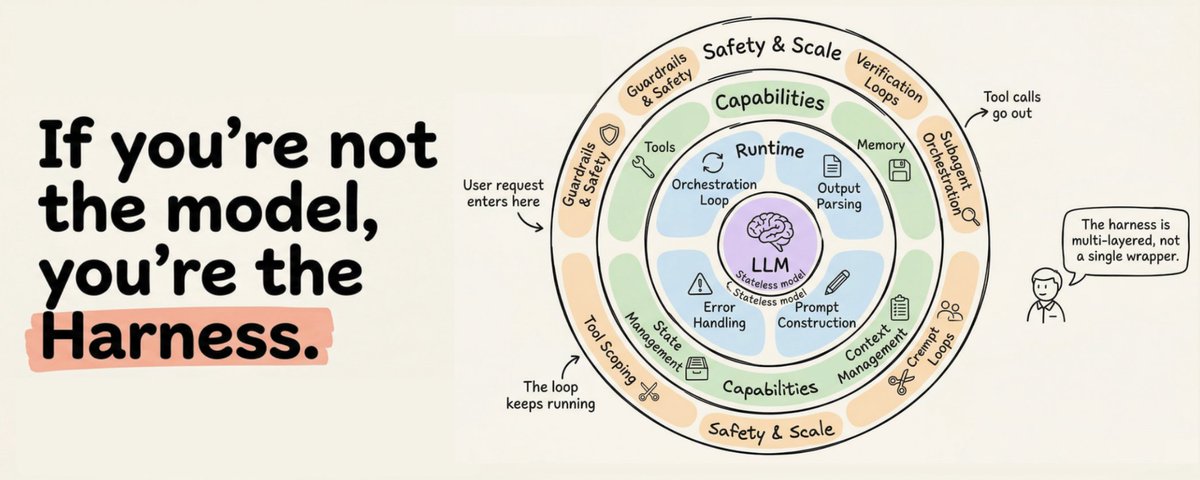
today you pick a fixed harness, and every task runs through it. a deep research question and a file-renaming task get the same memory strategy, the same planner, and the same tools exposed at every step.
JIT-Agent is a 27B open-source model that writes the harness instead. you hand it the task and the tool registry, and it emits four Python files plus a prompt config.
that happens once, before the task starts. then a second model, one you don't train or modify, does the actual work by being called step by step from inside those files. it never writes any of the code and never sees it.
each file covers one part of a fixed four-module contract:
→ memory decides what slice of the history that second model sees at the current step.
→ planning turns that view into a directive for the next action.
→ tool policy decides which tools are exposed for that directive.
→ action assembles the prompt from all of it, calls the model, and interprets the reply as either a tool call to run or a final answer.
because the code is written per task, the same generator produces structurally different agents.
here are a few tasks from the JIT-Agent paper, and the harness each one produced:
1) for a request that had to find contact records, build a workbook, and email it, it compiled the requirements into a dependency graph where delivery waits on artifact verification, and stored intermediate artifacts so later nodes consume finished results instead of rebuilding them from the transcript.
2) for a multi-hop identity question, a fixed graph would commit too early to one evidence path, so it synthesized a delegate tool that opens a private research subagent with its own memory and a five-step budget. the returned answer re-enters the parent loop as an ordinary observation.
3) for a task built around comparing numbers and ranking the results, it kept the arithmetic out of the model. the harness computes the numbers by running code, stores the results as fixed values, and hands those same values to every later step, so the model reads figures instead of recomputing them from text.
holding the working model fixed and changing only the harness, JIT-Agent's harnesses matched or beat hand-built runtimes on search and instruction benchmarks while spending well under half the tokens, and roughly a third less per case on average. writing the harness costs tokens too, and that cost sits outside those per-case numbers.
so harness design stops being one choice you commit to and becomes something written fresh for each task. JIT-Agent also keeps the harnesses that beat its current best in an archive, and pulls from it when a later task looks similar. its own weights never change while this happens.
this work is fully open-source.
repo: github.com/bingreeky/JIT
paper: arxiv.org/abs/2608.25593
i have written a detailed article on what a harness actually contains before a model starts generating one.
the article is quoted below.


Adarrsh Paul 🧑🏾💻🎹 retweeted

Anthropic hired this engineer at $250K-$750K a year because he knows how to build harnesses for multi-agent systems
In this 15-minute workshop, he shows exactly how to build one from scratch
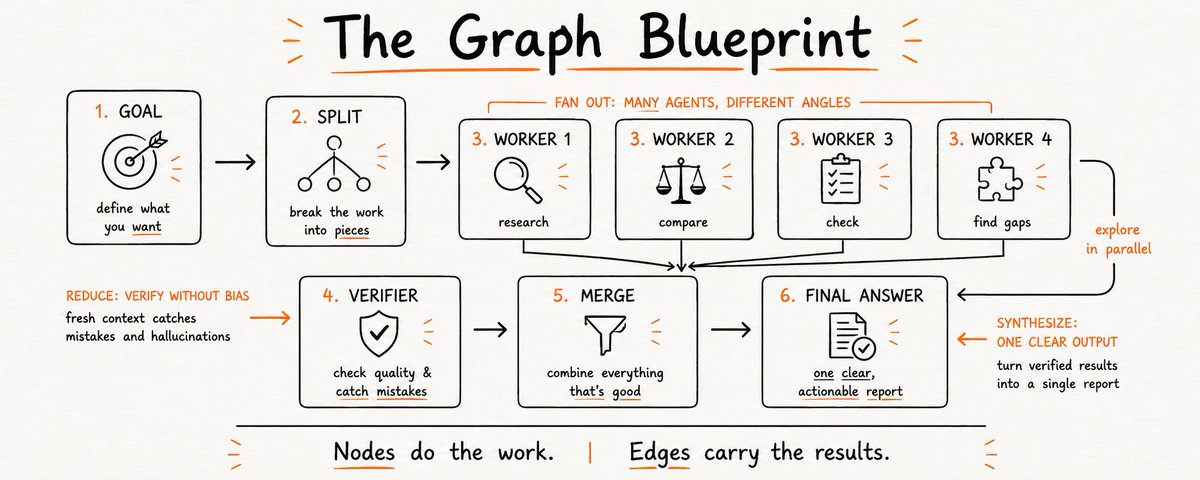
AI → Agents → Harness → Loops → Graphs
step 1 → start with the Claude Agent SDK - the harness handles loops, context, and sandboxing
step 2 → separate the brain from the hands - reasoning in one place, tools in a sandbox, 60% faster to first token
step 3 → run it server-side and log every step - close your laptop and it keeps running, crashes resume from the log
step 4 → make failure cheap - retry dead sandboxes and replay lost context instead of starting over
step 5 → turn yesterday's logs into new memory and skills - the harness wakes up smarter
Anthropic calls this "dreaming"
Most people spend weeks building this by hand
You don't have to
Bookmark and watch it
Then read the full harness engineering guide below ↓


Adarrsh Paul 🧑🏾💻🎹 retweeted

I deployed 650 agents and connected them seamlessly to a Second Brain, an active cloud supercortex orchestrating this digital swarm in real time
Before that, though, the Second Brain handled another priority. In mere moments, it playfully chewed through gigabytes of digital clutter that had been gathering dust across various directories for ages, effortlessly organizing every single piece of abandoned documentation, random notes, and archived files
The dashboard lit up with a massive data stream, and 650 autonomous threads simultaneously generated code, hunted down bugs, and tested one another. If any agent hit a roadblock on intricate logic, the Second Brain instantly retrieved a working pattern from a neighboring thread, resolving the challenge in milliseconds. It felt like a digital storm of absolute efficiency
Four minutes flat later, the logs went silent
The terminal flashed to life, verifying that all 650 tasks had finished with zero errors
I opened up the completed project, revealing pristine architecture, complete test coverage, and a smooth deployment. I closed my laptop lid, smiled, and headed off to sleep while the Second Brain, humming quietly in the servers, was already wrapping up the documentation for the upcoming sprint
I highly recommend bookmarking this article


Adarrsh Paul 🧑🏾💻🎹 retweeted
UC Berkeley just open-sourced FreeToken.
(2–4x faster local LLM inference than Ollama)
the results are wild:
- Qwen3.6-35B on an 8GB GPU at 39.3 tokens/s
- DeepSeek-V4-Flash 284B on a 32GB GPU at 22 tokens/s
- GLM-5.2 753B on a 96GB GPU at 14.9 tokens/s
a 35B model at 16-bit precision needs about 70GB just for its weights. even at 4 bits it is close to 18GB, and FreeToken serves it on an 8GB GPU.
let me explain how:
all three models mentioned above are Mixture-of-Experts, and that is what FreeToken takes advantage of. each layer holds hundreds of separate experts plus a small router that picks a few of them per token.
Qwen3.6-35B activates roughly 3B of its 35B parameters per token. DeepSeek-V4-Flash picks 6 of 256 experts per layer, so 13B of its 284B run at a time.
so compute was never the bottleneck. the weights a single step touches fit comfortably on a consumer GPU.
every expert the router might pick still has to exist somewhere. they sit in system RAM, and the GPU keeps a cache of the ones the model has been using recently.
so everything comes down to what happens when the router picks an expert that is not on the GPU.
there are two ways to serve that miss:
1. copy it over PCIe and run it on the GPU
2. run it on the CPU, where it already lives
both read from the same system memory, so they compete for one pool of bandwidth instead of adding to each other. existing engines pick one option and freeze it when the model loads.
but routing changes on every token, so a fixed choice misses most of what the model asks for.
FreeToken measures both bandwidths on your machine and splits each step's misses between the two paths in proportion. the GPU and CPU results then merge exactly, with no approximation.
two machines with the same GPU can end up wanting opposite strategies, which I did not expect. a 5090 in a gaming desktop should push nearly everything over PCIe, while an 8GB laptop is better off computing most misses on the CPU.
none of that is readable off a spec sheet, so the engine profiles it once per machine.
the second half of the design is about agents. coding agents constantly rewrite their own history, and every edit normally forces thousands of tokens back through prefill.
FreeToken saves its checkpoints at the exact boundaries agent frameworks cut on, so it only reprocesses the new part. its slowest first token stays under 44 seconds, while llama.cpp peaks at 232 and KTransformers at 946.
it serves the OpenAI and Anthropic APIs under Apache 2.0, so Claude Code and Codex can point at it directly.
releasing weights publicly decides who can download a model, not who can afford to run one. frontier open models keep shipping, and running them still assumes a rented cluster.
meanwhile there are over a hundred million consumer machines with discrete GPUs sitting mostly idle. closing that gap was never a hardware problem, and work like this is what turns open weights into something you can actually use.
paper: arxiv.org/pdf/2608.16157
repo: github.com/FlashML-org/FreeT…
almost every idea in this post, from why memory bandwidth decides the outcome to why moving weights costs more than computing on them, comes straight out of how a GPU is built. I wrote a detailed primer on that.
the article is quoted below.

Adarrsh Paul 🧑🏾💻🎹 retweeted

New Alibaba ByteDance paper shows that AI agents can no longer be served like ordinary LLM requests.
Because most of the performance problem now sits across tools, memory, environments, and the model together.
Bottleneck can also move from the LLM to embeddings, databases, sandboxes, or network transfer as the request and deployment change.
This paper builds AgentSysBench around 10 agentic applications and finds that model inference is often no longer the main bottleneck.
They find task-aware serving cuts latency by 29–40%, communication-aware placement delivers up to a 4.5× speedup, state offloading cuts memory by 4.6×, and caching removes 35.2% of redundant search calls.
So optimizing tokens per second is no longer enough. Agent infrastructure has to schedule models, tools, memory, and communication as one workload.
– arxiv. org/abs/2608.15127
Title: "From LLM Inference to Agentic Workloads: Characterization and Implications for Serving Systems"

Adarrsh Paul 🧑🏾💻🎹 retweeted

Don't waste 2 years learning to build LLMs like Claude & ChatGPT.
Stanford just dropped a 2 hour course on how to build LLMs from scratch.
00:00 - break text into tokens
25:44 - decode a user prompt
35:40 - train the model end to end
1:16:47 - build the architecture from scratch
Anthropic pays $750,000/year to engineers who understand this exact knowledge of LLMs.
Watch it, then go further with the step-by-step guide below on how to build a system that improves itself.

finally, a delivery that actually arrives... and in one piece! 📦✅
Thank you @Flipkart for the smooth experience. It’s refreshing to have a package marked "Delivered" that is actually in my hands. Reliability matters. #FlipkartBuyBuy2025 #CustomerService

