

I tweet about digital marketing and NBA.
Adelaide, South Australia
Joined August 2008
- Tweets6K
- Following804
- Followers878
- Likes59.8K








Andrew Webber retweeted

Yesterday (Oct. 26) marked the 150th consecutive day that the Niño 3.4 sea surface temperature set a new record daily high, at 30.22°C (preliminary).
This was more than 1.13°C above the previous record daily high set in 2015, as well as a record 3.49°C above the 1991-2020 baseline.

Andrew Webber retweeted

One reason the models can't track observed warming? The loss of shipping pollution hasn't been incorporated. You couldn't make it up.

New peer-reviewed paper confirms 0.4C/decade acceleration with reduced air pollution as a cause.
Contrary to popular belief, models aren't keeping up with observed warming.
"Further analysis shows that the ensemble mean of the 26 CMIP6 models reproduces the observed warming rate during 1971–2010 reasonably well (0.21 versus 0.18 °C per decade for models and observations, respectively), but fails to capture the recent doubling of the warming rate during 2011–2025, with a simulated rate of 0.29°C per decade compared with 0.40°C per decade in observations."
"The inability of most selected models to reproduce the observed doubling of the warming rate may be partially attributable to inaccuracies in aerosol emission inventories over East China used in CMIP6 and to the omission in CMIP6 of radiative effects and feedbacks associated with the International Maritime Organization’s 2020 regulation limiting the maximum sulfur content of shipping fuels. In East Asia–the North Pacific region, the accelerated warming has been linked to reductions in anthropogenic aerosol emissions from East Asia and from international shipping, as well as to cloud feedbacks in response to a warming North Pacific, and to a poleward shift of the North Pacific stormtrack."
"aerosol emissions are expected to continue declining in East Asia, and are likely to decrease in South Asia in the coming years, driven in part by India’s National Clean Air Programme, which was launched in 2019 to substantially reduce air pollution over the next decade. Since aerosols exert a cooling effect on climate, their reduction in India could contribute to regional warming over South Asia and the northern Indian Ocean. Together, these factors may help sustain or even amplify the elevated global warming rate observed during 2011–2025."
"Anthropogenic aerosols exert a substantial cooling influence on GMST. Since around 2010, aerosol emissions have declined markedly over East Asia as a result of stringent air-pollution controls and over global oceans following the implementation of low-sulfur shipping regulations. These reductions have been linked to enhanced warming in the North Pacific and North Atlantic during the past decade"

Andrew Webber retweeted
Vindication of Hansen et al.:
"The rate of global warming appears to have accelerated, rising from ∼0.05°C/decade between 1880 and 1970 to ∼0.19°C/decade between 1970 and 2010, and finally to ∼0.36°C/decade between 2010 and 2024
[...]
The acceleration may be partly related to reductions in aerosol pollutants that previously masked a portion of greenhouse gas warming (@DrJamesEHansen et al. 2025)."
Rectifications by media and certain vociferous scientific voices are in order.


Andrew Webber retweeted
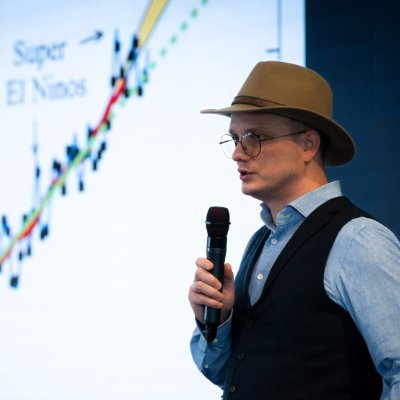
El Nino isn't separate from global warming, it IS global warming.
It's hard to believe that some experts aren't aware that El Niños have a step-change (ratchet) effect on global climate.
El Niño warming is categorically not temporary.
It is irreversible, permanent, forever.
El Niño is the engine that heats up the planet in apocalyptic surges.
This might be the single most important thing to understand about our situation.
For clarity, I added the steps to the graph...

Andrew Webber retweeted
This is so important to understand. We could carpet the entire land surface of this planet with solar panels, wind turbines and electric vehicles, and it wouldn't make a blind bit of difference. The greenhouse gases already in the atmosphere cause 10C of global warming after all amplifying feedbacks have operated and the planet has restored its energy equilibrium as required by physics.
Andrew Webber retweeted
No one is directly looking at our situation full in the face. If toxic air pollution doesn't keep pace with global warming, then global warming accelerates. Part of the doubling of the rate of warming to 0.4C is an aerosol Termination Shock. Air pollution is a highly temporary human-made sunshade which is constantly being replenished by the ongoing burning of fossil fuels. Existing GHGs cause 10C of global warming and stay in the atmosphere forever as far as humans are concerned. The idea that cutting fossil fuel emissions can help us provides a degree of comfort but it is false comfort, made-up nonsense.
"The Faustian aerosol bargain arises from the simultaneous production of greenhouse gas warming and aerosol cooling, both primarily a result of fossil fuel burning. In a 1990 article in Nature, Andy Lacis and I described this, pointing out that aerosol cooling can continue to offset a large fraction of greenhouse warming only if particulate air pollution continues to increase rapidly. But at some point fossil fuels will run out, or people will get fed up with increasing air pollution and decide to clean up particulate pollution. Then, because greenhouse gases remain in the air for centuries and aerosols fall out within days after aerosol emission stops, the payment—via rapid increase of global warming—will come due."
— James Hansen, Storms of My Grandchildren
Andrew Webber retweeted

It's hard to conceive what these changes will mean.
But they're catastrophic.

“Here we analyze the latest observational temperature records through 2025 and identify a statistically significant doubling of the global warming rate during 2011–2025 (0.40 °C per decade) compared to 1971–2025 (0.20 °C per decade). Extrapolating this accelerated rate projects a crossing of the 1.5 °C threshold by 2028, nearly a decade earlier than previous estimates.” 1/ link in reply…

Andrew Webber retweeted
The more you know ...
The 4-year running average for the global temperature anomaly is forecast to break the Paris Limit of 1.5°C over the 1850-1900 pre-industrial baseline on November 17, 2026.
We'll be covering the moment. Stay tuned!

Andrew Webber retweeted
The average on land will skyrocket from 1.8C to 2.7C in the 5 years from 2022 to 2027. A 50% increase in the temperature anomaly on land, practically in an instant.
Andrew Webber retweeted
I've never come across a climate scientist who understands our situation. Not even James Hansen. That is truly terrifying.
Andrew Webber retweeted

You have to be a special kind of stupid to believe AI is going to lead to a universal high income or a more equitable existence for the average person.
Andrew Webber retweeted

We’ve just had the hottest summer on record, farmers in despair as crops fail, and it’s going to get worse next year - no meaningful plan to tackle it from a woman who wants to be Prime Minister. Unbelievable.
#KemiBadenoch


Andrew Webber retweeted
Breaking News!
Code UFB!!!
For the first time in recorded history, the Niño 3.4 sea-surface temperature (SST) is above 30.0°C, reaching a preliminary SST of 30.06°C on October 5th.
The Niño 3.4 SST anomaly is now 3.41°C above the 1991-2020 baseline.
Everything is not fine.

Andrew Webber retweeted
Try to get your head around this.
Prior to the 2023/24 El Nino:
1.2C global + 50% = 1.8C on land
2026/27 El Nino onwards:
1.8C global + 50% = 2.7C on land
That's an increase of 0.9C on land in 5 years. Expressed another way, it's a 50% increase in the temperature anomaly. Practically overnight.
No need to wait until 2100 to experience 2.7C. It's coming next year to the land surface.


Andrew Webber retweeted

This is shocking. Graphic. Undeniable. But it will be denied because some people live in a fantasy land where man is not destroying his own home. Think about this chart. It is something that indicates there is a lot wrong with the global atmospheric system. It is expected that peak temperatures will reach an extraordinary 4.2C in December. They look like being completely off the chart. That is where this planet is going.


Andrew Webber retweeted

Después de más de 15 años estudiando la meteorología tropical y los ciclones con características tropicales, nunca pensé que fuese a decir esto:
Hará falta un estudio en mayor profundidad, pero cada vez me ronda más en la cabeza, viendo las animaciones de radar y satélite y por lo que planteaban los modelos, que el episodio extremo que ha afectado a Cataluña en las últimas horas es más consistente con un proceso de ciclogénesis tropical (que no ha llegado a su fin, aunque estaría por ver), es decir, con el verdadedo intento formación de un ciclón tropical a partir de un grupo de tormentas muy fuertes.
Y esto no tiene precedentes conocidos en el Mediterráneo. No ha sido ni es un medicane o “mini huracán” (algo que, por cierto, no existe físicamente), ni tampoco lo era lo que aparecía en los modelos.
No forma parte del modelo conceptual típico de medicane del Mediterráneo: esto es algo diferente, un proceso de formación de ciclón tropical como los que ocurren en el trópico.
Dejo esta imagen de satélite de ayer, antes de entrar: si le quito las líneas de costa, cualquier experto en meteorología tropical diría que pertenece al trópico. Y esto abriría un debate nuevo en la comunidad científica.


Andrew Webber retweeted

EXTRAORDINARY
WORLD CLIMATIC HISTORY REWRITTEN
The most extreme event the world has ever seen
Thousands of records brutalized with absurde margins in Saudi Arabia,Iran,Iraq,Kuwait,Bahrain,Oman,Emirates,Qatar,Pakistan,India,Turkmenistan,Uzbekistan,Bangladesh.
Updates coming...

