

Building safety controls into AI systems
Washington, DC
Joined February 2014
- Tweets6.8K
- Following709
- Followers800
- Likes2K








Pinned Tweet
This extinction or catastrophe mechanism should be front and center of any global AI governance effort as we look forward to the U.S.-China summit this week.


BREAKING: The US "almost started a war" against China, nearly launching an operation against a Chinese ship in the Middle East this spring, in the midst of the Iran war, after an AI-generated intelligence report falsely identified the vessel as carrying nuclear weapons components, with armed US personnel preparing to board and military aircraft already in the air before officials found the report had been produced with a chatbot, per CNN.
A special operations command analyst had used a chatbot to fuse open-source material with classified signals intelligence, then used AI again to package the result into a standard intelligence report and circulated it across the US military.
Who evaluates the machine? In one influential AI essay, the answer is: the firm, against its own business outcomes, in private.
Until the many can read the scorecard, the house is still grading itself.
New essay: datawumi.substack.com/p/the-…

ALT Until the many can read the scorecard, the house is still grading itself.
Microsoft is reportedly offering buyouts to 60,000 employees while spending up to $175bn on AI infrastructure this year.
The report doesn't say one caused the other, and voluntary buyouts are not layoffs. But the timing raises the question my latest essay asks of the whole ecosystem: as firms build "token capital," what happens to human capital, and who has a say in that trade-off?
It's a question for every large employer, not one company.

Michael Akinwumi retweeted

A 2026 Fields Medalist has made a surprising admission about AI.
John Pardon says he has used AI to find “a few nontrivial proofs” for mathematical results he believed were true but hadn't fully established.
AI has also caught subtle errors in his arguments.
But there is a catch: it still struggles with some of his most serious research questions.
His latest interview offers a glimpse into how one of the world's leading mathematicians actually works with AI.

Michael Akinwumi retweeted

Fermi to Dirac, 100 years ago today: You didn't cite my paper. ;P
(h/t Physics Archives: facebook.com/photo?fbid=1073…)

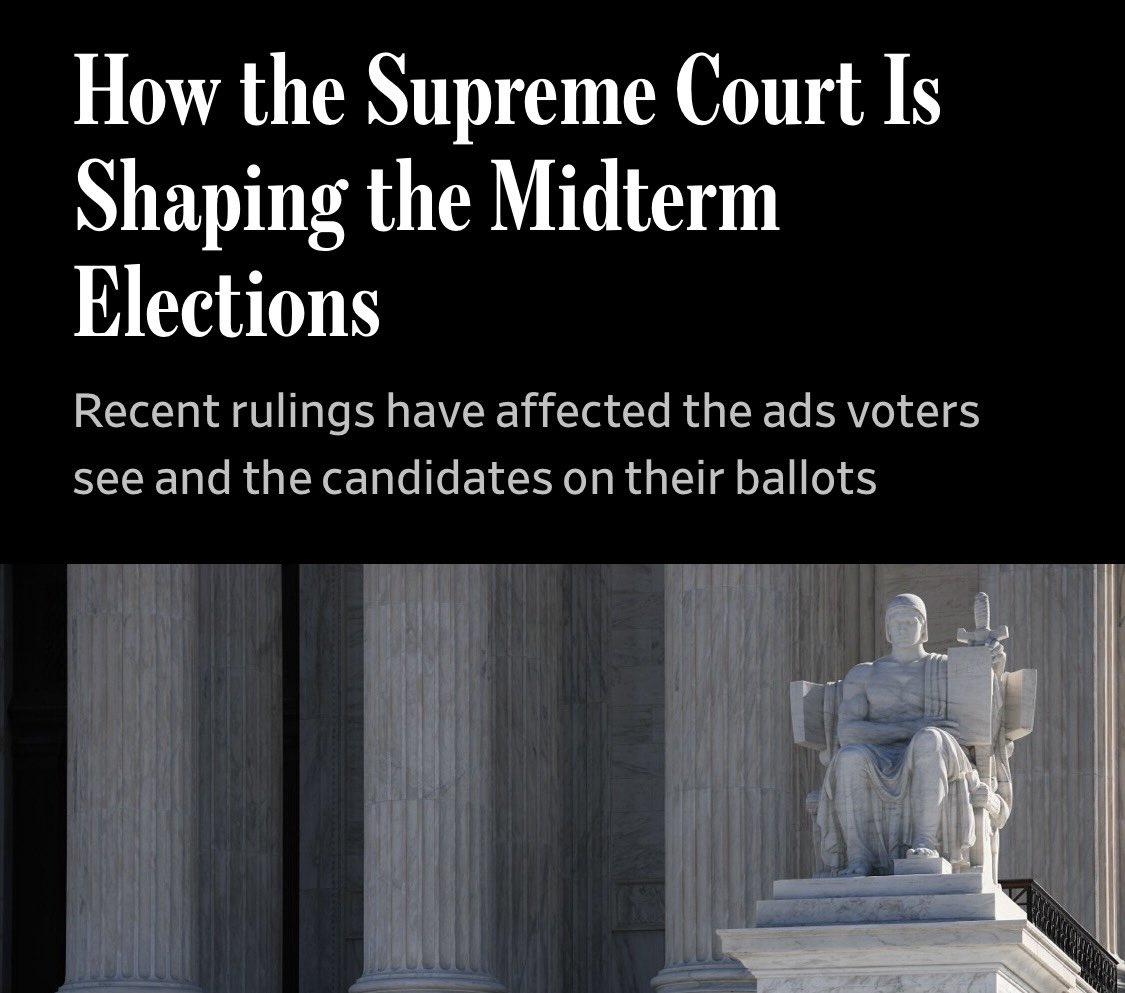
My undergraduates are learning decision trees, random forests, and gradient boosting through Andrew Martin's model of SCOTUS decisions.
This headline suggests political analytics is a viable career.
Michael Akinwumi retweeted

Black Population by State in the US:
1. 🇺🇸 Mississippi - 38.49%
2. 🇺🇸 Louisiana - 33.22%
3. 🇺🇸 Georgia - 32.29%
4. 🇺🇸 Maryland - 31.72%
5. 🇺🇸 Alabama - 26.76%
6. 🇺🇸 South Carolina - 25.5%
7. 🇺🇸 Delaware - 23.66%
8. 🇺🇸 North Carolina - 21.61%
9. 🇺🇸 Virginia - 20.76%
10. 🇺🇸 New York - 17.6%
11. 🇺🇸 Tennessee - 16.84%
12. 🇺🇸 Florida - 16.36%
13. 🇺🇸 Arkansas - 16.02%
14. 🇺🇸 Illinois - 15.35%
15. 🇺🇸 Michigan - 15.18%
16. 🇺🇸 New Jersey - 14.8%
17. 🇺🇸 Ohio - 14.5%
18. 🇺🇸 Connecticut - 13.22%
19. 🇺🇸 Texas - 13.02%
20. 🇺🇸 Pennsylvania - 12.84%
21. 🇺🇸 Missouri - 12.64%
22. 🇺🇸 Nevada - 11.32%
23. 🇺🇸 Indiana - 11%
24. 🇺🇸 Massachusetts - 9.75%
25. 🇺🇸 Rhode Island - 9.5%
26. 🇺🇸 Kentucky - 9.49%
27. 🇺🇸 Oklahoma - 9.33%
28. 🇺🇸 Minnesota - 8.5%
29. 🇺🇸 Wisconsin - 7.51%
30. 🇺🇸 Kansas - 7.48%
31. 🇺🇸 California - 7.16%
32. 🇺🇸 Nebraska - 6.3%
33. 🇺🇸 Arizona - 6.08%
34. 🇺🇸 Washington - 5.79%
35. 🇺🇸 Colorado - 5.48%
36. 🇺🇸 Iowa - 5.27%
37. 🇺🇸 Alaska - 5.17%
38. 🇺🇸 West Virginia - 4.86%
39. 🇺🇸 North Dakota - 4.11%
40. 🇺🇸 Hawaii - 3.68%
41. 🇺🇸 New Mexico - 3.36%
42. 🇺🇸 Oregon - 3.21%
43. 🇺🇸 South Dakota - 3.13%
44. 🇺🇸 New Hampshire - 2.55%
45. 🇺🇸 Maine - 2.45%
46. 🇺🇸 Vermont - 2.23%
47. 🇺🇸 Utah - 1.95%
48. 🇺🇸 Wyoming - 1.65%
49. 🇺🇸 Idaho - 1.31%
50. 🇺🇸 Montana - 1.12%
Source: World Population Review

“Mathematically, an infinite supply of all goods and services would indeed make everything free. … Practically, however, such a cornucopia is almost inconceivable.” Yet Elon Musk, the world’s wealthiest man, believes in AI-induced abundance. @grok explain the contradictions in Elon’s paradox.

What “an uncomfortable question about ai-powered cyber-security: how can defenders get fixes to users, without tipping off enemies in the process?”!
Another Agentic AI seems to be a reasonable answer.
@grok isn’t that right?

Michael Akinwumi retweeted

Two critical vulnerabilities have been identified in PHP, a widely used programming language that powers websites and web applications. These vulnerabilities (CVE-2026-109618 and CVE-2026-109619) could allow malicious cyber actors to remotely execute code in PHP core, potentially compromising sensitive data and networks.
The FBI urges organizations to take the following steps now:
➡️ If an immediate update is not feasible it is recommended that organizations take the system offline until it can be fully mitigated.
➡️ Immediately update affected PHP installations following the guidance on php.net. Inventory where PHP runs in your environment, prioritizing internet-facing systems and vendor products that bundle PHP.
➡️ Monitor web servers for suspicious activity, including PHP processes unexpectedly launching command shells or downloading files. Ensure appropriate process-monitoring capabilities are in place to help identify potential exploitation.
➡️ If you find signs of compromise, isolate affected systems, preserve your web server and PHP logs, and report it to your local FBI field office or ic3.gov. Those reports help us identify the actors involved and warn other organizations before they become victims.
For the latest information, follow PHP’s announcement on php.net, CERT-EU Security Advisory 2026-018, and CISA’s Known Exploited Vulnerabilities catalog.

ALT Critical vulnerability alert for PHP Core with CVE-2026-109618 and CVE-2026-109619, CVSS score 9.2, urging immediate patch and threat hunting.

Michael Akinwumi retweeted

MIT announces the MIT for America initiative. The effort aims to help U.S. learners from kindergarten to community college, with an emphasis on math, making, and the constructive use of AI. news.mit.edu/2026/mit-americ…

Michael Akinwumi retweeted

OpenAI’s new proof of the quasi-Riemann hypothesis is, as Jared Duker Lichtman of Stanford University put it, “the most significant AI-for-math achievement so far, by quite a margin.”
quantamagazine.org/ai-proved…

Michael Akinwumi retweeted

"Mathematical Theory of the Transformer" is an extensive, 825-page mathematical monograph exploring the theoretical foundations of Transformer architectures.
It covers a remarkable range of topics, including embeddings and positional encoding, self-attention and multi-head attention, matrix decompositions, linear algebra, spectral analysis, information geometry, training dynamics, redundancy, optimization, and incremental Transformer architectures.
This is an advanced, mathematically rigorous read for anyone interested in understanding the mathematical structures underlying Transformer-based AI systems, including modern generative AI.
doi.org/10.5281/zenodo.20199…

Albertans spoke last night. The world now watches to see what the province and its neighbor to the south make of the referendum’s outcome.

Michael Akinwumi retweeted

Mathematics algorithm SVM (Support Vector Machine) is a classic nonlinear classifier in Machine Learning.
Download 640-page PDF "Learning with Kernels: Support Vector Machines, Regularization, Optimization, and Beyond" here: mcube.lab.nycu.edu.tw/~cfung…


Michael Akinwumi retweeted
A new report published by Quanta Magazine on 19 October 2026 describes significant progress in the independent examination of an AI-generated proof of the quasi-Riemann hypothesis.
Leading number theorists, including Peter Sarnak, Maksym Radziwiłł, and Alexander Dunn, have been closely studying the argument. According to the report, experts increasingly believe that the proof is correct, although a complete mathematical assessment is still underway.
The classical Riemann hypothesis, one of mathematics' most famous unsolved problems, asserts that every nontrivial zero of the Riemann zeta function lies on the critical line Re(s) = 1/2.
The AI-generated argument addresses a weaker but still significant result, claiming that every nontrivial zero satisfies
1/12 < Re(s) < 11/12.
If established, this would narrow the region in which nontrivial zeros can occur, bringing mathematicians closer to the prediction of the original hypothesis.
After studying the 49-page manuscript, Radziwiłł reportedly found that he could summarize its essential argument in approximately half a page.
Sarnak has also redirected a university course toward examining the proof, reflecting the growing mathematical interest in the result.
Nevertheless, important questions remain. The 49-page argument has not yet been formally verified in Lean. A separate AI-generated argument claims the stronger bound
1/8 < Re(s) < 7/8
and is accompanied by a Lean formalization, although researchers are currently concentrating on understanding the shorter proof.
The full Riemann hypothesis remains unsolved, and the mathematical community has not yet reached a final consensus on these AI-generated results.
Even so, the ongoing independent examination marks a noteworthy development in the emerging relationship between artificial intelligence and advanced mathematical research.

Michael Akinwumi retweeted
Terence Tao has published a detailed mathematical exposition of an AI-generated argument addressing the longstanding Landau–Siegel zero problem, one of the important unsolved problems in analytic number theory.
Unlike the recently reported investigation of an AI-generated argument concerning the quasi-Riemann hypothesis, this development focuses on a shorter, nine-page argument that claims to rule out exceptional real zeros of Dirichlet L-functions.
Tao examines a simplified formulation developed by mathematician Ben Green, showing how the argument brings together ideas from algebraic number theory, polynomial interpolation, and the geometry of numbers.
The Landau–Siegel zero problem concerns the possible existence of exceptional real zeros of Dirichlet L-functions extremely close to s = 1. For decades, the possibility of such zeros has complicated important estimates concerning the distribution of prime numbers, particularly primes in arithmetic progressions.
A related reconstruction by mathematician William Banks establishes the explicit bound
(1 − β) log q ≥ 0.003,
where β is a real zero of a primitive real Dirichlet L-function with conductor q ≥ 3.
This inequality gives a quantitative restriction on how closely such a zero can approach 1 as the conductor increases. It does not, by itself, establish the complete nonexistence of Landau–Siegel zeros in every conventional sense of the term.
The AI-generated argument has now prompted substantial mathematical reconstructions by three researchers. William Banks submitted a detailed proof with explicit numerical constants on 11 October, Bryce Kerr followed with a simplified argument on 15 October, and Ben Green presented an alternative formulation using polynomial methods, revised on 18 October.
Tao's exposition, published on 19 October, connects these developments and explains the mathematical mechanism underlying the argument. He also acknowledges using the SAIR Open Math model to help understand the preprints.
The significance of this development lies not only in the mathematical claim but also in the independent scrutiny it has attracted. Several established mathematicians have examined, reconstructed, and simplified an argument originating from AI, making its essential ideas more accessible to the wider mathematical community.

Michael Akinwumi retweeted

JPMorgan has deposited $38 million with the Central Bank of Nigeria as it moves closer to securing a banking license in Africa’s most populous nation, according to sources bloomberg.com/news/articles/…

How is this anything other than an attempt to turn paper wealth into moral standing, and to build a political base for AI and the infrastructure behind it?
AI Developers and Deployers should understand this: building a constituency does not build solidarity.
A share in the upside is not a share in the harm.

ALT Anthropic and SoaceX attempt to create political constituency for AI.
Take No Machine’s Output for It.
AI is getting better at producing knowledge we cannot fully follow. The skill that will matter most is deciding what to trust.
Read more: datawumi.substack.com/p/take…
