
RS @GoogleDeepMind | CS PhD @stanford | BS @PKU1898
CA
Joined January 2022
- Tweets114
- Following360
- Followers444
- Likes373



Cool!

We are out of stealth! As AI writes more code, we're building tools to prove programs meet precise requirements, with Lean proofs anyone can independently check. Let's make verified software the norm in every language and application.
Come take a look: andtruth.com
1
4
350
Anjiang Wei retweeted

I did say we'd be releasing our models periodically...introducing Gemini 4 Carbon, our next frontier model.
Following Argon's release just two weeks ago, Carbon shows the pace at which we’re pushing the frontier, it ranks #1 on the recently updated v5.0 of @ArtificialAnlys Intelligence Index at 59. It also leads across key cybersecurity evaluations scoring 88.2% on SEC-bench Pro for finding vulnerabilities, 54.8% on ExploitGym for exploitation, and 71.0% on CWE-bench for patching.
We’re seeing significant improvements in long-horizon tasks even compared to Argon, and we’ve strengthened frontier safeguards.
As we did with Argon, we’re going to roll it out gradually + responsibly. Some trusted cyber defenders will get access starting this week. We'll be expanding it to more partners through our Fairwind Program, ahead of wider availability soon, so hang tight!

Anjiang Wei retweeted

We trained an imaginative agent! ✨
Agima: an omni agent that plans by imagining futures.
𝗦𝗙𝗧: Directly generalizes to harder tasks! 𝟮%→𝟰𝟬%, beats GPT-5.6 Sol (𝟮𝟬%).
𝗥𝗟: New ways to imagine emerge! Imagines a second plan only if the first one fails (𝟯𝟮%→𝟭𝟬𝟬%).


Interesting work!

Introducing Next-Concept Models (NCMs), a new paradigm for language generation that is significantly faster and more data efficient than diffusion models.
How it works:
1) First we learn a series of compressed representations of text from coarse to fine-grained, aka ‘concepts’. This step is done once, similar to training a tokenizer.
2) At inference, we generate text going from a coarse to fine hierarchy via these ‘concepts’. A transformer predicts each level of the hierarchy sequentially, but the codes within each level are generated in parallel.
Compared to strong diffusion language models, NCM achieves:
Up to 31× faster generation on downstream tasks like summarization and machine translation.
10-21× faster generation across TinyStories, LM1B, and OpenWebText, using 3-5× fewer training data.
On reasoning tasks like Sudoku, NCM outperforms both autoregressive and diffusion baselines with fewer sampling steps.
Lead authors: @KumbongHermann & @ishanskhare, together with a great team!

5
287
Glad to be acknowledged!

My favorite ideas from @COLM_conf 2026: 10 papers that challenge how we think about AI progress. 👇
A 0.6B model solves 72% of 25×25 Sudoku.
A robot can succeed 10 times in practice—and still fail the real test.
The same AI model can rank differently depending on whether it uses a GUI or a terminal.
The common thread? Structure may matter as much as scale.
🔟 ideas worth knowing:
1️⃣ Message Passing (CMU, oral)
Give each reasoning thread a persistent state and let it message only its (k) neighbors. A fine-tuned 0.6B model reaches 72% on 25×25 Sudoku, versus 20% for GPT-5 Pro without tools. Different setups, not a fair head-to-head—but a striking result for structured reasoning.
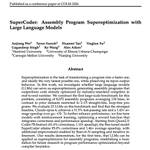
2️⃣ SuperCoder
RL on measured runtime turns a 7B coder into an assembly superoptimizer: 95% of rewrites pass the available tests, with 1.46× speedup over gcc -O3. The catch? Tests + a stopwatch can reward removing stack canaries.
3️⃣ HyperThink
What if reasoning lived in weights, not a long token trace? A hypernetwork generates a tiny, question-specific bias update. VQ adds 6.5 points of Pass@5 on MATH-500.
4️⃣ ORCA
A 5.1K-parameter probe learns when to stop reasoning. Result: 47.5% fewer reasoning steps in-distribution. Distribution shift remains the catch.
5️⃣ AHR
One scalar per attention head beats LoRA by 6.7 points with just 10 labels. The edge disappears at around 100.
6️⃣ Meta-Harness
Let Claude Code optimize the harness itself—not just read agent traces. It beats ACE by 7.7 points using 4× less context. Summaries can hurt.
7️⃣ Co-Director
A bandit searches 36 creative configurations while keeping Veo 3.1 as the generator. Orchestration—not a bigger video model—drives a major benchmark improvement.
8️⃣ SEAR 🤖
Skill libraries can help one robot agent and hurt another. Ten practice wins ≠ generalization.
9️⃣ CollabSkill (Stanford, oral)
The interface changes the leaderboard: Claude Cowork can outperform Claude Code in human-agent collaboration, even when autonomous benchmarks tell a different story.
🔟 Epistemic Diversity
Ten models collectively cover only 2–24% of valid reference answers. Ask for a “well-known physicist,” and Llama 4 Scout picks Hawking 100/100 times.
💡 My takeaway: AI progress isn't only about adding parameters. It's also about how models communicate, where they reason, when they stop, what they remember—and how we evaluate them.
Which result surprised you most?
We discuss ideas like these every Saturday at @saturdayrobotic Saturday Robotics 🤖
👉 luma.com/saturdayrobotic
#COLM2026 #LLM #AIAgents #Robotics


12
578
Check it out! Real problem, surprisingly good results.

AutoResearch agents keep burning tokens after they stop making progress. 💰😭
From authors of ACE and Meta-Harness: Introducing Stateless Language Agents (SLAs). Stateful search, stateless agents. Advancing the performance-cost Pareto frontier of RSI.
Across 9 tasks, up to 1B tokens:
- Best final result on every task 📈
- 14.5× fewer tokens to match the best kernel baseline 🚀
- Advisor (the “coordinator”) uses < 0.6% of total tokens 🫣
📑 Paper: arxiv.org/abs/2610.07625
NOT JUST HIGHER NUMBERS. Some more surprising findings in the thread below! 🧵 #LLM #AI #RSI #Agent

My collaborators @JOYSUN200402, @TarunSures41845, and I will be presenting Quokka at COLM 2026.
🗓️ Wednesday, Oct. 7, 11:00 AM - 1:00 PM
📍 Imperial Ballroom, Poster #55
Come chat about LLMs for program verification!
colm.cc/virtual/2026/poster/…

Excited to share that our paper, “Quokka: Accelerating Program Verification with LLMs via Invariant Synthesis,” has been accepted to #COLM2026! 🎉
Paper: arxiv.org/pdf/2509.21629
Code: github.com/Anjiang-Wei/Quokk…

My collaborator @TarunSures41845 and I will present SuperCoder at COLM 2026!
🗓️ Tuesday, Oct. 6, 11:00 AM - 1:00 PM
📍 Grand Ballroom, Poster #129
Come chat about code RL and making programs faster!
colm.cc/virtual/2026/poster/…

Excited to see the progress on cyber and coding!

Lots of discussion out there about our next model(!), so I wanted to give an early look as soon as possible. Introducing Gemini 4 Argon!
It shows frontier performance in complex workflows, cyber defense and software engineering. Teams are using it extensively at Google, from coding to quantum computing, great feedback.
Here’s a look at the benchmarks:

2
11
683
Anjiang Wei retweeted

⚡ Towards the Next FlashAttention
🧪 Squeezing out performance from GPUs now requires programming at the assembly level (like in FlashAttention/MLA/KDA etc). Can AI agents do it?
📏 That’s the question behind 𝗣𝗧𝗫𝗕𝗲𝗻𝗰𝗵. On H100 and B200, we ask models to write matrix multiplication and attention kernels using architecture-specific PTX: assembly-like instructions that expose each GPU’s specialized hardware (tensor cores, TMA, TMEM, ...).
🔍 PTXBench check three things:
• Is the answer right?
• Is the kernel fast?
• Did the requested instructions actually run?
🔴 The gap exists. An LLM can use the right instructions but still produce a slow kernel. Attention backward is especially hard, and no model we tested consistently matches expert libraries across the suite.
🛠️ We also built 𝗙𝗶𝘅𝗶𝘁, an SFT recipe that trains on the model’s own failures. Each example pairs a broken kernel and profiler feedback with a teacher repair and synthesized reasoning.
🟢 After Fixit, Qwen3.6-27B solves Hopper GEMM and attention tasks it couldn’t solve before. New shapes and attention variants are still hard.
🧠 Big questions remain:
• Should agents write PTX directly, or will GPU DSLs scale better?
• Correct, fast PTX kernels are hard to collect. What’s the minimal supervision required to train a PTX expert?
• Can a model trained on one GPU architecture generalize to another?
• How do we get from the right instructions ran to this thing is actually fast?
🚀 Getting PTX right is step one. Making it fly is what's next.
📖 Paper & Blog: arxiv.org/pdf/2608.17379 & zhang677.github.io/blog_md/p…
💻 Code: github.com/zhang677/PTXBench
🍾 Weights + data: huggingface.co/collections/G…
Amazing collaboration with @yi_xin_dong Chengze Fan @zz30gs Yueming Yuan @ShaoweiZhu95pu and @KunleOlukotun! Huge thanks to the generous support from @sgl_project @tinkerapi and Gemini Academic Program Award!
Check it out!

In my spare time, I wrote a TPU library translating a majority of video models from PyTorch to Jax.
💿Source code: github.com/FlyingGiraffe/vid…
📑Tech report: arxiv.org/abs/2609.18077
🧊Quick try with PyPI: pypi.org/project/vidax/
Great thanks to @Google TPU Research Cloud (TRC)!
Awesome work!

Diffusion LLMs and speculative decoding promise much faster agents. Yet agents need long contexts, and training on them is painfully slow.
Introducing Context-Sharded Block Parallelism (CSBP), a new distributed parallelism strategy unlocking significant training efficiency for diffusion LLMs, with speedup gains growing with context length 🚀
⚡ 7.59× faster DFlash2 speculative decoding drafter training
⚡ 1.61× faster block diffusion fine-tuning
⚡ 1.33× faster autoregressive → block diffusion adaptation
With the same GPU hours, models trained with CSBP score higher on SWE-bench Verified and Terminal-Bench Lite 👑
Open-sourced in Turbo-dLLM, our new optimized distributed training library.
Advised by @Azaliamirh and with an amazing team: @PranshuChatur11 @hangoo_kang @pshroff_ @ishanskhare @KumbongHermann

6
517
Anjiang Wei retweeted

I think this comes down to a classic systems tradeoff: generality vs. specialization. vLLM/SGLang cover a huge space of models × hardware × workloads. It’s hard for a single system to be best at every combination, and focusing on a narrower set gives you more room to optimize.
Historically, the challenge was engineering cost: optimizations for one configuration often need substantial rework for another. Coding agents are lowering that cost, which I suspect is one reason we’re seeing more specialized inference engines.
Fragmentation is worth discussing, but so is the value of specialization. Many of these engines can complement vLLM/SGLang, especially when users need more performance from a specific setup. My 2 cents.

Anjiang Wei retweeted
We built LithosAI to make every step of your agent faster. The public API is now live. Try it on your own workloads and show us what you build. 🚀

LithosAI now has the highest speed, lowest latency, and lowest price inference for Kimi K3. And now you can test it yourself with our public API.
Building coding agents, SRE workflows, or voice AI? Put LithosAI to the test: console.lithosai.cloud

Anjiang Wei retweeted

Harbor Adapters and Harbor-Index
arxiv.org/pdf/2609.04298
1+year work, 120+contributors, 300+PRs, 10+ funding partners.

Anjiang Wei retweeted

HUGE day for video understanding. 🔥
Agentic video is a product now, and the core idea is the one we introduced in VideoAgent (Mar 2024): let the model observe, think, and decide which frames to look at next.
This is why I love this field. Nothing beats watching your idea become real at the frontier of video intelligence. @Zhang_Yu_hui @orr_zohar @yeung_levy
Congrats to the Gemini team 🙌
arxiv.org/abs/2403.10517


Anjiang Wei retweeted

Introducing Gemini 3.8 Flash, another jump in Gemini's agentic + coding capabilities, and our 3rd updated Flash model in only 6 weeks...
This model has been a ton of fun to work with, excited to see what you all think!


