

4D Capital Management. “If you take care of the losses, the profits will take care of you". My investing diary. No advice. Prolific tech inventor.
California, USA
Joined December 2012
- Tweets6.1K
- Following522
- Followers556
- Likes20.2K





August Wu retweeted

China is one of the least export dependent economies the world.
* It’s even less export dependent than the numbers below suggest.
Different discussion… it might blow your little EU mind. 😈


August Wu retweeted

China’s clean technology dominance reshapes global net zero transition
Partnerships with China, not protectionism, will bring affordable, interoperable and equitable global decarbonisation and energy security
360info.org/chinas-clean-tec…
@PeterNewmanCUSP @ProfRayWills


August Wu retweeted

The Day the Car Industry Changed Forever
Think about this: just six years ago, China imported almost as many cars as it exported. Today, for every car China brings in, it sends nearly 30 out. That's not a slow shift. That's a landslide.
What makes it even more extraordinary is that this chart captures only the final six years of a transformation decades in the making. China spent roughly 20 years building something much of the West underestimated: not simply factories, but an entire industrial ecosystem around the future of mobility. Batteries, critical-material supply chains, electronics, software, charging infrastructure, manufacturing capacity and automation.
Industrial policy built the arena. Then something very different happened inside it.
State-enabled. Market-selected.
China created arguably the most brutally Darwinian automotive market on Earth. Hundreds of companies entered, fought vicious price wars, compressed development cycles, experimented, failed, consolidated and iterated at extraordinary speed. If you're too expensive, too slow or technologically behind, you don't survive.
That's important, because the companies now expanding globally aren't simply Chinese companies protected by industrial policy. Increasingly, they're the survivors of an industrial pressure cooker, and they're now escaping that ecosystem into the rest of the world.
The Horseless Carriage Mistake
When automobiles first appeared, people called them "horseless carriages." It made perfect sense. We tend to understand new technologies through the thing they're replacing. But the automobile wasn't ultimately a carriage without a horse. It became an entirely new technological platform that reorganised cities, industry, energy and human mobility.
I think we're making the same mistake with EVs. An EV isn't simply a car with a battery, any more than a smartphone is a telephone with a screen. It's becoming a battery-powered computing platform where software, electronics, AI, sensors, autonomy and increasingly robotics converge.
China understood this transition early and built the industrial ecosystem around it. Much of the Western automotive industry spent those same years protecting the economics of the old platform: combustion engines, legacy factories, dealerships and decades-old supply chains.
Now those two worlds are colliding.
Remember Nokia, Kodak and Blockbuster?
They weren't stupid companies. They were dominant companies optimised for technologies and business models that were being replaced underneath them. That's the danger facing the legacy auto industry now.
Foreign manufacturers have lost enormous market share inside China, while Western manufacturers are increasingly partnering with Chinese companies for EV platforms, batteries, software and technology they once expected to lead themselves.
The direction of knowledge transfer is reversing. The teachers are becoming the students.
And this isn't happening over generations. Look again at that chart: six years. China went from importing and exporting roughly the same number of vehicles to exports outnumbering imports by almost 30 to 1.
Now the survivors go global
Tariffs can slow this down. Trade barriers can redirect it. But they can't make the underlying industrial capability disappear. Chinese manufacturers are expanding production across Europe, Southeast Asia and other markets, increasingly manufacturing inside the very regions whose incumbents they're challenging.
I suspect the next decade will bring enormous consolidation. Some Western manufacturers will successfully reinvent themselves. Others will merge, partner with Chinese companies, license their technology or increasingly become assemblers of platforms and components developed elsewhere. Some won't survive.
Because this isn't simply China becoming better at making the automobile we already know. The definition of the automobile itself is changing.
Twenty years of industrial policy built the ecosystem. Brutal domestic competition performed the selection. Electrification changed the technological platform. Scale drove costs down. And now the survivors are going global.
Nokia. Kodak. Blockbuster.
Different industries. Same disruption curve. Except this time we're watching it happen to one of the largest industrial sectors on Earth.
We're not watching a downturn. We're watching the end of an era.


August Wu retweeted

Andrej Karpathy’s 1-hour Stanford lecture on AI engineering is one of the best explanations I’ve seen of how AI systems actually work.
The progression is simple:
10% → LLM
30% → Prompt
50% → Agent
70% → Loop
100% → Graph
The key takeaway:
AI engineering isn’t just about writing better prompts.
It’s about building systems around models — giving them context, memory, tools, feedback loops, and data flows.
“Delete everything, keep Graph.”
Definitely worth watching if you’re building with AI agents.
Watch → Bookmark it
August Wu retweeted

Google Brain founder Andrew Ng:
"Prompting will be dead in 6 months"
"Loops and graphs are replacing it"
In just 2 hours, he shows how to build agents that work, learn, and improve on their own
LLMs → Agents → Loops → Graphs → Self-Improving Systems
The first 15 minutes alone are more valuable than most $500 AI courses
Most people are still learning prompts while AI engineering is already moving beyond them
Watch the lecture first
Then read the full guide to loops and graphs below ↓


August Wu retweeted

THE UNITED STATES’ A.I. REVOLUTION is powered by a strategy of giving massive pay packets to scientists born and educated in China, statistics show.
The US is running a costly brain-drain operation to grab China’s AI skills—and many Chinese are taking up the offers.
“Only 11% of top China-educated AI researchers remain working in China — down from 16% in 2019,” said a report by Marco Polo Talent Tracker. They've been lured to the US.
.
AI MIRACLE 'IMPORTED'
For specialists, salaries range from a million US dollars a year to 100 times that. One China-born researcher, Tony Wu Yuhuai, recently spent US$70 million on a “mega-mansion” in California.
“Of China-educated AI researchers, 72% now work at institutions in the United States. America's AI advantage isn't homegrown — it's imported,” the study said. (Link provided.)
The US’s dominance in AI is not based on technological ability, but cash—the ability to buy talent born and educated in China.
.
MINORITY FROM U.S.
Only 24% of people in AI research in the US are from the US, while 38% are from China, said the study, which tracked the origins of scientists making breakthrough research in the AI field. The actual figure would be higher if ethnic Chinese who are first generation migrants to the US were included.
The US is using its wealth to create an AI brain drain in China. “The brain drain continues despite massive domestic investment,” the report said.
While most Chinese students at US universities return to their homeland, the same is not true in the AI field, thanks to financial inducements from US employers.
.
CURIOUS FAILURE OF BRAIN DRAIN EFFORT
However, the costly program has failed to kill China’s AI efforts.
The most talked-about rising stars of AI worldwide, including Z. ai, DeepSeek, Qwen and Kimi, are all created by Chinese staff born and based in China.
While staff may be paid a fraction of what they would earn in the US, other factors come into play. Compared to the safe, calm societies of China, the US is a dangerous, gun-ridden place with a dysfunctional society overseen by a rogue government creating conflicts worldwide.
.
CLUES TO THE FUTURE
Furthermore, the US tech scene is based on a bubble expected to burst at any moment.
Then there’s the open hostility of the US government aimed directly towards the Chinese students that California needs to keep its tech companies going. The China-hate efforts now running in Congress make the legendarily vicious Joe McCarthy of 1950s fame look tolerant.
One tech specialist who is staying in China told this reporter: “Smart players don’t look just at what’s happening today. We focus on the future.”
.
.

August Wu retweeted
Andrej Karpathy revealed what survives after prompting
"Prompting is fading away
Delete everything else and keep the graph"
In a 1-hour lecture, he explains how to build graphs and why they are the layer everything ends up becoming
LLMs → Prompts → Agents → Graphs
Most people are still trying to perfect prompts
The graph is the part that survives
Everything before it is just a step in the process
This free lecture is worth more than most $500 graph engineering courses
Watch it today
Then read the full guide on graphs below
August Wu retweeted

Andrew Ng just released a 1-hour course on AI engineering from start to finish
LLM → Prompts → Agent Teams → Graphs
0% → 0:17 - understanding LLMs from scratch
30% → 20:02 - how to actually write prompts
55% → 29:03 - building your first team of agents
100% → 47:19 - the final stage: graph-based systems
This is 30 years of AI engineering compressed into a single hour
From the person who helped shape the field
Most AI courses don't cover this much material
Watch it today
Then read the guide below and learn how to build graphs ↓


August Wu retweeted

今晚别刷Netflix了。
去看这个斯坦福2小时34分钟的讲座。
这是我见过最清晰、端到端讲透ChatGPT和Claude到底怎么建出来的课。
从Tokenization和BPE开始,一路到Transformer架构、训练管线、Next-token解码。
不管你是从没写过一行AI代码,还是天天在ship Agent,看完都会把很多“原来如此”的点一次打通。
真正核心就这几层:
1文本怎么变成模型能吃的数字(BPE tokenization)
2语言模型本质就是在预测下一个token
3Transformer怎么用Attention做消息传递
4训练时用NLL loss把整条序列概率拉高
5生成时怎么一步步解码出来
大多数人花好几年才拼出的全景图,这节课直接给你画完。
把时间空出来,这可能是你这个月最值的一堂课。
August Wu retweeted

目前网上最好的 AI 公开课:加州伯克利大学宋晓冬教授的Agentic AI:
这是Berkeley LLM Agents系列的第三期。
课程由Dawn Song (@dawnsongtweets ) 和 Xinyun Chen主讲,汇聚OpenAI、NVIDIA、Microsoft、Google DeepMind等专家,分为系统设计、训练评估、实际应用及具身安全四大模块,全部讲座和幻灯片公开可用。
爱学习的你 今天必须收藏这个!
agenticai-learning.org/f25


August Wu retweeted

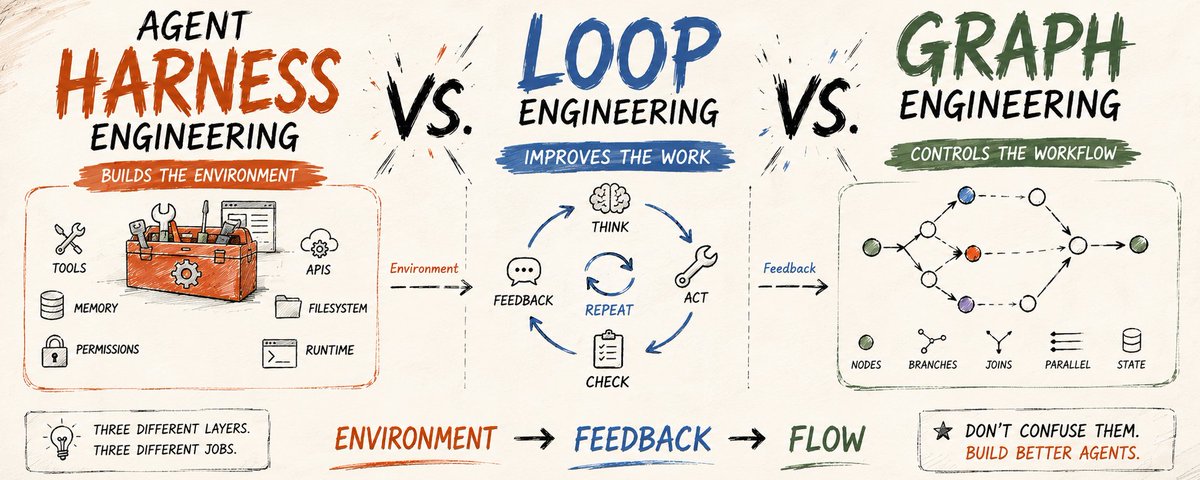
This paper is f*cking brilliant
A computer science paper applies classical scheduling theory to LLM agents, replacing unstructured agent loops with Graph Engineering (Graph Harness)
The result: explicit DAG scheduling and a 3-layer execution architecture eliminate unbounded retry loops while proving node termination and soundness
The crazy part is how scheduler theory exposes the flaw of standard agent loops
Agent loops act as single-ready-unit schedulers with opaque context policies, whereas Graph Harness lifts execution into immutable multi-ready-unit DAGs with strict escalation recovery
Most developers let an LLM dynamically decide its next step inside a growing context window
This architecture converts agent execution into an inspectable, mathematically sound DAG scheduler
Read the complete paper + article below
Bookmark it for future reference


August Wu retweeted

Ilya Sutskever 认为吃透30篇AI奠基论文,就能掌握人工智能绝大多数核心精髓。最大难点在于看得懂公式,却难以落地成代码。
开源项目 Sutskever 30 补齐了这一环:纯NumPy从零实现全部30篇经典论文,不依赖深度学习框架,Notebook 直接运行。从循环网络、Transformer 到 VAE、神经图灵机全部覆盖。
适合想要弄懂底层逻辑,拒绝只会调用API的开发者。
github.com/pageman/sutskever…

August Wu retweeted
GOOGLE CEO SUNDAR PICHAI: "IF YOU DON'T LEARN HOW TO ORCHESTRATE AGENTS NOW, YOU'LL SPEND 2027 CATCHING UP TO PEOPLE WHO STARTED TODAY."
30 minutes on why the best engineers stopped writing code line by line and started orchestrating agents instead.
Most people think building an agent requires an engineering degree.
It doesn't.
It requires one guide and one afternoon.
Watch the interview. Then read the article below.
One guide. One afternoon. That's all it takes.
August Wu retweeted

Sam Altman:
"AGI in 2 years. Prompting won't survive it.
Loops and Graphs will"
In 20 minutes he explains why the only engineers who won't feel it are the ones building Loops and Graphs.
The missing piece most people miss: AGI doesn't make you obsolete. Prompting does.
Watch it, then read the full guide on loops and graphs below

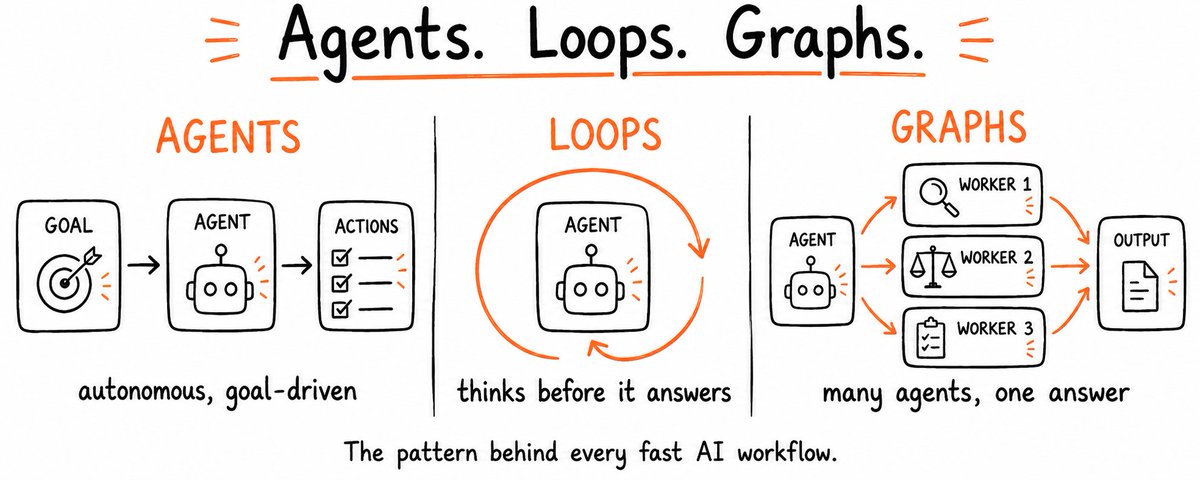

August Wu retweeted
Andrej Karpathy spent 8 years at OpenAI and Tesla
Last week, he packed everything he knows into one free 2-hour lecture
Agents → Loops → Graphs → Self-Improving Systems
People pay $15K for bootcamps that teach less than this
This lecture is better than most paid AI engineering courses
You probably don't have 2 hours right now
Don't let this disappear from your feed
Watch it
Then read the guide below
Readers added context they thought people might want to know
The lecture shown in the video, 'How I use LLMs,' was actually released by Andrej Karpathy on February 27, 2025, not 'last week'.
youtube.com/watch?v=EWvNQj…