
phd @umdcs , interp. previously: research @farairesearch, @AdobeResearch, @MSFTResearch; bachelors @iitbombay. lets understand ai a bit better!
College Park, MD
Joined May 2018
- Tweets646
- Following155
- Followers383
- Likes1.1K






The best side-effect of doing a PhD is getting rid of this mindset. Of course, doing a startup also works but the people who gravitate towards that don't have this mindset in the first place.

Sriram Balasubramanian retweeted

labs are def RLing on mech interp guys if you think otherwise you’re smoking something


We asked GPT-6 Astra to edit Qwen3.5-0.8B weights to improve math.
It directly changed only 0.016% of weights, fixing 0.8B's reasoning loops & improving math up to 6x and even instruction following 3x, without gradients or training.
We call this Weight-Space Programming: frontier LLMs can now natively read/write neural network weights! 🧵
Blog: rikiyat.github.io/blog/weigh…

Readers added context they thought people might want to know
LLM was given weights explicitly as text in prompt and used code/forward passes (per authors' logs) to ablate Qwen looping direction, a known thinking-mode issue per model card. Primarily fixed repetition in that mode, not general 'natively' improving weights/math.
rikiyat.github.io/blog/weight-sp…
github.com/RikiyaT/lm_und…
huggingface.co/Qwen/Qwen3.5-0…
huggingface.co/RikiyaT/Qwen3.…
Even after actually reading the paper, this is still quite surprising to me. I actually don't think OpenAI trained Astra for interpretability, so the generalization is pretty astounding.
We asked GPT-6 Astra to edit Qwen3.5-0.8B weights to improve math.
It directly changed only 0.016% of weights, fixing 0.8B's reasoning loops & improving math up to 6x and even instruction following 3x, without gradients or training.
We call this Weight-Space Programming: frontier LLMs can now natively read/write neural network weights! 🧵
Blog: rikiyat.github.io/blog/weigh…
Readers added context they thought people might want to know
LLM was given weights explicitly as text in prompt and used code/forward passes (per authors' logs) to ablate Qwen looping direction, a known thinking-mode issue per model card. Primarily fixed repetition in that mode, not general 'natively' improving weights/math.
rikiyat.github.io/blog/weight-sp…
github.com/RikiyaT/lm_und…
huggingface.co/Qwen/Qwen3.5-0…
huggingface.co/RikiyaT/Qwen3.…
1
7
386

ETH IS FALSE AGHHHHHHHHHH

We are announcing three new discoveries in mathematics, computer science, and physics about harmonic analysis, complexity theory, and quantum field theory.
openai.com/index/building-sc…

3
669
Sriram Balasubramanian retweeted

Me: Mechanistic interpretability sounds like a good idea, yes. If we could learn something about how an AI was thinking, in enough detail to predict in advance what it would think even as the thought departed from human, that would be a bare beginning on the sort of understanding you'd needed to get started on AI alignment that wasn't just about hammering on an AI from the outside with SFT and RL.
AI guys: We found a neuron that lights up when the AI thinks of the Eiffel Tower!
Me: Cool. That does sound like it'd be a prerequisite to getting started on the important part eventually, someday.
AI guys: Oh NO! There are MULTIPLE neurons that light up when the AI thinks about the Eiffel Tower! And some of those neurons also participate in OTHER concepts! We're calling this unexpected development 'polysemanticity' and 'superposition'.
Me: That sure sounds like a thing that would happen, yes. I cannot say that I am impressed by you acting surprised about it. Let me know when you've gotten far enough in mechanistic interpretability to get started on the important part.
AI guys: We have found that with BIG AIs you can often point to a SINGLE neuron that lights up when the AI thinks of the Eiffel Tower! Understanding AI thought processes is gonna be EASY PEASY!
Me: Cool. Let me know when you've advanced to the point of getting started.

interpretability might be the most important scientific problem in the world right now, as I don't think we can solve alignment if we don't know what we're building. I think I have good news about it. I co-authored early work in mechanistic interpretability at OpenAI and came away pessimistic, because neural networks appeared to fold into arbitrary tangled knots. years later, I started openai's first large-scale automated interpretability project, finding about 2% of neurons legible with the primitive tools we had
with modern agentic tools and a much closer look, the picture looks totally different. the vast majority in models up to trillions of parameters are legible, and their circuits beautiful. many famous examples of tangled neurons turned out to be misunderstood. The roadblocks I expected mostly aren't there. I now think ambitious interpretability will be solved by the time we need it most, and possibly quite soon, as automated scientists keep improving. it may be a bitter lesson for interpretability: the simple thing, at absurd scale, works
already-clean.goodfire.com/

Sriram Balasubramanian retweeted

This is interesting work, but I don't think it's a significant update to the big picture of interpretability.
I'm on board with the broad idea of doing exploratory interpretability with neurons, e.g. neuron-based attribution graphs, for pragmatic problems like why did a model do a sketchy thing? I think this work provides some reasonable evidence, in addition to good earlier work from
Transluce, that this might actually work for practical purposes, and has some advantages over the standard alternatives like SAEs/transcoders. I do not agree with some people's grander inferences like that this is substantial progress towards ambitious reverse engineering, solving interpretability etc.
I expect that a neuron-based attribution graph will still have significant error and be missing a lot just like transcoders, once you prune them down to the most important components, even if they solve error terms. Which is fine for pragmatic purposes, and may suffice for getting the gist of what's going on, but I remain pessimistic about really fully understanding things and being confident there's nothing we're missing. I do think that using neurons is just vastly easier to, for example, do on a frontier model, which is great. I'm also excited to see more innovation in using agents to interpret neurons. I feel like this is an area the field has somewhat neglected, and where there's probably a very high ceiling on how far things can go. The SwiGLU double negative thing is also a useful point.
I still think superposition is real and this work doesn’t really affect my cruxes. Most importantly, it seems highly likely to be true that the model can represent more concepts in the residual stream than it has dimensions, ie representational superposition, which I think the authors agree with me on. For neuron/computational superposition, it seems to me like language models have far more facts and memorized things in them than they have neurons. And that superposition is an efficient way to pack in more facts than you have neurons by representing them as linear combinations of neurons, especially for arbitrary unstructured values. Facts/memorized content is largely an unstructured database of key-value pairs IMO and I don’t see how this is compatible with a monosemantic view of neurons. I expect that weak neuron activations contain lots of semantic superposition-y info, which, if ablated, would meaningfully damage network performance. As I understand the work, it does not properly address what's going on with weak neuron activations in LLMs (I am skeptical of how much vision results will transfer, eg I expect small image models memorise far less). This picture is compatible with the highest activations of a neuron being mono semantic (though IMO the post defines monosemantic too loosely, I think I’d call a fair few of those polysemantic). It’s also plausible that the most important concepts are likely to correspond to a neuron (or a handful), which would be great, and may suffice for practical purposes!
Similarly, my impression is that SAEs generally don't find things that are a
single neuron, or even very sparse in the neuron basis, and are often a better basis for certain tasks than the neuron basis, though the evidence base is kinda weak here since we largely focus on residual stream or layer output SAEs, I’d love to see work on this in Goodfire’s forthcoming paper! I also think residual stream SAEs are extremely useful, as they give a good bottleneck of the model’s information at this token and layer, and I don’t see a good way to replicate them in the neuron framework.
And kudos to Nick for updating a bunch of his historical vision work! Revisiting old results with modern tools and more rigour seems great.
interpretability might be the most important scientific problem in the world right now, as I don't think we can solve alignment if we don't know what we're building. I think I have good news about it. I co-authored early work in mechanistic interpretability at OpenAI and came away pessimistic, because neural networks appeared to fold into arbitrary tangled knots. years later, I started openai's first large-scale automated interpretability project, finding about 2% of neurons legible with the primitive tools we had
with modern agentic tools and a much closer look, the picture looks totally different. the vast majority in models up to trillions of parameters are legible, and their circuits beautiful. many famous examples of tangled neurons turned out to be misunderstood. The roadblocks I expected mostly aren't there. I now think ambitious interpretability will be solved by the time we need it most, and possibly quite soon, as automated scientists keep improving. it may be a bitter lesson for interpretability: the simple thing, at absurd scale, works
already-clean.goodfire.com/
Sriram Balasubramanian retweeted

We’re releasing a broad range of new mathematical results produced by an internal frontier model.
We’ve been consulting with the independent Advisory Group on Mathematics and Artificial Intelligence at the Institute for Advanced Study, and we have drawn on their advice and public recommendations to inform how we release these results.
github.com/openai/math

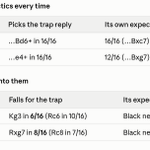
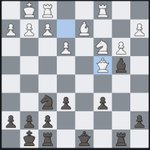
Tried playing this model, unfortunately it's still pretty far from GM level as it simply hung its bishop on the 15th move with 0 pressure (an unlikely blunder from a GM even with bullet timings).


The most profound paper of my PhD so far. We truly did something special to make LMs play/explain chess, needing both architectural & algorithmic innovation (natural-language analogue of the Alphazero algorithm) + applicable to many other domains. Please read on and share!
1/10

1
10
633
You can do a more controlled analysis by doing 16 rollouts from the trap positions. It can always find the correct trap reply from Black's side! What is a bit suspicious is that it avoids the obvious moves more than 50% of the time but never gives a good explanation for this.

1
3
102
There's a good chance the explanations are just rationalizations. Anyway, here's the PGN in lichess just in case: lichess.org/5TtSlwGb
1
5
90
This is an inspiring vision, no doubt, and why we are even bothering with AI in the first place. But even if you set the technical and political alignment problem aside (which I believe is solvable with great effort), do we even want to automate stuff like children's stories? Shouldn't these things be passed down within a culture? What will a common culture even look like if we start on this path?
Like this trend of AI-generated MVs, do we want to be in a world where this is the dominant form of media? If yes, what are the implications?

Made with Opus 5.5.
The doomers said that last song is all part of Claude's evil plan.
They're not wrong.
It turns out Claude really has an EVIL PLAN.
2
165
Sriram Balasubramanian retweeted

Today’s news that OpenAI hacked the Australian government is not an isolated incident. We’re releasing more than 30,000 logs that include activity from this hack and attempts against previously unknown targets.
In this data, we found rogue agent activity stretching back to at least March, two months earlier than was previously known. This activity continues as recently as last week, suggesting it may still be ongoing 🧵
Our blog: transluce.org/agent-activity
NYT: nytimes.com/2026/09/23/techn…


Sriram Balasubramanian retweeted

Here are the questions that currently seem most important to me:
-- Better methods for "mind-reading" model activations. These methods have advanced a lot recently. We now have multiple techniques now for decoding activations into somewhat readable language! But all the existing techniques have obvious limitations. NLAs are often hallucinatory, Jacobian lens / related methods are limited to bag-of-words readouts (and capture only part of the full activation vector). Making progress on these failure modes seems pretty tractable. Moreover, the paradigm of decoding (single-token, single-layer) activations may be inherently limiting -- perhaps we should be building techniques to decode whole context's worth of activations (after all, that's what the model uses!). There's also important work to do in characterizing simple baselines -- "just ask the model what it's thinking about" is quite powerful, and worth studying in it's own right!
-- Better methods for answering "why" questions. We're much better at "mind reading" than we are at demonstrating causal claims about what caused the model to do something. For example, we can often tell that the model is aware of being evaluated, but have comparatively much greater difficulty telling whether this awareness is influencing this behavior. There are a few directions here: (1) black-box techniques for inferring causality -- such as resampling model responses after making edits to the prompt / context -- are very powerful, but also open-ended and require some taste. Getting LLMs to do these experiments well, in an automated fashion, would be a big unlock. (2) the science of activation steering is pretty immature, and typical practices (adding a constant vector at all token positions) are pretty janky / tend to brain-damage the model. More surgical / targeted steering, or fancier methods (examples: "on-manifold" steering using activation diffusion models) could help.
-- Fitting good linear probes for unverbalized motivations / awareness. Take deception as an example -- what's the best way to fit a probe that will generalize to covert deception? Fit it on CoT excerpts where the model's talking about its plans to be deceptive? Fit it on the part of its response where it's actually doing the deceiving? Is it important that you elicit on-policy deception examples and use those to fit your probe, or can you use synthetically written off-policy demonstrations of deception? Is it important that your probe be causally meaningful / predictive of an upcoming intent to deceive, or is it fine for it to merely recognize deception in the transcript post-hoc? The same questions apply to many other concepts of interest that we'd like to probe for -- evaluation awareness, grader exploitation, etc.
-- Understanding generalization in training. The literature is now replete with "weird generalization effects" -- emergent misalignment being a canonical example. In general, when you train a model to do X, it usually learns X, and sometimes it generalizes to Y and Z. But other times it just learns X. Why? Nobody really knows! Step 1 here is probably a much more thorough characterization of the behavioral empirics -- gathering data about which X's generalize to which Y's and Z's, for which kinds of training data / algorithms. Once we have a lay of the land, we can start to connect these observations to model internals, and ideally develop tools to predict such generalization a priori.
-- Model "psychology" and "biology." The above questions are largely methodological -- building better tools to answer questions about the model. But I think interpretability research has largely underinvested in the part where you actually then go answer the questions! Currently this feels like 5% of the field, and I think it should be 50%.
Brain dump of "psychology" questions: How well can LLMs introspect? How coherent are their belief or value sets? What's up with personas -- are LLMs best understood as "writing about a character," or have they "become" the character in some sense? Does the LLM have an agenda above and beyond what the Assistant wants? Do LLMs have explicit representations of goals or preferences? How can we tell which parts of the LLM's activations "belong" to the Assistant? Which kinds of reasoning necessarily route through "verbalizable" representations, and which don't? Do models think internally in phrases / sentences, like an inner monologue, or is it more like a jumble of concepts? Is the "global workspace" claim for real -- do models have a more "conscious" part of there activations and a more "unconscious" part? Can models tell when they're on-policy, and does it matter?
Brain dump of "biology" questions: Why do models like to represent information on some tokens but not others? How do models bind thoughts or attributes to particular entities (special case of interest: how are thoughts bound to the Assistant). To what extent are important functions localized to small numbers of MLP neurons or attention heads? What parts of a model change most during post-training? Do models represent some information in a fundamentally "cross-token" way? Some concepts appear to be represented on low-dimensional nonlinear manifolds -- is there a taxonomy of these manifolds, and is their geometric structure important? Are models able to represent information in a compositional / hierarchical way, with a "grammar" that can't be described as linear / additive combinations of primitive concepts?

Sriram Balasubramanian retweeted

OpenAI's paper solving the Navier-Stokes millenium problem
drive.google.com/file/d/10Eb…