




Great news here! Would it have been so “easy” on an active pair? Like ETH/USDC?

We got an important step closer towards unified liquidity between L2s and Ethereum via @etheconomiczone.
Here is a @CoWSwap trade settled on L2 while using liquidity from L1. Bridging tokens out and receiving other tokens back all happens atomically!
Public testnet soon!

bh2smith.eth retweeted

One step closer to trustless cross-chain batch auctions.
@etheconomiczone & @CoWSwap will bring fragmented liquidity across stablecoins, RWAs, and beyond back together, without introducing a new validator set or trust assumptions...
We got an important step closer towards unified liquidity between L2s and Ethereum via @etheconomiczone.
Here is a @CoWSwap trade settled on L2 while using liquidity from L1. Bridging tokens out and receiving other tokens back all happens atomically!
Public testnet soon!
I just got my @EFDevcon ticket — paid for with ETH!
Next stop: Mumbai 🇮🇳 Join me at Devcon 8 from November 3–6, 2026 for four days of big ideas, technical depth, community, and the people building the future of open source technology.
devcon.org/ticket/bh2smith.e…

@policytensor - can you be my visa application reference? I can't send you a DM here cuz I don't haz blue checkmark.
bh2smith.eth retweeted

"Web3 was never meant to make you rich. It was meant to set you free."
Friederike Ernst @tw_tter on neutral ground - money that no single power can cut out from under you.
Recorded at the Web3 Summit 2026 of @web3foundation.
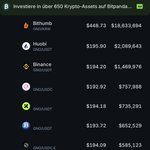
Hey @coingecko Something off with the $GNO price. Markets reporting prices ranging $194-448, while @CoWSwap showing ~103.
Affecting both CEX & DEX market listings, so it looks like a pricing/indexing bug rather than a single bad market. Worth investigating.


bh2smith.eth retweeted
If you have a lot, you will get more for free, or at least cheap. Makes sense, right? Right?!
Not in our books.
@koeppelmann on how the system works for the ones already rich.
bh2smith.eth retweeted

Awesome mini app on @aboutcircles by @NFSociety21 to boost reach on X with CRC crc-boost-market.vercel.app/
still rough around the edges but will get useful once I can choose to reward with certain CRCs - ie be able to select which communities I want get attention from
never stop building

bh2smith.eth retweeted

Ethereum is about to fundamentally change how blocks are executed. With the upcoming Glamsterdam hardfork, it's shipping EIP-7928: Block-level Access Lists, a proposal that brings parallelization to the EVM.
Here's a short explainer of what it is, how it works, and why it's a big deal for scaling.
Let's start from the top. Alongside EIP-7732 (ePBS), EIP-7928 is the execution-layer (EL) headliner for Glamsterdam. Like ePBS, the main focus has been scaling Ethereum, though both proposals come with a bunch of other, equally important properties on the side e.g. removing trust requirements from the PBS pipeline or improving sync.
EIP-7928 adds a Block Access List (BAL) to every Ethereum block. A BAL is a list of accounts and storage slots that the block touches, but that's not all: it also contains post-transaction state diffs (this part is critical!).
Post-transaction state diffs tell you what the state looks like after each transaction. Quick example: user A swaps 1 ETH for DAI on DEX B. The BAL tells you that user A's ETH balance decreased by 1 ETH + tx fees and their nonce went up by 1; that DEX B's ETH balance went up by 1 ETH; and that inside the DAI contract, user A's DAI balance increased while DEX B's decreased.
In other words, all of that info becomes statically available, something that previously required tracing the transaction.
Client software (Geth, Nethermind, Besu, Erigon, Reth, Ethrex, Nimbus) can use this to do a few very powerful things:
1. Parallelize transaction execution. Knowing the post-state of each tx resolves the dependencies between them. No transaction has to wait on the previous one anymore, so execution can be perfectly parallelized. Instead of large parts of block validation sitting idle waiting on sequential execution, clients can finally make much better use of modern hardware.
2. Batch prefetch. One of the most cumbersome jobs for a node has been fetching the state needed for execution from disk. Because state locations (e.g. the exact storage slot in the DAI contract where user A's balance lives) are only discovered along the way, while executing, state-fetching has been a real drag on scaling: it blocks execution, takes time, and eventually slows everything down. With BALs, everything a node needs for execution is known upfront and can be loaded into cache in one go, in parallel. This speeds things up even further.
3. Parallelize post-state root calculation. Another expensive task is walking the updated state tree to compute the post-state root, which is needed so that everyone agrees on what's on disk after executing the block. With the post-tx state already in the BAL, nodes can do this in parallel while executing. A heavy task that used to wait until all transactions had finished can now run alongside prefetching and execution.
4. Snap sync (v2). An often overlooked, less sexy aspect of blockchains is syncing. Nodes need to catch up with the chain, and they need to catch up faster than the chain progresses. Today, most nodes do snap sync: downloading blocks, headers, and state in parallel while chasing the tip, and then "healing" the database once they're close to the head. Healing means asking peers for trie nodes, receiving them, validating them, and updating the local DB. It's iterative, networking-heavy, can take a while, and especially higher throughput pushes that phase to its limits. BALs help here too: with snap v2, nodes can catch up to the tip and skip the healing phase entirely. Syncing at higher throughput becomes more robust and reliable.
So, to summarize, a BAL contains two things:
-> The state locations the block accesses
-> The state changes after each tx (incl. the new values)
We're already seeing big performance gains today: on 6-core machines, EL clients validate blocks up to 5x faster, making block gas limits of 300M a very realistic outcome. ePBS will add to that by decoupling the block from the payload, giving validators 2-4x more time for execution.
To not overshoot (security stays priority #1), the fork will likely ship with a 200M gas limit, but we shouldn't be stuck there for long before pushing to 300M and beyond. That's a 10x in scaling since we started taking the topic seriously, without touching hardware requirements.
None of this would have happened without people going all-in, heads down, shipping: so many hours spent in calls debating the right design, so many iterations refining the specs, and tons of test cases written (and still being worked on). The road from whiteboard to production-ready code has been a journey, and we're not at the finish line yet, but from what I can tell, things look super bullish for Ethereum.
Glamsterdam will be a fork that shows what's possible when a distributed, decentralized community works on a shared goal, laser-focused on providing enough block space to onboard the next wave of users.
bh2smith.eth retweeted

Been thinking about whether Julia could be an unusually good language for zk research tooling/DSLs
Not as a production zkVM competitor, but as a highly inspectable env for:
- constraint systems
- symbolic manipulation
- polynomial experimentation
- proof system prototyping
- visualization
I wrote up some thoughts on extending Groth.jl into a Julia-native zk eDSL with macros lowering into R1CS/Groth16.
At @__zkhack__ summit in Rome this week would love to discuss with PL/compiler/zk people IRL.
bh2smith.eth retweeted

RFV Raiders are back. Gnosis DAO is the new target.
It's a fun game, but first... a reminder:
In 2023 Real Value Raiders took down Rook (5x return), Tribe (Fei wind-down), and you'll probably remember they pushed Aragon to repurpose its treasury (they fought back).
Old playbook was finding DAOs where token mcap < treasury value, accumulate enough tokens, force a dissolution vote, distribute the treasury pro-rata.
Now the playbook is harder to fight.
----
GIP-150 on Gnosis is the new playbook:
Gnosis treasury sits at $223M (ETH, stables, ecosystem tokens). 1.3M GNO tokens are eligible to redeem against it.
So each redeemable GNO has ~$170 of treasury behind it.
But GNO trades at $135.95.
That's a ~$33 per GNO discount to NAV.
Or 24% gain risk free if redemption goes through. (Although RFVs likely bought at lower price).
So holders started asking: why am I funding Ltd while my GNO trades below treasury?
GIP-150 proposes opt-in redemption.
Holders surrender GNO, get their share of the treasury back.
Liquid assets (ETH, stables) distributed at face value.
Illiquid investments (offchain investments, Gnosis Ltd value) gets a claim token (gLTD-CLAIM) that pays out as values realize..
So this opt-in design is supposed to protect non-participants.
The RFV logic has a point: If Gnosis Ltd takes ~$30M/year of DAO money and produced $400k of revenue AND token trades below NAV, token holders' aren't happy.
So these 'attacks' put responsibility towards token holders. It also protects holders from teams that slow-quit by burning treasury in salaries while not really building anything.
But for RFVs this is pure arbitrage trade, not some moral mission.
In this case almost every DAO and projects beyond Hyperliquid and Tron should be shut down and Treasuries returned to token holders.
Whatever Gnosis Ltd is actually building (Gnosis Pay, Circles, Gnosis Chain) loses funding, and some of that work has real users. That is why I voted Against.
And building takes time. Plus market is bad so it is common that token trades under NAV for years.
Every other DAO trading below NAV becomes a target. Beefy is next btw.
Builders at DAO-funded entities now have to plan for potential redemption votes from coordinated holders.
Think to do buybacks, pump token or whatever.
Exciting times.
P.s. If I made any mistakes, sorry. It is my night night time.
GN


Iz hooman

I created a real picture. You can prove it here: provenance.saugar.dev/prove/…
@bh2smith
@saugardev
@worldcoinfnd
@ETHGlobal
bh2smith.eth retweeted
I created a real picture. You can prove it here: provenance.saugar.dev/prove/…
@bh2smith
@saugardev
@worldcoinfnd
@ETHGlobal
bh2smith.eth retweeted

There's a trick some DEXs are playing on traders right now.
You see a great price. You click swap. You get something worse.
And it's not slippage. It's not MEV. It's the AMM itself - and it's intentional.
Let’s explain 🧵


bh2smith.eth retweeted

Good speech by Cory Doctorow
Let's repeal anti-circumvention laws.
Nothing should be updateable without the user's permission, nothing critical should be a black box.
youtube.com/watch?v=3C1Gnxhf…


bh2smith.eth retweeted

Fully synchronously composable L2, or bust.

Just posted a new proposal on EthResearch about synchronous composability between rollups via realtime proving.
The idea explores how based rollups with realtime validity proofs could enable atomic L1↔L2 and L2↔L2 interactions in a single transaction, bringing back true cross-rollup composability.
Comments are very welcome.
ethresear.ch/t/synchronous-c…
#ethereum @VitalikButerin @koeppelmann
