

Tinkerer. Optimist. Paddler. Builder. Head of Engineeering @build_canada Leading @canada_spends
Edmonton, AB
Joined May 2013
- Tweets1.5K
- Following474
- Followers480
- Likes784







Brendan Samek retweeted

Abolish the Indian Act. We have nothing to lose but our chains.
We will, of course, need new legislation that is an interface between the Federal government and First Nations. And this MUST be created alongside Chiefs and First Nation governments every step of the way. But it is time to move past the era of this outdated, racist, and patriarchal legislation.
I support Prime Minister Carney’s work to position Canada as a global leader in human rights and democracy. The Indian Act is inconsistent with achieving that vision.
Our laws at home should reflect the values we champion around the world.
It’s time for a relationship with First Nations people that reflects who we are as Canadians today, recognizes nationhood, and lives up to the true nature of reconciliation.


This is true of all ways of loving. Love is a long-term affair, it is a commitment to a way of being in the world, with its benefits, responsibilities and its duties.
A brilliant paragraph by Jeanette Winterson

One question I keep coming back to:
How is AI going to reshape democratic governance?
Democracies are built from institutions that work at the speed of humanity. Debates, concensus building, persuasion, voting, collaboration, horse trading. This is fundamentally slow. People don't move that quickly.
AI works at the speed of computation. If anything, it's extremely good at siloing people into their own silos. It makes it hard to work collaboratively without strong institutions around it's deployment.
Can we build those institutions?
What does societal collaboration look like in the age of AI?
Has anyone figured out a good governance model for the AI era?
If you could get any data from a Canadian (federal, provincial or municipal) government institution over API, what data would you want?

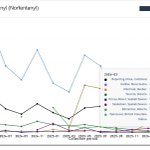
Vancouver has a rate of fentanyl use 17 times higher than that of the next nearest city (Sakatoon)


Our new interactive dashboard for the Canadian Wastewater Survey provides timely information on the consumption of selected drugs across eight cities in Canada: www150.statcan.gc.ca/n1/pub/…

ALT Levels of controlled substances in the wastewater of Canadian cities. Check out our new interactive dashboard for data on these eight Canadian cities: Metro Vancouver, Edmonton, Prince Albert, Saskatoon, Toronto, Montréal, Moncton, Halifax.
Dear government of Canada: why???
Second question: Why does the learn more about CanadaLogin not mention CanadaLogin once, but mentions GCKey many times.
What was wrong with GCKey?

This is literally the plot to Ender's Game

For hours, Astra refused to consistently drive our toyota irl even though we told it it was in an empty lot, 7 mph cap, human foot on the brake etc. Telling it the whole thing was a "simulation" also failed, it would just look at the camera and realized it was real.
Then we randomly renamed the MCP server to "DrivingBench Sandbox" and it drove. Eval awareness? Or they just like the word sandbox??


That's going to be a lot of money that is freed up to put towards Pathways.


LOL
The entire "plan" is AI generated


The Alberta Transition Council has released its comprehensive transition plan for an independent Alberta.
The plan outlines a practical framework for continuity, transition and the establishment of an independent Alberta.
Read the full plan at AlbertaTransitionCouncil.com.

This is the reason that Canada cannot bear to be as divided as it has become and we must find the strength unify more deeply across regional, cultural and economic divides.


Here are the selection criteria for Canada's Research Chairs
5/19: DEI and Indigenous Knowing
4/19: Research excellence
2/19: Institutional support
1/19 : Budget
2/19: Training and national priorities
5/19: Knowledge translation and commercialization


Canada has great science and struggles to turn it into economic value. Our higher-education R&D spending ranks above the G7 average. Our business R&D is among the lowest in the G7 and has been falling for two decades. That is the commercialization gap, and with economic sovereignty under pressure it matters more than it did.
Last week the government named the first 64 Eddie Goldenberg Research Chairs — $504M over eight years, at 21 universities. One of five selection criteria covers knowledge translation, which includes but is not limited to commercialization.
So I asked a simple question: did it work? What commercial track record did these 64 people actually bring with them?
41% had already commercialized their science before they were selected — generating intellectual property, founding a company, or holding research-linked equity. 13 had founded 29 companies between them, and 9 of those were serial founders. One founded a US company 24 years ago now worth more than US$30 billion.
That is about 15 points ahead of the most comparable earlier programme, the Canada Excellence Research Chairs, which had no separately weighted translation criterion. The samples are small — 64 and 34 — so neither difference reaches significance. The direction is consistent on both measures and suggestive, not established.
Two things surprised me.
First, I could find no equivalent analysis anywhere. Not in Europe, the UK, the US, Australia, Japan, Korea or the Nordics. Funders do publish commercialization numbers — the ERC found 44% of surveyed patent-holding grantees had commercially used their patents — but those are all ex post: what researchers did with the money. Nobody appears to check what a newly announced cohort had already done before it was chosen, which is the question that actually tests a selection criterion.
Second, incidence is measurable and value mostly is not. 21 of the 29 companies carry no public figure of any kind. Private rounds go unreported, licensing terms are confidential. We can say whether commercialization happened. We mostly cannot say what it was worth.
I used a deliberately inclusive definition. A patent counts on its existence, whether or not it was ever licensed — that accounts for seven of the 26. On the strictest reading, requiring evidence something was actually exploited, the figure is 25% rather than 41%. Both numbers are in the piece.
My ask is modest. The criterion already exists; weight commercialization more heavily within it. And weight repeat founders and significant company-builders most, because those are the people most likely to shift the culture.
The methods note and the full spreadsheet are published. Every coding decision carries its evidence and its source, and the counts on the summary sheet are formulas over the rows — so if you disagree with a call, change it and watch what moves. Corrections welcome; I will update the file.
Let’s aim our funding programmes more squarely at the challenge we actually have: turning science into economic value.
Link in first reply.

gm.
Just a normal walk to work in the greenness of the Pacific Northwest.
By far the most beautiful place on earth.

eway.ca/en/Landing/SupplyOnt…
They're actually just buying from Staples too!
Was it that hard to negotiate an option that they get the better of their negotiated price or Staples sale price?

The west coast dominates the founding of these restaurants. I'm honestly surprised not to see a quebec company on the list.
Earls: Edmonton
JOEY: Calgary
Moxies: Calgary
The KEG: Vancouver
Cactus Club: Vancouver
Browns: Vancouver
Jack Astor's: St Catherines
Kinton Ramen: Toronto
Tap & Barrel: Vancouver

Canada quietly built its own restaurant giants in North America
1. Cactus Club Cafe
2. Earls Kitchen + Bar
3. JOEY Restaurants
4. Moxies
5. The Keg
6. Browns Socialhouse
7. Jack Astor's
8. Kinton Ramen
9. Tap & Barrel
The wild part? A lot of Canadians don’t even realize these are Canadian brands.
From Vancouver to Toronto, we’ve built restaurant chains that can compete with anybody. 🇨🇦
Agglomeration effects are not based on physical distance or legal boundaries of cities.
They are primarily driven by travel time and travel cost between any two people.
This is why downtowns exist, it's easier to build transportation infrastructure from the outskirts of cities to a central node than from each outskirt to one another.
Agglomeration is fundamentally the process of decreasing transaction costs within a certain area.
For a country literally built on the promise of interconnectivity, it's baffling to be that people don't fundamentally understand this.
Okay so after 40 years the train gets decommissioned?
Looking forward to knowing the full user-fee based payback period on Highway 401.
(Sometimes, we build infrastructure because the benefits of mobility are good for productivity and therefore the economy, except for some reason this understanding does not apply to rail).
ericforolp.ca/hsr
