

Joined June 2024
- Tweets997
- Following1.1K
- Followers1K
- Likes2.5K



builnad retweeted

An intern from B-Harvest is studying consensus hard. The key is not just to learn how it works, but to understand why it was designed the way it is, what problems it would have if not, and the reason for the structure.
If you want to learn and grow blockchain properly, apply to B-Harvest. The door to recruitment is always open.

builnad retweeted
B-Harvest on-prem server lab is officially live.
Supermicro bare metals racked and operational.
The front: pristine.
The back: no comment.
The office: a warzone of styrofoam and cardboard.
We're calling it "production-ready."
Shoutout to @Gray_BHarvest for making it happen.


builnad retweeted

RaptorCast solves the following problem:
- have a huge block (say, 2 MB)
- need to get it to a bunch of people (say, 200) quickly
- require minimal bandwidth for each node
- It wouldn't be smart to send directly to everyone because that will cost 2 MB * 200 = 4 GB of upload (lots of bandwidth)
- It also wouldn't be smart to send it to 15 people and have each of them send it to 15 people because only a few of the initial 15 need to be malicious/offline to prevent general transmission (not fault tolerant)
- It also wouldn't be smart to send it randomly to a few people and have each of them randomly send it to a few people (aka gossip) because it might take many hops for some people to receive the block (high latency)
RaptorCast addresses the problem as follows:
- chunks are created using erasure coding (~2x replication factor)
- chunks are sent through a two-hop broadcast tree where each validator gets different chunks, and every validator is responsible for forwarding their chunk to all other validators
- under this strategy, every validator receives all chunks exactly once and exactly after two hops
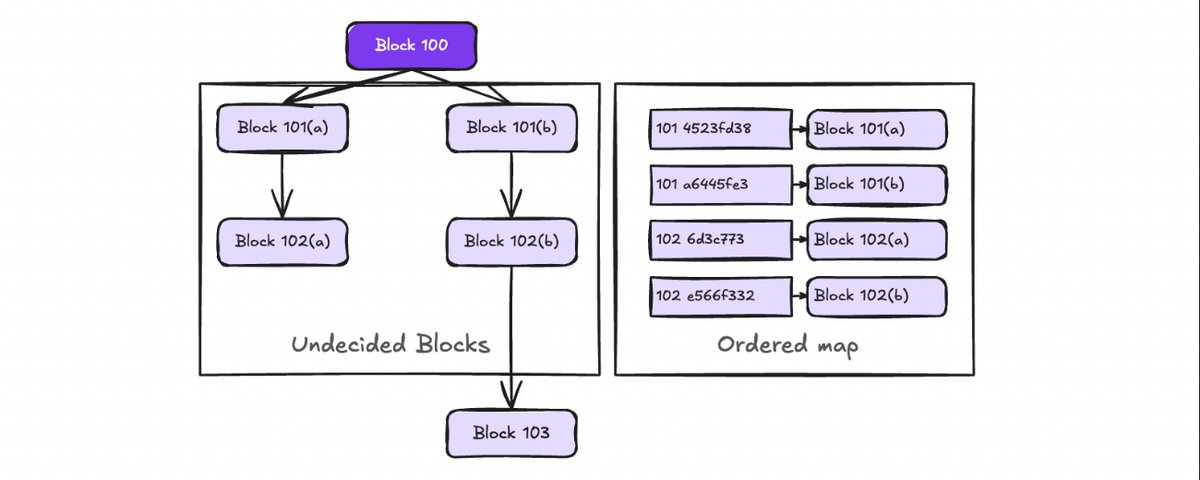
- since only a fraction (~half) of the chunks are needed to reconstruct the original block, the result is that most nodes can reconstruct the full block almost as fast as if the block were streamed directly to them (as shown in Daniel's diagram)
Insanely cool diagram:

이제는 기술로 인한 매스 어답션 내러티브는 이전만큼 고비용이 아니게 됩니다.
작년까지만 해도 시장의 흐름은 ‘빠르고, 안전하고, 넓게’라는 기술 내러티브로 L1에 대한 몇천억 원 규모의 투자 딜이 너무 흔했는데, 이제는 거의 공공재가 되어가고 있습니다.
몇천억짜리 기술들이 모두 오픈소스이며, 누구나 포크하고 누구나 사용할 수 있습니다.
여기에 더해 AI가 발전하다 보니 인력을 통한 코어 접근성 또한 장벽이 낮아지고 있습니다.
이제는 고성능 기술은 비싼 옵션이 아닌 필수재이며, 비즈니스에 종속됩니다.
즉, 비즈니스에 있어서 기술은 더 이상 방해물이 아니며, 철저히 비즈니스 가치에 의해 수익성과 가격이 결정됩니다.
커먼웨어는 네더마인드나 패러다임의 기술팀처럼 공공재처럼 자리 잡게 될 겁니다.
다만, 어떤 비즈니스나 프로젝트가 커먼웨어를 채택한다면 수익성 대신 오픈소스 커뮤니티를 얻게 되고, 기술은 점점 완고해지며, 이는 커먼웨어를 채택한 모든 프로젝트의 무형의 가치 상승을 가져옵니다.
그런 면에서 GTE 같은 프로젝트가 커먼웨어를 선택한 것은 매우 합리적인 선택이라고 볼 수 있습니다.
거의 공짜에 가까운 저비용으로, 향후 유지보수 가능성, 확장성, 강력한 개발자 커뮤니티 성장 등 모든 면에서 지금까지 나온 그 어떤 오픈소스보다 강력한 이점을 지니고 있기 때문입니다.
리테일이 알아야 할 것은 “커먼웨어 채택으로 돈을 어떻게 벌어야 할까?”가 아니라,
내가 투자하는 프로젝트가 개발이 안 되거나 지지부진한 건 기술이 어려워서가 아니라, 이제 명백한 스캠이구나라고 생각할 수 있는 시점에 도래했다고 판단할 수 있습니다.
커먼웨어가 등장함으로써 블록체인 L1 기술은 고성능·저비용·저러닝커브 시대에 진입한다는 점에서 큰 의미를 가집니다.

Will GTE adopt Commonware, and if so, does this meaningfully benefit Commonware’s business model?
Once regarded as part of Mega Mafia, a core group of builders within the MegaETH ecosystem, @GTE_XYZ announced in August last year that it would exit the MegaETH ecosystem, stating that it had “grown enough.”
Since then, the market has speculated extensively about GTE’s next direction. Recently, however, GTE unveiled its own independent implementation of Minimmit, the consensus protocol developed by @commonwarexyz, making it increasingly clear that the team is not positioning itself within an existing ecosystem, but is instead moving decisively toward building its own Layer 1 blockchain.
What makes this development particularly interesting is that, while GTE is leveraging Commonware’s consensus design, it has not merely forked an existing implementation. Instead, the team independently implemented and validated Minimmit on its own. Moreover, by contributing this implementation directly to the Commonware repository, GTE effectively signaled that its ambitions extend beyond building a single application—such as an exchange—and toward deeper involvement at the infrastructure and protocol layer.
How Minimmit Differentiates Itself from Existing Consensus Protocols
Why, then, is GTE focusing so heavily on Minimmit? The answer is straightforward: the team appears to believe that Minimmit offers meaningful technical advantages over existing blockchain consensus mechanisms.
The most notable feature is its single-round finality. Traditional consensus protocols such as Tendermint or HotStuff typically require at least two to three rounds of voting (i.e., multiple communication rounds) to finalize a transaction. In contrast, Minimmit can finalize transactions in a single round, provided that approximately 80% of the total nodes reach agreement.
At first glance, reducing the number of rounds may raise concerns about weakened safety. Minimmit addresses this trade-off through a dual-quorum design. Under normal network conditions, transactions are finalized in a single round with an 80% quorum. However, when the network becomes unstable or sufficient quorum cannot be reached, Minimmit switches to a Mini-Notarization (M-notarization) mode. In this mode, the chain can continue producing blocks with agreement from only around 40% of nodes, ensuring that progress does not halt entirely.
In other words, assuming honest nodes, a Minimmit-based chain can continue producing blocks even if up to 60% of nodes go offline. Compared to traditional BFT-style consensus systems—which typically require at least 67% (2/3) of nodes to remain online to preserve liveness—Minimmit offers significantly stronger resilience under adverse network conditions.
An Expanding Commonware Ecosystem—Is There a Clear Investment Strategy?
@tempo, @noble_xyz , and now @GTE_XYZ.
As more chains signal their intent to build independently using Commonware, the question of how investors should position themselves remains far from clear.
The core issue lies in the lack of clarity around Commonware’s business model. This situation closely resembles the Cosmos ecosystem, where the proliferation of Cosmos-based chains did not necessarily translate into value accrual for the Cosmos Hub itself. As an open-source protocol, Commonware does not automatically capture economic value when new chains adopt its technology. Even if a chain is built entirely on Commonware, that usage alone does not directly generate revenue for the development entity, Commonware, Inc.(Tempo represents a partial exception, as it has both invested in Commonware and contributed technically, creating a more direct alignment of incentives.)
From an investor’s perspective, this creates structural ambiguity. Even if Commonware succeeds in becoming a next-generation blockchain framework, there are limited and indirect ways to translate that success into a clear investment thesis. For institutional investors who have invested directly in Commonware, Inc., the path from protocol adoption to sustainable revenue and long-term business viability remains uncertain.
That said, the most pragmatic strategy at this stage may simply be to closely monitor the chains being built on top of Commonware. If Commonware does emerge as a foundational layer for next-generation blockchains, then the chains built using it are likely to attract disproportionate attention in their early stages—potentially offering more tangible opportunities for investors than the framework itself.
1
9
564


이제 아시아의 판도가 바뀔것이다

I'm honored to share that I will be joining @a16zcrypto as Head of APAC go-to-market.
a16z crypto backs exceptional founders, providing not just capital but also hands-on support to help them grow into transformative companies.
Now, a16z crypto is opening an office in Seoul and extending go-to-market support for its portfolio companies to encompass the Asia-Pacific region — one of the fastest-growing hubs for crypto innovation, deep talent, and bold founders. APAC is already shaping the future of web3, and I believe its impact will only grow from here.
Through the network, experience, and relationships I’ve built over the years in this industry, I’ll help a16z crypto’s founders access not just a new market, but the regional context and knowledge they need to scale (and vice versa).
I want to express my deep gratitude to @cdixon and @AAlbaneseNY for putting their trust in me, and I look forward to being a part of the incredible GTM team — @meigga, @lordvolth, and @cc_crowley.
If you’re building in crypto, web3, or any other frontier tech and interested in APAC — I’d love to connect.
8
914


... What the hell did you guys make? I just saw this now.
Monad currently overcomes the limitations of JSON-RPC and can capture transactions and blocks at the memory level.
You can view the state as quickly as possible without network bottlenecks.
@category_xyz @_jhunsaker @keoneHD

가보자~~

Nadfun is excited to announce our $1.1M raise to date
Seed Round led by @NeoclassicCap , with angel investments coming from the Monad community, builders and onchain traders.
Nadfun is a native launchpad on @monad designed around community-driven memecoin discovery and leveraged price prediction market.
Launch. Trade. Predict. On Monad.

1
12
534
builnad retweeted

From 9am to 10pm today.
Here's the staffs for Monad Blitz Seoul 3rd! @mingming_Monad @shim_sing @zero_N0de @yappingmeow @builnad
Special thanks to @mingming_Monad for preparation and super well organizing this amazing events with over 50 devs.

핵심 정리
- 생태계 개발(Ecosystem Development) 38.5%는 모나드 모멘텀 디앱 인센티브, 스테이킹, 스테이킹 리워드에 분배될것
- 이물량은 언락물량이지만 사실상 락물량에 가깝다.
- 공개판매(Public Sale) 7.5%
- 에어드롭(Airdrop) 3.3%가
- 이걸 합친 10.8%가 실질 유통 물량이 될것(0.1이면 사실상 1b다 = non 10b)
모나드 스테이킹 리워드는 연 2%정도로 20억개, 모멘텀의경우에도 뇌피셜로 이에 상응하는 물량이 첫 1년의 디앱 기여형 인센티브로 뿌려질것같다
그럼 초기 유통량 100억개, 인센티브 40억의 계산이 나온다.
또한 모나드 모멘텀의 경우 인센티브에 해당하는 만큼 디앱의 추가 인센티브가 주어진다.
초기 유통량 100억개 = 10%
스테이킹 인센티브 20억개 = 2%
모나드 모멘텀 디앱인센티브 20억개 = 2%
디앱 자체인센티브 20억개의 해당하는 디앱인센티브 =2%
하지만 코인베이스 세일 물량은 대부분 오더북에 걸려있는상태에서, MM들에게 빨리거나, 트레이딩물량이 될가능성이 높다.
그리고 코인베이스가 지속적으로 거래량을 만들어야함으로, 세일물량은 거래소에 묶여있을 가능성이높다.
그렇다면 낙관적으로 7.5%를 제외한 3.3%의 온체인 유통량이 6%의 인센티브를 약 1년간 획득할수있게된다.
그러니까 모나드의 방향성이 첫1년동안 디앱에 접근할수있는 유동성을 커뮤니티에게 준셈.
만약 시장이좋아, 가격유지만 잘된다면 자산을 두배늘릴수있습니다.
그리고 1년뒤에 디앱의 성공유무에따라 락물량이 매도될지, 유지될지에대한 방향성이 나올수있게됩니다.
정리하자면
- day1 - 1년까지 빈집이다(사실상 커뮤한테 2차시즌이다)
- 인센티브 털어먹고
- 매도를 할지말지는 1년뒤에 결정해야한다
- 마켓메이커 리스트봤으면, 어줍잖게 트레이딩하지말자, 뭘하든 다수를 털어먹는 플레이북을 가지고있다.
- 트레이딩 하지말고, 시장상황에따른 헷징을 하자
- 그럼 수량은 두배늘지않는가?
- 여기에 가격만 잘가주면 몇배가될수있다.. (디앱의 성공유무에따라서 플랫폼 가격이 결정될수있음)
에코시스템 디렉션이 명확한만큼 잘써먹어야한다.
@monad @koreanads