

🏛U of T Alum@Rotman, CFA Charterholder 🏳️🌈Humanist-Liberal-Freethinker 🏺Cultural History Buff ❤ Hospitality & 🛩🌏, Caring & Empathetic Society 🌸
Canada 🇨🇦
Joined August 2020
- Tweets18.8K
- Following651
- Followers685
- Likes30.6K






He speaks amazingly well and sounds genuine.

Leading the last uncalled Senate race in the South by 2,574 votes, Mississippi's Scott Colom was asked on live television whether he would back Chuck Schumer to lead the new majority. He answered with a map. WATCH
Full article: dailyletter.us/story/asked-t…
Chun-Che OU 🍁 retweeted

Je vous invite à écouter le documentaire de Simon Coutu intitulé "De souche", visionnable directement sur YouTube ou la plateforme de Télé-Québec.
Ce documentaire nous invite à réfléchir à la place que prennent les discours d’extrême droite au Québec.
Quand Nouvelle Alliance associe le lignage à un droit de prédominance et présente l’immigration comme une menace de remplacement du peuple, nous sommes bien dans une conception ethnonationaliste et nativiste, caractéristique de l’extrême droite.
Lorsqu'Alexandre Cormier-Denis, de Nomos-TV se félicite d'avoir rencontré Renaud Camus (fondateur de la théorie du Grand remplacement), ou qu'il applaudit le discours de Stéphane Ravier sur la remigration, il ne s'agit plus d'une simple proximité mais de convergence et d'approbations explicites.
La présence de cette frange d'extrême droite au Québec mérite d'être prise au sérieux.
Le Québec d'aujourd'hui n'est plus celui des années 1950, des années 1920 ou de 1800. Les identités évoluent sans que disparaissent nécessairement les fondements historiques et culturels de la nation ; le changement n'est pas intrinsèquement un effacement.
#polqc #NouvelleAlliance #politique #france #GrandRemplacement
youtu.be/cKM1hnmaeXE?si=AWzS…

En fait, il y a beaucoup d’exemples.
La Suisse où le français est une minorité - seulement 23%, presque le même poids que le Québec dans le Canada, mais avez vous déjà entendu parler du mouvement indépendantiste sérieux en Suisse? Pas moi en tout cas.
Le Bali en Indonésie, un pays musulman de 289 millions de personnes. Les Balinais à 4,5 millions gardent toujours leur langue, culture et religion toutes distinctes de la majorité indonésienne. En fait à moins de 5 millions sur 289 millions, suivant la logique des séparatistes québécois, ils devraient être assimilés déjà. Pourtant la réalité est très différente. Le monde en entier connaît Bali.
La Mandchourie qui a leur propre langue et culture distincte des Chinois Han est complètement intégrée dans la Chine. Elle avait leur empire et franchement le choix de se séparer de la Chine au début du 20e siècle mais ça les a jamais intéréssé.
En passant au Canada, les résidents d’origine de l’Inde ne comptent que 3,7% de la population. Il y a plus de gens qui viennent de l’Italie ou la Chine que l’Inde et presque autant qui viennent d’Ukraine.
#PolQc

Ne pas vouloir s’appartenir, vouloir appartenir à un autre peuple 80% plus nombreux qui en plus ne parlera jamais la même langue. Autre peuple, qui se fait lui-même dominer de plus en plus par de l’immigration de l’Inde et du Pakistan. Je vous défie de me trouver un autre peuple sur terre constitué d’autant d’idiots que celui composé des fédéralistes du Québec.
Il faut avoir de la pitié pour les séparatistes, puisqu’ils vivent toujours en 1759 pour une éternité - la conquête, l’abandonnement, la monarchie, la défaite…

«PSPP n’est pas venu en politique pour administrer [...]
un territoire conquis par une autorité extérieure. [...] pour jouer au joli,[...] être le béni-oui-oui de service. Son projet, plus noble, est [...] que le Québec devienne un pays souverain.»
ledevoir.com/opinion/libre-o…

Chun-Che OU 🍁 retweeted

🇨🇦 CANADIANS: STOP PANICKING ABOUT IMMIGRATION. LOOK AT THE ACTUAL NUMBERS.
There is an enormous amount of misinformation circulating about Canada's immigration and population outlook.
Let's separate the facts from the fear.
1. The 380,000 immigration target is NOT 380,000 new arrivals.
Canada plans to grant permanent residency to 380,000 people annually between 2027 and 2029.
But many already live, work, pay taxes and occupy homes in Canada.
A temporary worker receiving permanent residency doesn't add another person to the population. Only their immigration status changes.
2. Canada's temporary resident population is already SHRINKING.
Statistics Canada reports:
October 2024: 2.98 million non-permanent residents.
July 2025: 2.93 million.
July 2026: 2.78 million.
That's a decline of approximately 205,000 from the October 2024 peak.
The expansion has reversed.
3. Ottawa is explicitly converting existing residents to permanent status.
The November 5, 2026 immigration plan includes a special initiative allowing up to 200,000 people already living in Canada to transition to permanent residency by the end of 2027.
These are not 200,000 additional people arriving at the border.
4. New temporary resident arrivals are being sharply reduced.
Canada recorded approximately 972,000 new temporary resident arrivals in 2023.
The target for 2027 is 370,000.
That's a planned reduction of approximately 62%.
5. What matters is NET POPULATION GROWTH.
New arrivals minus departures, combined with births minus deaths.
A declining temporary resident population does not necessarily mean everyone has departed. Some have simply become permanent residents.
But it clearly demonstrates that Canada's previous period of extraordinarily rapid temporary-resident expansion is ending.
Now the real story, are we about to run out of workers?
🤖 Made with AI

Chun-Che OU 🍁 retweeted

昨天加拿大政府推出预算 Budget 2026,看到BBC报道里提到加拿大在G7里的对比,我去官方预算报表看了一下,几个数字比较清楚:
Chart 0.2:各级政府净债务占GDP 9.3%,G7最低。
Chart 0.3:IMF预测2027年增速1.7%,G7第二快。
Chart 0.4:各级政府赤字占GDP 2.5%,在G7里也属于较低水平。
Chart 0.11:对非美国市场的出口自2024年以来增加超过50%。
从这几组数据看,债务和赤字在G7里都算低的,短期预期也不算差。底子还在,未来希望能走稳、走好。
图表来源:Budget 2026


Chun-Che OU 🍁 retweeted

Les péquistes ont transformé et réduit les québécois en locataires au lieu d’être propriétaires sur le deuxième plus grand pays du monde ….
Chun-Che OU 🍁 retweeted

Tout porte à croire que le ministre des Finances, Nicolas Marceau, prépare le terrain pour jeter la faute sur le fédéral lorsqu’il ne pourra livrer le cadre financier du PQ.
Le constat est le suivant : le plan de retour à l’équilibre budgétaire promis par le PQ n’était déjà pas réaliste durant la campagne, et il ne l’est toujours pas aujourd’hui.
#PLQ #PolQc #AssNat – at Québec, Canada
Doug Ford est un “dirigeant étranger” mais Mark Carney n’est pas? Ce serait plus simple d’admettre le statut en question n’a pas de rapport.
Je vais faire une prédiction: les prochains sondages vont montrer le PQ en baisse et les autres partis au Québec en hausse.
C’est la vrai raison derrière ce changement d’attitude dernièrement.
#PolQc

It’s just a photo op for him. Almost no one believes he is remotely sincere with his crocodile tears after nearly a quarter century of grifting.
This is a guy who refused to vacate Stornoway for months after losing his seat despite owning not one, not two but three properties.
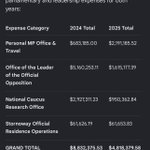
Poilievre is by far the MP who expensed the taxpayers the most , higher than even both PM Trudeau and Carney.
Remind me, how did he end up owning that many real estate properties without any wealth or significant income prior to his lifelong grift as a politician?
#cdnpoli


Hypocrisy at its best! @PierrePoilievre chooses a food bank as his backdrop for criticizing the budget & highlighting the increasing use of this type of service, when he and all members of the @CPC_HQ VOTED AGAINST a national school food program.

Chun-Che OU 🍁 retweeted

Faut lire.
lapresse.ca/actualites/chron…

Chun-Che OU 🍁 retweeted

Poilievre deputy chief of staff departing for private-sector job thestar.com/politics/poiliev…

Chun-Che OU 🍁 retweeted

La loi 101 au collégial c'est faire reculer le Québec de 100 ans. Les anglophones bilingues vont être aux commandes des entreprises et les francophones unilingues redeviendront des porteurs d'eau.
Chun-Che OU 🍁 retweeted

Mark Carney: "The debt-to-GDP ratio... I don't know what the leader of the opposition's inability to actually read the budget -- the debt-to-GDP ratio is down by 3 percentage points."
Chun-Che OU 🍁 retweeted

Your brain switches between glucose, lactate, ketones, and fatty acids throughout the day to match energy demand. In Alzheimer's disease, this fuel flexibility is progressively lost. A Journal of Neurochemistry review reveals why the brain gets metabolically stuck.
Alzheimer's disease has long been characterized by reduced glucose metabolism visible on brain scans. The standard interpretation was that neurons couldn't access enough fuel. But a new framework from researchers at the University of Kentucky proposes something different: the brain isn't starving for energy. It's locked into a rigid metabolic program that can't adapt to changing needs.
Metabolic flexibility describes the ability of cells to sense, access, and switch between different fuel sources based on availability and demand. In a healthy brain, neurons primarily use glucose.
But they can also run on lactate produced by support cells called astrocytes.
During fasting or ketogenic diets, both neurons and glia can use ketones.
Fatty acids provide another backup fuel source.
This fuel switching happens constantly. After a meal, the brain uses glucose. During sleep, it may shift toward lactate and ketones. Under metabolic stress, cells activate alternative pathways to maintain energy production. The system stays flexible, matching fuel use to functional requirements.
In Alzheimer's disease, this adaptability breaks down.
The review argues that AD is fundamentally a disorder of metabolic inflexibility where cellular metabolism gets actively reprogrammed to support inflammatory and disease-associated processes at the cost of neuronal function.
Alzheimer's disease doesn't progress in a straight line of declining metabolism. It unfolds in two distinct phases that seem contradictory.
In the early stages, often years or decades before symptoms appear, the brain actually burns more glucose than normal. This hypermetabolism comes from immune cells ramping up their energy consumption to fight inflammation. Think of it as the brain running hot, immune cells working overtime.
Later, in the stages when cognitive decline becomes apparent, the pattern flips. The whole brain shifts into hypometabolism, burning less glucose than it should. This is the energy collapse, where neurons can't get enough fuel to maintain normal function. By this point, the metabolic machinery that would allow cells to adapt has broken down.
The shift from early hypermetabolism to late-stage collapse follows a biphasic trajectory:
• Early stage: Immune cells and support cells burn excessive glucose to fuel inflammation
• Late stage: Brain-wide energy shortage as neurons lose access to fuel
The brain's immune cells, called microglia, drive this metabolic shift. When they detect damage, they switch to a faster way of burning glucose that prioritizes speed over efficiency. This helps them respond to threats quickly. But once locked into this mode, they consume glucose at rates that starve nearby neurons of fuel.
Support cells called astrocytes normally convert glucose into lactate and deliver it to neurons as fuel. In Alzheimer's disease, these cells stop making lactate and start hoarding glucose for themselves instead. The fuel pipeline to neurons shuts down.
Both cell types lose their flexibility. They get stuck burning fuel in ways that support their own inflammatory responses but cut off the energy supply that neurons need to function.
This metabolic rigidity creates a vicious cycle. When cells can't switch fuels flexibly, they get stressed. That stress increases production of amyloid-β plaques and tau tangles, the hallmark proteins of Alzheimer's disease. These proteins trigger more inflammation, which locks cells even deeper into their rigid metabolic programs.
The damage spreads beyond individual cells. Neurons become overactive when they can't meet energy demands, throwing off the brain's excitation-inhibition balance. Network connectivity breaks down. Sleep fragments. Cognitive function declines as the whole system fails to coordinate.
System-level consequences include:
These cellular-level changes show up as system-wide brain dysfunction:
• Neurons fire erratically when starved of energy, disrupting communication patterns
• The default mode network, critical for memory and self-referential thinking, loses connectivity
• Sleep architecture deteriorates, reducing the brain's ability to clear waste during rest
• Memory, attention, and executive function decline as metabolic failure spreads across brain regions
Here's what makes this framework different from viewing Alzheimer's as simple energy failure: the metabolic programs are initially adaptive. Microglia activate glycolysis because it helps them respond to damage. Astrocytes shift fuel use to support their own functions under stress. These are protective responses.
But they become chronically maladaptive. What works as a short-term stress response traps the brain in a metabolic state that can't support normal neuronal function. The longer these programs run, the more rigid they become, and the harder it is for cells to switch back to flexible fuel use.
The critical insight from the review: metabolic inflexibility may be reversible.
Unlike permanent structural damage, metabolic programs can potentially be reprogrammed.
The authors propose that restoring metabolic flexibility could mitigate amyloid and tau pathology, reduce neuronal loss, and improve functional outcomes.
Evidence supporting reversibility comes from preclinical studies testing metabolic interventions.
Ketogenic diets, which force the brain to use ketones instead of glucose, have shown some cognitive benefits in animal models and small human trials. Compounds that enhance mitochondrial function or shift cells away from pure glycolysis are being tested.
Other approaches target specific aspects of metabolic inflexibility.
Drugs that improve insulin signaling in the brain could help cells take up and use glucose more effectively.
Interventions that reduce microglial inflammation might allow these cells to return to more balanced metabolic programs. Enhancing the astrocyte-neuron lactate shuttle could restore an important fuel pathway.
The review synthesizes human neuroimaging data showing regional patterns of hypometabolism that correlate with cognitive decline, cerebrospinal fluid studies demonstrating altered metabolite profiles, and animal research revealing the cellular mechanisms behind these changes.
Clinical trials are actively testing metabolic interventions.
Some focus on dietary approaches like ketogenic diets or medium-chain triglycerides that boost ketone availability.
Others test drugs that improve glucose metabolism or mitochondrial function.
Results so far have been mixed, but the framework suggests timing matters. Early intervention, before metabolic programs become too rigid, may be critical.
The view of Alzheimer's disease as a disorder of metabolic inflexibility reframes how we think about disease progression. It's not just about plaques and tangles accumulating. It's about the brain's support systems getting stuck in metabolic states that prioritize inflammation over neuronal support, speed over efficiency, and short-term survival over long-term function.
Those choices, made at the cellular level, compound over time. They create an environment where neurons can't get the fuel they need in the forms they can use. Network function deteriorates. Cognitive abilities decline. The brain collapses energetically not because fuel is absent, but because the metabolic machinery to access and use it flexibly has been dismantled.
Restoring that flexibility means more than just providing alternative fuels. It means helping cells regain the ability to switch between fuels based on need, rebalancing the metabolic priorities of glia to support rather than compete with neurons, and breaking the feed-forward cycles that lock the brain into rigid metabolic programs.
Whether this approach translates into effective therapies remains to be determined. But redefining Alzheimer's disease as metabolic inflexibility rather than simple metabolic failure opens new intervention points at stages of disease where structural damage may still be limited and metabolic programs potentially reversible.

Chun-Che OU 🍁 retweeted

🚨 DERNIÈRE HEURE
Le premier ministre du Québec, Paul Saint-Pierre Plamondon, rencontrera Doug Ford demain, à 17 h, à Queen’s Park, à Toronto.

La croissance PIB du Québec est encore la dernière parmi les 10 provinces canadiennes.
#PolQc

Statistics Canada released the provincial economic accounts for provinces this morning!! Newfoundland and Labrador led the country at +4.3% growth last year, followed by PEI and AB. www150.statcan.gc.ca/n1/dail… #cdnecon
