

building @bartiegenie | Founder CEO/CTO @TSPOWERGRID | CTO/co-Founder @askstocmed | 💼 Paulina oil | $2740/day | not quitting.
Joined January 2021
- Tweets3.6K
- Following259
- Followers776
- Likes5.2K





Pinned Tweet
A month ago a friend posted a video of our work.
We had just commissioned the Gbagada site for First Fiducia.
A man saw that video. He called my friend. He said he wanted to invest.
He asked us to come and inspect a mini estate in Ogun State. He wanted to give power to two buildings. The buildings contain seven apartments.
We went. We assessed the energy demand of every occupant. We measured the load. We specified a 12kVA inverter, a 20kWh battery and 20 panels.
We supplied the grid materials. We installed the system. We connected seven neighbours.
Before, the residents had less than one hour of power each day.
Now they have power for 24 hours.
Six neighbours pay ₦400 per kWh. The operator pays ₦300 per kWh. The investor set these prices. He plans to reduce the price by ₦50 after three months.
This project tested our product hard. Our P2P Gateway Hub was built for four users. This site needed seven. We stretched the capacity. It held.
The work was not easy. I travelled to Ogun State many times. I missed classes. One night we arrived at 11pm to repair a fault. There were many low moments.
Every one of them turned into joy. The residents use the product. They love it. The investor is secure and he is happy. We are happy.
In two weeks the site returned almost ₦100,000 to the investor. In my own house I have earned ₦30,000 (in July alone) from selling power. And it is no longer only my house.
It started with one person. Today we touch many lives.
More than 100 people are on our waiting list. My team and I work every day to reach them.
Now I go to prepare for my final year pharmacy exams.
We achieved much in a short time. We are only starting.


Lunch was great, but meeting everyone was awesome.
Eventful day.


@nombahq
Hosted founders building in renewable energy today. Really blown away by the amount of innovation in this space.
Energy is at the core of every productive economy.
Thanks to everyone who showed up.
The food was my highlight 😄


spirit (-e/acc) retweeted
Starbucks CEO says the company is planning to focus more on AI and tech, including adding a system that would recognize customers as they arrive in stores to "present personalized digital menus."
spirit (-e/acc) retweeted

Why "Networking" is difficult in Nigeria:
- Nigerians don't know how to network
- Nigerians are difficult to network with
Let me highlight how to network upwards in case some might find it useful.
A thread 🧵👇🏽
spirit (-e/acc) retweeted

1,234kWh a day? How's that possible abeg? Even if na factory. 😳
DISCOs should do better. @NERCNG

Who can I speak to at @EKEDP because this makes absolutely no sense
How do you send a bill 4x what is calculated then say the bill needs to first be paid before we can contest the nonsense they sent to us
What the fuck is going on in this country. You send 8m for a 2m bill and say we must pay it first before complaining??
@fccpcnigeria @instablog9ja @yabaleftonline @PulseNigeria247


“Decentralised electricity” 🤔

NERC Urges Investors to Leverage Regulatory Frameworks to Boost Electricity Supply
The Nigerian Electricity Regulatory Commission (NERC) has called on investors to take advantage of existing regulatory frameworks to drive large-scale investments capable of improving electricity supply across the country.
Speaking during an interactive panel session at the 32nd Nigerian Economic Summit held in Abuja on Tuesday, 27 October 2026, the Chairman of NERC, Dr. Musiliu Oseni, represented by the Commission’s Director of Economic Regulation, Mr. Abba Terab, highlighted the opportunities available within the power sector for investors seeking bankable and sustainable ventures.
Addressing participants at the session themed “Power Growth: Reliable Electricity for Industry and Prosperity,” Mr. Terab noted that NERC has established several regulatory instruments designed to facilitate viable transactions and attract private sector capital into the electricity market.
Mr. Terab further explained that the Federal Government, in pursuit of the Vision 30:30:30 target, has continued to liberalise the electricity sector through the provisions of the Electricity Act and supporting NERC regulations. He cited the promotion of decentralised electricity supply models, including embedded generation, as a key strategy for expanding access to reliable power.
The panel session was moderated by Jumoke Delano, Managing Consultant at Competence Builders International. Contributions from other panellists include:
Chijioke Okwuokenye, Managing Director of the Abuja Electricity Distribution Company (AEDC), emphasized the role of regulation in driving initiatives such as embedded generation and net billing arrangements to accelerate access to renewable energy.
Deen Solebo, Managing Director of Elektron, highlighted government efforts to strengthen gas-to-power infrastructure, enabling medium-scale power plants to serve specific geographic areas and customer clusters more efficiently.
Segun Ajayi-Kadir, Director General of the Manufacturers Association of Nigeria (MAN), underscored the importance of building a viable electricity market where energy supplied to customers is delivered reliably and paid for accordingly.
The annual summit was organised by the Nigerian Economic Summit Group (NESG) as part of its efforts to promote economic reforms aimed at creating an open, inclusive, sustainable, and globally competitive private sector-led economy.
#Electricity #NERC #NESG #NES32 #NESI #Regulations #PowerSector


spirit (-e/acc) retweeted

NERC Urges Investors to Leverage Regulatory Frameworks to Boost Electricity Supply
The Nigerian Electricity Regulatory Commission (NERC) has called on investors to take advantage of existing regulatory frameworks to drive large-scale investments capable of improving electricity supply across the country.
Speaking during an interactive panel session at the 32nd Nigerian Economic Summit held in Abuja on Tuesday, 27 October 2026, the Chairman of NERC, Dr. Musiliu Oseni, represented by the Commission’s Director of Economic Regulation, Mr. Abba Terab, highlighted the opportunities available within the power sector for investors seeking bankable and sustainable ventures.
Addressing participants at the session themed “Power Growth: Reliable Electricity for Industry and Prosperity,” Mr. Terab noted that NERC has established several regulatory instruments designed to facilitate viable transactions and attract private sector capital into the electricity market.
Mr. Terab further explained that the Federal Government, in pursuit of the Vision 30:30:30 target, has continued to liberalise the electricity sector through the provisions of the Electricity Act and supporting NERC regulations. He cited the promotion of decentralised electricity supply models, including embedded generation, as a key strategy for expanding access to reliable power.
The panel session was moderated by Jumoke Delano, Managing Consultant at Competence Builders International. Contributions from other panellists include:
Chijioke Okwuokenye, Managing Director of the Abuja Electricity Distribution Company (AEDC), emphasized the role of regulation in driving initiatives such as embedded generation and net billing arrangements to accelerate access to renewable energy.
Deen Solebo, Managing Director of Elektron, highlighted government efforts to strengthen gas-to-power infrastructure, enabling medium-scale power plants to serve specific geographic areas and customer clusters more efficiently.
Segun Ajayi-Kadir, Director General of the Manufacturers Association of Nigeria (MAN), underscored the importance of building a viable electricity market where energy supplied to customers is delivered reliably and paid for accordingly.
The annual summit was organised by the Nigerian Economic Summit Group (NESG) as part of its efforts to promote economic reforms aimed at creating an open, inclusive, sustainable, and globally competitive private sector-led economy.
#Electricity #NERC #NESG #NES32 #NESI #Regulations #PowerSector
spirit (-e/acc) retweeted

I feel better at 57 than I did at 33. Why? I choose hard.
When you ignore the check engine light, a $100 sensor becomes a $5,000 engine rebuild.
Your body, your marriage, your energy, and your finances all have that warning system.
Every choice is a stitch, a thread-- yet few people see the skin they are sewing, a skin that they will bear like a sack of bricks, carried for decades.
The Rule of Imminence. Hard is inevitable. However, when you continually choose easy, hard arrives at 33, not at 83. Choose wisely.

ALT The graphic contrasts the outcomes of choosing discipline versus taking easy paths in life, illustrating the life stages and consequences.


spirit (-e/acc) retweeted

Here is what we all go through every church service!
One thing missing in financial services is a layer that understands people and human behaviors, not just how to process their transactions.
Think about church giving in Nigeria.
Every Sunday, multiple account number flash on screens for a few seconds or about a minute. You're still typing the first one when the slide changes.
You try to remember the 10-digits across multiple account to give to, look around for someone who got it, If you're seated far away, you might not even see it clearly. Sometimes, you give up and tell yourself you'll do it later. Sometimes, later never comes.
We tested a different approach with CCI (a use-case). @cci__global @pst_iren
So, we built a layer on our existing infrastructure to simplify church and gathering fiat and stablecoin payments rail.
You search your church by name, and its giving accounts appear in one place. You can give your tithe or offering without racing against a slideshow, even before Sunday all on WhatsApp.
The superpower of Fluxt sits at the intersection of industries, Al, payments, and human behaviour. The payment infrastructure already exists. What's missing is a layer that makes it feel natural to use. That's the layer we're creating.
If you face this same problem every church service, mention your church below and make a soft intro.


spirit (-e/acc) retweeted
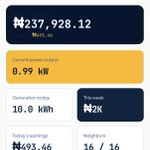
Our dashboard so far:
•3,012 kWh delivered
•₦1.72m in energy consumption billed
•₦1.57m credited to hosts
•₦152.6k in platform fees
Helping solar owners sell power to their neighbours. Still early. Still building

spirit (-e/acc) retweeted

The minimum solar installation required to qualify is 50kWp. That's roughly 80 - 100 solar panels, depending on their wattage. This immediately excludes most homes and small to mid sized businesses in Nigeria.
The policy is clearly targeted at industrial scale solar users and minigrids, which is fine. But let's not frame it as though it applies to anyone with solar panels. Less than 0.5% of homes with solar qualifies
Many of us raised concerns about these high eligibility requirements during the community outreach for this policy, but... – at Lagos, Nigeria
Turn your excess solar energy into savings with NERC's Net Billing regulations! By exporting surplus electricity from your home or business to the grid, you can earn energy credits to reduce your monthly bill.
Read the Net-Billing Regulations 2026 on our website at nerc.gov.ng to learn if you qualify to generate, export and earn.
#NetBilling #NERC #SolarNigeria #renewableenergy #NESI
24/7 electricity from clean energy.
We will interview interested neighbours of these sites for testimonies to post here soon.
