

Associate Professor @uni_of_essex Curious about customer groups, deepfakes, artificial intelligence, services marketing.
Colchester and Vancouver
Joined January 2011
- Tweets1.3K
- Following2K
- Followers1.1K
- Likes808




Linda W. Lee retweeted

The Canadian Security Intelligence Service (@csiscanada) produced this report on disinformation and #deepfakes as part of its Academic Outreach and Stakeholder Engagement (AOSE) and Analysis and Exploitation of Information Sources (AXIS) programs.
It nice to see that it cites our (@7_dials, @TimKietzmann, @curiousllee) work how deepfakes are produced, see here:
doi.org/10.1016/j.bushor.201…

CSIS’s Academic Outreach & Stakeholder Engagement program just published a new unclassified report on #DeepfakeTechnology!
Learn how this #tech poses challenges to Canada’s #NationalSecurity: canada.ca/en/security-intell…

Linda W. Lee retweeted

Nature rejected her paper for not being original,
University of Pennsylvania (her employer) demoted her,
and yesterday Katalin Karikó won the Noble Prize in physiology.
In mid-2000s, Karikó and her Drew Weismann submitted their paper on mRNA (messenger Ribonucleic Acid) to Nature.
Nature desk rejected their paper for being "an incremental contribution" only. The paper was later published in another journal, Immunity.
Earlier in her career at the University of Pennsylvania, Karikó was demoted because her applications for grants kept getting rejected.
But Karikó persevered and kept on going.
In 2013, she joined BioNTech, a German company founded by two scientists, Uğur Şahin and Özlem Türeci. In 2018, BioNTech partnered with Pfizer to develop mRNA vaccines against the influenza virus.
When the COVID-19 hit the world, Karikó's research helped Pfizer to produce the first vaccine against the disease.
I don't know how the Nature editors who desk rejected Karikó's paper and the Penn administration who demoted her feel about Karikó Nobel Prize.
Takeaway: Many academics and scientists worry about getting published in "prestigious" journals. Instead of worrying about prestige, we should try to put our work out as quickly as possible like Karikó did.
Once you put your work out without caring about prestige, two good things happen:
1. Your work will lead to newer opportunities.
2. You will start getting feedback from the scholarly community, which you can use to iterate and improve.
Here's another interesting Nobel Prize story.
Peter Higgs, a British physicist, joined the University of Edinburgh in 1956. By 1964, Higgs has published his groundbreaking work about subatomic particles.
After 1964, Higgs published less than 10 papers.
When his department would ask him how many papers, he published in a given year, he would reply "None."
It happened so often that he stared feeling like an "embarrassment to the department."
The University of Edinburgh, however, never fired Higgs because in 1980 he had been nominated for the Nobel Prize.
Higgs retired in 1996 and stayed on as an emeritus professor at Edinburg.
In 2012, experiments conducted at the CERN laboratory confirmed Higgs work and the existence of Higgs Particle.
And in 2013, Higgs was awarded the Noble Prize in physics and the University of Edinburgh got rewarded for being patient.

ALT Katalin Karikó's first science medal that she won on Feb 7, 1973, at an open biology exam in her high school in Kisújszállás, Hungary. Image source: Karikó's Twitter/X account.
Postings for Lecturers/Senior Lecturers (Teaching and Research) at Edge Hotel School, University of Essex linkedin.com/pulse/postings-… via @LinkedIn

1
1
89
Linda W. Lee retweeted
It's long overdue, but here is an open-access version of the article: Deepfakes: Trick or Treat?
ssrn.com/abstract=4471207
Linda W. Lee retweeted

👀After 154 pages of tests of GPT-4, this paper concludes “Given the breadth and depth of GPT-4's capabilities, we believe that it could reasonably be viewed as an early (yet still incomplete) version of an artificial general intelligence (AGI) system.” arxiv.org/abs/2303.12712


Linda W. Lee retweeted

How can deepfakes be detected and how can they be used positively? In a reality check on the latest research on deepfakes, our centre member @curiousllee discusses positive applications of deepfakes in a podcast by @ABCaustralia:
abc.net.au/radionational/pro…
doi.org/10.1016/j.bushor.201…
Should we fear or embrace the power of deepfakes? I see great potential in the use of the technology, as I explain in this interview with ABC (my section starts at about 9:20). The other speakers in this podcast discuss how deepfakes can be detected.
abc.net.au/radionational/pro…

Here is my paper that discusses deepfakes in greater detail doi.org/10.1016/j.bushor.201…
Linda W. Lee retweeted

What's the key to sustained creativity? Balancing a high "need for certainty" with a low "need for competence." In today's Science of Creativity newsletter:
anniemurphypaul.substack.com…
Causal AI, the next step beyond correlational AI? thedigitalspeaker.com/cause-… – at East, England
1
40
A robot that can melt and reform to get into hard to reach places or that can escape all confines. coolhunting.com/tech/a-robot… – at Vancouver, British Columbia
25
As an academic researcher, I frequently ask businesspeople for their views on topics I'm researching. I am so grateful for the thoughtful feedback from very kind and busy people. This makes such a difference - thank you! – at Vancouver, British Columbia
1
64
Linda W. Lee retweeted
Quantitative research is like baking a cake: the research design & execution should be as good as possible before putting it in the oven.
Qualitative research is like cooking a stew: you can adjust the ingredients & spices as you learn how it tastes.
(Davide Ravasi, AMJ)

Linda W. Lee retweeted
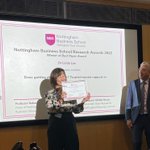
Massive congratulations to our colleagues @curiousllee and Dr. Soheon Kim on winning best paper award in Marketing @NBS_NTU conference for the 2021/22 academic year. Well done!
#marketresearch #Tourism #WeAreNBS #Research_Imagined

Linda W. Lee retweeted
I am proud to say that my recently published article on tourist-to-tourist rapport in group services just received the best paper award from my university! @nbs_ntu @NBS_Dean
doi.org/10.1016/j.tourman.20…
@Toffeemen68

I am proud to say that my recently published article on tourist-to-tourist rapport in group services just received the best paper award from my university! @nbs_ntu @NBS_Dean
doi.org/10.1016/j.tourman.20…
@Toffeemen68