

Systematics | Evolutionary Biology | Mammals Postdoctoral researcher in @PaleoLabUSP
Belo Horizonte, Brazil
Joined March 2023
- Tweets189
- Following170
- Followers88
- Likes487


Daniel Casali retweeted

The PROGressive PHYLOgenetics LAB is now officially open and I'm looking to hire at all levels!
If you are interested in phylogenetics and macroevolution, and enjoy any/all of the following: fossils, morphology, genomics, simulations, or method development, please reach out to me

Daniel Casali retweeted

Proud to share our latest paper in out in @Nature today on the origin of #snakes. We present Tametara mirim, an articulated 3D preserved stem snake from the Late Cretaceous of Brazil.
nature.com/articles/s41586-0…

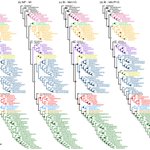
1/6 How do we advance beyond historical uncertainties in armadillo evolution? We started by building the largest morphological matrix for Cingulata to date, evaluating alternative analytical settings to find highly congruent trees across inference methods.
onlinelibrary.wiley.com/doi/…

5/6 Establishing an inclusive phylogeny and timescale of cingulates and clarifying long-standing conflicts between morphological and molecular evidence provides a framework for future exploration of palaeobiological, macroevolutionary, and biogeographical questions.
6/6 Huge thanks to my co-authors (Mariela Castro, Martin Ciancio, Timothy Gaudin, Jeremy Bramblett, Alberto Boscaini @abpaleo, Fernando Perini, and Max Langer) and funding agencies (@AgenciaFAPESP, @CAPES_Oficial, @CNPq_Oficial) who made this comprehensive study possible!
Daniel Casali retweeted

🚨 New terrestrial croc paper alert!
Another study led by @paiva_als (PhD student I co-supervise with Max Langer) is out today in Palaeontology!
We revisit a classic question with new tools: how big were notosuchians, really? 🐊📏
onlinelibrary.wiley.com/doi/…
Art: @MirantaKouvari

Daniel Casali retweeted

Happy to share our new paper published in Proceedings B! led by @acapomorphic and @SebastianHoehna
“How to date a molecular phylogeny: comparison of effective priors between node calibration and fossilized birth–death”
@RSocPublishing
🔗 doi.org/10.1098/rspb.2025.32…


Daniel Casali retweeted

Cualquier proyecto de investigación puede ser dañado por una lectura hostil, exigencias imposibles, criterios cambiantes, mala fe o por una posición de poder que decide qué cuenta como rigor y qué no.
Si lo que se quiere es destrozar un proyecto, se destroza.
Daniel Casali retweeted

With various colleagues including @lukejharmon I just published a new pre-print to @biorxivpreprint entitled "Unlocking a flexible set of phylogenetic models for discrete and continuous trait evolution using discretized stochastic diffusion." doi.org/10.64898/2026.04.20.… 1/7

Daniel Casali retweeted

A crise de reprodutibilidade nas análises filogenéticas tandfonline.com/doi/full/10.…

Daniel Casali retweeted
🚨 Out today: our Editorial in the Journal of Vertebrate Paleontology on an important issue in science - the reproducibility crisis in phylogenetic analyses.
In it, we analyze several years of editorial data to ask a simple question: are things improving?
tandfonline.com/doi/full/10.…

Daniel Casali retweeted
Many thanks to the JVP Senior Editors (Mike, Adriana and Julie) for inviting me to serve as a phylogenetic editor and for the opportunity to write this editorial. And huge shout-out to my colleague and friend @danielcasali13, who was with me throughout this insightful journey!
Daniel Casali retweeted

Estou muito feliz e impressionado com a repercussão do nosso estudo envolvendo a nova espécie de Ave do Terror, Eschatornis aterradora.
Muito obrigado!
@ThePalAss @TwitiGalli @NatSciChannel

Daniel Casali retweeted

A new terror bird (Cariamiformes, Phorusrhacidae) from the Late Pleistocene of Brazil: insights into the last representatives of the family onlinelibrary.wiley.com/doi/… #PapersinPalaeontology #FossilFriday

ALT Top right: map showing the position (red dot) of the Toca dos Ossos Cave fossil locality, with inset showing South America. The State of Bahia, Brazil, is shaded grey on both. Bottom left: Holotype specimen MCL-A-1.795, a left tibiotarsus, in medial view. Scale bar at top right is 1 cm. Bottom middle: a life reconstruction of Eschatornis aterradora by Zeinner de Paula, with the position of the tibiotarsus indicated with converging straight lines. Bottom right: red rectangle is cover image for the journal Papers in Palaeontology.

Daniel Casali retweeted

Before science, humans had very little freedom because nature decided everything:
If crops failed → famine.
If you got an infection → death.
If winters were harsh → starvation.
If a child was born → high risk of dying.
Science changed that.
Vaccines → freedom from many diseases
Fertilizers → freedom from constant famine
Electricity → freedom from darkness and cold
Antibiotics → freedom from deadly infections
Science doesn’t just produce knowledge. It removes the constraints that used to control human life.
And when constraints disappear, people gain freedom.
Science is the technology of human freedom.

