




Pinned Tweet
I wrote about what I loved Twitter a while back. Sadly, it’s all gone. NBA highlights and Polish Twitter isn’t enough to justify using this place regularly anymore. See y’all at some of the other places, and preferably out there in real life.
insidehighered.com/views/202…

Dominik Stecuła retweeted
New paper: "AI Article Reviews Dominate Human Peer Reviews at Their Best: Evidence and Policy Choices" See: GaryKing.org/peerless. with Steven Worthington. Comments welcome!

Dominik Stecuła retweeted

Churchill could have shortened WW2 by years if he had just “done a deal” with Hitler. George Washington could have done a deal to end the American Revolution. Zelenskyy is in good company.
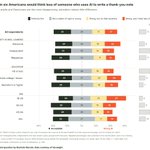
Thanks @verasight_data for fielding my question (it wasn't my best work, but I mostly came up with it on the spot). Anyways, young people seem to really dislike AI more than anyone else. 27% of 18–29 year olds say they’d think less of someone who used AI to write a thank-you note


The Verasight APSA 2026 omnibus survey report is out.
Here are just a few results from the 155 questions submitted by conference participants to our verified panel:
1. 63% of respondents say democracy in the United States is becoming weaker.
2. 59% of respondents trust neither polls nor prediction markets to predict who will win an election.
3. 69% of respondents say the costs of new data centers to their state's water and energy resources outweigh the economic benefits.
4. 62% of respondents have not used any AI tool to learn about politics for the election.
View the full report, findings, and methodology: reports.verasight.io/r/2026-…
Thank you to every researcher who contributed a question, including: @busranozguler, @DemocracyM, @emineari_IR, Celeste Beesley, @dburbach, @HayleyCohen, @MatthewDardet, @cantstopkevin, @SLDeMora, @fatiherol_pols, @goyal_tanushree, @RikioInouye, @lanalattu, @DebraLeiter, @wpmarble, @markovitis, @Jair1215_, @jkmucci, @noveyator, @lrpalladino, @haroldpollack, @jacobfhsmith, @decustecu, @DanielWSzabo, @GoszaTarasenko, @ozlem__tuncel, @samvannoort, @CBWlezien

John is an amazing scholar and a fantastic teacher. You should attend this seminar!

🗓️ 𝐃𝐨 𝐲𝐨𝐮 𝐨𝐫 𝐲𝐨𝐮𝐫 𝐬𝐭𝐮𝐝𝐞𝐧𝐭𝐬 𝐝𝐨 𝐬𝐮𝐫𝐯𝐞𝐲 𝐞𝐱𝐩𝐞𝐫𝐢𝐦𝐞𝐧𝐭𝐬?
On 12/3, I'm hosting a free, 1 hr. online seminar called, "Doing Better Survey Experiments" from 1pm - 2pm (ET). Please help spread the word if you can! 🙏
instats.org/seminar/doing-be…


This is one of the most exciting developments around making science accessible. For a while, I have lamented the fact that a static pdf is the currency of science. We didn't need AI to move beyond that, but it can really help us explore new possibilities. Sky's the limit, fam


I wrote a few words about a topic I’ve been thinking a lot about lately: how sports is one of the last vestiges of shared culture we have. And I think it can be leveraged for good.

Opinion: Ohio State football bring together people who might disagree on just about everything else. How Buckeye Nation offers lessons for divided America. 🏈 dispatch.com/story/opinion/c…

Dominik Stecuła retweeted

This is how US citizens and their noncitizen spouses and parents get treated daily in this country. There is no reason to do this. Listen to the terror when she thinks they are going to kill him. This campaign isn't "for Americans." It's a war on Americans.
Erin is on the job market. You should absolutely hire her.
Congratulations to @itserinfitz and @profgoose on a new article in the Journal of Retailing and Consumer Services, published with Verasight survey data.
"Who considers, who owns? Multi-study evidence on the behavioral process of cryptocurrency adoption in the United States" studies the step most research on cryptocurrency overlooks, the point where someone would consider owning it but does not yet.
Across three nationally representative samples of US adults, roughly one in five respondents do not own cryptocurrency but would consider owning it. Conservative political ideology and technological optimism related more strongly to considering, while stock ownership and disruptive orientations related more strongly to owning.
Read the full paper: doi.org/10.1016/j.jretconser…

Dominik Stecuła retweeted

Brilliant @APSAtweets panel arranged by @decustecu on the obligations of polisci during a age of contentious politics.
Diminished confidence in many institutions, for sure, but the GSS shows that only the press is polarizing faster thaneducation and science.

Dominik Stecuła retweeted

Gościnny, bardzo ciekawy tekst @decustecu o tym, jak w USA przespali transfer Roberta Lewandowskiego - trzeciego najlepszego piłkarza XXI wieku. Towarzyszący temu szum był niewielki, ale są plusy.
Przede wszystkim: sam transfer do MLS rzadko był głównym wydarzeniem.
ANALIZA:
weszlo.com/analiza-dlaczego-…

Dominik Stecuła retweeted

Jak Ameryka przegapiła transfer Lewandowskiego? Analizujemy marketingowe fiasko przenosin Polaka do Chicago Fire. Na twardych liczbach.
Do lektury zaprasza @decustecu, wykładowca na Uniwersytecie Stanu Ohio.
⬇️⬇️


Dominik Stecuła retweeted

Removing standardized tests has been a disaster for many top colleges.
Seven years ago, the University of California system appointed an 18-member committee to study the use of standardized tests in its undergraduate admissions. The committee included professors from all 10 campuses and a range of disciplines. They spent a year studying the issue and published a 225-page report full of evidence and recommendations.
The committee concluded that scores on the SAT and ACT, the main standardized tests for college admissions, did a better job measuring student readiness for college than high school grades. High test scores were particularly good at finding talented students from low-income families and underrepresented minority groups. For these reasons, the committee recommended the system continue to require applicants to submit SAT or ACT scores.
The university’s leaders disregarded the report.
A few months after its release, early in the Covid-19 pandemic, the system’s Board of Regents voted to stop using the tests in undergraduate admissions. Initially, the university planned to make the submission of SAT and ACT scores optional, as many other colleges did during the pandemic. Almost immediately, though, the University of California began refusing to accept SAT or ACT scores, even from students who wanted to submit them. The policy was known as “test blind.” University leaders wrongly claimed that it would make admissions fairer and more equitable.
The results have been terrible. At the University of California, San Diego, a faculty group last year reported “a steep decline in the academic preparation” among entering students. Last fall, for example, nearly 12 percent of first-year U.C.S.D. undergraduates were not qualified to take pre-calculus, a low-level class, up from only 0.5 percent in 2020. “The key problem is that many of the students coming in do not know algebra,” said Mina Aganagic, a Berkeley physics professor. More than half of entering Berkeley students who took a math placement test incorrectly answered basic questions (such as solving for x in x²> 4). nytimes.com/2026/07/06/opini…


Disgrace of Kansas City is gonna be lit.
The video is of Janusz Jojko, back when Polish football was comically corrupt in the early 90s.

Dominik Stecuła retweeted

Individual preference predictors for Messi:
1) Progressive ideology
2) Interest in politics
3) Highly educated
Ronaldo:
1) Short video consumption
2) High self-confidence
3) Authoritarian orientation

