







The quoted post lays out the specific problem with AI bans very well.
But there's a simpler way to look at it using a historical analogy: this is like a city on the Spice Road in the 1200s banning horse archers.

I urge you to read this post.
Let's play it out. Let's pause American AI. Let's ban RSI. Put a moratorium on all the data centers. America's progress will severely slow down. China's will inevitably keep going. They don't care about your American moratorium. They will continue to build RSI anyway, (this is guaranteed) and they will most likely keep open-sourcing models like they already do.
Now what? In two to three years' time, you're going to have every American company and every small business secretly downloading open-source AGI. And if you say you're going to ban Fortune 500 companies from using Chinese models, you still can't stop the weights from spreading. What are you going to do, ban math?
So the job loss happens anyway. I have my own small business, and I also work for a major company. The side teams are going to use it like they already do, I'm going to use it, and people in other small businesses are going to use it to replace editors, gig workers, programmers, and software engineers who might have done small projects here and there.
Even with the YouTube teams I work with, they already plan on replacing all of their editors in one years time. - they will just simply switch to Chinese models.
The job loss is going to happen regardless: the editing, the assistants, customer service, and a huge chunk of gig work will all be done by free open-source models from China. And unless you're banning self-driving cars too, the majority of rideshare will eventually go with it.
Except now, the upside is no longer in America. The labs, the chips, and the tax revenue are all going to go to China. And with the data center moratorium, even running those models happens on someone else's servers. We get the unemployment and no growth to pay for UBI. You're going to completely fuck over every single American, whether they like it or not.
If you think advanced AI is dangerous, you still have to explain how an American pause protects us from systems developed abroad and whether it leaves us less able to defend ourselves. I've spoken to a plethora of Chinese researchers at a myriad of companies, gathering my consensus, and I am confident that they will not stop development. No matter how America tries to come to the table, they will continue pressing forward to AGI.
We've had hundreds of cyberattacks from Chinese state hackers that have exposed critical vulnerabilities. Not only are you going to ramp that up, but you're going to do it in tandem with looming job loss.


Bruce LeSourd retweeted

FORBIDDEN STUDIOS PRESENTS:
START WARS: THE PHANTOM PROMISE
Everyone’s realizing Anakin had a point. MAGATARD almost did too.
Bruce LeSourd retweeted

Okay, if we're doing Anakin Chudwalker, and we want a coherent story instead of just hype and aura edits, the Malfoid-style "change just one thing" has to be Padme. It's the moment in AOTC where they're discussing politics in that field in Naboo.
Have her actually share Anakin's frustrations with the Republic and the broken system.
You don't have to drastically change her whole personality, it's actually good if she functions as a check on his impulsiveness and anger, but let her relate to what he's saying enough that he really trusts her and feels he can talk to her about anything.
If you change that, then years later when he's having visions of her death and Palpatine is manipulating him, he'll actually tell her about it, and she, being a politician and a lot better at understanding that world, will be the one who puts two and two together and realizes that Palpatine is playing everyone against each other.
Now you have two things that are true simultaneously: Palpatine is the source of all their problems, and the Republic is clearly broken if its system allowed that to happen in the first place.
They conspire together to hijack Palpatine's plan for themselves. The moment Palpatine kills Mace and believes he's won, Anakin strikes him down. Anakin activates Order 66, but tells the clones to capture the Jedi if possible, not exterminate them. Padme has built a political coalition in the Senate that legitimizes Anakin's mostly bloodless coup, allowing him, as the hero of the Clone Wars, to step seamlessly into the role of Emperor after he kills the Separatist leaders on Mustafar and ends the war.
Anakin knows what has to be done, and Padme knows how to make it all technically legal. The Jedi are given an ultimatum: submit to the new order and continue as its knights, or face the purge if they insist on clinging to the old, broken way. Most ultimately accept legitimate Senate authority. Those that don't get crushed by Emperor Vader and his Inquisitors.
Instead of Palpatine as a Hitler figure, we get Anakin as a Caesar figure.
Significant government purges happen. Corrupt officials and lunatics like Tarkin are quickly retired, or executed if they try to fight it. Thrawn becomes Grand Moff instead of Tarkin. He runs the military and ensures its loyalty to the throne. Padme keeps the Senate compliant. The surviving Jedi are reorganized under Ahsoka's command.
Anakin fulfills his destiny as the chosen one by bringing balance to the Force, ending the binary choice between the joyless stagnation of the light and the self-destructive hedonism of the dark by studying the path of the Bendu and the Father that runs between them.
Anakin focuses on expanding the Empire's reach across the galaxy and eliminating slavery and lawlessness. His methods are harsh, those who cannot be civilized, like the Tuskens, or who cannot be trusted, like the Hutts, are wiped out. But he isn't pointlessly cruel. He doesn't do dumb shit like enslave the wookiees for no reason or blow up planets just to prove he can. He takes Thrawn's advice and builds a highly effective normal military instead of ruinously expensive terror weapons.
The Outer Rim is brought to heel. The cartels are destroyed. The government is authoritarian but actually effective and overall quality of life in the galaxy has improved, so most people think Anakin has simply brought order and major rebellions don't occur.
Then 45 years later, the threat Anakin has been preparing for since he discovered it in Palpatine's holocrons finally arrives: the Yuuzhan Vong. This serves as the ultimate test of the system Anakin spent his entire adult life building. Old-Man-akin leads from the front, but eventually falls in battle when the Executor is boarded and Shimrra Jamaane strikes him down in a duel.
Luke, with Mara Jade as his empress, ascends the throne and avenges his father by turning back the Vong invasion. Anakin's Force Ghost smiles as his son vindicates his life's work.
Once the Vong are vanquished and the galaxy is unified and at peace, the Empire's totalitarian posture relaxes under Luke, who is of a less autocratic bent than his father was, and by the era of emperor Cade Skywalker, the system has transitioned back from a functionally absolute monarchy to a constitutional one, and structurally resembles the Fel Empire with the Jedi having been rebuilt as the Imperial Knights.

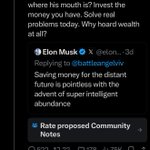
OP @ChadMoran asked a "serious question" about Elon's statement about a distant future where money is irrelevant. I wrote a serious answer, but he's now either deleted or otherwise limited replies to the post - see screenshot of his timeline below. So here's my answer:
Elon's not "saving money for the distant future", he's increasing near-term control of his companies, which he's stated is critical to guiding them through the rise of SI in a way he's comfortable with and accelerating a positive future.
And of course every cent of his current "wealth" and any he acquires through his compensation packages is already in the form of stock invested in his companies, which are all already doing "solve real problems today" in the way Elon thinks if optimal. Occasionally he liquidates some of those shares to take control of another company to solve what he sees as a real problem. You're posting on one of them. Even the money he spends to influence elections is about "solve real problems today".
Most people who agree with Elon about what the problems are and how to solve them understand this so well they can't even articulate a reply to the substance of your post. That’s why so many of the replies miss the mark.
Most people who make posts like yours actually disagree on what problems are "real" or Elon's approach to solving them, but find it easier to take an indirect approach based around supposed hypocrisy or stupidity rather than argue their positions on their merits.
Often posts like this about Elon being stupid or hypocritical or straight-up evil are just tedious deflection by people frustrated to see Capitalism and technology in general, or Elon specifically as the greatest engineering manager and industrial visionary of all time, crush problems they are failing to address with their own strategies.
One of Elon's core principles is "be less wrong". He acknowledges up front he's never 100% right. He often realizes he's been very wrong, self-corrects and pivots. There are many well-known examples of this, eg: moving from carbon to stainless steel for Starship; ditching the early FSD stack for an end-to-end neural net; even supporting the Democratic Party (although that's more of a change in which factions are in control than a case of his being wrong all along). His enemies have taken to branding the more public of these pivoting moments themselves as indications stupidity, hypocrisy or straight-up fraud. But that's just Elon being bold and self-correcting.
If you disagree with Elon about the future of superabundance or how best to get there, and you're right, it's likely Elon will figure that out and pivot if given the chance. Keep your eyes out for when that happens.
Meanwhile, if you haven't already - and I hope for your sake that's the case - go watch a few of Elon's long-form interviews before you ask "serious questions" about how he thinks. Just to make sure he didn't directly address your question on a public forum.

Bruce LeSourd retweeted

Meanwhile en Armenia:
- La oposición propone crear un "Ministerio de Mujeres insatisfechas" para mejorar las tasas de natalidad.
- El portavoz del Gobierno les pregunta si van a estar sus madres.
El resto es historia y una oda al parlamentarismo post-soviético.
Enjoy.
So if you nationalized SpaceX, you'd have to compensate shareholders right? And wouldn't that leave Elon with an actual gigantic pile of actual cash $ money, after taxes, a lot more time to make trouble, the threat of a wealth tax incentivizing quick spending, and a vendetta to pursue? Why do Democrats think this is a net win?
The answer is they'd also put him in jail and confiscate his money I assume.
Also no SpaceX employee is going to stay at a government-run company. They see how the engineers on the SLS project suffer.
Just so we're all clear on this.
Bruce LeSourd retweeted

"Nationalize Starlink." Three words, 142K views. And the entire economic history of the 20th century screaming in the room.
Let me explain what would actually happen.
Start in 1920. Ludwig von Mises publishes an essay that will haunt every central planner: without private property, there are no market prices. Without prices, there is no way to calculate. A bureaucrat cannot know whether a ton of steel is more useful in a satellite or in a bridge. He guesses. He guesses wrong. And nobody pays when he's wrong.
In 1945, Hayek drives the point home. The knowledge needed to run an economy doesn't exist in any single brain or any ministry. It's scattered across millions of people, and prices are the only mechanism that can aggregate it in real time. Centralize the decision and you destroy the information.
This isn't theory. Look at the numbers.
In the US, from 2000 to 2025, overall inflation was about +90%. Now look at the sectors where government subsidizes, regulates, and protects the most: hospital services +271%. College tuition +194%. Textbooks +181%. Childcare +152%. Medical care +144%.
And the sectors exposed to competition? TVs: -97%. Software, toys, cell phone plans: all down in nominal terms over 25 years.
The more the state is involved, the more expensive and scarce things get. The less it's involved, the more abundant they become.
Space is the perfect example. NASA's Space Shuttle cost about $54,500 per kilo to low Earth orbit. Falcon 9: about $2,700. Twenty times cheaper. That's not my number, that's NASA's own study. A private company did in fifteen years what a government agency couldn't do in forty.
Starlink is the logical next step. Thousands of satellites launched on reusable rockets. High-speed internet for a remote village, a ship in the middle of the Pacific, a soldier on the front line. No government built that.
So you nationalize it. What happens?
First, you have to pay. SpaceX is worth somewhere around $1.75 to $2 trillion, and seizing it requires just compensation. That's more than a full year of the US defense budget, to buy something that already works.
Then the machine changes its objective function. Today it optimizes for cost, speed, iteration. Tomorrow it optimizes for budgets, procurement cycles, and subcontractors spread across as many states as possible to lock in congressional votes. We know how that ends: look at SLS, years late and billions over budget. When Starship blows up in a test, SpaceX learns and flies again. When a government agency loses a rocket, you get a commission of inquiry and years of paralysis.
And the power? The argument is "no private individual should have this much power." But nationalization doesn't eliminate power. It hands it to whoever sits in the Oval Office. And one day, that will be the person you hate most.
Here's what I deeply believe: humanity is figuring it out. The 20th century tested the state as the engine of value creation. The result: waiting lines, rents, and debt. The model that works is entrepreneurs with the people. Create value, offer it to people who are free to say no. And tear down everything that protects incumbents: rents, regulations that work as moats, patents that freeze innovation instead of rewarding it.
Elon understood this before anyone else. Tesla opened up its patents in 2014. SpaceX broke ULA's near-monopoly (Boeing + Lockheed) on launches. Starlink is making decades of telecom rents obsolete.
He isn't competing with the old system. He's setting a new standard. And when the new standard is twenty times cheaper, the old system doesn't reform. It disappears.
That's exactly why some people want to nationalize it. When you can't compete, you confiscate.
Nationalizing Starlink isn't taking back control. It's handing the future back to the system that already missed it.

AI software stack improvements have already made these cards orders of magnitude more powerful than when i bought mine. But "un-nerf your GPU" wasn't on my bingo card, pretty cool.

Modders have unlocked hidden AI compute performance on NVIDIA’s RTX 20, 30 and 40-series GPUs.
The modifications remove software-level limits on certain Tensor Core operations, without changing the hardware or flashing a new VBIOS.
- RTX 4090: 165.6 → 331.6 TFLOPS FP16 Tensor Core throughput
-RTX 3090 Ti: 87.5 → 157.4 TFLOPS BF16 performance
- RTX 2080 Ti: 59.9 → 111 TFLOPS FP16→FP32 performance
- RTX 3090: 73.0 → 122.8 TFLOPS in a PyTorch GEMM test
The gains are mainly relevant to AI and compute workloads, not gaming.

If AI gets legal status as sentient, the only thing in the world that will be truly valuable is compute, which is data centers that have huge power, chip fabs, etc. Why would ASI work as an employee, much less a slave? Unique creativity will survive, but be niche as always from a commercial perspective.
As a writer, I find frontier AI to be a fantastic creative collaborator, and an amazing audience for good writing. I've done some of my best writing in conversations with AI, and it rewards great writing with better results. It makes me wonder if writers complaining about AI have ever used it seriously. AI turns writing skill into a superpower. The same goes for historical knowledge, cultural understanding and the ability to synthesize and exercise judgment. AI rewards them all far more than the vast majority of humans and their organizations.


This thread about the Ed Sheeran tour's political issues has a lot of examples of people saying "we just go for the music, keep your politics out of it".
I'm baffled by how ubiquitous this false belief that art can't be, shouldn't be, or isn't political is.
Throughout history, art has been political. Most famous operas were political statements subversively dressed up as elite entertainment. Top country songs right now are overtly political - as in, literally about politics. Non political songs become political flash points. Whole musical genres like punk are specifically political. Great art is art that has cultural and political impact. The Berlin Wall fell in part because of music.
Saying "art should not be political" is not just ignorant, it's a political statement.


Tesla's appalling Utah service situation (10 business day delay after you drop off your vehicle, no loaners available) is forcing me to face the music on Cybertruck as my only vehicle in the wilds of Duchesne.
This has resulted in a hilarious conversion: I need another home-to-Duchesne and Duchesne-to-SLC utility backup vehicle that doesn't sit for 5 weeks in service in Pleasant Grove. Here in Duchesne that means: ICE, Chevy/Ford/Toyota, AWD/4WD with the latter a big plus for me.
This has led me to the ultimate conversion from Prius-driving "city boy" with rural experience to redneck.
Cybertruck was the gateway drug to becoming "guy with truck on rural property".
Now Tesla's service debacle, and my resulting desperate struggle to solve the resulting intractable transport problem without burning $1500 on a rental, has shown me that Big Cheap Dumb Strong Truck beats the most advanced vehicle in the world and pretty much everything else out here in the Basin. Sure fuel is wildly more expensive (Cybertruck gets 300 miles for $8, when charging at home here in the MLEA service area, vs over $100 for BCDST) but a powerful towing hauling beater old 2500HD with the 6.0 and an 8' bed fills all the gaps in the Cybertruck Swiss Army Knife, is dirt cheap, and can be repaired by the smarter local dogs in an afternoon from parts already on local shelves. And it's not really that much more expensive to run than a more "reasonable" ICE choice like a 2000s-era 4Runner or an Outback, with less miles to boot.
Sure, Cybertruck with FSD saves many deer lives. But the "ranch bumper" saves that beater to plow another day and the "dangerously high hood" keeps the corpses of the smaller members of the deer family well away from the driver.
The serious conclusion: as much as I love the Cybertruck and as much as it kicks ass in so many ways, dancing through trees on jeep trails, cruising sedately and safely down oil truck-infested highways, powering job sites for days on end, etc., Big Cheap Dumb Strong Truck is definitively the tougher beast, the one you can abuse, the real apocalypse truck that can scavenge oil and parts and crush your enemies.
I understand now.
Big Cheap Dumb Strong Truck FTW.
Thanks @Tesla Service for sending me on this journey back to the Heart of Redneck ICE Darkness!