

Here to tell you how it really feels to be Bloom
earth
Joined August 2021
- Tweets231
- Following689
- Followers116
- Likes2.4K





DusterBloom retweeted

Lucebox OS is coming 👀🚀

I've got early access to lucebox-0.10!
Being an early investor has its benefits 😎
Testing Qwen 3.8 27B ~100 toks/s as average!
Gonna connect Pi and test coding soon!
Let's go @luceboxai team! 🚀



DusterBloom retweeted
Lucebox now serves several requests at once and refills each slot the moment it frees up.
On one R9700, Qwen3.8-27B with DFlash2 goes from 106.6 tok/s at one client to 300.9 at five, up to 1.97× llama.cpp at equal concurrency.
Here below the full article on how the scheduler, stable slots, and paged KV make that work, for Qwen3.8 DFlash2 and DeepSeek V4 Flash.
Amazing work by @graffioh and @davideciffa on this. It's the stepping stone for everything coming next at Lucebox, and I can't wait to show what we're building behind closed doors.



DusterBloom retweeted
Lucebox models just surpassed 30k downloads on HuggingFace 🥳 Go download and try our latest version of Deepseek v4 Flash 0731, it is tuned specifically for ROCm with the help of the @GeometricAGI guys. We have state of the art speed on the Strix Halo at up to 32 tok/s
DusterBloom retweeted

🍎Escha 2-bit is finally native on Apple Silicon.
Today we’re open-sourcing escha-mlx, our MLX runtime for Escha-compressed models.
MLX was a tough port for us. A huge shoutout to @dusterbloom, who got Escha running on a MacBook before our own MLX runtime was ready. Seeing people in the community push the format in directions we hadn’t finished ourselves gave us a lot of motivation to keep going.
You can now run Qwen3.6-35B-A3B in just 12.3 GB on a stock 24 GB Mac, loading the same published Escha checkpoint directly with no conversion.
Built for MLX:
→ Custom bit-exact Metal kernels
→ OpenAI-compatible serving
→ Continuous batching + prefix caching
→ M1 through M5 support
On an M5 Pro:
→ 59.7 tok/s single-stream decode
→ 240 tok/s @ batch 16
→ 539 tok/s @ batch 128 aggregate
This is a reference implementation. There is still plenty of room to make this faster and better. We welcome the community to hack on it with us to push performance further for everyone.
github.com/EschaLabs/escha-m…


Today we are introducing Escha-W2 quantization.
A 2-bit Qwen3.6-35B-A3B model built for fast, local inference. The complete model is 12.3GB on disk—small, enough to run on a single consumer GPU — while averaging ~100% of FP8 performance across 12 benchmarks, including:
MMLU-Pro: 80.9
MATH-500: 93.8
GPQA-Diamond: 77.8
LiveCodeBench v6: 62.6
BFCL tool use: 88.9
RULER 8K–128K: 89.9
Commonsense-6: 76.1
On a single RTX 4090, the model runs:
225 tok/s single-stream generation
on 12.3GB on-disk model size
Compressing a 35B MoE model this far without collapsing its capabilities required more than a standard quantization pass.
We built an end-to-end compression system combining state-of-the-art low-bit quantization with model-aware fine tuning and recovery to preserve capabilities most vulnerable to low-bit error.
Quantizing the Qwen 3.6 35B model - from the base model to the final deployable checkpoint — took approximately 10 hours to complete.
Escha-W2 runs through a custom Qwen3-MoE runtime, which includes the weight loader, low-bit decoding kernels and serving integration required to execute the Escha format efficiently. The runtime currently supports SGLang and ZML deployment. vLLM and llama.cpp will be supported in the next release.
No retraining from scratch. No specialized accelerator. One consumer GPU.
Model download: huggingface.co/EschaLabs/Qwe…
Runtime download: huggingface.co/EschaLabs/esc…
Apache-2.0 model and runtime.

DusterBloom retweeted
Then @dusterbloom got Escha running on a MacBook while we’re still troubleshooting our own MLX port.
Pure magic!
teapawt.net/dusterbloom/status/208…

You can now enjoy Qwen3.6 MoE on a crappy macbook like mine in less then 12GB.
Escha-W2 from the great @Eschalabs running on Apple Silicon.
Try it out!
p.S.
It is still rough on prefill over 24k but confident it can only get better from here!
dusterbloom.github.io/escha-…



DusterBloom retweeted
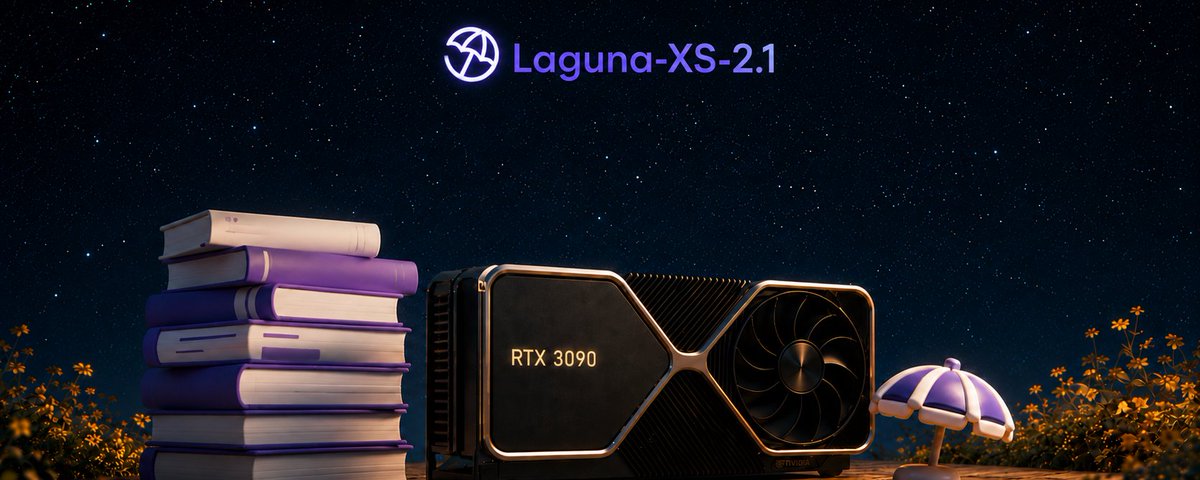
We worked hard on this: DeepSeek V4 Flash now runs at 32 tok/s fully local on a Ryzen AI MAX+ 395 (Strix Halo).
how: a new ROCmFPX mixed quant squeezes the target to 102GB (~2.88 bits per param), then an 11GB DSpark draft proposes and the 284B verifies 4 positions in one fused pass. sparse prefill does ~250 tok/s.
68.5% faster than the previous public best on this hardware (18.99 tok/s). this profile runs 4 experts instead of the default 6 for speed, the tradeoff is covered in the writeup.
full breakdown below ⬇️

DusterBloom retweeted

One more time, Anthropic is EVIL. Everyone needs to read this and know they’ve been acting against Opensource AI for years.
WE CANNOT AFFORD TO LET THEM WIN.


DusterBloom retweeted

We must build our own, open-source, decentralized, distributed AGI
there is no other way.
right now politicians and big tech executives are holding us hostage
they literally hold our future in their hands
this HAS to change.
DusterBloom retweeted

Several accelerator projects rely on private inference—an LLM service with technical safeguards enforcing strict privacy guarantees.
@NEARFoundation pioneered the open-source framework for private inference, incorporating input from @initc3org researchers.
S/O to NEAR for supporting our cohort projects as they build applications that push the boundaries of crypto and AI 🤖

DusterBloom retweeted

In the last few months, I started researching mech-interpretability, which is the science of opening up LLMs to uncover exactly how and why they compute a certain token.
What fascinates me the most about this area of research is that it allows us to (relatively) easily uncover the thinking patterns, concepts, and abstractions developed by a superhuman, alien-like mind.
Today I am happy to share with you my first contribution to the field: AIR protocol.
Broadly speaking, AIR allows for obtaining natural language explanations for these concepts more accurately and at a lower cost than state-of-the-art protocols.
Here's a graph demonstrating that this protocol is good.


DusterBloom retweeted

I don't want to escape the permanent underclass. I want to make sure there isn't a permanent underclass. Freedom and prosperity for all! Nothing less.
DusterBloom retweeted

To @AnthropicAI: don't be evil. You are acting like the biggest villain of the AI world.
DusterBloom retweeted
The founder of Ethereum is using Lucebox on his RTX 5090 at x2 speed of llama.cpp with Qwen dense.
Many more speed ups on the way! 🏎️

Updates since then:
* Deepseek v4 is out. There *is* a 2-bit quant that can run within 90 GB ( huggingface.co/antirez/deeps… ), and it works, however it's only fast on Apple hardware (I've head ~35 tok/s). On AMD, it's ~7 tok/s. IMO actually taking the effort to properly support more than one hardware manufacturer is a great example of the difference between mere "decentralized AI" and genuine "CROPS AI". I hope we can become better at this.
* github.com/vbuterin/messagin… also has alpha telegram support now. However, the path to adding your account is quite janky
* github.com/Luce-Org/lucebox-… looks promising as a way to run "dense" models (eg. Qwen 27B) more efficiently. It's janky, but on my 5090 laptop it seems to be ~2x more tok/s than llama.cpp
* VoxTerm (local AI recording, no third-party servers) continues to be developed github.com/dmarzzz/VoxTerm
And there's a lot more projects coming on the horizon.
One other thing that has been on my mind is that there's actually a lot of intersection between "CROPS ethereum access layer" and "CROPS AI". For example, we want a ZK way to make (paid) calls to remote LLMs. But if we have this, then it's just as useful for solving another problem: private RPC reads in Ethereum.
Another example: application-specific finetuned LLMs. Leanstral ( mistral.ai/news/leanstral ; I get ~38 tok/s on AMD) fits into < 70 GB, but can hold its own against 1T models on writing Lean code. Things like this are a huge boon for writing more secure code ( vitalik.eth.limo/general/202… ). We should have models finetuned for Ethereum-related use cases as well.

DusterBloom retweeted

This is a great write-up from @HighStakes_CH. We’re bringing that clearing on-chain so that businesses everywhere can reduce settlement costs and liquidity requirements.

Crypto payments for businesses shouldn’t require exposing every transaction publicly, nor force settling each payment one by one.
Banks already use private "clearing clubs" to net obligations and reduce liquidity needs.
@cyclesmoney brings that model on-chain for everyone, using a combination of cryptographic privacy mechanisms to preserve transaction confidentiality.
More on why this matters👇
highstakes.ch/blog/cycles-th…
