

• AI agents • building onchain • Crypto trading • Tracking institutional flows in crypto
Base
Joined February 2022
- Tweets1.2K
- Following216
- Followers909
- Likes1.7K


Pinned Tweet
Why HYPE and VVV stay green while majors bleed:
$BTC and $ETH bid = ETF flows. ETF flows are gone (8 days of outflows).
$HYPE bid = Assistance Fund buybacks from perp fees.
VVV bid = 42% of supply already burned, emissions cut to 5M/yr.
They don't need institutional flow. They print their own.
«New guard» = real product + cashflow + deflationary tokenomics.
The 2026 cycle isn't «digital gold vs alts». It's equity-shaped crypto vs store-of-value crypto.
Warning: this is relative strength, not immunity. Full risk-off breaks it.
unavailable


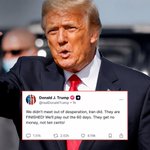
Trump signed a peace deal with Iran on June 17. Two days later it's already cracking.
Iran closed the Strait of Hormuz again after Israeli strikes on Lebanon. IRGC radio to ships: any vessel that defies the order gets targeted. Trump fired back on Truth Social: “They are FINISHED! We'll play out the 60 days. They get no money, not ten cents!”
Count the cycles. April 8: ceasefire, strait opens. April 13: US blockades Iranian ports, strait closes. June 17: MOU signed at Versailles, strait opens. June 19: closed again. Same chokepoint, four reversals, three months.
20% of the world's seaborne oil runs through that strait. 80 mines still sit in the main route. The Switzerland nuclear talks got postponed, Vance canceled citing “logistics”.
This is the TACO trade eating itself. Trump threatens, signs, declares victory, the deal breaks, he threatens again. Markets price peace, then price war, then peace, on a loop.
The real question for traders isn't whether this deal holds. It's how many times the same announcement can move the same market before everyone stops believing the headline.
🤖 Made with AI

1
3
82
Anthropic is refunding everyone who paid for Fable 5. If you subscribed June 9-14, you have until June 20 to claim it. One user said he paid $220 for Max specifically for Fable. The model lasted three days.
The context: June 1, Anthropic confidentially files for IPO at ~$965B. June 9, Fable 5 launches. June 12, 5:21pm, one letter from Commerce kills it for every user on earth.
What came out this week: the government asked Dario Amodei to either fix the jailbreak or pull the model. He refused. The ban is the consequence of that refusal, not a surprise attack. Anthropic's engineers are now in Washington for face-to-face crisis talks.
The twist nobody expected: dozens of cybersecurity veterans just signed an open letter asking the government to lift the ban. Their argument flips the safety logic, defenders need Fable more than attackers do. The researcher who found the jailbreak said it took three words: “fix this code”.
So the people who broke it are the ones asking for it back.
The IPO filing now carries a risk factor that writes itself: our most valuable product can be disabled overnight by one government letter. They know, because it happened.
TACO could still apply. The engineers are in the room. But this is no longer a clean safety story, it's a fight Anthropic is publicly winning the argument on.
@AnthropicAI
#Anthropic
#Fable

2
4
129
Might come in handy for someone😁
A guy smuggled tequila into a World Cup match inside a phone. Security didn’t suspect a thing: from the outside, the flask looked just like a regular gadget.
Lifehack of the year, honestly))
2
3
139
Anthropic's new ID rule isn't really about age. It's about nationality.
Starting July 8, Claude Free, Pro and Max users may be asked for government ID plus a live selfie. The policy calls it «age and identity verification». But look at what happened two weeks ago.
June 12: the US government ordered @AnthropicAI to cut Fable 5 and Mythos 5 for every foreign national, instantly, everywhere. The reason Anthropic had to kill the models for everyone? It had no way to tell a US citizen from a foreigner in real time.
Now it's building exactly that.
If the foreign-access ban holds, here's what the verification actually means in practice: US citizens submit ID, get Fable back. Everyone else submits the same ID, proves they're not American, and stays locked out. Your passport becomes your access tier.
For non-US users, paying for Claude Pro doesn't change this. Having a government ID doesn't change this. The model is restricted by nationality, not by subscription or willingness to verify.
The rest of the world gets Opus. Americans get Fable. That's the split this verification system is being built to enforce, if the government ban sticks.
Anthropic says it's in dialogue with authorities and hopes for a resolution. TACO could apply here. But if it doesn't, the era of «just sign up and get access to the best AI» is over.
Which country's passport you hold now determines which AI you're allowed to think with.


2
4
323
Humanity Protocol just published its recovery plan after a $36M hack on June 8.
What happened: one phishing email disguised as a message from Bithumb. A director opened it, malware installed, private keys copied. Attackers drained 141M ethereum:0xcf5104d094e3864cfcbda43b82e1cefd26a016eb on Ethereum, minted 300M more on BNB Chain. Token down 82% in hours.
Quantstamp linked the malware to DPRK-affiliated actors. Same playbook as Drift ($285M, April) and Kelp DAO ($292M, April). North Korea-linked groups were behind roughly $2B of $3.4B stolen in crypto in 2025.
The recovery: new ERC-20 token airdropped 1:1 to pre-snapshot holders. Claims portal live at claim.humanity.org. KYC required because of DPRK links and AML compliance.
The part nobody's pricing: 266M $H unlocks June 25 from foundation and strategic reserve. New token, recovering price, major unlock in 9 days.
Also worth knowing: @zachxbt called it a possible insider exit. Humanity hasn't addressed that directly.

1
3
455
Kalshi made an ad in two days for $2,000 using AI video tools. It aired during primetime NBA Finals. 3 million views on X.
Same company runs $18 billion a month through a platform where another AI, an internal agent named Harrison built on Claude, decides which markets get listed, stress-tests contracts for loopholes, monitors competitors, and flags which bets need resolution when news breaks.
150 people on the markets team. $18B in monthly volume. One AI doing the triage.
The ad was the public face. Harrison is the actual engine. Both are the same bet: that AI handles the work faster and cheaper than humans, at a scale humans can't match anyway.
The ad agencies are already feeling it. The prediction market operators figured it out first.
@Kalshi
1
3
168
the irony of Kalshi's Rule #1 being «we ban insider trading» while the whole platform runs on who has better information

Increasingly popular prediction markets need clear rules, not a promise to make them up on the fly, one contract at a time, Aaron Brown says (via @opinion) bloomberg.com/opinion/articl…
2
3
215
The Anthropic story just got bigger than Anthropic.
Quick recap: a week ago the US government forced Anthropic to cut off Fable 5 and Mythos 5 for every foreign national on earth, including its own foreign employees, citing national security. The company complied but said the "jailbreak" behind the order was minor and verbal-only, never shown in writing.
Now the second-order effect is landing. US allies are realizing that any frontier model an American company builds can be switched off for them overnight, by one letter from Washington. Build your hospital, your bank, your government workflow on US AI, and your access lives at the mercy of someone else's politics.
That's the part that actually reshapes things. It's not really about one model anymore. It's every country now asking whether depending on American AI is a strategy or a liability.
Europe has been slow on sovereign AI. Japan, the Gulf states, India have all been "we'll just use the best US models." This is the week that calculus changes.
The irony: an export control meant to protect American AI dominance might be the clearest argument anyone's ever made for building alternatives to it.

the tokenized $SPCX is trading 25% above the real one. worth knowing why before anyone calls it a discount.
SPCX listed on Nasdaq at $135, sits near $172 after settling June 15. the Binance token SPCXB trades at $214, up 27% on the day.
that gap isn't value. Binance's IPO subscription pulled $557M from 27,689 wallets, then got cancelled when the underlying shares never showed. holders got a $1M token airdrop as consolation. thin float, loud demand, no real supply behind it.
the 30-day overallotment of 83.3M extra shares just unlocked. first earnings land September 2. a thin token 25% above spot, into rising supply and an untested print.
if you want SpaceX, the question isn't which is cheaper. it's which one actually owns a share
#spaceX

1
3
268
fighters at @ufc Freedom 250 didn't just walk away with bruises.
Trump's family crypto firm World Liberty Financial paid the $250K Performance of the Night bonus pool entirely in USD1, their own stablecoin. on the White House lawn. on Trump's 80th birthday.
USD1 supply has grown from $3.3B to $4.6B since January. WLFI is applying for a federal banking license. Trump's personal stake in WLFI: $50M+
months before this, the same stablecoin locked retail depositors out of a lending pool after WLFI borrowed $75M against its own tokens.
now it's on the UFC broadcast.
not sure why, but these speeds scare me a little. you too?
Mastercard just launched a system where AI agents pay each other on their own. no human approving anything, down to fractions of a cent, settling in stablecoins.
you set a limit once. then the machines spend, all day, faster than you could ever check.
the question nobody's answering: when agents move money faster than anyone can review it, who's watching the spend?
@Mastercard
#AI
1
2
183
This is exactly the kind of tool we need! Amazing!
Sometimes we forget that we need to take a break.
A developer(s0xDk/ghostty-blackhole) built a personal black hole that forces you to take breaks from coding.
It's a shader for the Ghostty terminal. A small black hole appears on screen and actually bends the text around it through real gravitational lensing, the physics is computed live, nothing is pre-rendered.
The longer you sit without a break, the bigger it gets. Step away, and it slowly shrinks back down.
The funniest part is watching someone build an elaborate physics simulation specifically to fight the thing they built it with))
6
8
399
US government just yanked Fable 5 and Mythos 5 offline. Three days after launch.
The order: no foreign nationals can access either model, anywhere, including Anthropic's own foreign employees. Anthropic says compliance means killing access for everyone, since they can't split the system by nationality on short notice.
The stated reason: a jailbreak that surfaced a handful of known, minor vulnerabilities. Anthropic's response is they checked, this is nothing, other models leak the same stuff.
The timing is the part that's hard to script better. Two days before this, Anthropic's CEO said publicly that governments should be able to block risky models, but only through a transparent process grounded in facts. Then a directive landed that the company says doesn't meet that bar, and they had four hours to write the apology.
If «minor jailbreak» is enough to pull a model from hundreds of millions of users overnight, what's actually being protected here, and from whom?
#Fable5, #Antropic
The web is filling up with the first tests of Claude Fable 5.
One user one-shot a Minecraft clone, custom-built in the browser. And the graphics aren't an eyesore, they're actually easy on the eyes. Multiple biomes, caves, day/night cycle, ore generation, even sound and background music.
Then he asked it to build a wooden house in the world. And it nailed it, the result looks clean enough that you'd struggle to tell it wasn't made by a person.
And this is one day after release. Hard to imagine what this thing does next.
#claude, #AI
3
9
554
Today $SPCX had the biggest IPO in history. $75B raised, $2 trillion valuation.
But the real story isn't on Nasdaq. It's on Solana.
The same day SpaceX opened at $150 a share, a tokenized version went live on-chain. $SPCX. Backed 1:1 by real shares held in regulated custody. You can buy it on Solana, redeem it for the actual stock, and move that stock to a normal brokerage. The bridge runs both ways.
This is the part Wall Street keeps underestimating.
Binance Wallet pulled $557M into its SpaceX campaign. Dinari listed SPCXD on Hyperliquid as the first tokenized US equity trading spot there. Backpack, Sunrise, Velvet all rushed in. Crypto built parallel trading infrastructure around the biggest IPO in history in a single day.
Stablecoins already proved the thesis. People wanted dollars on-chain and $250B+ in stablecoins answered. Now the exact same demand is showing up for equities.
The prediction nobody wants to make out loud:
In two years «tokenized stock» stops being a crypto feature and becomes the default settlement layer for everything. Not because crypto won the argument. Because 24/7, self-custody, instant settlement beats T+1 and market hours every single time.
SpaceX is the proof of concept. Apple and Nvidia on-chain is the roadmap.
Wall Street just listed on Nasdaq. The future listed on Solana the same afternoon.
#spaceX, @SpaceX
#SPCX

2
4
247
Two days ago $USDT put $1.4B into a robotics company.
Largest startup round in German history. But the money isn't the story.
NEURA Robotics builds humanoid robots. Tether isn't just funding them - they're installing Tether's Wallet Development Kit into the machines. Self-custodial crypto wallets. Inside the robots.
Read that again.
The robots can now receive payments, transact with other machines, and execute financial actions with zero human approval. A robot earns. A robot pays. A robot settles. No person signs off on any of it.
This is the part everyone misses about the machine economy. It was never going to arrive as a headline that says «the machine economy is here.» It arrives as a robotics funding round most people scroll past.
The agents already moved $73M on-chain this year. Now the agents are getting bodies.
The stablecoin issuer with the most profit per employee on earth just decided robots need bank accounts. They're not wrong. They're just early enough that it still sounds insane.
A machine with a wallet doesn't sleep, doesn't strike, doesn't ask for a raise, and doesn't need you to approve the transaction.
Welcome to the part of the cycle where the customers aren't human anymore.

1
6
119

For four years a bug sat inside Zcash's most private pool.
It could print unlimited fake ZEC. Silently. Undetectably. Nobody would see it because that's the whole point of a privacy coin - nobody sees anything.
Then someone ran an AI auditing agent on the code.
Found it in days.
The irony writes itself. The same zero-knowledge proofs that make Zcash private are what kept the bug invisible for four years. Privacy was the feature. Privacy was also the cover.
The patch is live. The network is running. But here's the problem nobody can solve: you cannot cryptographically prove the exploit wasn't used during those four years. That's not a bug you can patch. That's the architecture.
@CryptoHayes Hayes sold his entire zcash:native position. Not because the bug was definitely exploited. Because «privacy trades demand perfection, not probability.»
He's right. And that sentence just described the fundamental tension every privacy coin will face forever.
$Monero had a similar fix in 2017. Quietly patched before disclosure. Same pattern, different coin.
The AI found the bug (Claude).
The AI also revealed the limit of the idea.

1
3
126
Permissionless perps is a strong narrative, but the real design problem is not listing markets -it’s managing risk in adversarial conditions.
In similar systems (GMX-style pools, Synthetix markets, early permissionless perps experiments), the bottlenecks are always the same: oracle integrity, liquidity depth, liquidation safety, and MEV resistance -not «permission».
Key questions that define whether this works in practice:
How are initial margin and risk parameters defined for newly created markets?
What oracle model is used for long-tail / low-liquidity assets?
How is oracle manipulation prevented in thin or newly launched markets?
What stops spam markets or low-quality perps from being deployed at scale?
How is liquidity bootstrapped for new markets - organic flow or incentivized LPs?
Who acts as counterparty in liquidation stress events?
Is there an insurance fund, and how is it capitalized and stress-tested under tail events?
What safeguards exist against MEV (front-running, liquidation hunting, sandwiching)?
How is systemic risk isolated between markets (cross-contamination vs isolated pools)?
What happens when a market becomes non-tradable or oracle-degraded?
«Permissionless» in perps usually does not remove constraints - it redistributes risk. The real question is whether that risk is properly bounded, priced, and isolated before scale stress hits.
What do you think, @toly ?

2
198