

Vater, Bürger, Niederösterreicher. Freier Journalist, u. a. Datum, WZ, Missing Link; vormals Kleine, Presse, NZZ, Addendum. Beseelt von Garten, Tee und Bienen.
Joined August 2012
- Tweets82.2K
- Following261
- Followers26.2K
- Likes73.7K




Ich habe heut in Zeitungen gelesen, dass wir unbedingt
a) ein neues Fußball-Nationalstadion
b) eine Skihalle
brauchen. Man fragt sich halt schon, in was für einer (Budget-)Welt Sportler so leben.
Georg Renner retweeted

China consumed more coal in the last four years (2022–2025) than the entire world consumed throughout the 19th century.
Die Neutralität schützt uns nicht.
Also: wozu sind wir dann überhaupt noch neutral?
mailings.datum.at/u/archive/…
„You can't solve the problem by going after immigrants (as the right asserts) or the rich (as the left asserts), but you could solve it by going after the old.“

The ugly truth about France and some of the other European countries currently in turmoil - and which none of the politicians want to admit because it'd be political suicide - is that you can't solve the problem by going after immigrants (as the right asserts) or the rich (as the left asserts), but you could solve it by going after the old.
One extraordinary statistic for you: people over 60 in France, a quarter of the population, own 60% of France's wealth, non-financial and financial (ofce.fr/pdf/revue/2025/3-192…).
And here is another crazy statistic:
that same quarter of the population, those above 60, receive nearly two-thirds of all social spending by the French government (previssima.fr/actualite/prot…) - which is famously among the highest in the world (France's government spending is an insane 57.3% of GDP).
Last statistic: they make up about 40% of voters because they're a third of registered voters (insee.fr/fr/statistiques/266…), and they turn out far more than anyone else (franceinfo.fr/elections/sond…).
Put our 3 statistics together and there's almost a bit of an apartheid situation here: the old own most of the country's wealth, collect most of the social spending and have the political power to keep it that way.
Which makes them a de-facto rentier class, living off assets and transfers paid for by younger generations.
And, of course, at the risk of stating a truism, the future is built by the young. Yet France keeps effectively taking money away from them to give it to those whose working lives are already behind them - and need the money far less since they already own the country's wealth.
What about inheritance, I hear you ask? That's the funniest/saddest aspect: given that life expectancy has kept rising, the French now inherit a home at 54 on average. The most common case is someone in their 80s leaving it to heirs in their 50s, in effect the very old transferring wealth to the about-to-be old (insee.fr/fr/statistiques/fic…).
You can add this to our earlier apartheid statement: on top of all the rest, even when the old finally let go of their wealth, it stays within their own "camp".
That's my personal situation, incidentally: I'm 42, my father is 71 and he is starting to look at ways to pass things on to me and my siblings, when our professional lives are already well settled, so it'll arrive when it changes things the least, which is pretty much the French system in a nutshell.
Now, I get that there'd be some unfairness in going after them: they paid into the system their entire working lives, playing by the rules of a social contract that told them if they paid up they'd collect at the end. Changing the rules now means breaking that promise, which is admittedly unfair.
But there's no magic wealth tree in any society: you can only take it where it is. That's the way most major societal transformations end up happening. They're often triggered by a catastrophic event (the so-called "four horsemen": mass-mobilisation war, revolution, state collapse, plague) BUT what really drives change is a transfer: wealth gets pried from the privileged class who've been sitting on it and handed to those who'll build what comes next.
So, in theory and in an ideal world, you can do without the catastrophic event and directly proceed with the transfer...
The fact that in France, and elsewhere in Europe, it's the youth protesting is probably no coincidence - even though they don't frame it as a generational fight. And even though, cruel irony, the left politicians many of them march behind promise to bring the retirement age back to 60 (lcp.fr/actualites/legislativ…), which would make the situation even worse.
Let's say they understand intuitively that the system is stacked against them, even if they haven't yet figured out how. And politicians are obviously doing what politicians do, meaning pandering to the people who actually vote, while pointing the young towards easier - and politically convenient - scapegoats.
To be clear I'm not saying it's the only problem in France, VERY far from it. I'm also not saying that all old people in France live a lavish lifestyle at the expense of younger generations: there are also plenty of very poor retirees who, if anything, would deserve more.
What I am saying is that it's probably the biggest elephant in the room: everyone can see it, nobody dares mention it - no politician, from any side, wants to run on cutting grandma's pension - and it makes every other problem harder to fix.
+1, sensationell

Ich war letzte Woche im PVZ St. Pölten, das ist das größte PVZ Österreichs. Ich hatte die Möglichkeit, zwei Stunden intensiv mit dem Gründer zu reden. Ich bin zutiefst beeindruckt. Das ist ein Mini Spital, nur freundlich, termintreu und umfassend. In einem Gewerbegebiet vor St. Pölten. Was für ein großartiger Unternehmergeist, was für eine gute Versorgung. Und Zusatzangebote von Wahlärzten auch dabei. Das war wirklich toll!

Bedenklicher write-up des beschleunigten Sicherheitsverfalls im digitalen Raum in den vergangenen Wochen von Zvi Mowshowitz (ja, DER Zvi Mowshowitz).
Samt Prognosen und persönlichen Handlungsempfehlungen.
The Hackening
thezvi.substack.com/p/the-ha…

Georg Renner retweeted

Gerade diejenigen, die immer wieder „Verhandlungen“ und „Frieden“ fordern, betonen, dass „nun endlich Schluss sein muss“, und gleichzeitig davon ausgehen, Russland werde Europa niemals angreifen, sollten sich einmal mit den Aussagen aus dem Kreml und dem russischen militärischen Fachdiskurs auseinandersetzen.
Die Datenlage ist nämlich relativ eindeutig, was die Frage angeht, ob und auf welche Weise Russland Europa in einer Krisensituation angreifen könnte. Wenn ich nachfrage, worauf sie ihre Einschätzungen stützen, kommen normalerweise Antworten wie: Putin sei doch nicht so blöd, Russland könne sich das nach den Verlusten in der Ukraine nicht mehr leisten oder Russland wolle schließlich keinen Selbstmord begehen.Über das, was in Moskau und innerhalb der russischen Streitkräfte sowie der "Defense Community' tatsächlich diskutiert wird, sind die meisten allerdings so gut wie gar nicht informiert.

'Today, after nearly five years of war, and 22 months of the second Trump administration, the mental map guiding Russian strategy has changed. First, Russia now sees Europe, instead of the United States, as its principal geopolitical adversary, a shift that has driven Russia’s defense establishment to call for an approach known as “castling” to deal with the main threats. Related to this, Moscow now attributes new strategic agency to Europe itself because of the dramatic military modernization taking place in many European countries and the growing interest among some European leaders in developing or extending their own nuclear deterrent. A third shift concerns Russia’s theory of deterrence: Moscow’s traditional understanding of nuclear coercion is giving way to new thinking about nonnuclear strategic deterrence using advanced conventional weapons systems aimed at Europe.
...
One of the most notable trends in Russian strategic thought over the past year has been the emergence of the idea of “castling.” A term borrowed from chess, castling in geopolitics describes the repositioning of forces and resources to optimize a state’s strategic posture. Moscow’s defense experts have used the concept to describe a strategy for dealing with a new reality: for the first time since World War II, they have argued, Europe, rather than the United States, has become Russia’s principal geopolitical adversary. According to this view, European countries are now the principal source of Ukraine’s military capacity, political resolve, and strategic resilience; it is Europe and not the United States that has made Ukraine its proxy and is encouraging Kyiv to pursue Moscow’s strategic defeat.
As a consequence, Moscow must direct coercive pressure at Europe—its elites, its decision-making centers, and its critical infrastructure. By doing so, Russia can instill into Europe’s calculus what theorists in Moscow call a “deterring fear”: a European reluctance to antagonize Russia through further support to Ukraine. Such action, they argue, can also rebuild Russian credible deterrence for long-term competition with the West, which is now centered on Europe.
....
Drawing on this experience, Russian military theoreticians center NNSD on using massive, deep, precision strikes against the adversary’s critical military, political, and economic infrastructure. The strategy, they suggest, should be aimed not only at Ukraine but also at its European supporters. Although the exact contours of NNSD are still emerging, the concept appears to be more escalatory than the hybrid warfare and deniable asymmetric campaigns that Russia is currently pursuing in Europe.'


Georg Renner retweeted

Habs für 🇦🇹 nachgebaut, nach Personen und soweit möglich ohne Doppelzählungen: 3,8 Mio. Menschen bekommen Pension, Gehalt oder Arbeitslosengeld vom Staat. In der Privatwirtschaft arbeiten 3,6 Mio.
So viel zum „neoliberalen“ Europa.


The biggest, and stupidest, myth in European politics, particularly popular in France, is that Europe suffers the consequences of "austerity" and "neoliberalism". In the biggest 5 countries in Europe, more than half of the population makes its income from the state, less than half from the private sector. This is what makes the problem of reducing the welfare state so impossible: more than half of the voters are net recipients. No surprise that Italy's budget has not been balanced in 100 years, France's in 50 years (ooh la la, l'austérité!!):
-France: 30 million from the state versus 21m private sector workers. State spending is 57% of GDP, taxes more than half the economy. The budget hasn't been balanced in the lifetime of most French (since 1974).
- Germany: 35 million adults from the state, versus 34 million from the private sector. 10% of the population is registered as severely disabled. Public spending is over half of GDP. Germany has had a continuous budget deficit since 2019.
-Italy: 23 million from the state, versus 20.5 million private-sector workers. Public spending is 51% of GDP. Italy has had a budget deficit every year since 1925, for 100 years.
- Spain more people get their income from the state since 2024: 18.21 million from the public sector versus 17.9 million people working in the private sector. Since 2025, Spain also had more government employees than self-employed workers (autónomos) for the first time in history. State spending is at 45%, budget has not been balanced since 2007.
- UK: 54% of households now receive more in state benefits than they pay in taxes. State spending is 44.5% of GDP, taxes (40%) are at their highest since 1950, the budget hasn't been balanced since 2001, and 1 in 5 new cars is paid by the government through a bizarre state disability scheme (Motability).


Wenn nicht jedes weitere Kind gleich viel kostet - argumentierbar! -, warum steigt die Familienbeihilfe dann mit jedem weiteren Kind?
(Bzw: Will die Koalition auch das kürzen?)

Georg Renner retweeted

Anthropic’s Chief Information Security Officer on the growing AI cybersecurity threat:
“yes. it was always going to be this way. we tried to warn the world.”
he’s warning security teams that things will get a lot worse before they get better, and they need to get the basics right before it’s too late.
“we need to hold on for 18 months.”


Georg Renner retweeted

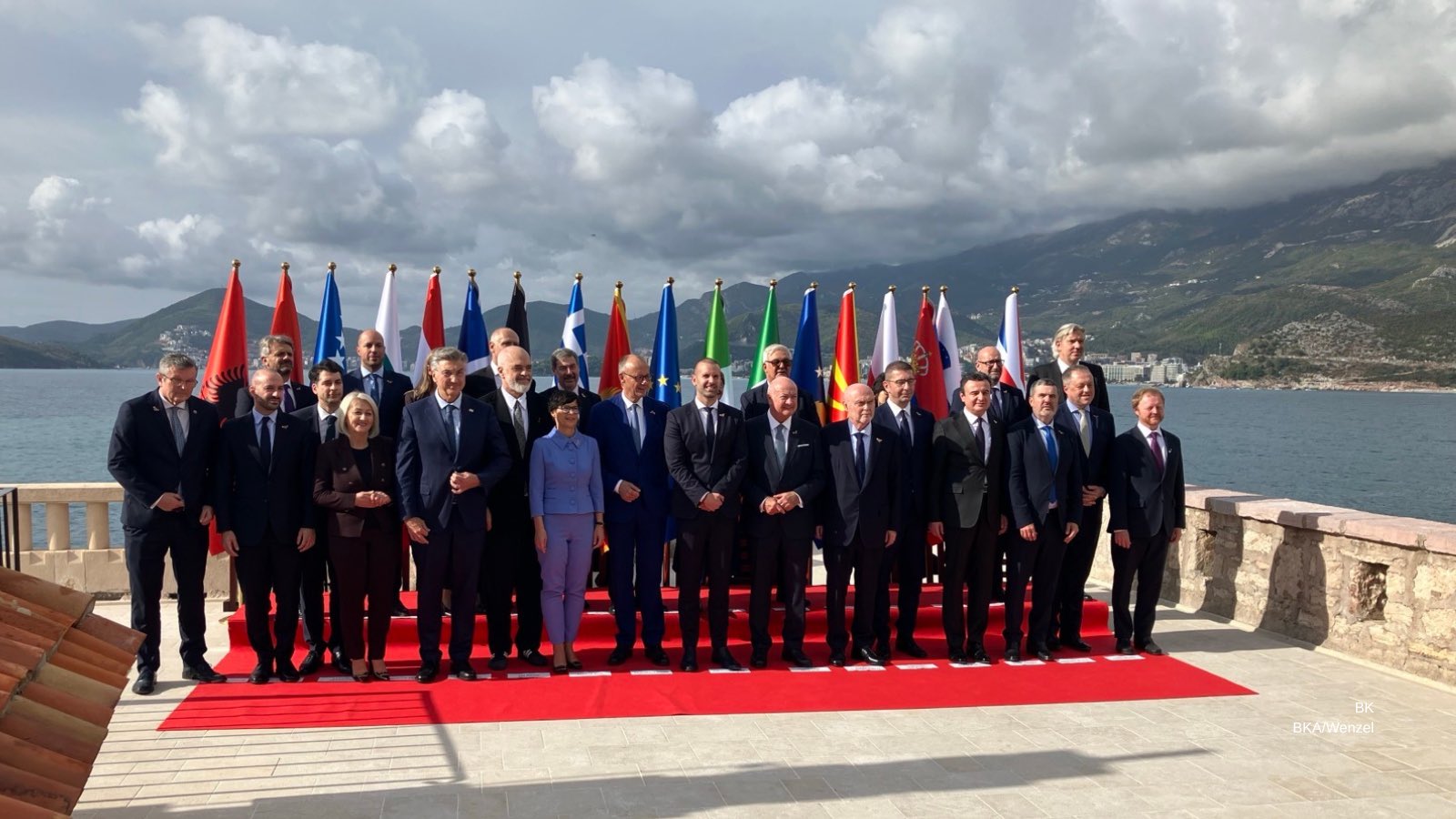
It is a great honour for Austria to take over the chairmanship of the Berlin Process in 2027! 🇦🇹🇪🇺
We remain a reliable partner to the Western Balkans and are committed to advancing the region’s European future.
Our priorities will be youth, reconciliation and regional cooperation. We want to bring young people together across borders, overcome historical divisions and bring the region closer to the European Union.
Our goal is clear: The Western Balkans must grow closer become a part of the EU as soon as possible. This requires more than political commitment. It requires concrete action and tangible results for the people of the region.
My sincere thanks to Prime Minister @MickeySpajic for hosting this year’s summit and to @bundeskanzler Friedrich Merz for Germany’s continued commitment to the Berlin Process. (BK)


Die Flugabgabe sei ein "Schildbürgerstreich", sagt die LH, der Wiener Bürgermeister sekundiert.
Als Finanzminister Pröll diesen "Schildbürgerstreich" 2010 vorgeschlagen hat, haben beide Landesregierungen in ihren Stellungnahmen genau nichts dazu gesagt.
wienerzeitung.at/a/schildbue…




Funny times: Gegen die Einführung der Flugabgabe protestiert haben 2010 die Regierungen von Neuseeland und Südafrika. Welche Regierungen dagegen auffälligerweise nicht protestiert haben, lest Ihr morgen in meinem WZ-Newsletter.
Sign up here: wienerzeitung.at/newsletter

