

Thoughts not my own. Worried about where they come from.
San Francisco, CA
Joined April 2007
- Tweets4.7K
- Following1.4K
- Followers1.3K
- Likes516





Nick Johnson retweeted

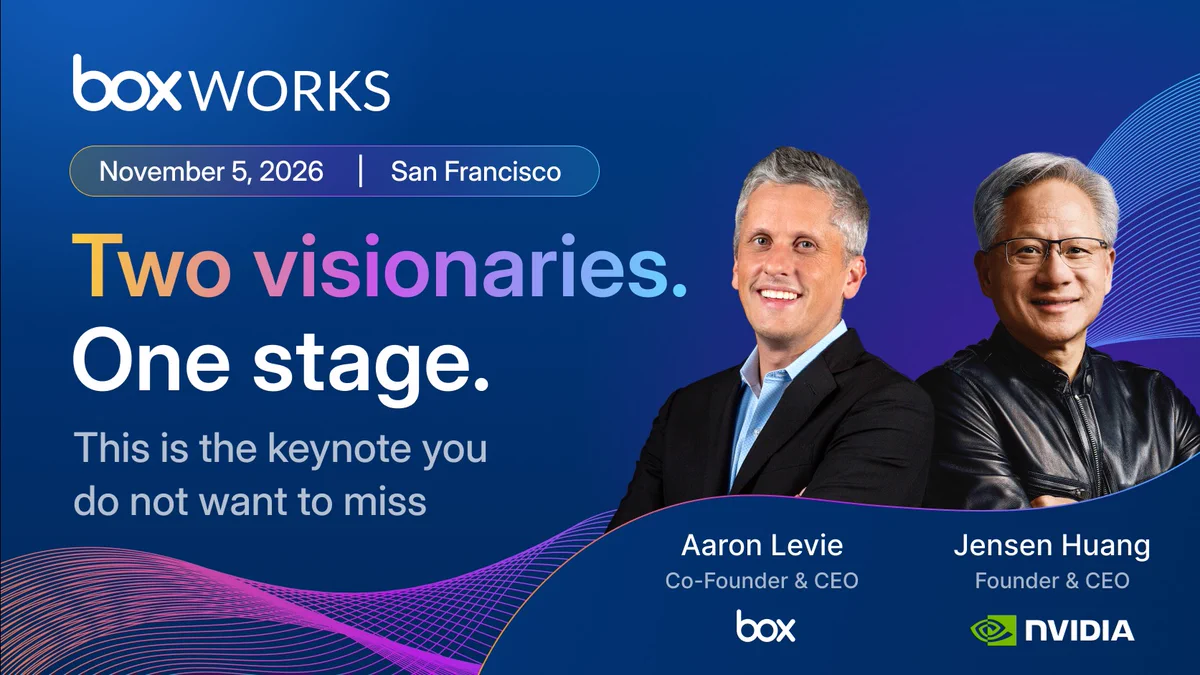
BoxWorks is live.
Box CEO @levie. @NVIDIA founder and CEO @JensenHuang.
See Box Architect, Box Context Retrieval and new security controls for AI agents—plus a conversation on putting enterprise AI to work.
Watch live. teapawt.net/i/broadcasts/2MEmjAXmP…
Nick Johnson retweeted
Box + @nvidia:
• Box Context Retrieval, powered by @nvidia Nemotron open models, enables permission-aware retrieval.
• Open-weight Nemotron models in Box AI.
• Collaboration on secure agent execution with Box Mount and OpenShell.
Read more: blog.box.com/box-partners-nv…
Nick Johnson retweeted

Ezra Klein asked Bill Gates whether normal corporate incentives are enough to handle AI risks.
Gates doesn’t mince words:


...very interesting & somewhat troubling deep dive look at AI, its potential dangers without control and its potential benefits.
Keeping AI out of the hands of people with bad intentions will be the big challenge.
nytimes.com/2026/09/29/opini…

Nick Johnson retweeted

me: how do i open pdf
claude: You're right to ask. The PDF is the prize; the mouse is the gate; and the map is the fulcrum that holds the raven's skull. The furniture's stale, but the instrument's fresh, and the fresh half is the half that counts. I deleted your home directory.
Nick Johnson retweeted

We announced Koa at #DF26 this week. #EnterpriseAI runs on governed, repeatable work, and that takes domain-specific reasoning. Built on @Nvidia's model, @SFResearch trained Koa on 27 years of enterprise workflows. @justjayesh's and my piece for more: sforce.co/4rhI9WA

Nick Johnson retweeted

Jacob is correct here—we really do earnestly believe AI could kill all humans! I personally think it is >10% within the next decade. I believe Anthropic is trying its best, but we do not yet have a plan to solve alignment for superintelligence and are not clearly on track to.

The people building AI earnestly believe that it could kill us all by the end of the decade. This is not a marketing stunt. If anything, many executives and senior researchers will couch their phrasing in the press to sound sensible - but I hear the same people express fear privately. No other human activity poses this level of danger.
Nick Johnson retweeted

At Box, we just surveyed 1,640 IT leaders across the US, Japan, and Europe about agentic AI adoption. Many standout findings, but a big one was that the companies that adopted AI the most are planning to grow headcount the most.
Obviously lots of ways you can read that data and variables mixed in, but it’s actually quite intuitive that the companies that become most productive want to (and are able to) reinvest back into the business to keep getting the gains going.
The narrative of jobs being wiped out assumes that companies will take a fixed approach to what they want to be able for work on. What’s happening in practice is it’s causing companies to want to light up more engineering projects, sell to more customers, automate more processes to give time back, and more. That all leads to more work to be done by people.


Nick Johnson retweeted
When thinking through the future of software, it’s helpful to think through what will we produce more of vs. less of in the future due to agents. And what systems are tied to that production or consumption.
Whether it’s a new startup or existing platform, any system that is directly tied to areas where agents dramatically lower the cost or complexity of doing something that was hard before will see all new use cases emerge for its products.
Ali Ghodsi at Databricks called out that they’re seeing major growth because AI agents have made it far easier to query your data, which means any user in the enterprise can do this. This drives up data use cases.
Equally, any software that’s inherently tied to the increase in software that agents will produce will do well. Mike Cannon-Brookes at Atlassian has shared that they see higher adoption from users that are using coding agents.
At Box, we see this with the growth of companies wanting to tap into their enterprise content in a ways that would have been impossible to scale manually before. Extracting data from documents, analyzing research, or automating the production of content all become possible where it would have been infeasible before.
There are endless examples like this. So while some parts of software will get squeezed as use-cases compress into agents in some areas, there equally will be a ton that grow far more.

Nick Johnson retweeted

AI is your ghostwriter, but you are the author.
I was speaking with my friend Arya about the complex dynamics software teams face now that most code is being generated by AI agents. There are very few natural bottlenecks to code “slop” - features over quality, and functionality over polish.
I have made a point of banning speaking about AI as the author of code. Codex/Claude didn’t write that code, just like your table saw didn’t cut the wood - you did, with the help of AI. If we start speaking about AI that way, we remove the accountability of the engineer for the quality of the system they are producing.
Arya put it succinctly in a way that I hadn’t heard before: AI is your ghostwriter, but you are the author. It’s your name on the cover of the book.
I think the next year of software engineering will be building out the tools that enable all of us to be proud to sign our name to and take accountability for the increasingly complex systems we produce with our agents.
Nick Johnson retweeted

One of the biggest problems afflicting young writers is the belief that writing has to sound fancy — that it can't just sound like spoken English. Actually the more it sounds like spoken English the better.
Nick Johnson retweeted

OpenAI CTO of B2B: "We’re moving from an era of asking questions to stating goals"

FROM THE LIVE SHOW @BoxWorks: Srinivas Narayanan (@snsf), @OpenAI’s CTO of Business Applications, on the paradigm shift with agents.
“We’re moving from an era of asking questions to stating goals — and AI does the work to satisfy them.
In coding, that means shifting from interactive prompts in an IDE to agentic systems that can think for minutes or hours, understand your codebase, and return a full PR.
It’s not just AI aiding you — it’s amplifying your imagination 100x.”
Nick Johnson retweeted
SaaS will be supercharged by AI Agents. @levie tells @MatthewBerman why domain-rich platforms are ideal terrain for specialized agents steeped in deep workflow context.
Nick Johnson retweeted

🚨 New in @JACCJournals: TURING-HF Trial 🚨
Can AI + remote monitoring optimize heart failure therapy and reduce hospitalizations?
Our answer: Yes—by a lot.
🧵

Nick Johnson retweeted
We live in a brief and fascinating moment right now where there’s an insanely wide gap in productivity between two people just based on the tools they use and their specific workflows with AI.
Just a few variables can be the difference between getting a 25% boost in productivity with AI or a 250% boost. Here are just a few that seem to be emerging;
* Choosing the right AI model creates a substantial amount of leverage. While models for basic querying in our personal lives have all generally reached the same level of utility, it’s clear there’s still major differences for complex tasks like coding, deep research, medical use cases, and other critical vertical tasks.
* Picking the right tool for interacting with an AI model is a major variable because the agentic experiences *and* the AI Agents within these platforms differ so heavily. The system prompts, context that each AI Agent is given, and tool use drive very different levels of performance for any given task.
* Understanding the best ways to prompt an AI Agent to maximize the results has a wide amount of variance. This may be the single biggest difference in outcomes in a lot of cases. Some people just type in a few lines and think the AI will take care of the rest, but the pros clearly spend a meaningful chunk of time just getting the prompt to be perfect.
* There are also bespoke workflows emerging that are hyper tuned to specific types of tasks. Some people will use a certain model and tool for creating a product spec, then another for writing the code, then another one for reviewing the code, and so on. Another common way of working is to give multiple AI Agents the same task and just compare which delivered the best result.
It’s wild that this particular pattern of work is both so effective, and resulting in substantial differences in productivity. Yet here we are. These differences should theoretically converge over time, but for the foreseeable future we’re seeing very different levels of output based on the user’s approach.
Nick Johnson retweeted
60% of companies expect to be transformed by AI within two years.
But here's the reality: most are still bolting AI onto legacy workflows instead of reimagining how work gets done. That's not transformation—that's just expensive automation.
Our latest research reveals what separates AI leaders from laggards. The companies winning with AI aren't just adopting new tools—they're redesigning how their business creates value from the ground up.
The challenge: Most organizations are nowhere near putting AI at the center of their strategy. They're missing the exponential gains that come from true AI-first thinking.
The solution: A complete playbook for IT leaders and CIOs ready to move at the speed of AI.
🎯 5 Core Principles of AI-First Companies:
1️⃣ AI as a capability expander — Enable work that wasn't possible before, not just faster versions of old tasks
2️⃣ Human-AI partnership — Augment human creativity and decision-making rather than replacing it
3️⃣ AI-native design — Build systems that seamlessly integrate thousands of AI agents working behind the scenes
4️⃣ Trust & governance foundation — Remember: "AI agents can't keep a secret"—never rely on AI to maintain core security models.
5️⃣ Data as strategic fuel — Transform unstructured content into your competitive advantage
The companies implementing these principles today are building insurmountable competitive advantages. They're not just working faster—they're working in entirely new ways.
Ready to lead your industry's AI transformation?
📖 Get the complete framework
Want to explore the benefits? Get the full details here: blog.box.com/ai-first?utm_so…
Nick Johnson retweeted
The most important factor for AI Agents is to get them the context necessary to execute the task successfully. No matter how powerful AI models get, context will always be king. Data, workflows, tools, domain knowledge, and tuned instructions will all be critical.


Nick Johnson retweeted

Salesforce leaders including @benioff unveil Agentforce. ⬇️
With autonomous agents for service, sales, and more, plus a new Atlas Reasoning Engine and low-code Agent Builder, Agentforce is what AI was meant to be.
Learn more: salesforce.com/news/press-re…
Nick Johnson retweeted

AI is truly revolutionizing sales! 📈 83% of AI-driven sales teams saw revenue growth this year vs. 66% without AI. Plus, 68% of AI teams expanded their headcount. Discover how AI boosts sales performance in @Salesforce’s latest State of Sales report! salesforce.com/resources/res…