
running experiments @aeos_labs
Mumbai, India
Joined November 2020
- Tweets5K
- Following536
- Followers300
- Likes62.4K




Aman Hanspal retweeted

We’re glowing with excitement over the new MacBook Pro. You’ve gotta touch it to believe it.


Aman Hanspal retweeted

i used to skip movie credits.
now i'm in them. 😎😎
@synclabs just made its theatrical debut 🚀🚀
years of building AI, countless commits, and sleepless nights. all leading to seeing my name on cinema screens across the world.
the craziest part?
our biggest projects are still under wraps. 🤫
this is just the beginning!!

Aman Hanspal retweeted

Introducing EmbeddingGemma 2! 🚀
Our lightweight, multimodal embedding model maps text, code, images, video, and audio into a single, unified embedding space. Optimized for on-device use cases, it features:
- 740M parameter form factor with modular encoders
- Flexible dimension sizes (768dim-128dim) via Matryoshka Representation Learning (MRL)
- 8K context window (4x larger than text-only EmbeddingGemma)
- A commercially permissive Apache 2.0 license
Aman Hanspal retweeted

Introducing EmbeddingGemma 2, a new open multimodal model that sets the standard for on-device efficiency.
- our first open, natively multimodal embedding model
- handles text, code, image, video, and audio tasks within a lightweight, modular 740M parameter form factor
- ideal for offline, privacy-first RAG when paired with Gemma 4
- outperforms some specialist models more than twice its size
Weights available now on Hugging Face.
Aman Hanspal retweeted

learned so much while coding this out, i actually think i have gotten a lot better at understanding profiling results, and i also created a manual sort off thing which i can use for future work
ezzzz

Aman Hanspal retweeted
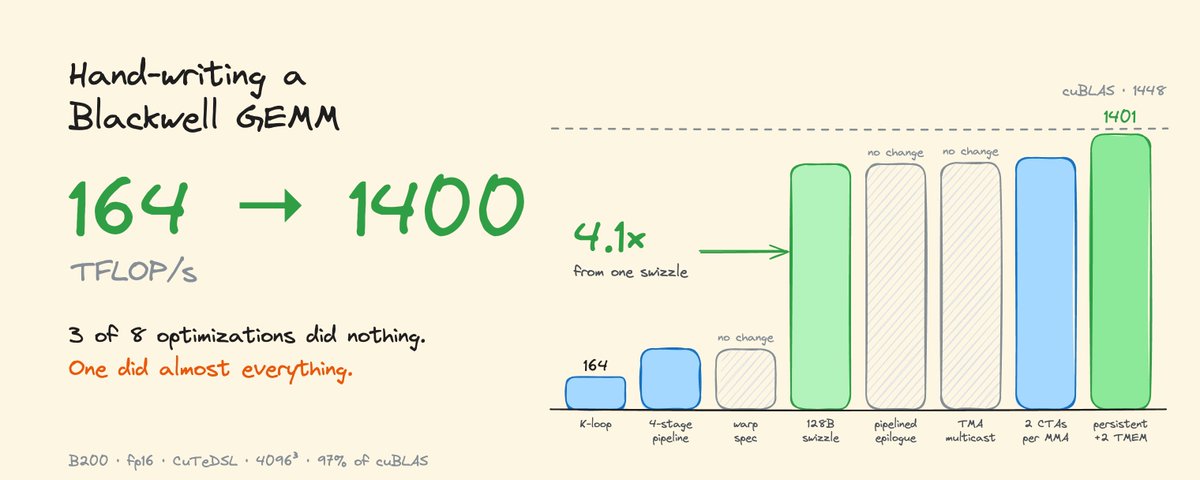
hand wrote a blackwell gemm in cutedsl and went from 164 to 1401 TFLOP/s on a B200, about 97% of cuBLAS

Aman Hanspal retweeted
Here’s the TOC:
Also, I think this is the same online? I’m reading the paperback modal.com/gpu-glossary


Aman Hanspal retweeted
Sending lots of love to the Apple community on my last day as CEO. My title changes tomorrow, but the love I have for the Apple community never will. Thank you for being a constant source of inspiration. My gratitude is endless, and I’m excited for the next chapter!
Aman Hanspal retweeted

Can't recommend this blog post by @gordic_aleksa more. The perfect technical balance.
vllm.ai/blog/2025-09-05-anat…

Aman Hanspal retweeted

In this (extremely long) video, I'll build a distributed training framework from first principles using PyTorch.
We'll derive everything from first principles, explaining the mathematics behind distributed training as well as every auxiliary component we build along the way, including Multi-head Latent Attention (MLA), Rotary Position Embeddings (RoPE) and YaRN.
I'll explain process groups, ranks, collective communication operations, distributed autograd, device meshes and distributed tensors, and then use these foundations to implement the major forms of parallelism used to train modern language models.
We'll derive and code pipeline parallelism, data parallelism, FSDP, HSDP, tensor parallelism and context parallelism, including pipeline schedules, block matrix multiplication, model sharding and ring attention. We'll then combine these techniques and examine how tensor layouts and gradients must be tracked as data moves between devices.
Most importantly, we won't study each parallelism technique in isolation. We'll combine pipeline, data, tensor, context and expert parallelism into a single working framework and follow the tensors, communication operations and gradients as they move across GPUs. By the end, you'll understand not only how these techniques work individually, but how modern distributed training systems compose them to train large dense and mixture-of-experts models.
We'll also build the important components of a modern transformer, including rotary embeddings, long-context extensions, multi-head latent attention and a mixture-of-experts architecture. This leads into expert parallelism, expert tensor parallelism, token dispatching, all-to-all communication and combining different parallel dimensions through dense and sparse device meshes.
We'll also build the supporting training infrastructure, including the training loop, optimizer, learning-rate schedule, checkpointing and metrics.
The goal is to give you the foundations required to understand how distributed training frameworks work internally and how to design and implement new parallelization strategies yourself. No prior knowledge of distributed training is required.
Link to the video: youtube.com/watch?v=XoGvCBRn…


n8n is all fun unless you have to scale it for recurring users. You have to understand the architecture underneath- no. of workers, concurrency across each worker, queue mode etc.
Wrote an article on medium explaining the nuances around scaling a self-hosted n8n workflow.
If you find it useful, share it with someone who may need it.
Link: medium.com/@amanhanspal05/gu…

