

Interventional Cardiologist with a passion for prevention through exercise and nutrition. Premier Cardiovascular Health and Performance.
Columbus, OH
Joined January 2012
- Tweets2.8K
- Following824
- Followers844
- Likes1.2K




Dr Chris Huff retweeted

I want to make explicit the absurdity of this pivot from Norwitz:
He is using a subset of 8 Cleerly scan pairs (setting aside the preposterous level of clinical research violations this involves) to argue that the original 100 pairs, which were burdened by unmanageable levels of intra-assay variance, were invalid. The same test. With less power. But now, since they see less progression, it’s exonerating.
The only appropriate consideration left was to say the methodology was invalid and retract. Put together a new analysis with heartflow or Qangio if you want, but claiming this is exonerating is absurd.
If you had any doubt remaining that this is an exercise of narrative building, you need not have it anymore.
Dr Chris Huff retweeted

Are you a clown? 🤡
If you think a median NCPV change of 18.8mm³ over one year qualifies as "no or minimal" plaque progression, you might be a clown.
If you think that "plaque begets plaque" is an insightful statement, you might be a clown.
If you think that self-applying a label that includes the word 'hyper" gives you superpowers, you might be a clown.
If you think it's reasonable to convert continuous variables to discrete categories without scientific justification, you might be a clown.
If you think that underpowered exploratory analyses should be the centerpiece of your publication, you might be a clown.
If you think that reporting your primary outcome in a tweet is a hallmark of scientific rigour, you might be a clown.
If you think that it isn't misleading for researchers to report their prospective cohort study as a trial, you might be a clown.
If you think that repeatedly shouting "heterogeneity" turns shitty results into good results, you might be a clown.
If you think it's reasonable to tell people to count pixels to extract your primary endpoint, you might be a clown.
If you think an underpowered secondary analysis of 100 butter-chuggers upends 70+ years of medical science, you might be a clown.
If you think it's reasonable for a senior author to publicly throw their co-authors under the bus with a bunch of lies, you might be a clown.
If you think that purveying hallucinated models of metabolism will save you from an atherogenic lifestyle, you might be a clown.
If you think that repeatedly using the taglines "stay curious" and "cautiously optimistic" will make your lack of scientific integrity any less obvious to the world, you might be a clown.
Dr Chris Huff retweeted

Nick fails to address the best criticisms post the publishing of his keto ‘trial’.
The fact is approx 95/100 participants had plaque progression with a large % of these having much more rapid progression than observed in truly healthy subjects.
Are there a few outliers… sure - like anything there are outliers (likely explained by genetics). But overall this data suggests LMHRs as a group are not a metabolically healthy low risk cohort.
I suggest Nick responds to the below LTE including the ApoB part.
osf.io/preprints/osf/78bph_v…


Dr Chris Huff retweeted

I used the same prompt (ChatGPT o3), and it reported the following (note I am not suggesting that we base conclusions on which AI tool is right lol):
"Key quantitative take-aways from your table ( n = 100, 1-year follow-up):
Incidence of progression: 93 % had any PAV increase; 43 % met the widely-used “rapid progression” definition of ≥1 % PAV/year; 7 % converted from no visible plaque to new plaque within a year.
How this compares with other cohorts:
Bottom line: the LMHR ketogenic cohort is experiencing ≈ 3–6 × faster plaque growth than seen in most observational registries of comparable age, and a far higher proportion meet the “rapid progression” threshold.
Overall cardiovascular-risk assessment for the cohort:
Traditional risk markers: LDL-C ≥ 190 mg/dL and ApoB > 120 mg/dL (values reported for this study) place individuals in a “severe hypercholesterolaemia” category that guidelines already treat as high ASCVD risk, independent of imaging.
Imaging findings:
Median CAC = 0 suggests low short-term (5-year) event risk, yet the presence and rapid expansion of non-calcified plaque is worrisome because NCP is the most rupture-prone subtype.
A 1 percentage-point rise in PAV per year is itself linked to higher event rates; 43 % of participants exceed that.
Predictors within the cohort: Consistent with the 2025 JACC paper, baseline plaque—not LDL or ApoB—best predicts further growth (“plaque begets plaque”). Nevertheless, the whole group’s very high ApoB exposure remains biologically atherogenic, even if intra-group variance doesn’t explain progression.
Integrated view:
Although these lean, insulin-sensitive ketogenic dieters start with little calcification, the speed and composition of plaque progression point to at least a moderate-to-high future ASCVD risk if the current trajectory continues. Close follow-up (repeat CCTA or CAC at ≤2-year intervals), aggressive LDL-lowering therapy, and shared-decision making around diet/lipid management are advisable."
Dr Chris Huff retweeted

It no longer matters whether @JACCJournals retracts the KETO-CTA paper or rewrites it.
The damage is done.
What will remain is the undeniable fact that a group of individuals—posing as scientists—tried to fabricate credibility for a failed hypothesis by manipulating data and deceiving the public.
They didn’t just get it wrong—they lied.
The #LMHR group won’t be remembered for scientific innovation, but for intellectual dishonesty and reckless behavior that put lives at risk.
This is no longer a scientific debate—this is a case study in how pseudoscience, ego, and ideology can poison medical discourse.

Dr Chris Huff retweeted
The KETO-CTA Study: Peeling Back A Layer 🥓🫀
It's been a wild 2-weeks. We've just been told this wasn't "the paper", despite 10 days of promoting and defending it?!
In this video, I run through events, comments, and criticisms offered so far. Who knows what's next...
#LMHR

Dr Chris Huff retweeted
This is brilliant. Can you explain why homozygous FH causes cardiovascular disease in kids and why people with homozygous familial hypobetalipoproteinemia don’t get cardiovascular disease?
Dr Chris Huff retweeted

I can't quote tweet @nicknorwitz because I'm blocked, so you'll need to view my screenshots for context.
Nick mentioned upfront that there's been "confusion" around the data. No one is confused. What you're seeing are valid scientific and ethical concerns around selective reporting, interpretation of risk, and the way this research is being framed publicly. Dismissing this pushback as "confusion" is just evasive nonsense to prevent having to engage with it.
(1) Yes, the primary outcome (NCPV) was shown in Figure 1. But the actual numbers were completely absent from the text and had to be shared post-hoc on X. That’s not standard practice, especially when the median increase was 18.8 mm³, which is more than 2.5x higher than what your protocol predicted. Omitting this result is not being transparent and leads to misunderstanding of the study’s core finding.
(2) That most LMHRs were not rapid plaque progressors depends entirely on how “rapid” is defined. When LMHRs who are lean, normotensive, insulin-sensitive, and inflammation-free show greater plaque progression than patients with diabetes, hypertension, and metabolic syndrome, that should be a wake-up call. The issue isn’t whether everyone progressed equally. The issue is the average progression was worse than in people with far more traditional risk factors.
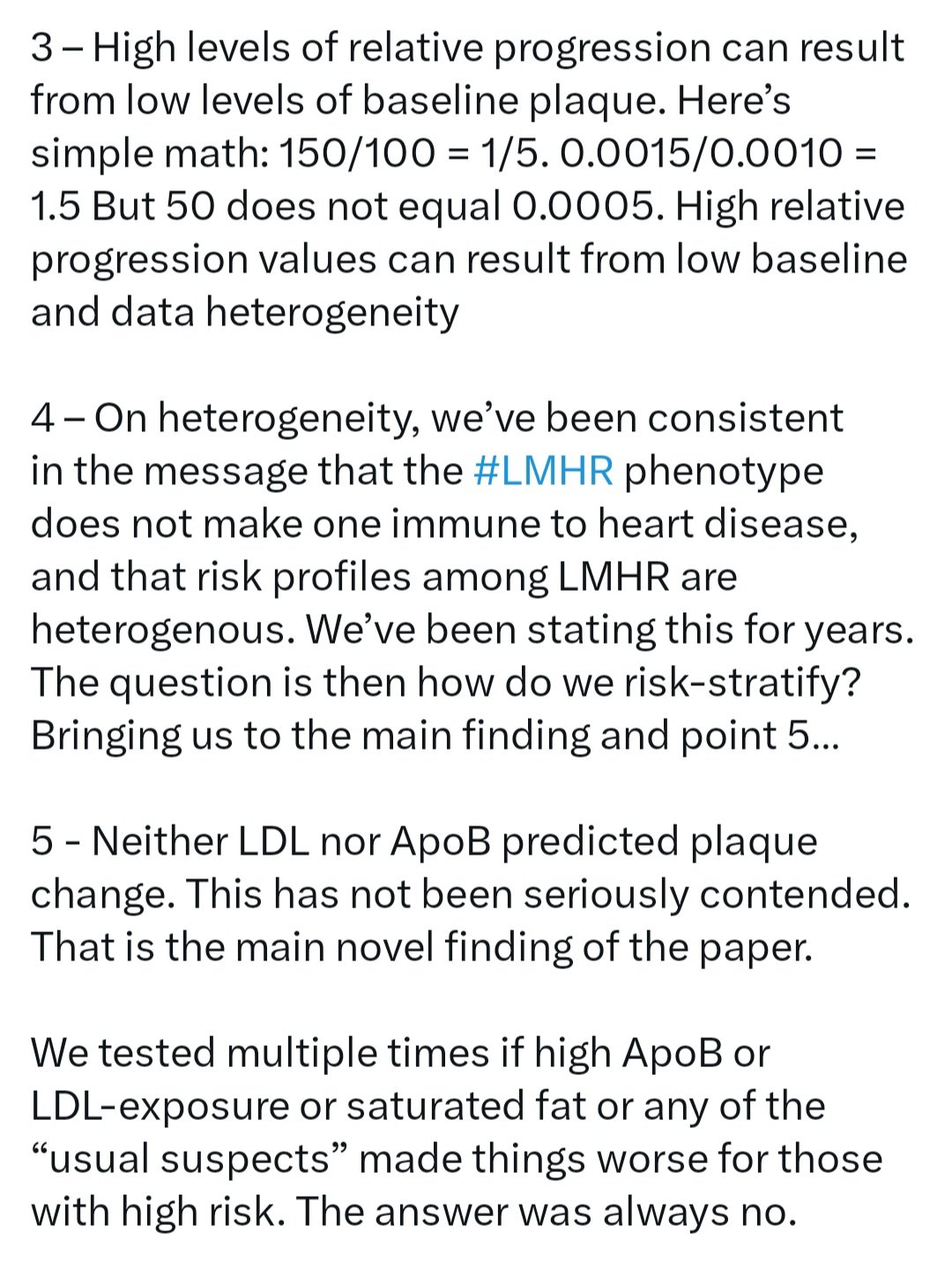
(3) Higher relative progression from baseline is a good point in theory, but the problem isn’t about percent change. The absolute change in NCPV (18.8 mm³) puts LMHRs on par with people who have type 2 diabetes in other studies. Even among participants with zero baseline CAC, PAV progressed similarly to those at intermediate ASCVD risk. That’s what makes the findings so concerning.
(4) Heterogeneity is real, but it doesn’t negate group-level trends. Smoking and diabetes also show heterogeneity in who gets sick and how fast. That doesn’t stop us from calling them risk factors. The same standard should apply here. If LMHRs, on average, show accelerated progression of unstable plaque, then the burden is on us to treat that seriously, even if some individuals seem protected.
(5) The lack of association with apoB is a classic case of a compressed exposure range. You can’t detect a dose-response when every participant already has very high ApoB. That’s like studying only 2–4 pack/day smokers and finding no correlation between packs smoked and CVD. Without a control group with low ApoB, this result can’t be used to argue that ApoB isn’t a driver of progression.
(6) We all agree the LMHR phenotype is scientifically fascinating and absolutely worth studying. But when we promote a group with extreme lipid elevations as “metabolically healthy” and potentially low-risk, while they’re showing faster plaque accumulation than people with known disease, we have an ethical obligation to present that risk clearly. This is especially true when the messaging influences people’s medical decisions.
Stay curious guys, just not too curious in case the results don't go the way you wanted.


Dr Chris Huff retweeted
If these are points that @BudoffMd raised, that's concerning and unexpected. He’s a respected leader in cardiovascular imaging, and I wouldn't have expected this level of hand-waving around the results.
(1) "Crucial data wasn’t hidden.”
Okay, technically, NCPV was included, but only as a figure, without commentary, numbers, or context. It was the primary endpoint, yet not even mentioned in the results or discussion. Only after public pressure did the lead author share that the median NCPV increase was 18.8 mm³, which was more than 2.5x greater than the protocol’s original prediction.
Just take this one on the chin. You guys fucked up. Was this done on purpose? I don't know, but it's a very real issue in how key results were communicated.
(2) “The study doesn’t show keto causes plaque progression.”
No one credible is claiming causation. That’s a straw man. The concern is simple: the LMHRs in this study, despite being metabolically healthy, experienced plaque growth on par with or worse than people with diabetes, hypertension, and metabolic syndrome. That’s alarming. Whether the cause was keto, sky-high LDL, or something else, the outcome should raise red flags, not be deflected with semantics.
(3) “They focused on PAV instead of NCPV due to CTA literature precedent.”
This was not a neutral decision. NCPV is often regarded as the more relevant markers of vulnerable plaque. It also happened to be the one that showed a larger effect size. When a pre-registered primary outcome produces unexpected results, downplaying it in favor of more favorable secondary endpoints is a textbook example of selective reporting. That it was peer-reviewed doesn’t absolve it (and the peer-review clearly failed here).
(4) “Relative % changes are misleading due to low baseline PAV.”
The baseline PAV was indeed low (~1.6%), so percentage change alone isn’t enough. But the absolute change of 0.8% overall and 2.4% in those with CAC >100 is still worse than comparator groups with active disease. This isn’t about being “misled” by math. It’s about what the numbers mean. The fact that such a “healthy” group progressed so much, so fast, is cause for concern, not minimization.
(5) “These were treatment-naive participants, unlike other studies.”
Exactly! And that makes the findings even more troubling. If people with ideal health markers and no pharmacologic interventions are progressing faster than those with multiple comorbidities on medication, then the LMHR phenotype cannot be assumed to be low-risk. That’s not a flaw in the comparison, it’s a major insight. It suggests that something (most likely the extremely elevated LDL and ApoB) is overriding the expected protection of good metabolic health.
(6) “Some individuals were high-risk (e.g., CAC >100), and that explains the outliers.”
Sure, but again, this was supposed to be the healthiest, most ideal subset of LMHRs. Many others were excluded for not meeting strict criteria. If this is the best-case scenario, then average or below-average LMHRs likely face even higher risk. We can’t use subgroup variation to hand-wave away the average result.
And let’s not forget that the reported values were medians, not means, so any extreme outliers wouldn’t have inflated the results. The elevated progression we’re seeing reflects a central tendency, not a few high-risk individuals dragging the average up.
(7) “The science isn’t settled.”
Of course it isn’t. That’s precisely why we must interpret early data responsibly, especially when it challenges popular beliefs. But when findings suggest accelerated plaque growth in a group often told they’re safe, it’s ethically irresponsible to minimize, reframe, or delay open communication of that risk.

🧵The Keto and Plaque Progression Debate
There has been a lot of discussion about the new Keto-CTA study (jacc.org/doi/10.1016/j.jacad…) looking at LDL cholesterol, ApoB, plaque progression and cardiovascular risk in Lean Mass Hyper-Responders (LMHR) on keto.
Two of the biggest misconceptions we have heard are:
❌ Crucial data was hidden from the publication ➡️ Not True
❌ This study shows that keto causes rapid plaque progression ➡️ Not True
Over the weekend, we hosted the study's lead investigator, @BudoffMd from UCLA’s Lundquist Institute, on the Metabolic Mind Podcast to discuss some of the misconceptions surrounding the study.
Here are a few key takeaways 👇

Dr Chris Huff retweeted
I just finished writing a blog post about the Keto-CTA study for anyone interested.
The LMHR phenotype does not seem protective against atherosclerosis. On the contrary, it appears to be associated with greater plaque progression than we’d expect.
alexleaf.com/lean-mass-hyper…

Dr Chris Huff retweeted

🔥The Keto-CTA study followed 100 adults on low-carb diets with markedly elevated ApoB (median ~178 mg/dL). Despite being lean & active, they had a mean increase of 18 mm³/year in non-calcified plaque (NCP). So how concerning is this? I'll get to that in a moment.
Dr Chris Huff retweeted
A few quotes from a Sniderman editorial in 2023 addressing LDL-c and CV risk that I think are useful for this recent KETO-CTA study:
"CAC > 0 is a homogenous category: they all have diffuse atherosclerotic disease, and, therefore, all are at risk of a clinical event." (plaque begets plaque - nothing new)
"CAC = 0 is a heterogenous category: some will have high-risk, lipid-rich, but noncalcified plaques; others will have no signficant disease; and all the rest will be somewhere in between. (CAC of zero is not no risk ; heterogeneity is expected - nothing new).
"The evidence that LDL-C plays a causal role in the pathophysiology of atherosclerosis is so strong that a negative association in a small group in a short period of time is not compelling." (he was referring to a study of >20,000 patients here... what would he think about a study of 100 who all had an apoB level in the top 10% of the population studied over 1 yr that [wrongly] concluded apoB does not beget plaque?)
ahajournals.org/doi/10.1161/…
~Sniderman, April 2023.

Dr Chris Huff retweeted

Looked at the recent LMHR data from a few different angles.
I hypothesize that, despite large within group differences, there is actually a pretty consistent pattern for plaque growth in this population. 🧵

Dr Chris Huff retweeted

🎇The KETO-CTA study has been making big waves on X recently... for all the wrong reasons.🎇
Initially touted by keto and carnivore proponents as proving that high LDL on keto doesn't matter, it appears to show the exact opposite. 👎
Researchers failed to report their primary endpoint - 18.8 mm^3 of coronary plaque growth - burying it in a graph with poorly defined axes.
The only viable explanation for this omission seems to be... because the data doesn't support the conclusions they wanted!
This study does NOT support the theory that LDL does not matter for coronary plaque development in otherwise healthy keto practitioners. In fact, these people are laying down plaque at a notably accelerated rate.
I am NOT against the keto diet. I think a healthy keto diet has a role for the right patient - and it can be life saving for the right patient! It is one of the options I will explore with certain clients.
BUT, severe dyslipidemia is serious business and should absolutely not be ignored.

🚨 KETO-CTA: A Teachable Moment in Scientific Transparency
- - -
What happens when a highly publicized study FAILS to report its primary outcome?
The KETO-CTA study, designed to evaluate the impact of diet-induced hypercholesterolemia on coronary plaque progression, has sparked interest—and concern. Despite preregistering % change in non-calcified plaque volume (ΔNCPV) as the primary endpoint (see image below), the investigators did not report this outcome directly in the manuscript. Instead, results appeared later...in a social media meme.
🔍 Why it matters:
Non-calcified plaque progression is not a trivial metric—it’s the most relevant measure of early atherosclerotic risk. In KETO-CTA, ΔNCPV was +18.8 mm³ in one year (according to the lead investigator--see below), a rate typically associated with much higher-risk cohorts (e.g., familial hypercholesterolemia or diabetes). This was a study of supposedly "low-risk" individuals.
📉 Additional limitations include:
🔹 Short follow-up (1 year): Too brief to reliably detect meaningful progression in low-risk populations. Most longitudinal plaque imaging studies span 3–6 years.
🔹 Lack of control group: No comparator arm to contextualize imaging findings or isolate effects of diet-induced hypercholesterolemia.
🔹 Historical controls misapplied: Cross-study comparisons without accounting for differences in baseline risk, imaging protocols, or statistical methods.
🧠 This isn’t just about one study.
When primary outcomes vanish from manuscripts, it erodes trust. When clinical implications are downplayed, we risk misleading patients. The duty to report results transparently isn't optional—it’s foundational to scientific integrity.
Let’s be clear: ketogenic diets may offer benefits in select cases. But studies evaluating their cardiometabolic effects must be held to the same rigorous standards applied to all clinical research. In this case, the investigators appear to have fallen short—and possibly engaged in selective or misleading reporting to obscure unfavorable outcomes.
📣 We need better, not louder. We need data, not dodges. Most importantly, we need to treat scientific integrity as non-negotiable.
STUDY: jacc.org/doi/10.1016/j.jacad… #EvidenceBasedMedicine #KetoCTA #Cardiology #ResearchEthics #ScientificIntegrity #PreventiveCardiology


Dr Chris Huff retweeted
One of the worst things for science is when a leading journal like @JACCJournals publishes a manuscript so devoid of ethical and scientific rigor.
The responsible action would be to retract it and issue a public apology.
Anything less is a disservice to the medical community.
🚨 KETO-CTA: A Teachable Moment in Scientific Transparency
- - -
What happens when a highly publicized study FAILS to report its primary outcome?
The KETO-CTA study, designed to evaluate the impact of diet-induced hypercholesterolemia on coronary plaque progression, has sparked interest—and concern. Despite preregistering % change in non-calcified plaque volume (ΔNCPV) as the primary endpoint (see image below), the investigators did not report this outcome directly in the manuscript. Instead, results appeared later...in a social media meme.
🔍 Why it matters:
Non-calcified plaque progression is not a trivial metric—it’s the most relevant measure of early atherosclerotic risk. In KETO-CTA, ΔNCPV was +18.8 mm³ in one year (according to the lead investigator--see below), a rate typically associated with much higher-risk cohorts (e.g., familial hypercholesterolemia or diabetes). This was a study of supposedly "low-risk" individuals.
📉 Additional limitations include:
🔹 Short follow-up (1 year): Too brief to reliably detect meaningful progression in low-risk populations. Most longitudinal plaque imaging studies span 3–6 years.
🔹 Lack of control group: No comparator arm to contextualize imaging findings or isolate effects of diet-induced hypercholesterolemia.
🔹 Historical controls misapplied: Cross-study comparisons without accounting for differences in baseline risk, imaging protocols, or statistical methods.
🧠 This isn’t just about one study.
When primary outcomes vanish from manuscripts, it erodes trust. When clinical implications are downplayed, we risk misleading patients. The duty to report results transparently isn't optional—it’s foundational to scientific integrity.
Let’s be clear: ketogenic diets may offer benefits in select cases. But studies evaluating their cardiometabolic effects must be held to the same rigorous standards applied to all clinical research. In this case, the investigators appear to have fallen short—and possibly engaged in selective or misleading reporting to obscure unfavorable outcomes.
📣 We need better, not louder. We need data, not dodges. Most importantly, we need to treat scientific integrity as non-negotiable.
STUDY: jacc.org/doi/10.1016/j.jacad… #EvidenceBasedMedicine #KetoCTA #Cardiology #ResearchEthics #ScientificIntegrity #PreventiveCardiology
Dr Chris Huff retweeted

🚨 KETO-CTA: A Teachable Moment in Scientific Transparency
- - -
What happens when a highly publicized study FAILS to report its primary outcome?
The KETO-CTA study, designed to evaluate the impact of diet-induced hypercholesterolemia on coronary plaque progression, has sparked interest—and concern. Despite preregistering % change in non-calcified plaque volume (ΔNCPV) as the primary endpoint (see image below), the investigators did not report this outcome directly in the manuscript. Instead, results appeared later...in a social media meme.
🔍 Why it matters:
Non-calcified plaque progression is not a trivial metric—it’s the most relevant measure of early atherosclerotic risk. In KETO-CTA, ΔNCPV was +18.8 mm³ in one year (according to the lead investigator--see below), a rate typically associated with much higher-risk cohorts (e.g., familial hypercholesterolemia or diabetes). This was a study of supposedly "low-risk" individuals.
📉 Additional limitations include:
🔹 Short follow-up (1 year): Too brief to reliably detect meaningful progression in low-risk populations. Most longitudinal plaque imaging studies span 3–6 years.
🔹 Lack of control group: No comparator arm to contextualize imaging findings or isolate effects of diet-induced hypercholesterolemia.
🔹 Historical controls misapplied: Cross-study comparisons without accounting for differences in baseline risk, imaging protocols, or statistical methods.
🧠 This isn’t just about one study.
When primary outcomes vanish from manuscripts, it erodes trust. When clinical implications are downplayed, we risk misleading patients. The duty to report results transparently isn't optional—it’s foundational to scientific integrity.
Let’s be clear: ketogenic diets may offer benefits in select cases. But studies evaluating their cardiometabolic effects must be held to the same rigorous standards applied to all clinical research. In this case, the investigators appear to have fallen short—and possibly engaged in selective or misleading reporting to obscure unfavorable outcomes.
📣 We need better, not louder. We need data, not dodges. Most importantly, we need to treat scientific integrity as non-negotiable.
STUDY: jacc.org/doi/10.1016/j.jacad… #EvidenceBasedMedicine #KetoCTA #Cardiology #ResearchEthics #ScientificIntegrity #PreventiveCardiology
Dr Chris Huff retweeted
Once again, misleading your audience, with many “LMHRs” now thinking your study showed no plaque progression 🫠
@nicknorwitz can you make a post to tell your fans that there WAS progression, and discuss how this compares to other low risk cohorts?
(Without GIFs & distractions)

🫀To suggest this patient might be a LOW risk for cardiovascular disease is not just provocative, it’s blasphemy.
But the fact of the matter is that Lean Mass Hyper-Responder patients like this are unique with so much to teach the biomedical community.
What’s dangerous is not posting the labs of a well-informed patient (with consent) but ignoring important scientific and medical data when they come knocking…
✊🚪
Read more below & learn 👇
And many videos and podcasts published and to come cc @realDaveFeldman @AdrianSotoMota @DrAseemMalhotra @chadinabhan @bschermd @Metabolic_Mind @JEverettLearned @KenDBerryMD @SBakerMD @MatthewNehsMD @janellison @BenBikmanPhD @AKoutnik @wideeyetv @drericwestman

Dr Chris Huff retweeted

Of course this is incorrect. They hid the primary outcome of the study which showed on average a lot of progression. More than an average person on the ol SAD (standard American diet).


