








FullyPorted retweeted

fellas, if your girl:
- is always there when you need her
- never asks you to choose
- makes everyone around you better
that's not your girl. that's @AquaZero0


FullyPorted retweeted

you can now fund an aqua0 vault with any asset you already hold, from whatever chain you live on.
no bridging, no swapping, no looking up token addresses. @Trustware_io routes and converts into what the vault accepts and carries it through the destination deposit, so you end up with a credited position instead of a transfer you still have to finish. without ever taking custody.
they also made changes on their end so our provide flow could read your balances directly. that is not something every team does.
just in time for season 0.


FullyPorted retweeted

Happy 1 year anniversary of the biggest single day loss on crypto that I’ve ever taken in my life 🥂
FullyPorted retweeted

pitching to investors matters. pitching to other builders does too.
last thursday: six teams, different products and different stages. each sharing their progress at Studio Sessions vol. 8.
savings, AI agents, wallet usability, social trading, liquidity and a new telegram client.
join us for more demos, firesides and workshops at The Studio:
luma.com/thestudio_xyz


FullyPorted retweeted

Balcore’s working product is nearly ready. Now it’s time to build strong partnerships with people who are just as agile, aggressive, and serious about execution.
Had a great chat with @ifullyported from @Trustware_io, whom I connected with at Avalanche Summit in New York. He showcased their client SPICE Credit’s working product and walked me through how they integrated Trustware. Always good to see a real product in action.
We discussed making the experience around Balcore simpler, especially for people coming from outside crypto. I’m looking for seamless fiat onboarding, easier access to tokenized stocks, and a straightforward way to bring supported assets from other chains onto Avalanche. Users should not have to figure out five different platforms just to put their capital to work.
A major audience I’m targeting is traditional investors and asset holders. Many of them have never connected a wallet, used a bridge, or provided liquidity on a DEX. Balcore could be their first real experience using blockchain for practical utility. That first experience matters. A lot. We cannot say we are building for everyone and then expect everyone to become a crypto expert before they can use the product. The complexity is ours to solve, not theirs.
I’ll do everything I can to make that experience simple and useful. Building the engine is one part of the job. Making it accessible to people who have never stepped onchain is just as important.
Be the Market Maker. There is no escape. 🔺

FullyPorted retweeted

some alpha: @AquaZero0 goes live on @solana in the next few days.
shared liquidity will run on top of @orca_so and @Raydium pools. the same capital backing a pool on Orca can back one on Radyum
and one more: pre-stocks are coming. Anthropic, OpenAI, SpaceX and more, through @PreStocks . provide liquidity and trade them like any other pair.
more soon.


FullyPorted retweeted
I'm confident eip-8141 will be a turning point for ethereum/defi adoption in tradfi
we’ve spent years talking about bringing financial assets onchain. distributing those assets through products that people can actually use still runs into the account model
a fintech will expect to be able to let a customer fund an investment without sending them off to buy ETH first. as a treasury should be able to change its signing keys without changing the account everything settles into. and developers should be able to batch an approval and a swap without leaving the approval behind if the swap fails
we’ve been building toward this experience with account abstraction. although not perfect, erc-4337 already makes a lot of it possible, through smart accounts, bundlers and paymasters
but eip-8141 would bring these modules into ethereum’s native transaction model
a transaction will become a sequence of frames: validate the account’s authorization, approve who pays the fees and then execute the calls. account logic defines what a valid authorization looks like, and the customer and the gas payer can be different parties. calls can be explicitly grouped to succeed or revert together
that gives developers a much stronger foundation for the one-click account abstraction we've all been waiting for
financial products need accounts that can work with their authorization policies and fee models and customers expect the application to handle the mechanics
this is the future we’re building at @trustware_io
we’re building non-custodial routing and settlement so users can arrive with the assets they already hold, while applications receive the asset they actually need. client-controlled gas sponsorship is part of making that experience usable without handing control of funds to an intermediary
eip-8141 could materially simplify the execution underneath those flows; the application could sponsor the transaction, the user could authorize a tightly defined set of calls, and that coordination would be handled natively
of course, cross-chain routing and settlement still have to be solved as do the regulatory and operational requirements of the future products and primitives. but a more capable native account model gives everything above it a better foundation to build and deploy on
eip-8141 is still a draft and not scheduled until post Glamsterdam
but this is the kind of upgrade that makes me bullish on ethereum as the infra that financial applications can distribute to millions of people who never need to learn how a gas token works
ethereum was always the home of defi and will forever be
FullyPorted retweeted

Routing liquidity into SPICE credit products is now easier than buying $PONS
Big milestone with @Trustware_io powering our deposit flow. You can now route deposits into SPICE credit products from any chain or asset; frictionless, non-custodial, and seamless.
Trustware is proud to announce our live integration with @SpiceProtocol 🫡
SPICE is building modern digital credit infrastructure, bringing private credit onchain through transparent and verifiable credit products.
SPICE is using Trustware to power its deposit flow and support cross-chain vault deposits into SPICE credit products!
💠 Route deposits from a user's source asset and chain into SPICE credit products
💠 Swap users into the assets required for SPICE vault deposits
💠 Settle funds non-custodially into the intended SPICE vault
Together, SPICE and Trustware are making private credit easier to access, no matter where a user’s assets start.

FullyPorted retweeted
its 11pm on a friday night and we've had this slack huddle going for 10hrs straight
no one outworks @trustware_io

FullyPorted retweeted

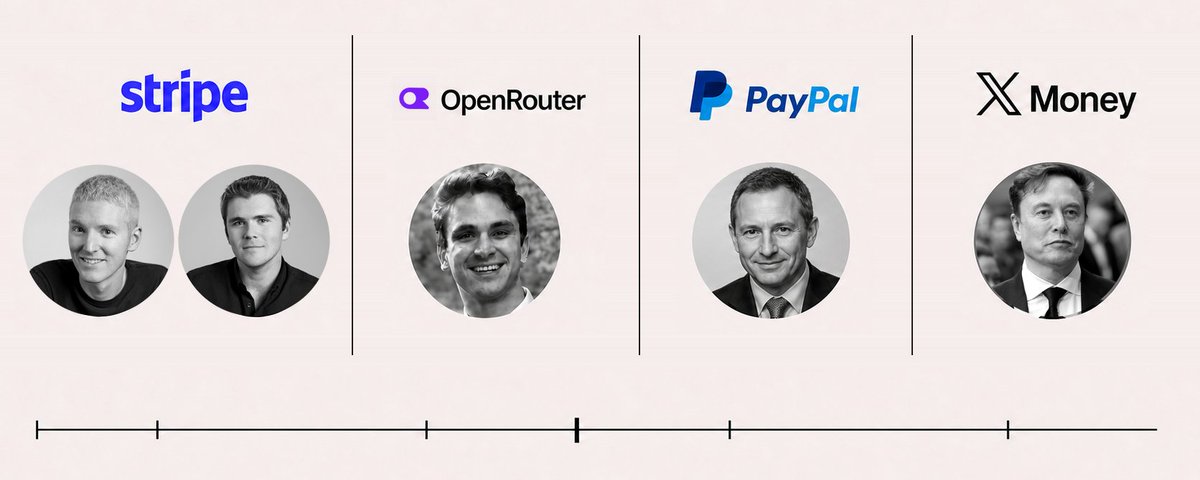
If Stripe had its way, it would spend $63 billion this quarter on two seemingly unrelated acquisitions: PayPal and OpenRouter
Here's why Stripe wants both, and why the two deals are really one thesis
FullyPorted retweeted
Looping supply is defi's most important liquidity engine
When it expands, deposits grow faster than real capital inflows. When it contracts, the whole lending stack shrinks and liquidity in defi consolidates
Lending deposits are down ~$30B yoy
A lot of the old supply was loops, but loops are closing and incentives are compressing


The first defi experiment was token incentives:
pay users to show up
bootstrap liquidity with emissions
hope it sticks
hope liquidity doesn’t leave
hope attention turns into real inflows
but some of defi is starting to look more like legitimate protocol balance sheet design:
native collateral
treasury credit
structured leverage
buyback/burn loops
retention mechanics
$OHM cooler loans and Origami $hOHM:
gOHM as collateral
Olympus becomes the credit layer
Origami turns the loop into a liquid token
We're in the middle of the rise of leveraged financial primitives, and it deserves to happen on defi rails,
it already is
FullyPorted retweeted
IMHO there's a more nuanced way to look at this.
The monetization function doesn't actually matter that much. Whether you're hashing SHA-256 or running LLM inference, you're ultimately converting electricity into a monetary instrument. Once that conversion becomes reliable, capital markets follow.
But lumping all crypto mining together is a bit of a gross generalization. Bitcoin (ASIC dominated) and GPU mining taught two very different lessons.
Bitcoin proved you could monetize stranded or underutilized energy almost anywhere in the world. It created the first truly global buyer of electricity that was location agnostic, interruptible, and almost infinitely composable. That fundamentally changed how people thought about energy infrastructure.
GPU mining solved a very different problem. Companies like CoreWeave, early on, became exceptionally good at rapidly deploying, orchestrating, and reallocating fleets of GPUs. What we used to call speculative mining, constantly redirecting compute toward the highest value PoW workload on behalf of clients, looks surprisingly similar to modern AI infrastructure, albeit at a fraction of today's scale.
AI workloads are fundamentally different operationally. Crypto miners, by design, can shut down in seconds. In fact, we built both physical and economic systems around that capability. The economic consequence is borne by the miner. AI infrastructure typically carries customer workloads, SLAs, storage, networking, and stateful processes. Reliability requirements are in an entirely different class.
That's why Crusoe starting on flare gas is so interesting (well timed pivot). Variable power is perfectly acceptable for Bitcoin mining. It's much harder to run reliable AI infrastructure on intermittent generation.
For NVIDIA specifically, crypto absolutely accelerated GPU demand, CUDA adoption, and developer mindshare. It also created years of inventory volatility. It's difficult to argue NVIDIA simply benefited or simply suffered. Both are true. The GeForce 10 series and the years that followed are probably the best example of that tension (long live the 1080ti).
I agree with you in general however, the real bridge wasn't crypto itself, It was the operational knowledge the industry accumulated: how to finance compute, negotiate power, source sites, deploy hardware at scale, manage thermals, optimize utilization, and ultimately treat compute as an asset class rather than just IT infrastructure.
While I was running North America, Europe, and South America for Binance Pool in 2020-2021, I pitched hashrate futures and secondary markets for compute capacity. At the time, they were considered too early. Maybe the market simply wasn't ready.
Looking back, I think those markets eventually emerged, just inside AI infrastructure, inference, and financing before filtering up into public capital markets. Or perhaps they're still in the process of emerging.
I think I can speak for many people who were deeply involved in mining. At some level, we knew we weren't just building for Bitcoin. We were building systems for monetizing compute and electricity.
AI simply became the next buyer, and for now, the more profitable taker.

FullyPorted retweeted
As stablecoin volume continues to grow, total supply has remained relatively flat in 2026
In my opinion this is due to defi's slump and de-leveraging; not the stablecoin or payments sector slowing
there was always room for OUSD, the execution is the question

USDC became the standard because it had distribution. However, post-genius act, the distribution wanted its own economics.
So it's no surprise Mastercard, Visa and Stripe are involved with OUSD: major payment processors have been making relentless moves in the stablecoin sector for the past year.
OUSD: Shared reserve yield, no mint/redeem fees, launched by 140+ companies.
For Circle, the writing was on the wall months ago when, their arguably most important partner, polymarket launched their stablecoin.
The flagship platforms do not want to be passive endpoints for someone else’s dollar. They want the yield, the roadmap, and they've always wanted to sit closer to the settlement layer. Even though polymarkets stablecoin is backed by USDC, polymarket placed itself directly inside the settlement layer.
I'm not writing off Circle, but USDC being the default is no longer a given, and although I'd argue mainly yield farming driven: there has always been growing stablecoin competition in defi.
And don't forget, USDC was never even the largest stablecoin. Current supply roughly $184B USDT vs $74B USDC.
The platforms that bring the users and volume are done giving away the carry.
FullyPorted retweeted
Hyperliquid may have just changed how people think about IPO price discovery.
The IPO priced at $135, but SPCX-USDC on Hyperliquid never really traded like $135 was the fair value.
As IPO details came out, SPCX-USDC sold off under $200, then spent days prior to the IPO chopping in the $150-$180 range.
On IPO day $SPCX traded much closer to that range than the official IPO price.
Most people without an allocation were never getting filled anywhere close to $135, and the first real fills were closer to where Hyperliquid had already been pricing it.
The obvious value of tokenized pre-IPO shares is access; but the deeper value is price discovery, and Hyperliquid just proved it can be a real pre-IPO price discovery engine.
Hyperliquid showed that a synthetic pre-IPO market can become a better price discovery venue than the actual IPO process itself, and I think this really changes the way people think about these markets.
The access matters as it allows retail to trade private companies, because defi can create a more efficient public market around tradfi assets before tradfi lets most people participate
If @HyperliquidX can price SpaceX before Nasdaq opens, then future IPOs may have two prices: the official allocation price, and actual fair value the market discovers first.
Anthropic is the next obvious test for this.


