

God First. Intel and Terafab are cool
Hong Kong
Joined May 2026
- Tweets1.3K
- Following246
- Followers6.6K
- Likes4.6K







Takeaway from Nomura Global Memory
The AI spending race has become extremely difficult for Big Tech to stop, even as it eats into free cash flow.
1. AI capex is becoming a game of chicken
Stop spending → risk falling behind in AI and potentially hurting your existing business.
Keep spending → accept negative FCF and increasingly rely on external funding
2. Why 2027 memory looks protected
2027 memory is basically already booked.
2028 is the bigger question.
More supply could arrive, while power constraints and demand become increasingly important
3. What could actually stop the AI spending race?
The AI race probably doesn't stop because Big Tech wants to spend less.
It stops if Big Tech can no longer easily raise the money to keep spending.


🌈🐻Citi is saying the semiconductor-equipment story may still be strong, but the stocks could fall further because companies may not be able to build and ship enough equipment.
Too much demand can actually become a short-term problem.
AI demand ↑
↓
Equipment demand ↑↑
↓
Component shortages ↑
↓
Equipment shipments constrained
↓
WFE growth limited
↓
$AMAT / $KLAC / $LRCX earnings upside limited
↓
Stocks de-rate
Sound confusing? The original text is even more confusing

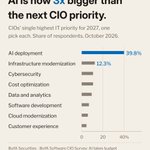
AI is now the top priority for CIOs.
85% want AI agents.
17% are seeing company-wide returns today.
And there’s a second effect
more AI → more security spending.
For the chart 2
The three numbers measure different things:
84.5% = plan to deploy agents within 12 months, from BofA Exhibit 7.
37.3% = more than 25% of AI pilots progressed into production over the last 12 months, from Exhibit 13.
17.2% = already generating measurable enterprise-wide ROI, from Exhibit 11.
Because the three bars sit together, some of you could interpret them as a funnel:
85% want agents → 37% reach production → 17% get ROI
That's not what the survey measured. They are three separate questions, and the middle number refers to pilot conversion over the last twelve months.


First, CFROI is basically how much cash return a company generates from the money invested in the business.
And right now, tech returns is verystrong.
But the market is already expecting these returns to come back down.
Memory is the clearest example
Record returns are forecast, yet the market is pricing in a much weaker future.
At the same time, funding the massive AI buildout is becoming another question.
Strong today. But for how long, and at what cost?


How much are customers willing to pay upfront? $CRWV
Customer prepayments change the financing equation dramatically.
For the 4.2 GW scenario:
No customer prepayment → $84.5B new debt
20% customer prepayment → $38.0B new debt
So, customers effectively help fund the infrastructure needed to serve their own AI workloads.


Why does HBM need hybrid bonding?
HBM stacks are getting taller → hybrid bonding helps make them thinner.
The bigger technological benefits are:
Hybrid bonding → denser interconnects → faster communication + lower latency + lower power → better thermal management
It's potentially about making HBM perform better and consume power more efficiently.
Fun Fact:
Intel remains positioned for a further hybrid bonding ramp.
BESI stated that Intel's substantial HB tool orders from 2024/25 have now been delivered and installed. $INTC
With Intel already utilizing hybrid bonding technology and seeing improved end-market demand, management suggested that a further round of capacity expansion could materialize in 2027.
Takeaway
1. Why is the market worried?
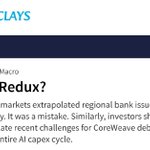
CoreWeave's unsecured debt came under heavy pressure, with the report noting yields around 15%.
That raised fears that financing for the broader AI buildout could be cracking.
2. Why does Barclays think that's the wrong conclusion?
Because the Because the bonds getting crushed are only a small and particularly risky piece of CoreWeave's financing structure.
CoreWeave has roughly:
$35B total debt
Less than $2B in unsecured bonds
And importantly, those unsecured bonds sit far down the repayment hierarchy.
Think about it like this:
CoreWeave owes a lot of people money.
If things go wrong, creditors don't all get paid equally.
First in line: Secured lenders
Then: Other creditors
Finally: Unsecured bondholders
So, these bonds offer a very high yield.
3. What if CoreWeave really does run into trouble?
Even then, Barclays estimates CoreWeave accounts for only roughly 4-5% of total AI capex.
If CoreWeave's spending were cut in half, Barclays estimates the impact on total AI capex would be around 2%, or roughly $20B on a $1T+ 2027 estimate.
Not nothing. But not the cycle
4. So what should investors actually watch?
Watch the price and demand for compute, not just CoreWeave's bond price. $CRWV
If a company has a $35bn mortgage and a $1.5bn credit card balance, and the credit card rate spikes to 15%, that tells you something about the credit card.
It doesn't tell you that all the mortgage borrowers in that city are in trouble.

John Intel retweeted

I spent two days touring Intel’s most advanced fab and talking to its technical leadership to understand what the chips of the future will look like.
A lot of what's coming next – gate-all-around transistors, backside power, CFET, hybrid bonding – is hard to follow without actually seeing it, so we made all the awesome animated explainers that I wish I had while I was prepping.
I also asked Intel’s leadership how the semiconductor industry will cope with the enormous shock in demand from AI.
AI compute has grown 3x a year for the last decade, but according to Intel's CTO, Intel could only double leading-edge wafer production with today’s global stock of chipmaking tools.
What kinds of tricks can foundries pull to extend this crossover point where demand surges way ahead of supply?
This was a totally new format for us - hope you enjoy!
0:00:00 – Intro
0:00:47 – How Intel brings up a new process node
0:03:22 – What Intel learned from 10nm
0:06:28 – From planar transistors to gate-all-around
0:13:13 – Why High-NA EUV pays off for Intel but not TSMC
0:19:20 – Could chips have evolved completely differently?
0:23:33 – Inside Intel's "Hot Topics" meeting
0:29:30 – Replacing copper wires with ruthenium
0:32:41 – Why stacked transistors take a decade to ship
0:39:45 – Hybrid bonding and the chip-to-chip bottleneck
0:48:00 – There aren't enough tools to 10x chip production
0:53:14 – Can Intel catch up to TSMC?
1:01:02 – Terafab, and rethinking the fab from scratch

This is actually new to me.
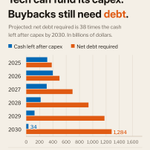
I thought tech was issuing debt because AI capex was getting so huge that cash flow couldn't cover it.
Apparently, tech's aggregate cash flow still covers capex through 2030.
The financing gap shows up after buybacks + dividends.
So tech isn't necessarily borrowing because it can't afford the AI buildout.
They want to fund the AI buildout AND keep shareholders happy.

More agents = more work = more CPUs.
AI can now do things for us!!!
Look at Grok, Muse and Dots
That means more computing happening behind the scenes, and potentially a much bigger role for CPUs.


Each new AI chip generation uses more power, but the amount of work it can do is growing much faster.
The chips are getting more efficient.
Our demand for AI is just growing even faster.
$NVDA

Wait, so Samsung and $SKHY are already pricing in a 2027 memory downcycle and negative memory pricing?


If semiconductor demand is about to peak, why are customers placing orders this far out?
$ASML


Before anyone takes these charts as gospel
They’re based on JPMorgan’s model, not my forecasts or necessarily SpaceX’s own plans.
The further out you go, the more assumptions are involved. $SPCX
Chart 1 — revenue mix
Plots three segment revenues as 100% stacked columns; the printed labels are the SI share.
The three shares always add to 1 by construction, which is why the stacked columns total 100%.
Chain worth knowing: 2025A SI revenue is SI!H42 = SUM(H31,H37) = infrastructure H31 = SUM(D31:G31) (1,356) + advertising H37 = SUM(D37:G37) (1,844) = 3,200. From 2028E, infrastructure is SI!S31 = S27*AVERAGE(R20,S20) ($/Watt × average nameplate MW) and ads are SI!S37 = R37*(1+S38).
Chart 2 — compute capacity
Plots end-of-year nameplate compute in GW: total (row 19) as the column height, in-orbit (row 9) as the orange top, on-Earth (row 14) as the blue bottom.
So the chart's stack is internally consistent by construction: from 2030E the orbital figure is defined as total minus terrestrial, and terrestrial is frozen (V14 = U14 = T14 = 20.877936).
Chart 3 — capex vs free cash flow
Both series are the same unit (Minthesheet,plottedinMinthesheet,plottedinB). Capex is stored negative, plotted positive.
Printed labels: CF!S17 −389,118.8 → "389B";‘CF!R41‘−81,608.7→"−389B";‘CF!R41‘−81,608.7→"−82B"; CF!V17 −818,965.1 → "$819B". Note CF!A41 is labelled Free Cash Flow while DCF!A17 is Unlevered free cash flow — a different series (DCF!C17 = C10+SUM(C14:C16)); the chart uses only the CF row.
Chart 4 — margins
Three ratios from the IS tab, all divided by the same revenue cell.
Row labels are formula-linked (IS!A91 = A12, A94 = A18, A97 = A39), so the margin block never drifts from the P&L.
Printed labels: IS!H94 −13.86% → "−14%", IS!V94 65.56% → "66%", headline $500 from Rel Val!C7.


JPM doubled $SPCX target price to $500
TLDR
JPM isn't raising SpaceX to $500 because rockets got better.
It's because its model effectively turns SpaceX into one of the world's largest AI infrastructure operators.
Takeaway:
How aggressive is the AI compute buildout?
Extremely aggressive.
Which GPUs are driving this?
Almost all of the 10 GW incremental compute planned for 2027 will be Nvidia Vera Rubin generation. SpaceX expects 440,000 Vera Rubin GPUs deployed by the end of 2Q27
Why does Vera Rubin matter so much?
It's not just more compute. Vera Rubin monetization could be roughly 40% higher than the strongest GB300 systems.
Better GPUs → more intelligence per watt → higher monetization → potentially faster payback → more compute investment
How much money could the AI business actually make?
By 2027, JPM expects SI to contribute 86% of total SpaceX revenue.