

PhD Candidate in @AlexValvezan's lab, interested in the cell cycle control of metabolism.
Joined July 2022
- Tweets22
- Following214
- Followers46
- Likes3K


Pinned Tweet
1/10 The cell cycle mediates cell growth & division. Each phase has distinct biosynthetic requirements that are necessary for successful progression, indicating that phase-specific control of metabolism is essential. But how this occurs is largely unknown.
doi.org/10.1016/j.celrep.202…
Jay Joshi retweeted

How does leukaemia develop? 🩸 How long does it take? ⏳
🌟 Our paper, started back when I was a PhD student in @jrblundell’s lab, is out today in @Nature 🌟
Yearly blood samples from women who developed AML in later life let us trace it back decades 👇
doi.org/10.1038/s41586-026-1…
Jay Joshi retweeted

Happy to share our latest story! Thanks @padder_rayees and all our collaborators for the hard work!

1/5Excited to share our work "PTEN-loss confers dependence on the guanylate synthesis enzyme IMPDH in T-cell acute lymphoblastic leukemia" where we uncover an actionable metabolic vulnerability in T-ALL, an aggressive leukemia affecting children and adults
doi.org/10.1038/s44321-026-0…

Jay Joshi retweeted

1/5Excited to share our work "PTEN-loss confers dependence on the guanylate synthesis enzyme IMPDH in T-cell acute lymphoblastic leukemia" where we uncover an actionable metabolic vulnerability in T-ALL, an aggressive leukemia affecting children and adults
doi.org/10.1038/s44321-026-0…
Jay Joshi retweeted

It's time to rewrite reviews-aKG doesn't just regulate demethylation. Work from my lab and @mzspectrum demonstrates a new role for aKG in promoting histone acetylation and DNA repair through regulating carnitine synthesis. Congrats @ApoorvaUboveja!
nature.com/articles/s41586-0…
Jay Joshi retweeted
Congrats to our outstanding graduate student, Masuda Akther! And thank you @PhRMAfoundation for providing this support!

Cancer cells are like a fast-growing city, and #PhF26 awardee Masuda Akther @RutgersU wants to stop construction. She is targeting two cancer mechanisms with one therapy to create a more efficacious treatment.
Learn more in the full interview: phrmafoundation.org/news-eve…
Jay Joshi retweeted

Our Rapamycin & Exercise clinical trial has just been published!
The topline result?
Rapamycin didn't help. Instead, it may have made things worse.
Here's what we found 🧵
onlinelibrary.wiley.com/doi/…



Jay Joshi retweeted

How can the same "master regulatory" protein mTOR recognize different sets of targets to separate nutrient and growth factor signals?
Thrilled to share our new paper, in which we reveal how mTORC2 recognizes Akt.
🧵 on our new paper in Science:
science.org/doi/10.1126/scie…

Jay Joshi retweeted

Structural basis for the recruitment and selective phosphorylation of Akt by mTORC2 | Science science.org/doi/10.1126/scie…

Jay Joshi retweeted

Excited to share our latest work out today in @MolecularCell, revealing a molecular link between succinate dehydrogenase and purine synthesis, connecting two fundamental metabolic pathways. Congratulations to first author @MushtaqNengroo! sciencedirect.com/science/ar…
Jay Joshi retweeted

Surprising result: AKT-mediated TSC2 phosphorylation is the predominant mechanism of hepatic mTORC1 induction by insulin but is dispensable for activation by feeding @Manning_BD biorxiv.org/content/10.1101/…
Jay Joshi retweeted

FROM CELL DEATH TO REGENERATION: What if dying cells -come back to life? Now online @embojournal I tinyurl.com/yp8m7he6 , we aim to answer this question. Here is the journey. If you🩷science, please dont 🛑till the end of 🧵, I promise you will not regret. 1/n


8/10 So how does the cell cycle regulate the TSC complex? This remains TBD, but we examined major known upstream inputs: Akt, MEK/Erk, and CDK4/6 signaling, and none of them are responsible, possibly suggesting there could be a novel, independent cell cycle input!

1
164
9/10 Interestingly, the mechanism of mTORC1 regulation during mitosis is different than during interphase. We found that the TSC complex is not required for suppression of mTORC1 during mitosis. Instead this occurs through changes in the subcellular localization of mTORC1 itself.

1
88

7/10 We found that the subcellular localization of the essential TSC complex component TSC2 changes throughout interphase in a manner that corresponds with the changes in mTORC1 activity. Deleting TSC2 abolishes the interphase oscillation in mTORC1 activity.


1
80
6/10 What is the mechanism of mTORC1 activity oscillation throughout the cell cycle? Many signaling inputs to mTORC1 control it’s activity through spatial regulation of an upstream negative regulator, the TSC complex.
1
73
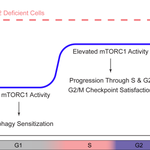
5/10 mTORC1 is known to suppress autophagy, and we also found that low mTORC1 activity in G1 sensitizes cells to autophagy induction in response to partial mTORC1 inhibition or reduced nutrient levels.


1
1
74
4/10 In addition to promoting progression through G1, we find mTORC1 also promotes progression through S + G2 & is important to satisfy the G2/M checkpoint to allow entry into mitosis. Interestingly, mTORC1 is not required during mitosis, corresponding with its low activity then.

1
1
73
3/10 Given this observation, we wondered whether mTORC1 can have cell cycle-phase specific functions. We first asked whether mTORC1 is essential for progression through each phase of the cell cycle?
1
76
