

Ser humano común + montón de defectos.
Mexico
Joined April 2011
- Tweets875
- Following37
- Followers63
- Likes938







Comienza la era de cobrar por los MCP's aunque aún no están súper claras las tarifas, primero con Workspace que es un gran gran jugador en las aplicaciones empresariales.

Google will start forcing AI agents to use MCP (instead of APIs) for Workspace (Gmail, Drive, Calendar, Docs, etc.) starting Feb 1, 2027.
AI agents will no longer be allowed to call the normal Workspace REST APIs freely starting Feb 1, 2027. Instead, they must use Google’s official Workspace MCP servers (or the Workspace CLI).
Regular (non-AI) applications can continue using the existing REST APIs as usual.
According to Google, they are doing this to improve security, visibility, and control. MCP gives Google (and admins) better policy checks, human in the loop confirmations for sensitive actions, and clearer audit trails when autonomous agents interact with Workspace data.
The commercial reason (which Google won't admit) is that they can charge extra for higher usage (higher usage will move to a paid “Scaled” tier starting April 1, 2027.).
AI agents that call Workspace REST APIs directly will be limited to Standard tier quotas, no matter which tier the project is on. To get higher quotas for agent use, you must switch to MCP and enrol in the Scaled tier.
It is important to note that they are not fully blocked. But they get throttled to the low free-tier rate limits. Google has not published exact numbers for those Standard limits yet, but they are expected to be too low for most real agent workloads.
The Workspace AI Tools Addendum (effective the same day) requires AI agents to use MCP (or the CLI). It also says you may not obfuscate or circumvent that requirement.
Google’s standard language in these announcements is: "Failure to comply with the updated terms may result in a breach of your service agreement."
If Google determines you are running agents in a way that violates the Addendum (including continuing to use direct REST APIs for agentic access after the deadline), they can treat it as a terms violation. That can lead to further restrictions, suspension of API access, or other account-level actions, beyond just the automatic rate limiting.
What this means in practice is that:
>> Your AI Agents will generally have a lot more restricted capabilities than they do with direct API access. You only get the tools and actions Google exposes on its MCP servers, not every REST endpoint.
>> You have less control over your agents. Google decides what your agents can do, how data is returned, and when human confirmation is required.
>> You will pay more to Google to access Google Workspaces.
This move could encourage other enterprise vendors to move in a similar direction. They may also decide it’s easier and safer to steer agents through their own governed MCP servers rather than leave the full REST APIs wide open.
And let's be honest, in most cases, vendors can benefit more from selling (or metering) MCP access than from unrestricted direct API access, especially for AI agents.
With direct REST APIs, it’s harder to distinguish “normal app” usage from high-volume, autonomous AI agent usage. MCP makes agent traffic more visible and controllable, so vendors can apply different (usually higher) pricing or stricter quotas.
7


Agree: MCP's a a bit underestimated, yet a super powerful "power up" for agents

I came to the conclusion that most SaaS should become an MCP server.
we’re getting the economics of AI software backwards. A lot of AI startups are building their own chat interfaces, agents, and workflows, essentially reselling tokens from the big labs at low to negative gross margins.
What if SaaS companies did the opposite?
Take HR software. Instead of building an AI assistant, become the best MCP server for HR. Expose tools to:
- Benchmark salaries against proprietary market data
- Run compensation reviews and calculate pay equity
- Model salary increases against a department’s budget
- Recommend promotions based on company policies
- Update employee compensation in the HRIS
- Manage approvals, permissions, and audit trails
Let ChatGPT, Claude, or Copilot handle the conversation, reasoning, and orchestration. Let the customer pay for the tokens.
The SaaS company keeps the valuable stuff: proprietary data, integrations, business logic, permissions, compliance, and the system of record.
You still charge a SaaS subscription, but you’re no longer paying to generate every answer. You can ship faster, with fewer engineers, and potentially restore software-like gross margins.
The next generation of SaaS might not have much of a UI at all. Just an incredibly good MCP server.
2


Súper interesante lo que se viene en 2027 con el Business to Agent economy

Agents now make up the majority of web traffic, write more than half of new articles published online, and generate most of the code pushed to production.
This is what the early stage of a platform shift looks like: adoption is measurable, but the business models it enables mostly aren’t visible yet.
Welcome to the agent economy.
a16z.news/p/welcome-to-the-b…

4
Jaime N retweeted

Canva is laying off 22% of its workforce which is 1271 employees, and this is what their CEO said.
We need more founders like thissss.

Por supuesto que el modo IA genera tráfico, solo que ahora se lo queda todo el lab de IA y muchas veces no citan la fuente, no porque no puedan, sino porque un párrafo es multifuente 🤷🏻♂️🙃

La IA se está comiendo las visitas de sitios grandes, y esta semana se notó.
Por ejemplo, Reddit anunció que está perdiendo más de 1 millón de visitas por semana desde Google. Su CEO dijo: “El modo IA no genera tráfico, ni para nosotros ni para nadie”. Así que ahora están probando exigir que inicies sesión antes de entrar a Reddit.
Stack Overflow también está recibiendo menos de 1.000 preguntas al mes, cuando en sus mejores años recibía unas 200.000.
Además, Wikipedia avisa que pierde lectores y les pide a los laboratorios de IA que paguen por los datos que muchos modelos usan para entrenarse. Dicen que no están pidiendo caridad: básicamente piden un pago por el uso de esos datos.
Es decir la IA responde con el contenido de todos, pero ya nadie visita la fuente. Y, siendo honesto, ¿para qué, si el modelo te lo resume bastante bien?
Por eso Cloudflare ya está proponiendo salidas. Por ejemplo, cobrarle a una IA cada vez que lee tu contenido, cada vez que lo usa o lo cita en una respuesta y cada vez que un agente usa tu servicio. De hecho, Stack Overflow ya usa este método y les cobra a los bots que leen su contenido.
Así que la monetización del contenido está cambiando, y es muy importante tenerlo en cuenta, sobre todo si vas a crear tus próximos proyectos.
10
Genio el Richard Feynman ... ojalá nos comenzaran a contestar así Claude o Chatgpt a preguntas "no calibradas", por decirlo elegantemente. 🤷🏻♂️

In 1983, a BBC interviewer asked Richard Feynman why two magnets push each other apart — and he refused to answer it.
What he did instead is the best seven minutes on thinking ever filmed.
Bookmark & watch today, no matter what.
15
Agree, ya lo estamos viendo en clientes que usan el Data Warehouse y los Dashboards como backend y Claude les hace todos los análisis ultra a la medida 📊🤖🤖

Satya Nadella is basically describing the death of the traditional SaaS model.
Explains the AI agentic future, and where the "value" lives.
Because business logic is moving from the software application to the AI agents.
Currently, you buy software for its specific features and rules.
Nadella argues that in the future, software apps will essentially become dumb databases ("CRUD") or simple tools.
The AI Agent will hold all the intelligence, orchestration, and reasoning, simply updating the databases as needed. The software becomes a commodity; the AI becomes the "brain" and the worker.
10
A wevo vamos para arriba 💪💪

A Curva da Felicidade.
O economista David G. Blanchflower analisou dados de 132 países para investigar a relação entre idade e bem-estar subjetivo. O trabalho reuniu 109 conjuntos de dados e encontrou evidências de uma curva em U em todos os países analisados.
A curva sugere que:
- Na juventude: o bem-estar tende a ser relativamente elevado.
- Na meia-idade: a satisfação com a vida diminui, em média.
- A partir de aproximadamente 47 a 48 anos: o bem-estar tende a se recuperar, segundo as estimativas médias do estudo.
Créditos: IG / longevitydaily_
4
Jaime N retweeted

The CFO job has gone from accountant to banker to builder, and the whole finance function is being rebuilt around it:
1. Data stopped being the bottleneck. AI pulls and reconciles data across systems, so teams spend more time acting on numbers instead of chasing them.
2. The finance stack is becoming part of the finance team. AI-native tools stand up in days, pull their own data, and turn a monthly close into a daily one.
3. The rise of the finance engineer. Finance people proficient in Claude Code or Codex are building their own tools.
4. The finance team gets smaller and higher leverage. The old heuristic of finance at 5% of headcount is heading to 2% for the leanest teams.
5. Planning becomes continuous. Usage-based revenue (tokens, API calls) moves too fast for a monthly forecast, so planning shifts from annual budgets to a live view.
6. Controls become a critical feature of the product. Every number an agent touches keeps an audit trail back to its source, and finance still owns sign-off.
7. Finance gets a bigger mandate. Compute spend, people versus software, and build versus buy are now finance decisions.
"The CFO is becoming a builder and architect of the company's operating system... The job is still finance, but more of the job now is designing how finance gets done."
a16z's @seemaamble, @IvanoMakSF, and David Borecky on why you need a new CFO: a16z.news/p/you-need-a-new-c…


Trying to replace Screen Studio with @RecordlyHQ ... let's see how it goes

50
Mi historia y lecciones aprendidas en +100 hrs trabajando con Claude Design + Cowork + Code. Y los templates gratis en Github 👉 medium.com/@jaiment/50-techn…

29



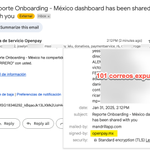
Sorprendente el nivel de protección de datos personales que tiene @OpenpayMx en sus emails ... exponiendo en este caso 101 correos de empresas. Ver imagen. CC @INAImexico

31